The HCAC public history focused digital archive cataloging is an ongoing process, and we may update this record as we conduct additional research and review. We welcome your comments and feedback if you have more information to share about an item featured on the site, please contact us at: HCAC-DigiTeam@si.edu
Andrew L. Johnson emphasized the importance of positive thinking and overcoming challenges such as anger, jealousy, and fear, which can hinder personal growth and fulfillment.
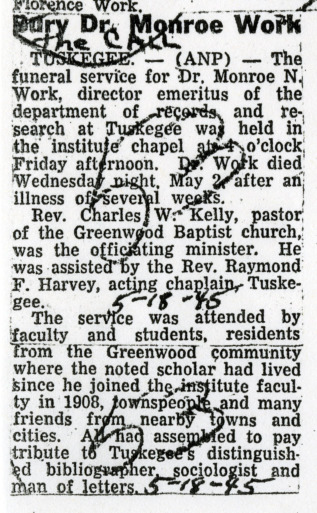
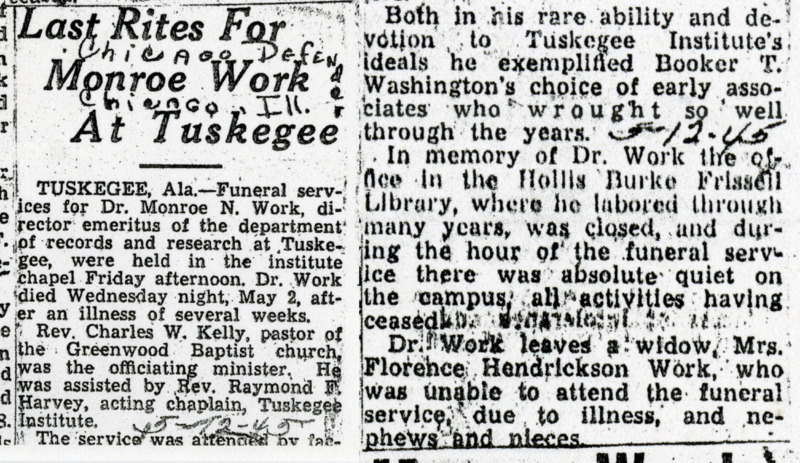
Newspaper article about Monroe Work's funeral service at Tuskegee. The article mentions two ministers who officiated Work's service: Charles W. Kelly and Raymond F. Harvey. The service was attended by faculty, students, and members of the Greenwood community.
Samuel L. Gandy emphasized the concept of consumerism as a religious experience, urging the congregation to avoid being "taken" by life's circumstances.
Andrew L. Johnson addressed the historical relationship between Tuskegee and the state, with the financial challenges faced due to the Alabama legislature's failure to pass the Tuskegee appropriation bill, which would have provided $1.25 million towards the university.
William Watley emphasized the beatitudes, stressing blessings for the poor in spirit, mourners, meek, those seeking righteousness, merciful, pure in heart, peacemakers, and persecuted.
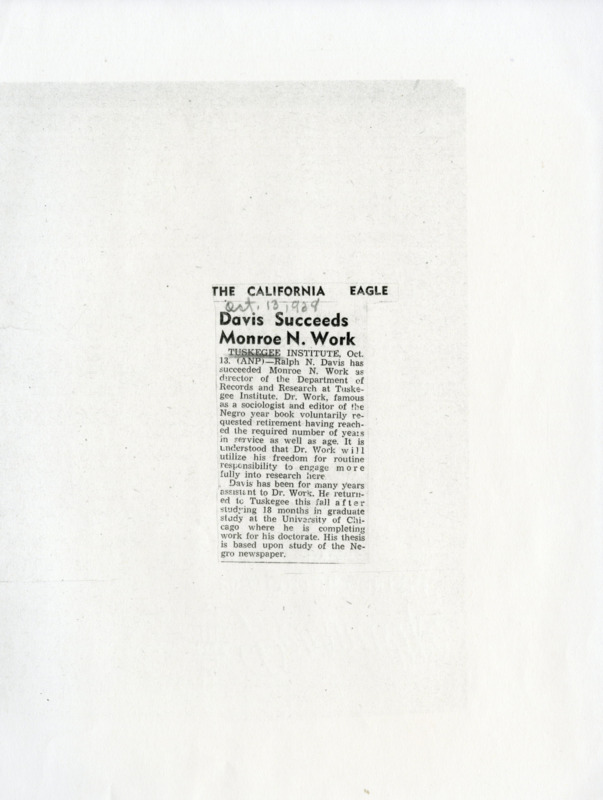
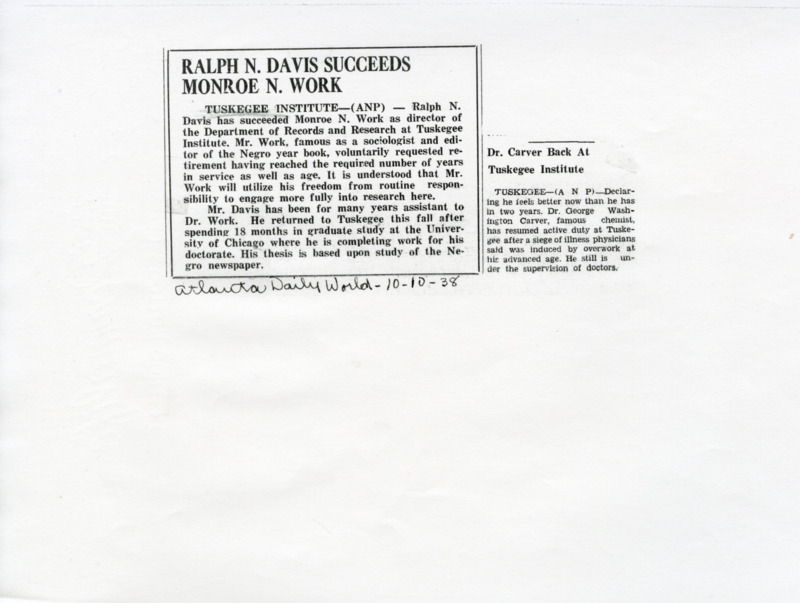
Newspaper article about the new director for Tuskegee's Department of Records and Research, Ralph N. Davis. Mentions Monroe N. Work's retirement and that Davis worked as Work's assistant for many years.
Cornelius E. Thomas emphasizes the importance of holding onto faith and dreams, symbolized by the biblical significance of the rainbow as a covenant sign and urges the congregation to maintain hope and optimism.
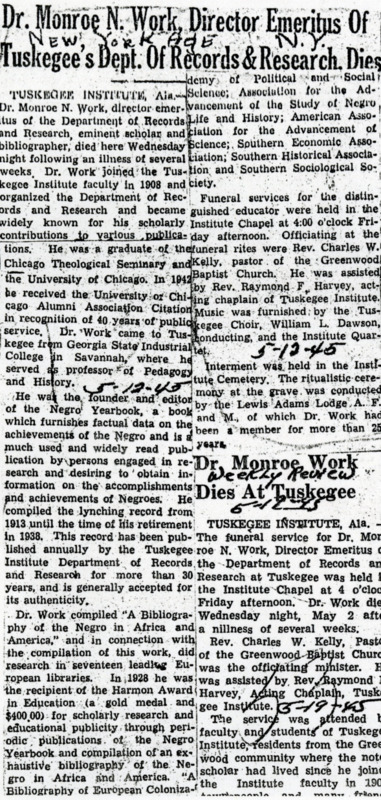
Newspaper obituary for Monroe N. Work. Article mentions Mr. Work's funeral service at Institute Chapel and internment at Institute Cemetery. Charles F. Kelley and Raymond F. Harvey officiated the service, while the ceremony at the grave was led by the Lewis Adams Lodge, A. F. and M.
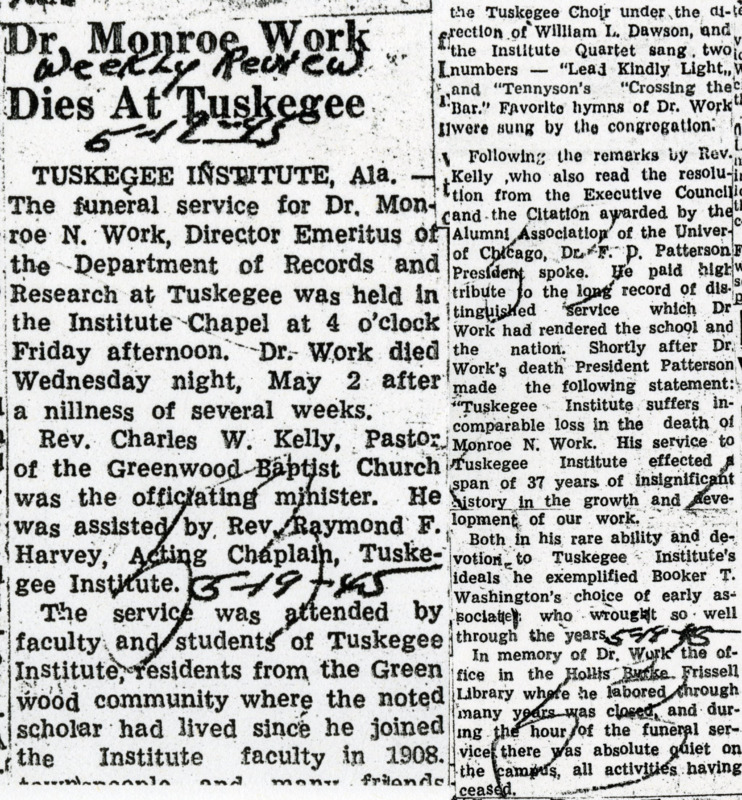
Newspaper article about Monroe N. Work's funeral service at Tuskegee. Article includes a statement from Tuskegee President, Dr. Frederick D. Patterson regarding Work's death. Article also states that the office in Hollis Burke Frissell Library was closed in memory of Mr. Work.
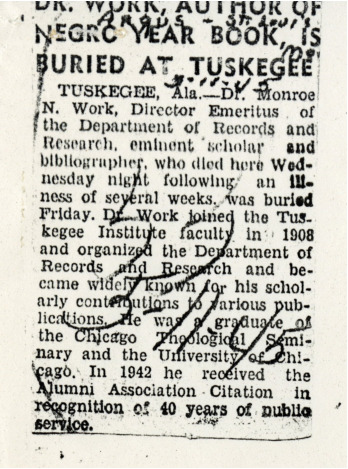
Newspaper article discussing Monroe N. Work's burial, professional activities, and education. Article also mentions Work's 1942 Alumni Association Citation for 40 years of public service.
Andrew L. Johnson’s sermon urged the congregation to strive for excellence, symbolized by gold, over mediocrity, represented by bronze, emphasizing the lasting value of gold in all aspects of life, from education to personal goals.
Newspaper article about Monroe N. Work's funeral service at Tuskegee. Article states that the office in Hollis Burke Frissell Library was closed in memory of Mr. Work and that Mrs. Florence Work was unable to attend the service due to illness.
Rabbi Jacob Rothschild emphasized the need for moral courage and action in response to societal challenges, such as the Vietnam War, the Lod Airport massacre, and the election of a known racist.
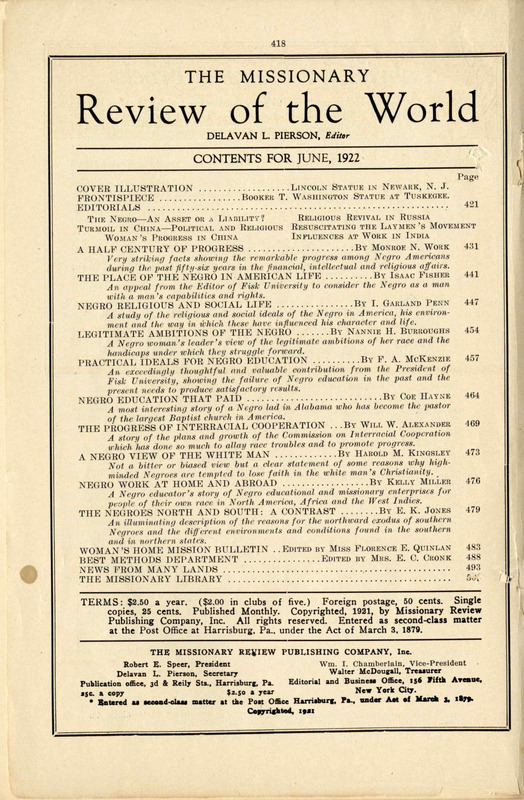
94-page document containing more than 10 articles by a variety of contributors, including a 12-page article by Monroe N. Work titled "A Half Century of Progress: A Contrast, The Negro in America in 1866 and in 1922."
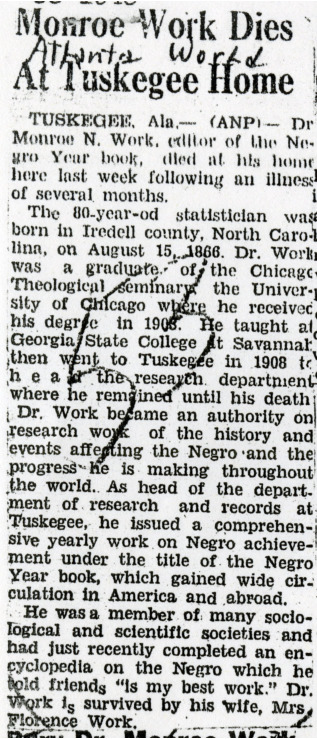
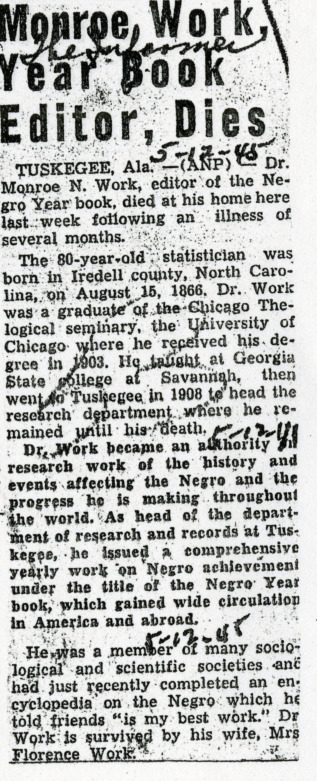
A newspaper obituary article about Dr. Monroe N. Work, a sociologist who founded the Department of Records and Research at Tuskegee University. This article discusses his birthplace, education, and professional achievements throughout his life.
Samuel L. Gandy highlighted the role of faith in transforming society rather than being shaped by it, citing historical figures like Mahatma Gandhi and Dr. Martin Luther King Jr. as examples.
Charles S. Spivey, Jr. emphasized the significance of inner strength and spiritual anchorage, drawing parallels between Jesus' temptation in the wilderness and everyday struggles.
Harry V. Richardson emphasized gratitude and dependence, highlighting the importance of expressing thanks to those who support us, particularly parents. The sermon also discussed the dual nature of dependence, where individuals are both dependent on others and are depended upon by them.
A newspaper article announces Ralph N. Davis as the new director of Tuskegee University's Department of Records and Research. The article highlights his extensive experience as an assistant to Monroe N. Work and notes that he is currently completing his graduate degree at the University of Chicago.
Benjamin E. Mays emphasized the humility and wisdom taught by Jeremiah, urging the congregation not to boast in their wisdom, wealth, or strength but to seek loving kindness, justice, and righteousness.
Henry J.C. Bowden emphasized the need for complete commitment to God, likening spiritual renewal to urban renewal, which requires a comprehensive overhaul.
Dr. John Hope Franklin’s speech at Tuskegee Institute underscored the importance of historical context in addressing present issues, critiquing oversimplified narratives and highlighting a growing shift toward objective scholarship that reexamines Southern history and fosters interracial academic respect.
Andrew L. Johnson emphasized the importance of faith, education, and service, urging the community to participate fully in the upcoming religious enrichment week.
Vinton Randolph emphasized how prayer is not just a habit but a powerful tool for strength and understanding when addressing God as "Father" and seeking daily necessities and spiritual sustenance.
William D. White emphasized the importance of spiritual transformation and the need to recognize and address personal shortcomings, such as immorality, impurity, and anger, as outlined by Apostle Paul.