The HCAC public history focused digital archive cataloging is an ongoing process, and we may update this record as we conduct additional research and review. We welcome your comments and feedback if you have more information to share about an item featured on the site, please contact us at: HCAC-DigiTeam@si.edu
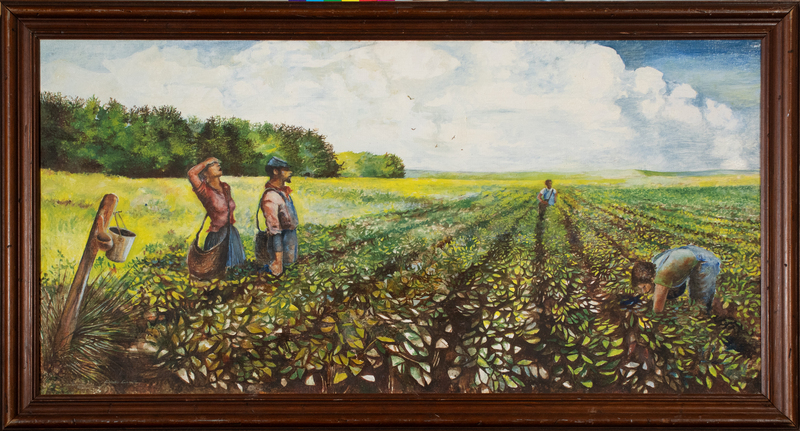
Curnell's painting shows a field of crops stretching into a cloudy horizon, with four people working the field. Two men are actively picking, while a man and woman stand to the side, resting next to a water pail. The figures’ dress and posture seem to suggest that this may be a family farm, rather than a plantation scene depicting slavery.
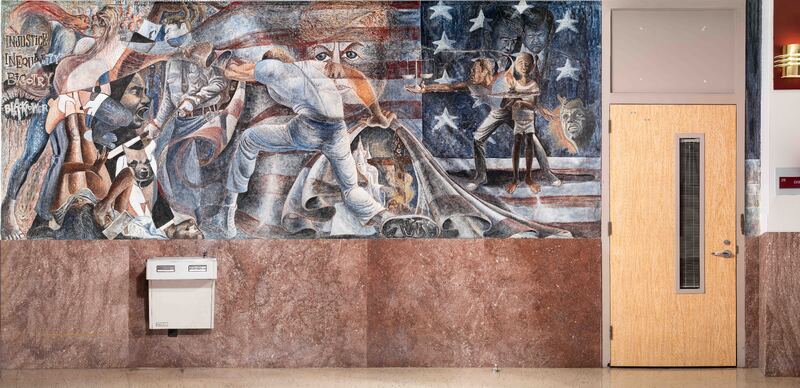
Mills’s mural depicts a nation in turmoil, with scenes of racial violence, and pushback by Black protestors. A figure lifts the American flag to reveal white supremacy. On the right side, Stokely Carmichael’s face bursts through the flag, alluding to the 1967 TSU Invasion. During the invasion, 488 TSU students were arrested and Houston Police fired almost 5000 bullets into the men's dormitory.
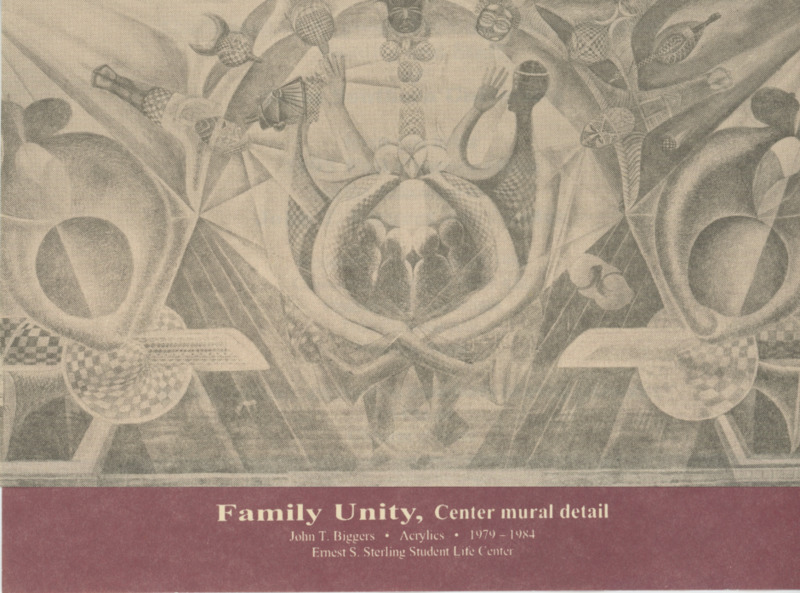
This is an invitation to Texas Southern University's Fall 1995 convocation and the dedication of the John T. Biggers Art Center. Biggers founded the university’s art department in 1949 and taught classes until 1983. The invitation features a detail shot of Biggers’ mural Family Unity, which is located in the cafeteria of the Sterling Student Life Center on TSU’s campus. The invitation is printed in TSU’s maroon and gray colors.
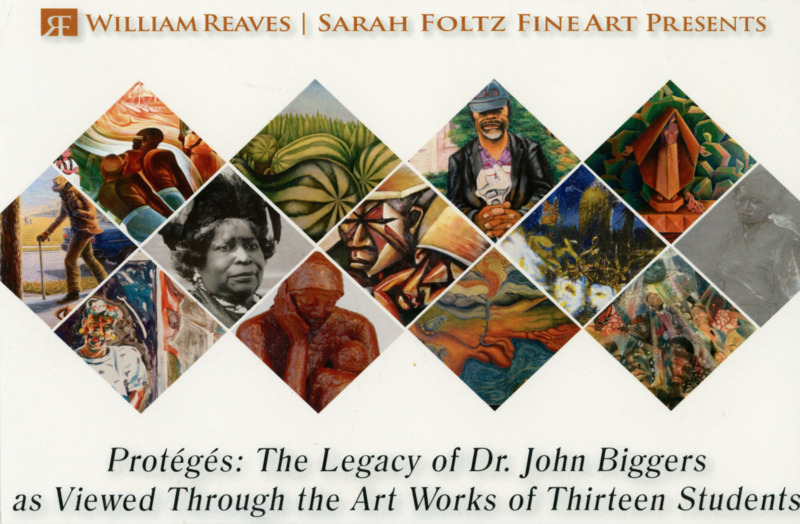
This is an invitation from William Reaves - Sarah Foltz Fine Art gallery to the exhibition Protégés: The Legacy of John Biggers As Viewed Through the Artworks of Thirteen Students. The featured artists - Charles Criner, Geraldine Crossland, Karl E. Hall, Earlie Hudnall, Jr., Harvey Johnson, Earl S. Jones, Josie Mendoza Postel, Robert Meyers, Elizabeth Montgomery Shelton, Kermit Oliver, Jesse Sifuentes, Charles Thomas, and Roy Vinson Thomas - are all Texas Southern alumni and students of Dr. Biggers.
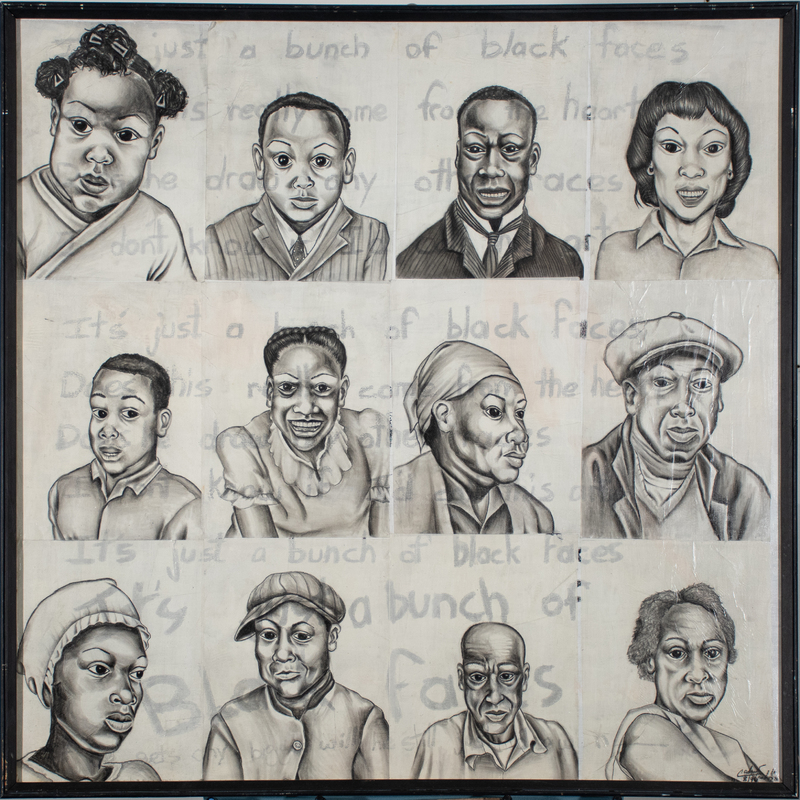
Franklin’s painting contains 12 portraits of Black people, ranging in age from children to elders. The postures and facial expressions range from smiles to blank stares, and there is also a range in attire from formal to casual wear. Behind the faces are the words: “It’s just a bunch of black faces/Does this really come from the heart/Does he draw any other races/I dont know if I’d call this art (2x)/It’s just a bunch of black faces/It’s just a bunch of Black faces/If he gets any bigger will he still just draw n___”
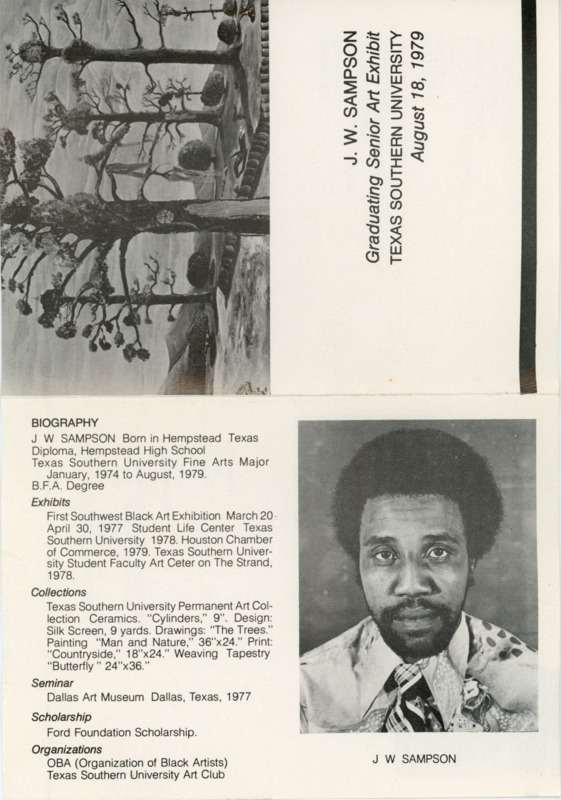
This is a brochure for Sampson’s senior art exhibition. The culmination of the Texas Southern art curriculum is a senior exhibition where students showcase artwork created over the course of their undergraduate studies. The brochure features a photo of Sampson, a brief biography, a catalog of the artwork featured in the exhibition, a photo of one of his tapestries, and photos of two of his paintings.
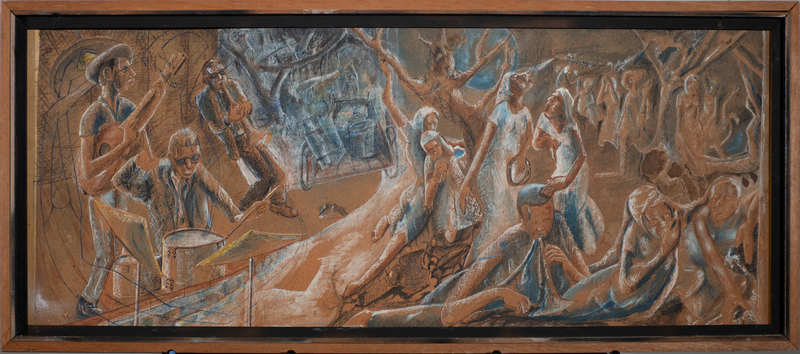
Vital’s drawing may be a mural pre-study. The scene depicts a spirit of revelry, with musicians entertaining a large crowd gathered to enjoy the music and dance. The instruments vary from those of a typical blues and jazz ensemble, like the drum set, trumpet, and guitar, to the tambourine, often associated with southern gospel. The figures' fluidity suggests movement and freedom.
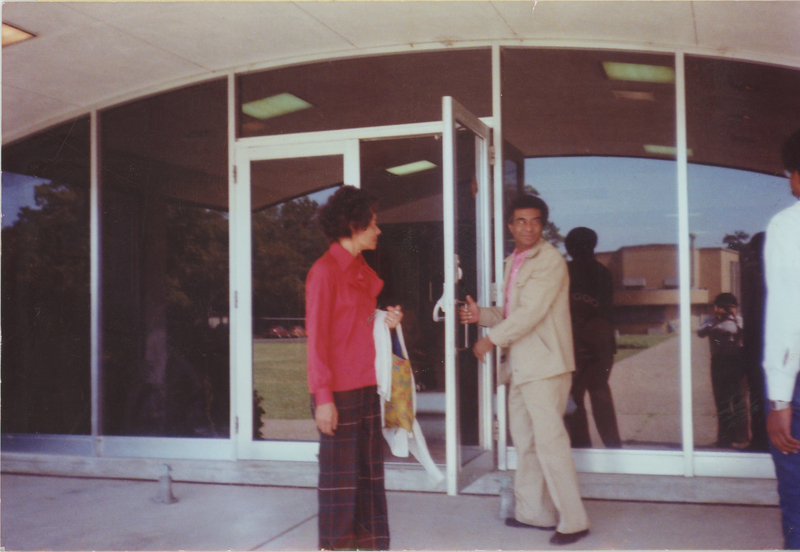
In this photograph, Dr. John Biggers opens the door to Texas Southern's art building, which was dedicated as the John T. Biggers Art Center in 1995. Dallas-based artist Jean Lacy stands to the left of Dr. Biggers. Biggers founded the university's art department in 1949 and retired in 1983.
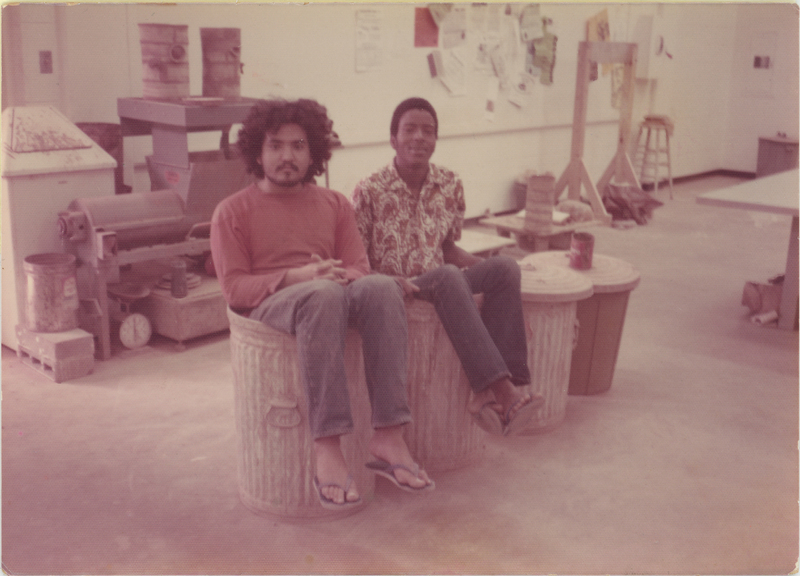
Texas Southern art alumni Jesse Sifuentes and Earl Jones are pictured in this photograph from the mid 1970s. They are seen here in the ceramics room of the John T. Biggers Art Center, seated in the trash cans where clay was stored. Sifuentes later went on to teach ceramics at Texas Southern University.
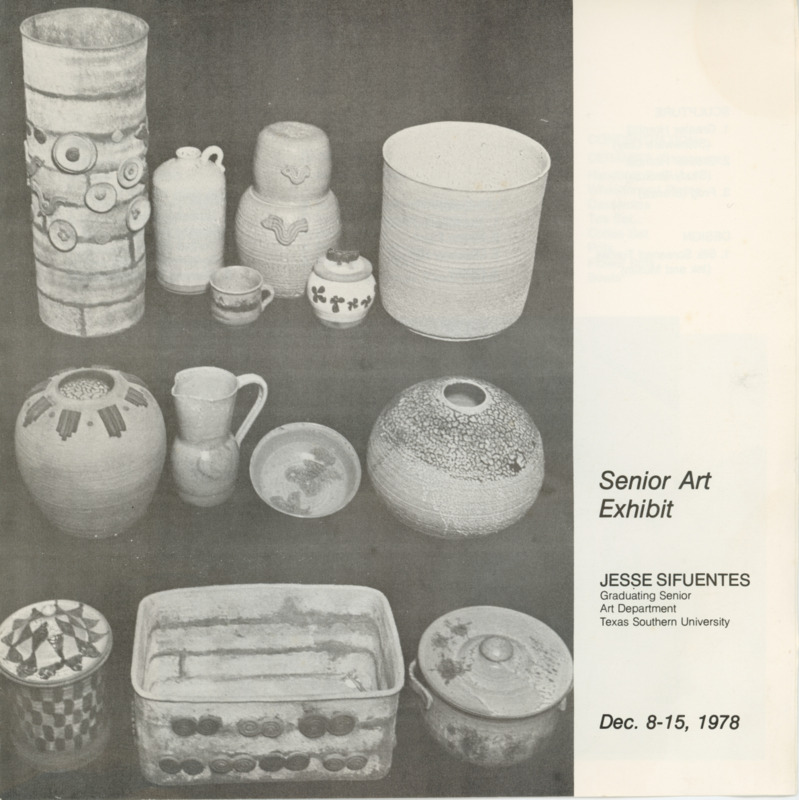
This is a brochure for Sifuentes’ senior art exhibition. The culmination of the Texas Southern art curriculum is a senior exhibition where students showcase artwork created over the course of their undergraduate studies. The brochure features a brief biography, a catalog of the artwork featured in the exhibition, and photos of two of his paintings and several of his ceramics. Sifuentes later returned to TSU to teach pottery, ceramics, and sculpture classes.
This image was captured by Earlie Hudnall, Jr., longtime TSU campus photographer and student of Dr. Biggers. This photo is of Biggers’ mural Family Unity, located on TSU’s campus in the student center dining hall. The mural was commissioned by the student body in the mid-1970s, and reflects themes of family, ancestry, and rural & urban house structures.
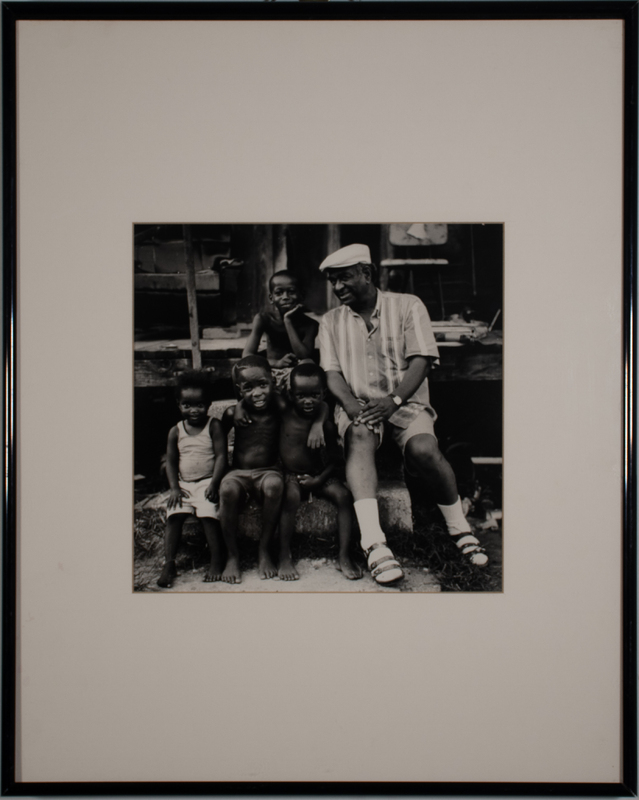
This photograph by Earlie Hudnall, Jr. shows John Biggers seated with boys on a porch. The setting is Laurel, MS, where the men stopped during a road trip on their way to Gastonia, North Carolina, Biggers' hometown. Lacking proper materials, Hudnall stored the negative in water in a McDonald's cup until he could develop it.
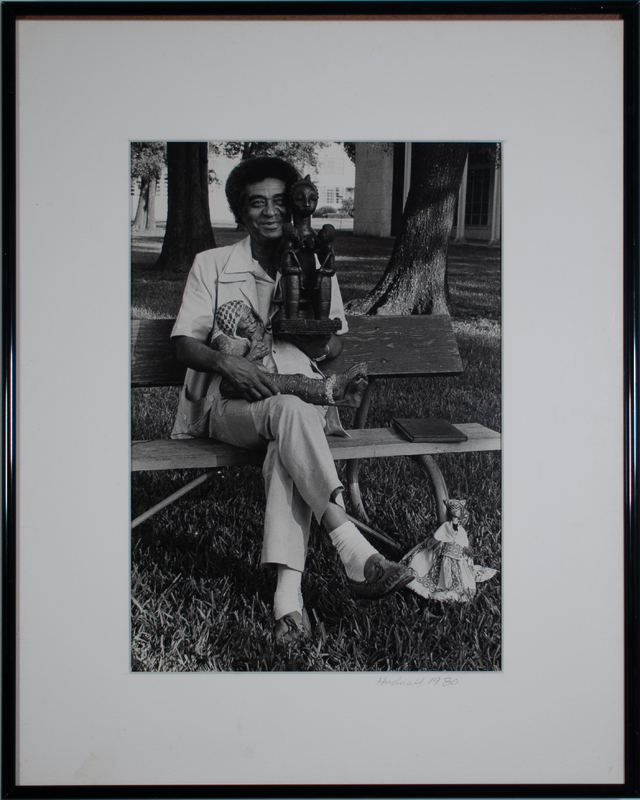
This photograph by Earlie Hudnall, Jr. shows John Biggers seated on a bench near Texas Southern's Fairchild Building. He holds a mother & child sculpture in his left hand and an Aunt Dicy sculpture in his right. A mammy doll is seen to his left on the ground. In 1955, Biggers illustrated J. Mason Brewer's version of the African-American folktale, Aunt Dicy Tales: Snuff-Dipping Tales of the Texas Negro.
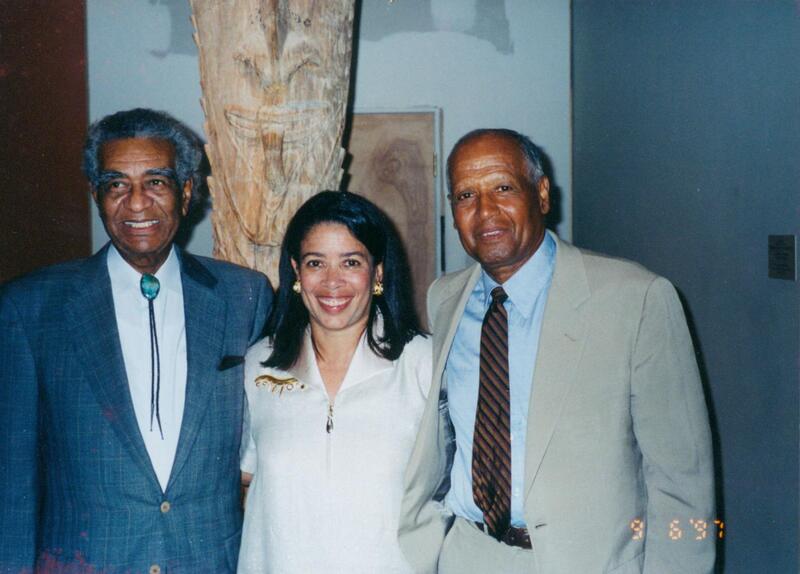
This photograph shows, from left to right, Dr. John T. Biggers, Dr. Alvia J. Wardlaw, and Roy DeCarava. Wardlaw, the founder of the University Museum at Texas Southern, previously served as a curator at the Museum of Fine Arts, Houston, where in 1975 she organized the first retrospective of DeCarava’s photographs. Biggers and DeCarava were mutual admirers; DeCarava appreciated Biggers’ sense of African history, and Biggers praised DeCarava’s attention to the common man.
A commentary on the conflict between technology and progress, history and culture, Davis painted this mural in response to the destruction of several Hannah Hall murals to create windows into a new computer lab. Davis’ own mural was later damaged by subsequent construction, as foreseen in its design.
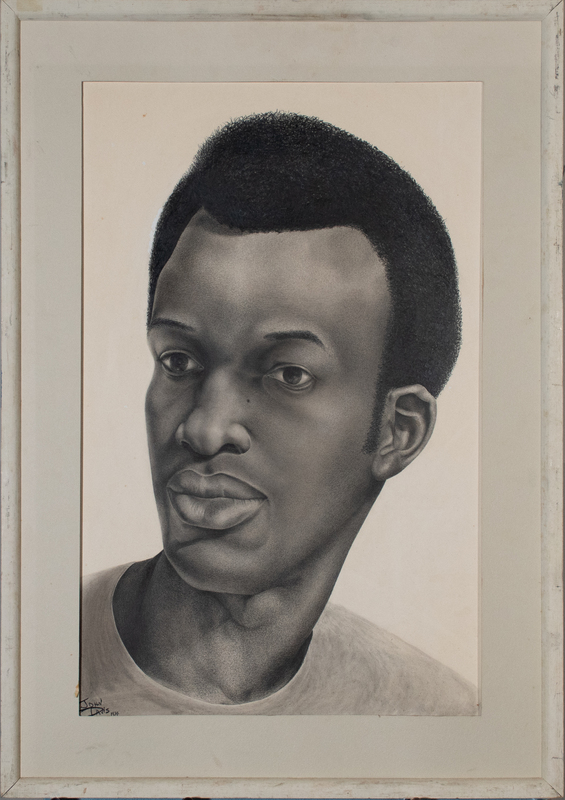
Davis drew his black-and-white self portrait during his time as an art student at Texas Southern University. He drew himself clean-shaven with long sideburns. His use of charcoal creates the smooth and balanced shading seen in this piece.The artist also completed a terracotta self portrait of his head. Self-portraits in drawing classes remain a part of the art major curriculum at TSU.
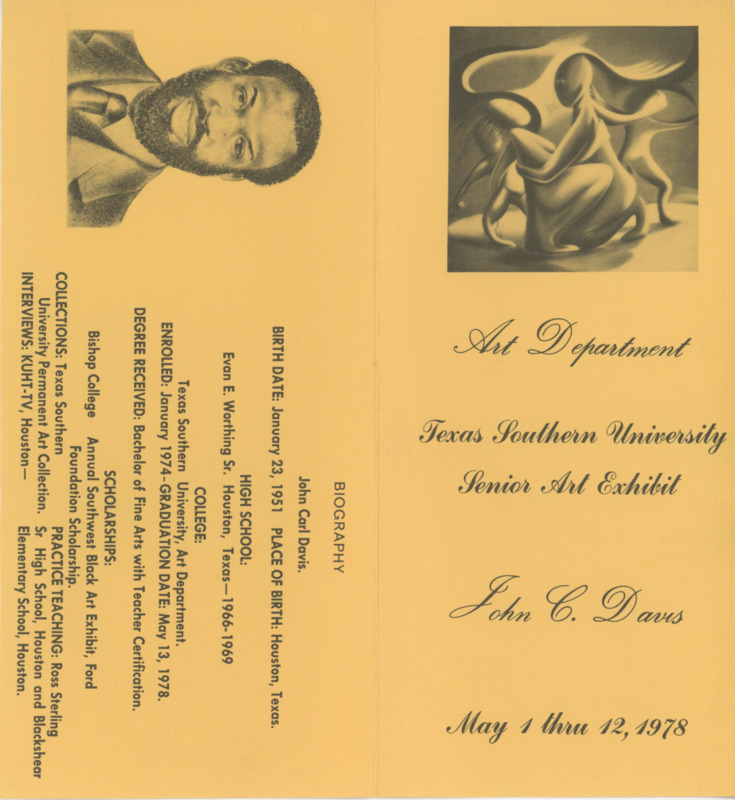
This is a brochure for Davis’ senior art exhibition. The culmination of the Texas Southern art curriculum is a senior exhibition where students showcase artwork created over the course of their undergraduate studies. The brochure features a self-portrait of Davis, a brief biography, a catalog of the artwork featured in the exhibition, and a photo of one of his artworks.
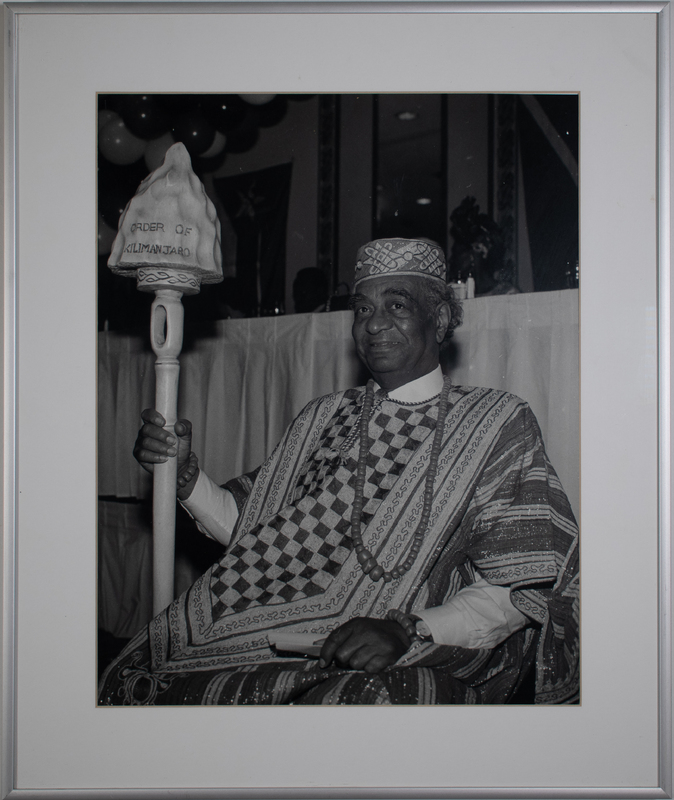
This photograph by Earlie Hudnall, Jr. shows John Biggers being inducted into the Order of Kilimanjaro, an award given to him by the African Union at an event in Houston. Africa and African roots were essential parts of Biggers' art and teachings. He is often credited as one of the first African American artists to visit Africa and begin to incorporate African art and traditions into his art.
In this interview, Texas Southern art alumnus Johnetta Tinker discusses her experiences as a student in the class of 1972. As a student, she worked closely with Dr. Biggers and would sneak into his studio to watch him work. She recalls a strong sense of camaraderie with her classmates. After TSU, she was mentored by Boston artist Allen Crite.
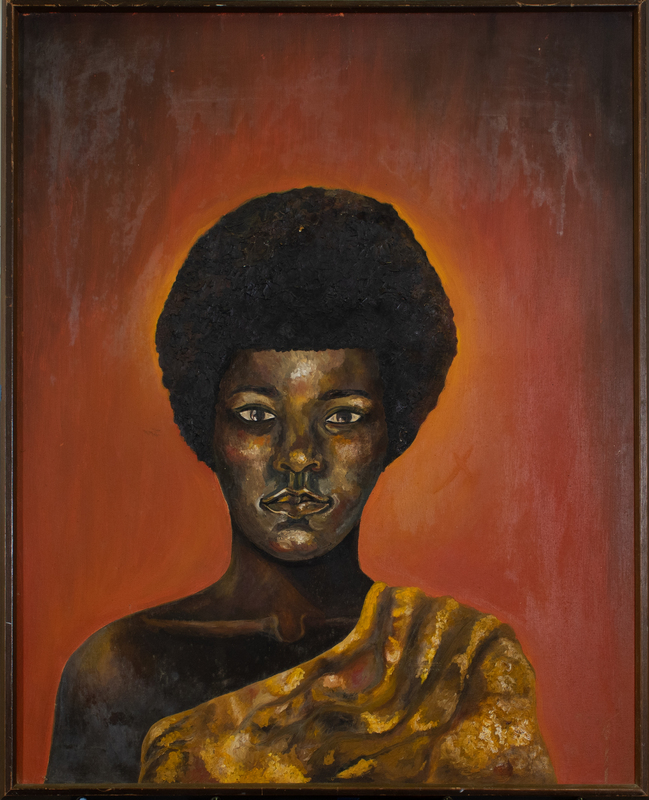
Tinker's painting is a self-portrait of the artist wearing her hair in an afro and a tunic draped over one shoulder. A golden halo emanates from behind her afro, attracting the viewer's eye to the center. As a part of the art curriculum, students would create various self-portraits. Tinker continues to practice art and is now based in Boston.
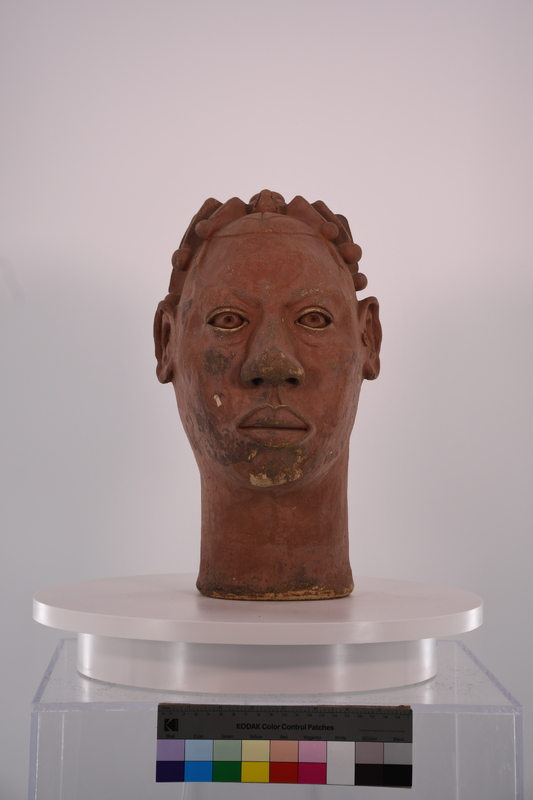
Jones' self-portrait has a piercing facial expression and displays protruding veins near the brow line and a direct stare from the eyes. The crown is adorned with a spider and the outline of a web along the scalp, along with a spiral near the left ear. The design may have been inspired by Spiderman, who debuted in comics 8 years earlier.
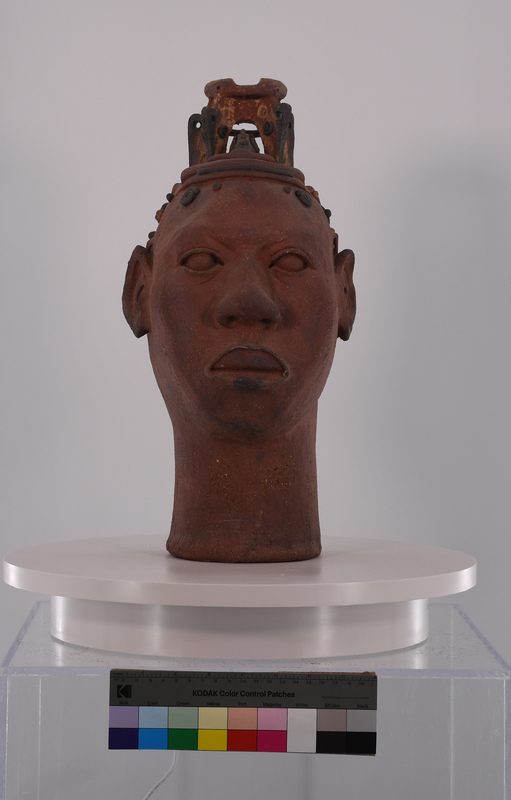
This bust is a self-portrait of the artist. Jones depicted his face with sharp features, high cheekbones, and protruding veins near the brow line. The crown is adorned with spiral motifs, dots, and rolled clay. Atop is a shrine structure, with a turtle within. Turtles and tortoises are often used to symbolize longevity. Students were encouraged to adorn their self-portraits with additional embellishments.
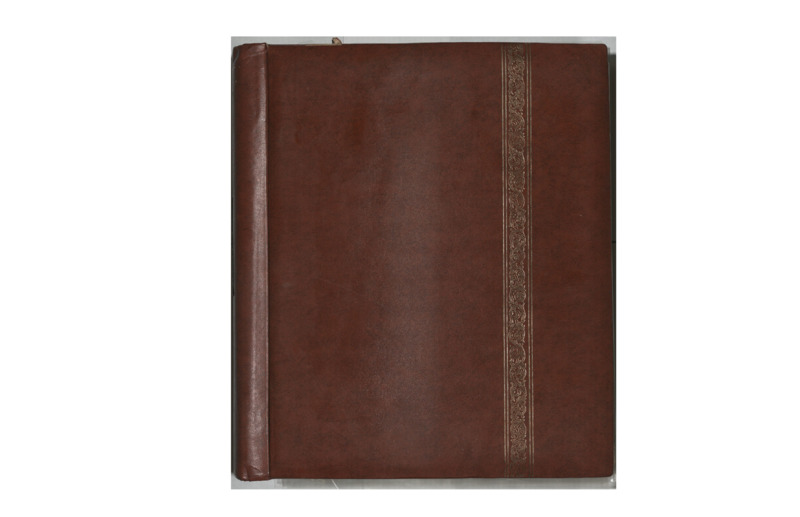
Jones’ senior notebook includes his written philosophy of art, photographs of the artist’s works and his process, and a copy of his senior exhibition brochure. As a part of the Texas Southern art curriculum under Dr. John T. Biggers and Professor Carroll Harris Simms, students would create these notebooks to explain their artistry and showcase the works they created as students.
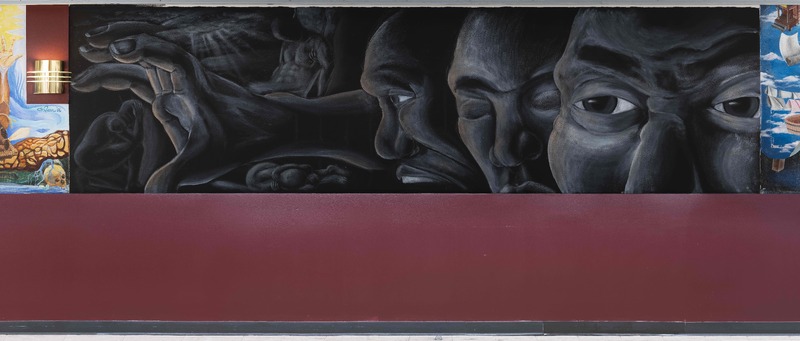
Lloyd’s scene closely focuses on three faces wracked with strong feelings. In the foreground, an angry man reaches out, while the middle figure turns completely inward, and the far right figure is deep in thought. These emotions are heightened by the dark hues in the composition.
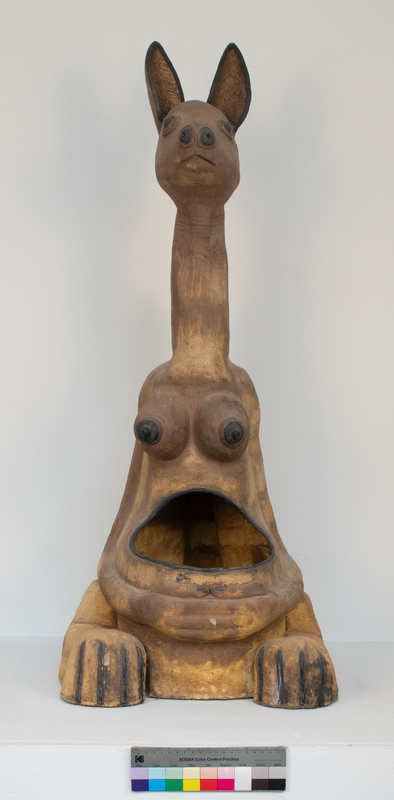
Moses Adams Jr.'s sculpture depicts a kangaroo mother with human-like hands and breasts. The clasped hands under the open pouch signify protection. Detailed, oversized hands are characteristic of the work of John Biggers and his students. Additionally, mothers of various forms and species are a common subject of the student terracottas from Texas Southern University.
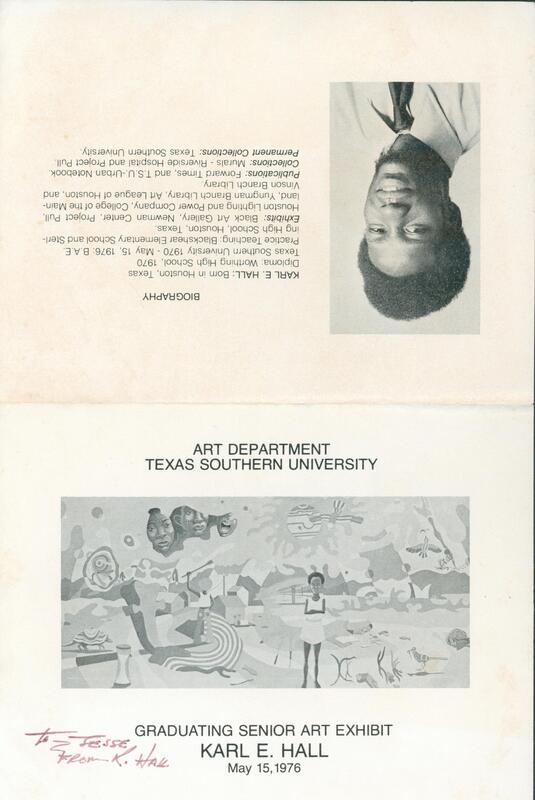
This is a brochure for Hall’s senior art exhibition. The culmination of the Texas Southern art curriculum is a senior exhibition where students showcase artwork created over the course of their undergraduate studies. The brochure features a photo of Hall, a brief biography, a catalog of the artwork featured in the exhibition, and a photo of one of his paintings. It is inscribed with a note from Hall.
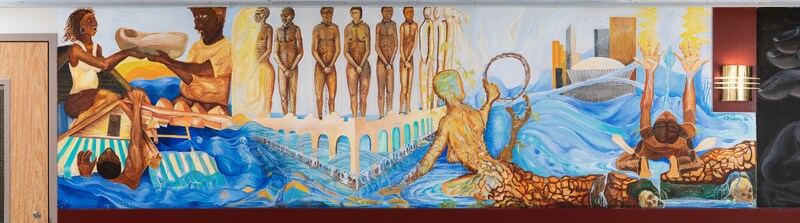
A native of New Orleans, Green transferred to TSU’s art program following Hurricane Katrina. His mural ties different aspects of New Orleans history and culture together through floodwaters. Enslaved ancestors stand at auction, and the city skyline, including the Superdome, is featured prominently.
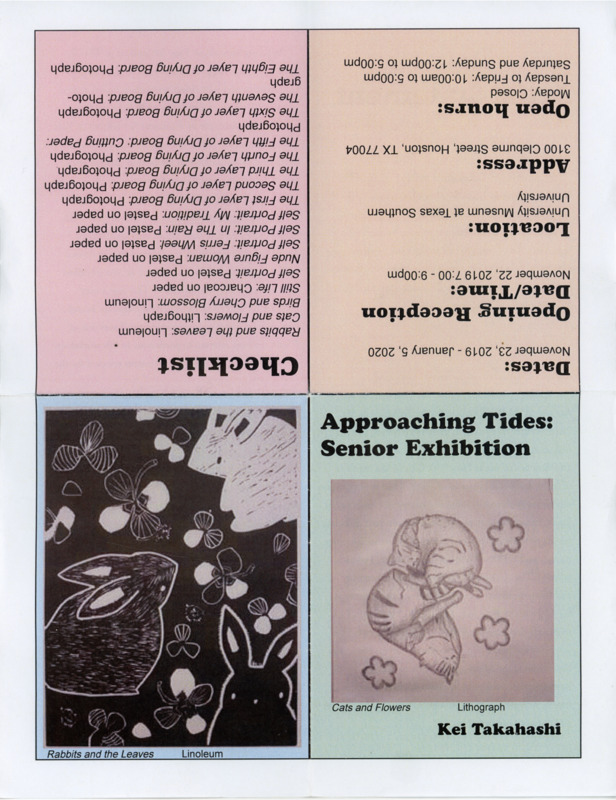
This is a brochure for Takahashi’s senior art exhibition. The culmination of the Texas Southern art curriculum is a senior exhibition where students showcase artwork created over the course of their undergraduate studies. The brochure features a brief biography, an artistic philosophy, a catalog of the artwork featured in the exhibition, exhibition viewing information, and three photos of her artwork.
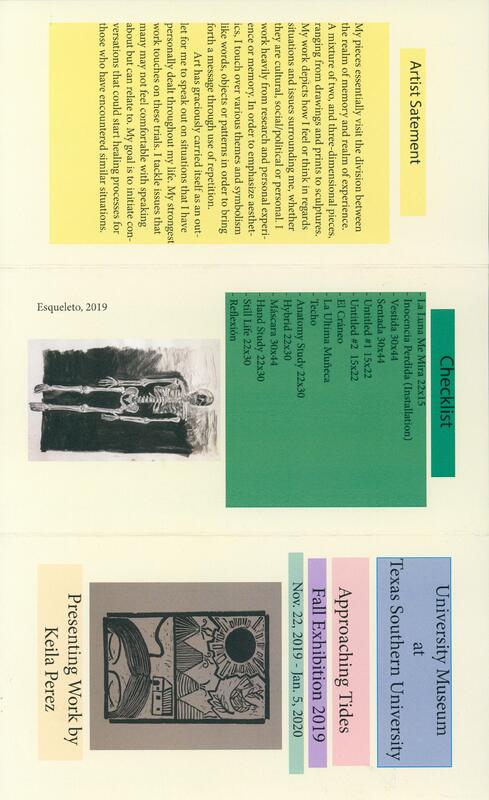
This is a brochure for Perez’s senior art exhibition. The culmination of the Texas Southern art curriculum is a senior exhibition where students showcase artwork created over the course of their undergraduate studies. The brochure features a brief biography, a photograph of the artist, an artistic philosophy, a catalog of the artwork featured in the exhibition, and five photos of her artwork.
In this interview, Texas Southern art alumnus Kermit Oliver discusses his time at Texas Southern (1962-1967) and his artistic philosophy & practice with Dr. Alvia J. Wardlaw, director and curator of the University Museum. He highlights the religious, personal, historical, and political influences that shape his artwork.