The HCAC public history focused digital archive cataloging is an ongoing process, and we may update this record as we conduct additional research and review. We welcome your comments and feedback if you have more information to share about an item featured on the site, please contact us at: HCAC-DigiTeam@si.edu
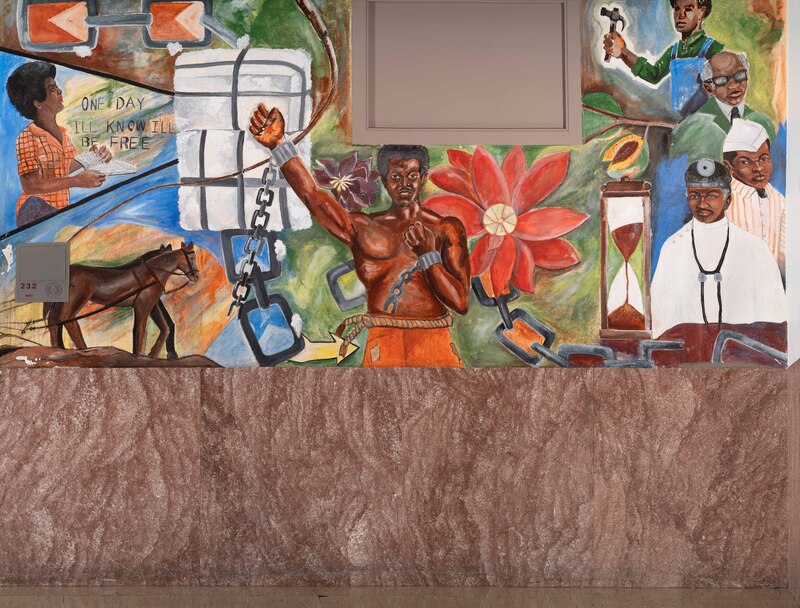
This mural reflects themes of emancipation and progress. The figure of a Black man raises his fist, while broken chains dangle from his waist. The bales of cotton and chains allude to slavery. Black men in various professions represent changes brought by emancipation.
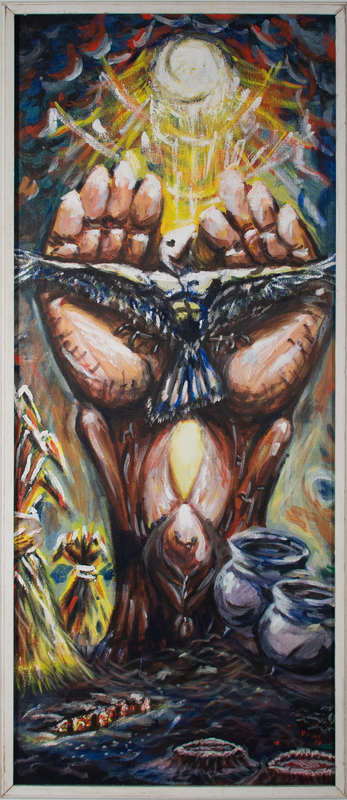
This detailed painting by Barry Morris includes a pair of hands rising up and clasping a bird. There are also bundles of wheat and a set of vessels. This work is very similar to the leftmost section of Morris's Hannah Hall mural and may have served as a partial study for the mural. Oversized, detailed hands and birds are frequent motifs in the artist's work.
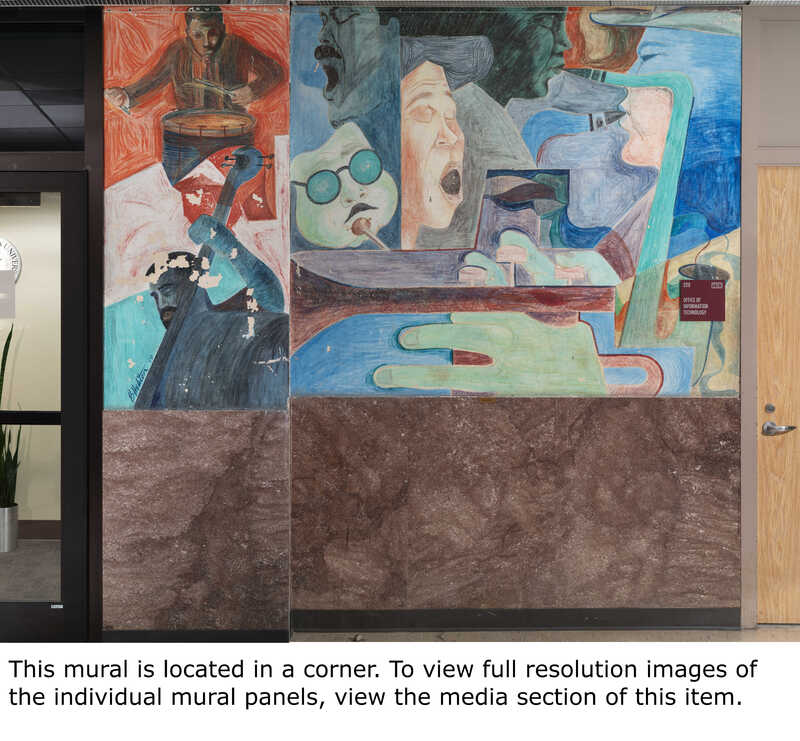
The mural captures the emotion and creative environment of a mid-20th century jazz club. Heliton chose a corner spot for his mural, which lends a sense of depth to the piece. The overlapping of patterns, portraits, and instruments suggests the intimacy of a small club interior.
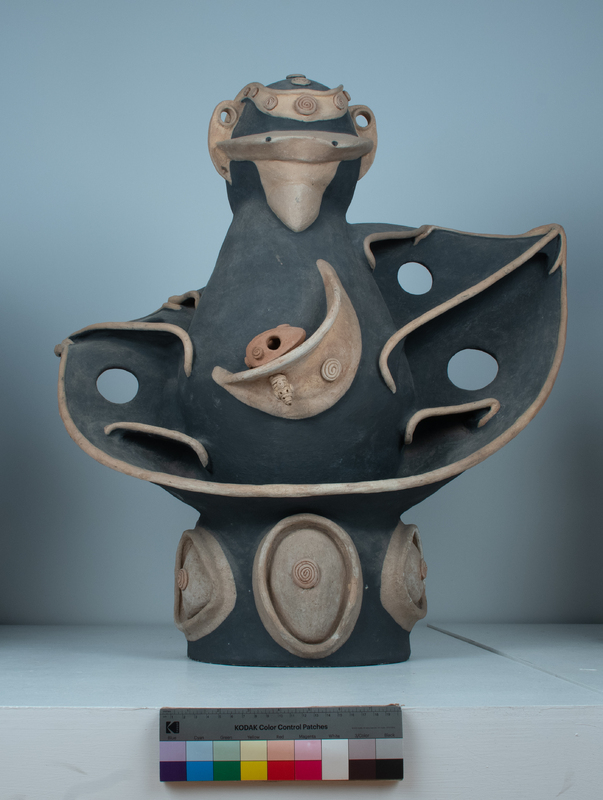
“Owl,” by Oliver Parson, features spiraled embellishments on the head and symmetrical holes on the wings, with a gray slip painted on the body. In the middle of the figure’s body, a crescent shape cradles a small egg, perhaps referencing owls’ nocturnal natures. Parson experimented with different clay colors in his terracotta sculptures.
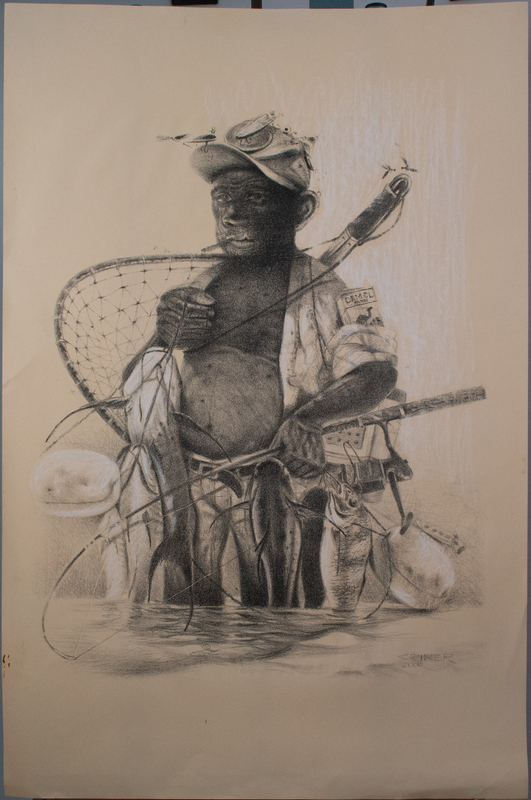
Criner’s print shows a man fishing; he is holding several catfish that he has caught. He is wading in the water with his hands full of fishing gear. Criner learned printmaking firsthand from Dr. John Biggers and was the longtime artist-in-residence at Houston’s Museum of Printing History.
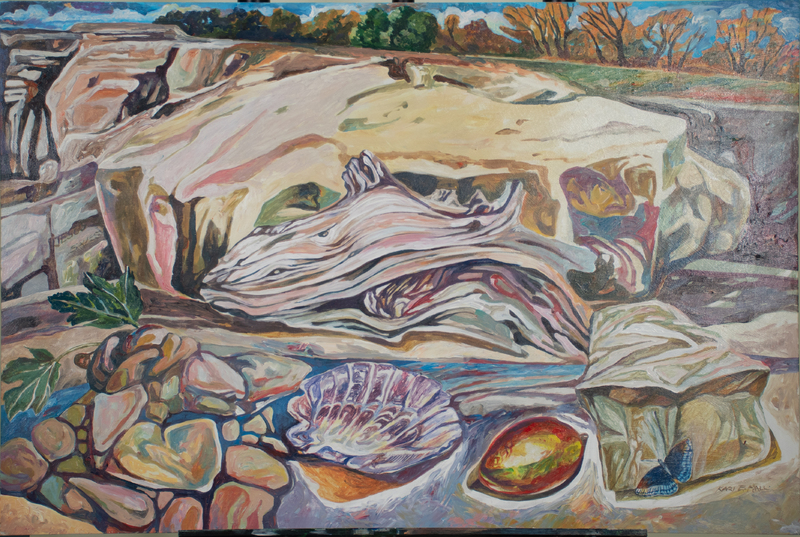
Hall’s painting is a surreal landscape of water flowing through a creek with various items along the path. There is also a faint inscription that reads “Jesus Saves” on a boulder to the far left. A mango, fossil, and butterfly are all pictured in the foreground. The loose and fluid paint strokes are reminiscent of impressionist paintings and characteristic of Hall’s style, particularly his more recent works.
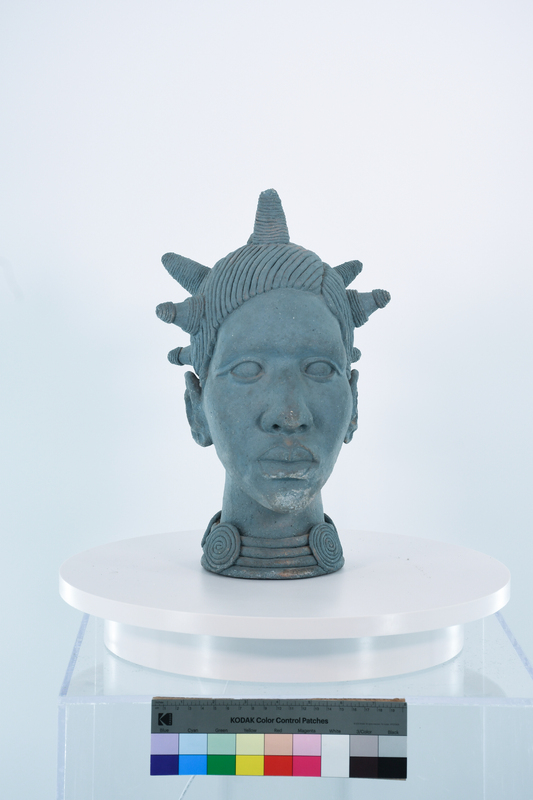
Morris's sculpture depicts a stylized version of the artist's own head and neck. As was required by Professor Simms, the artist adorned her self-portrait with swirls on the neck and rear of the scalp. The bust's blue hue is unique within the Texas Southern terracotta collection.
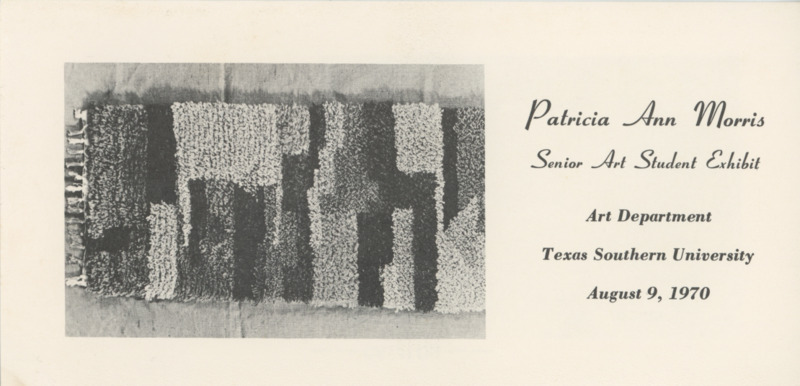
This is a brochure for Morris’ senior art exhibition. The culmination of the Texas Southern art curriculum is a senior exhibition where students showcase artwork created over the course of their undergraduate studies. The brochure features a catalog of the artwork featured in the exhibition, a photo of one of her textiles, and a photo of one of her paintings.
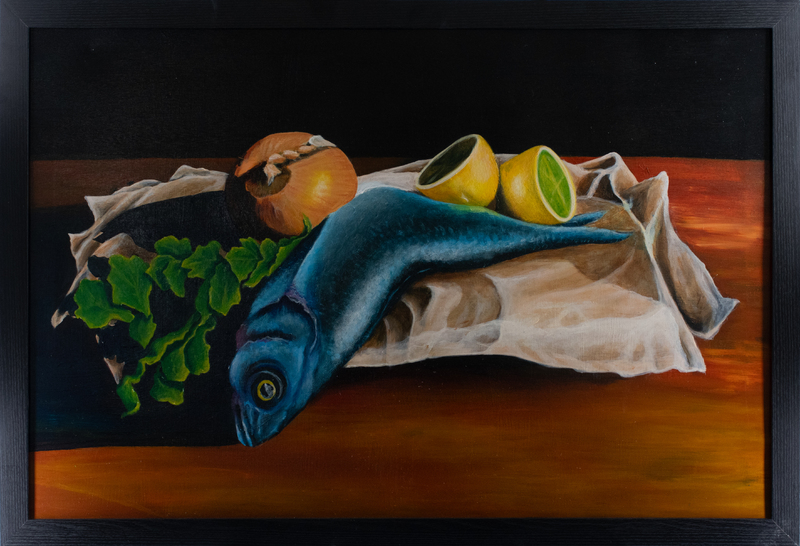
Hinojos' painting, "Pescador de Hombres," draws on Christian themes. The painting references the story of Jesus' miraculous feeding of the multiple with bread and fish, but also a symbolic representation of Christ as the "Bread of Life," a source of spiritual sustenance. Hinojos is a graduate of Texas Southern, accomplished airbrush artist, and founder of the Houston Art Center, an organization that aims to support artists in the Hobby area of Houston.
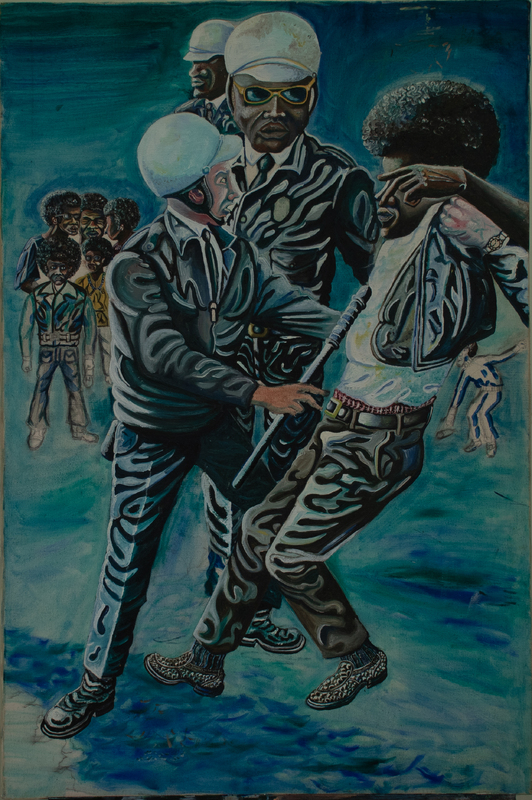
Settles' painting tackles the ongoing issue of police brutality against and harassment of Black Americans. The fluid swirls on the men's clothing, the anxious onlookers, and the white officer's drawn baton illustrate the high intensity and precarious emotion of the piece.
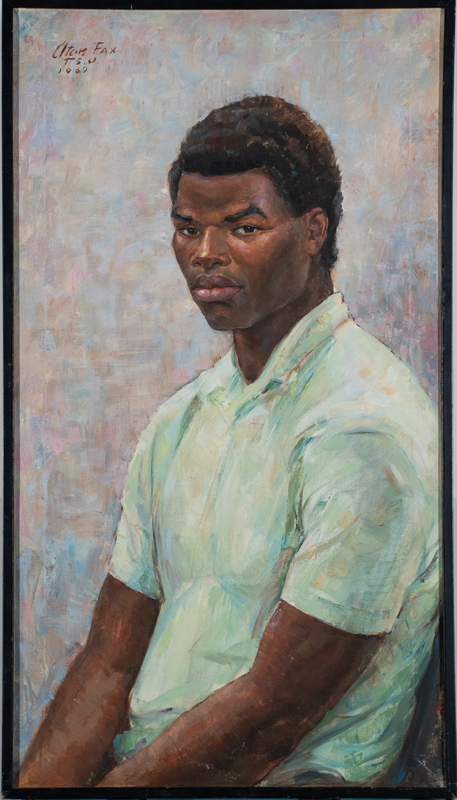
Fax’s painting is a portrait of a young man sitting with his hands in his lap. Yearbook photos suggest the subject may be George Latson, who was an art student at TSU at this time. During his career, Fax taught and held residencies at a variety of institutions, including Texas Southern University. He became internationally acclaimed for his work as a cartoonist, illustrator, and writer.
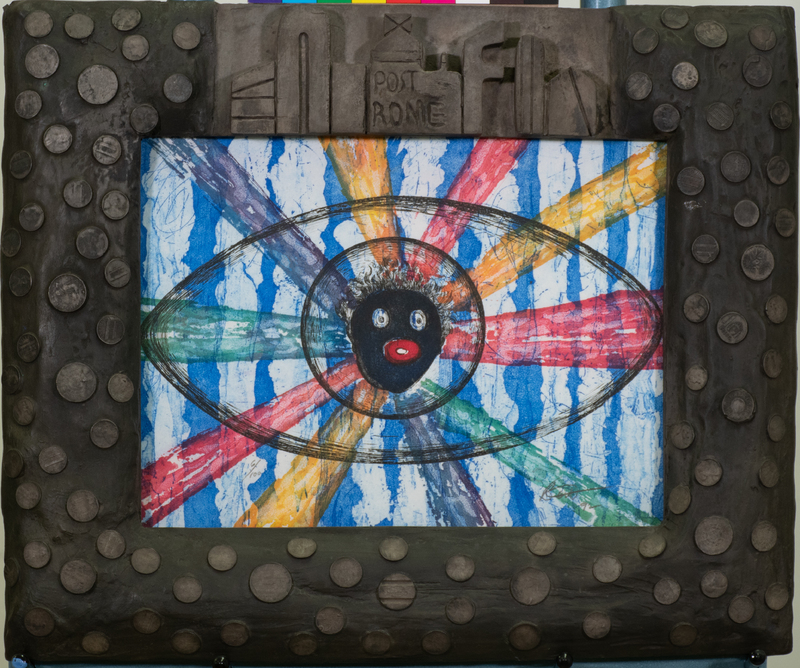
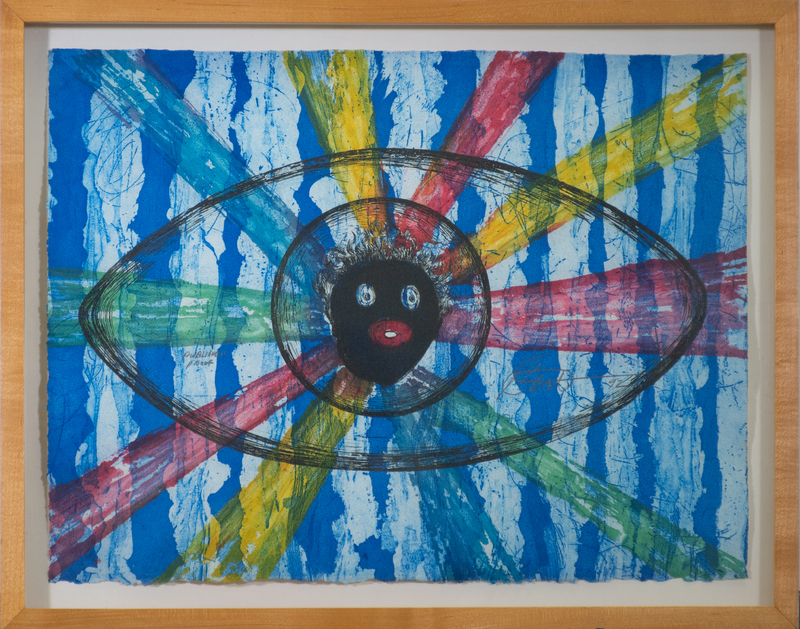
Long’s print was created during his 1990 Prix de Rome fellowship. At the center of the design is a large, oval-shaped eye. This is a frequently used motif in Long’s artwork, across many different mediums. The vertical and diagonal rays and bars draw attention towards the eye, which features a man’s face where the pupil would be. The frame, made from cast bronze, features a city skyline, embedded coin shapes, and the words “Post Rome.”
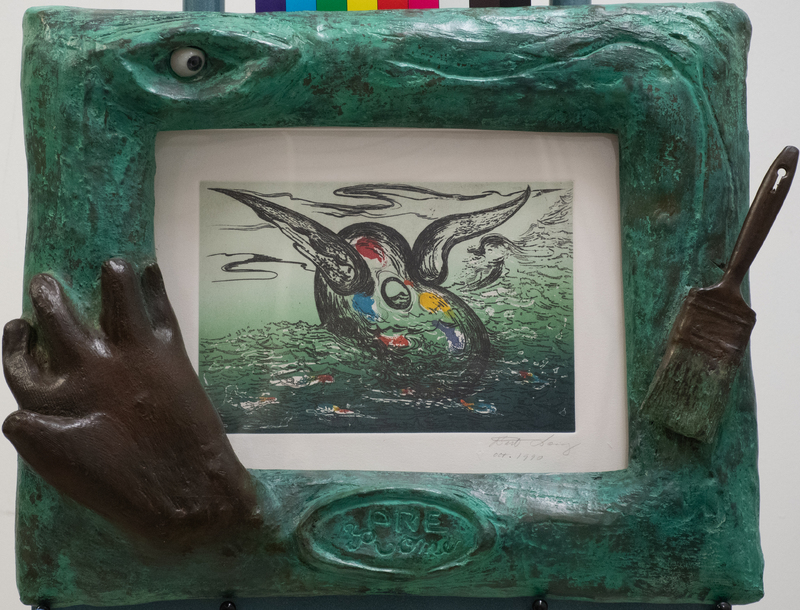
Long’s print was created during his 1990 Prix de Rome fellowship. The print features two aquatic animals, possibly whales or birds, emerging from the water, while other colorful creatures float around and within them. The cast bronze frame features the words “Pre Rome,” a hand, a paintbrush, and an eyeball, which is one of the motifs that appears most frequently in Long’s artwork.
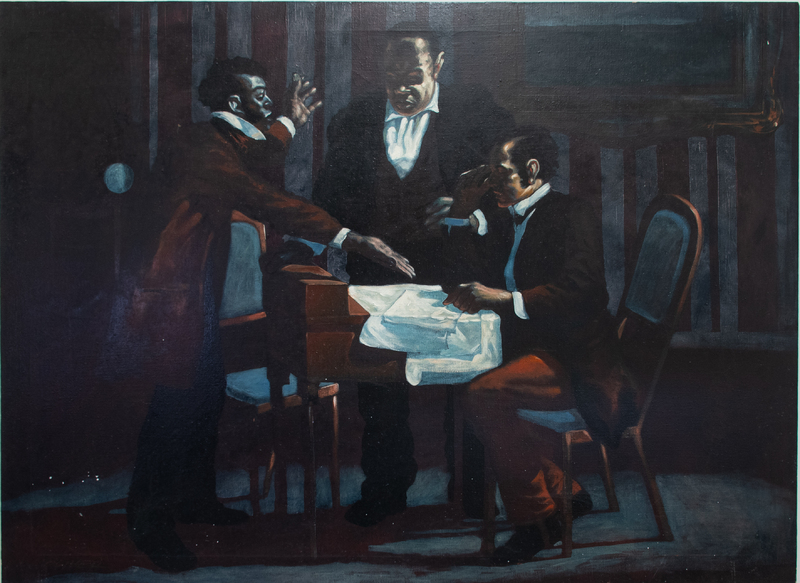
Oliver's painting depicts vanguard Black politicians from the Reconstruction period following emancipation. Radical Reconstruction saw the election of dozens of Black lawmakers in former slave states like Texas. After 1897, Texas didn't elect another Black legislator until 1966.
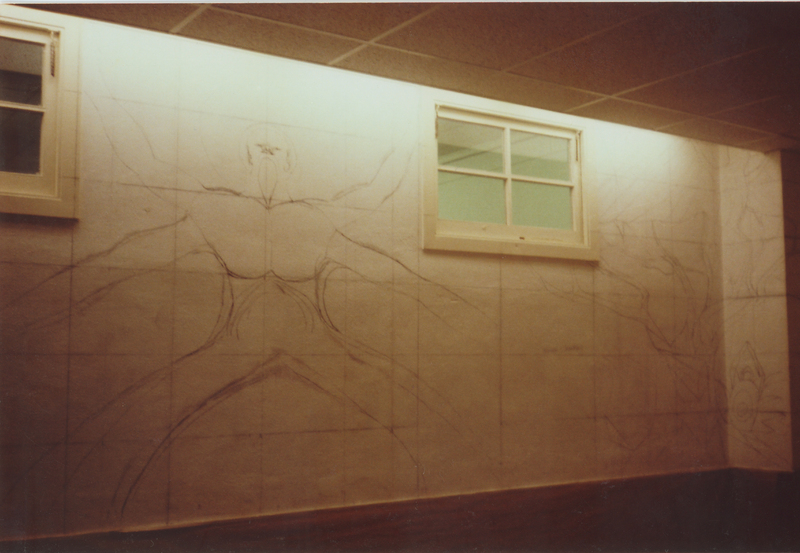
The pre-sketch stage of Texas Southern alumnus J.W. Sampson's mural on the first floor of Hannah Hall is shown here. Before he took paint to the wall, Sampson first made a grid (to help with scaling up to the large mural size) and then drew out his intended design. His final, geometric design is characteristic of Dr. Biggers's teaching at the time.
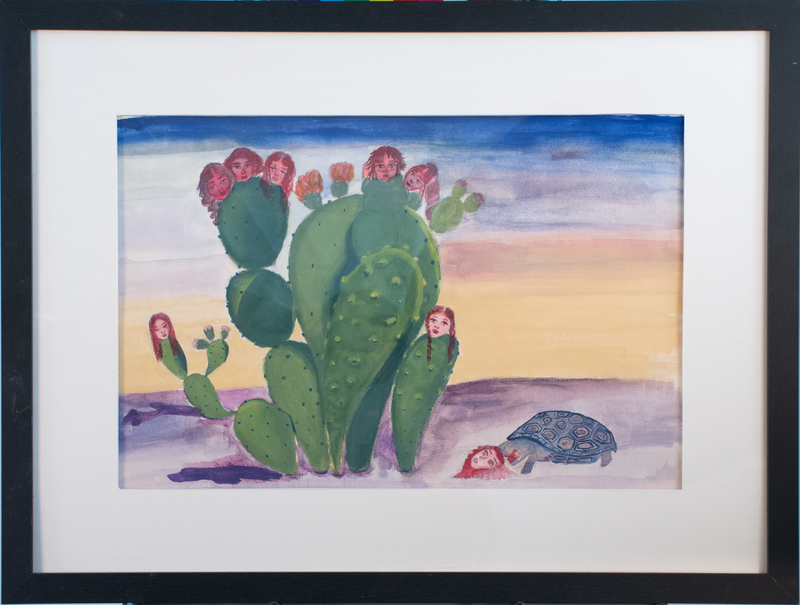
Toussaint's painting, "Prickled," pushes back against the notion that women's role is limited to being nurturers. In her own words, her "creative perspective is rooted in a sensitive and feminine lens—one that challenges the common reduction of femininity to gentleness and passivity." After graduating from Texas Southern University, Toussaint started teaching art in a Houston-area middle school.
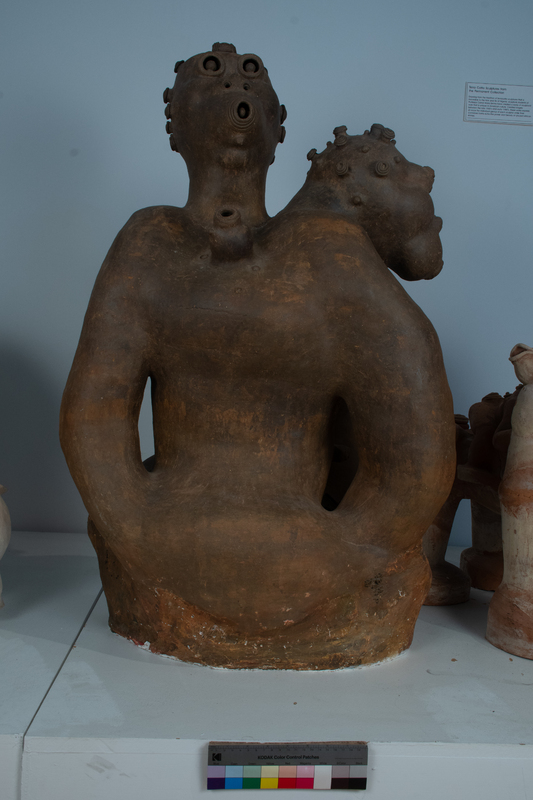
Obey’s sculpture, “Primeval Couple,” features a prehistoric male and female couple fused within the arms of one another. The heads of the figures are decorated with embellished swirls, often featured in the terracottas made by students of Carroll Harris Simms. Simms related Obey’s design to those he had seen in the mountains of northern Nigeria.
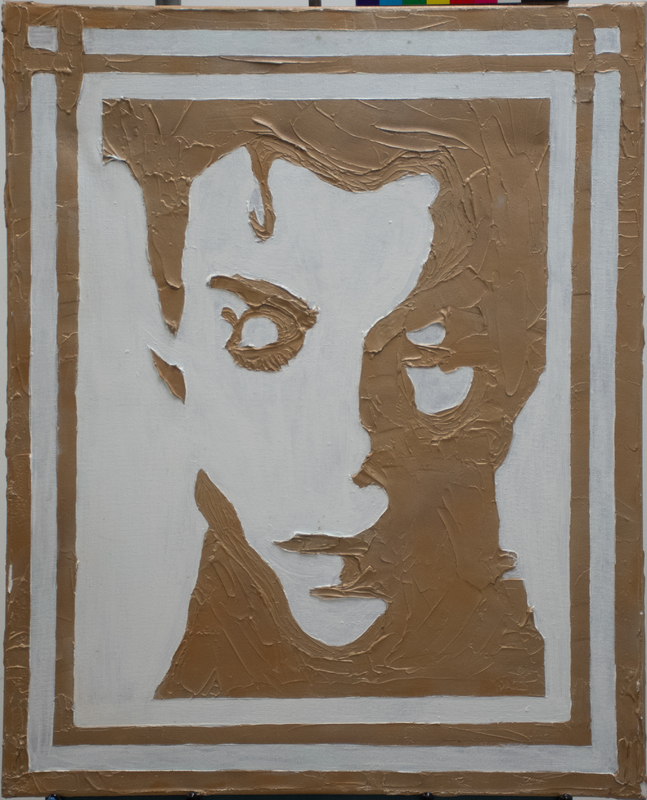
Morris’ painting is a golden, close-up portrait of singer and performer Prince; his head is slightly bowed and his eyes are closed. The painting is inspired by Prince 3, a photograph of the singer taken by Herb Ritts in 1991. Before his death, Prince became one of the best-selling musicians of all time, celebrated for his soaring vocals, multi-instrumental skills, and pioneering aesthetics and sounds.
In this interview, Texas Southern art alumnus Prinston Nnanna discusses his experiences as a student in the class of 2016. He describes TSU's art building as the first place where he learned about living Black artists. He also cites Dr. Biggers as inspiring him to use symbolism in his artwork. Post-graduation, Nnanna teaches at the Pratt Institute.
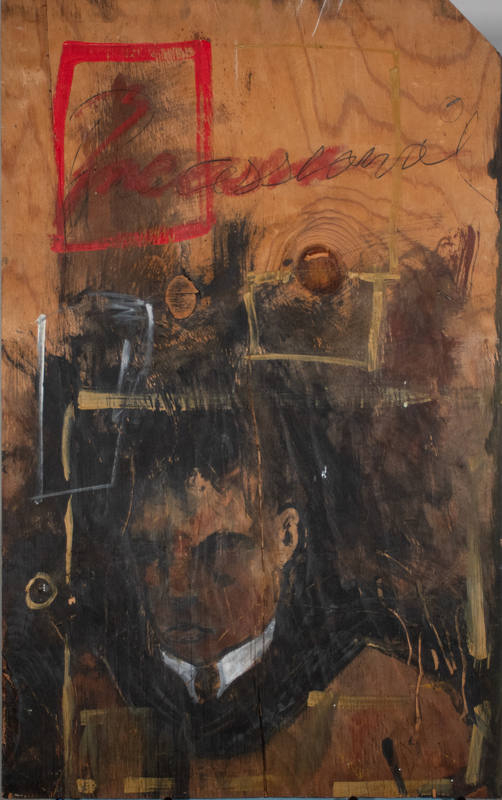
Pruitt’s painting is based on a photo he took of the preacher of his childhood church. At the time this piece was painted, the artist was exploring different faiths and struggling with his religious beliefs. Pruitt cites Basquiat and Rauschenberg as stylistic inspirations that influenced this painting. The muddied brushstrokes used to create this piece reflect the internal struggle of the artist.
This is a publisher’s proof for Long’s print Post Rome, which was created during his 1990 Prix de Rome fellowship. At the center of the design is a large, oval-shaped eye. This is a frequently used motif in Long’s artwork, across many different mediums. The vertical and diagonal rays and bars draw attention towards the eye, which features a man’s face where the pupil would be.
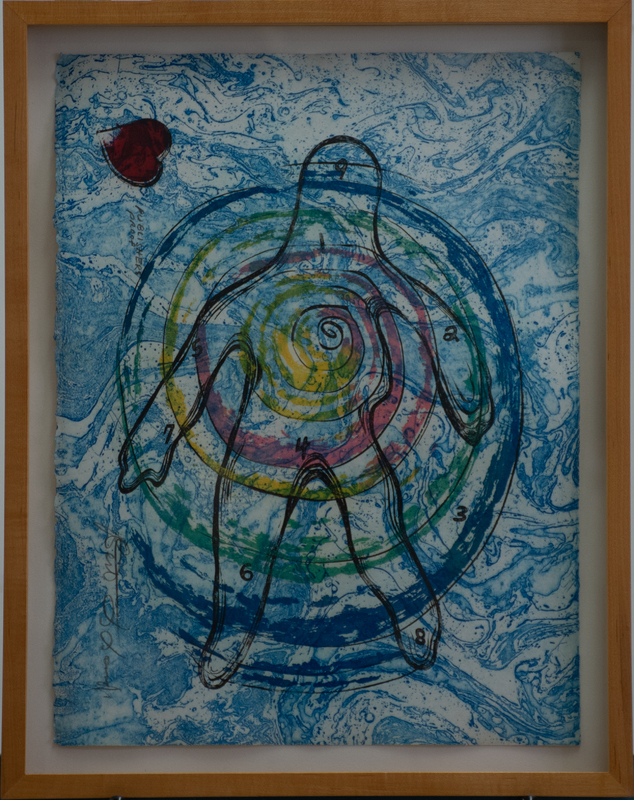
This is a publisher’s proof for Long’s piece Roma, which was created during his 1990-91 Prix de Rome fellowship. Featuring a blobby figure and colorful swirls, the composition is somewhat reminiscent of Da Vinci’s Vitruvian Man. Long rose to prominence as an “outsider artist” without formal training, later becoming one of the co-founders of Project Row Houses.
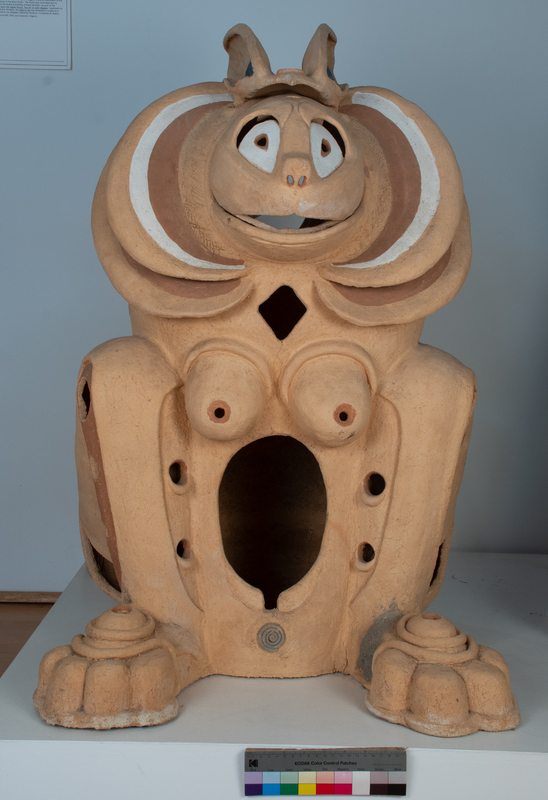
“Queen Rabbit,” by Earl Jones, features a mythical female rabbit. The center of the body includes an oval-like opening with identical circular holes on the legs and feet, creating balance. The rabbit’s ears are constructed with a removable crown piece; the same technique is used in several busts created by other Texas Southern artists.
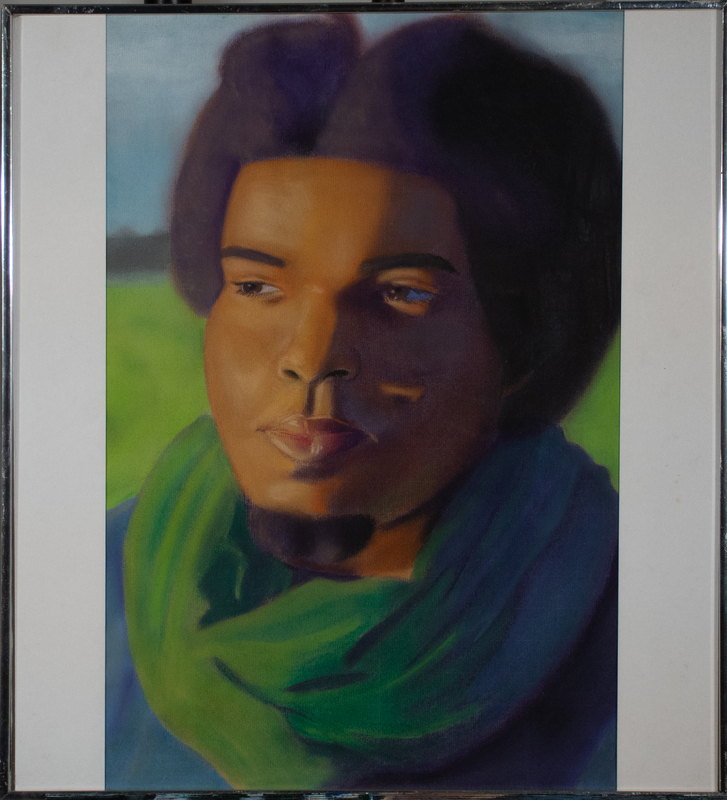
This work by Raheem Bellard is a self-portrait of the artist, with his face illuminated by the sun, wearing a green scarf. Cool colors are used throughout the piece, which enhances the tranquility of the composition.
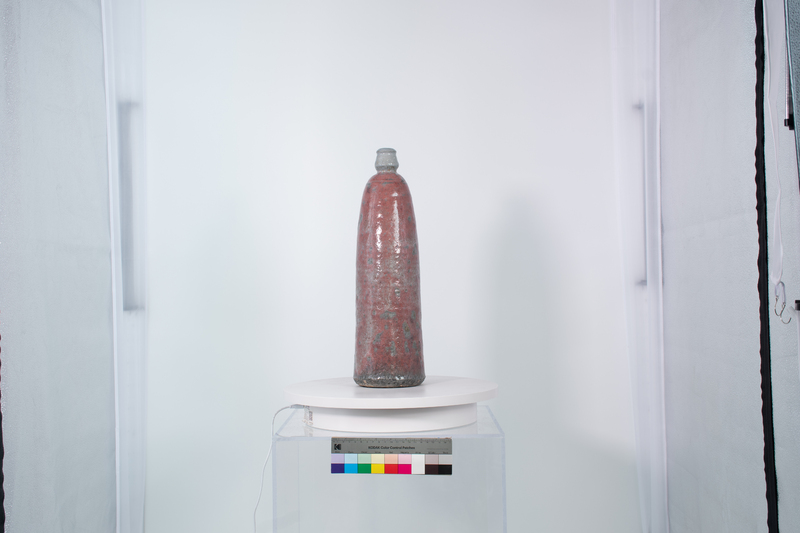
Simms’ ceramic vessel is hollow, with an opening at the top, and has a red and gray glaze. Carroll Harris Simms worked alongside Dr. John T. Biggers to establish the Texas Southern University Art Department. Simms taught sculpture, ceramics, and jewelry-making classes.
In this interview, Texas Southern art alumnus Richard "Sunnyside" Williams discusses his experiences as a student who graduated in 1994. He learned from faculty like Biggers, Simms, and Vital, and cites classmates and fellow alumni Roy Vinson Thomas and Karl Hall as influences. Williams taught at Worthing High School for years after graduating.
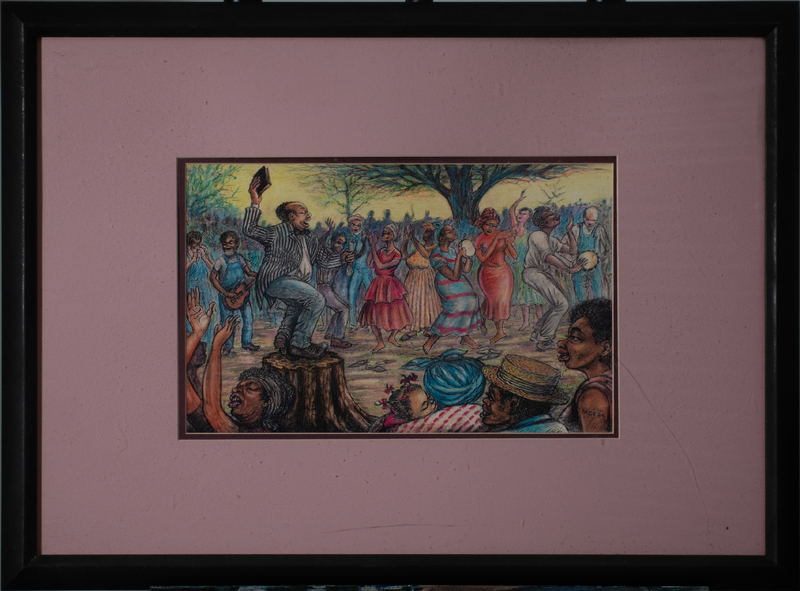
Moe's work displays a joyous religious gathering, featuring a preacher, dancers, musicians, and others. The group appears to be performing a ring shout, or praise break, a characteristic tradition of some Black churches in the Southern US involving dancing, stomping, and singing.
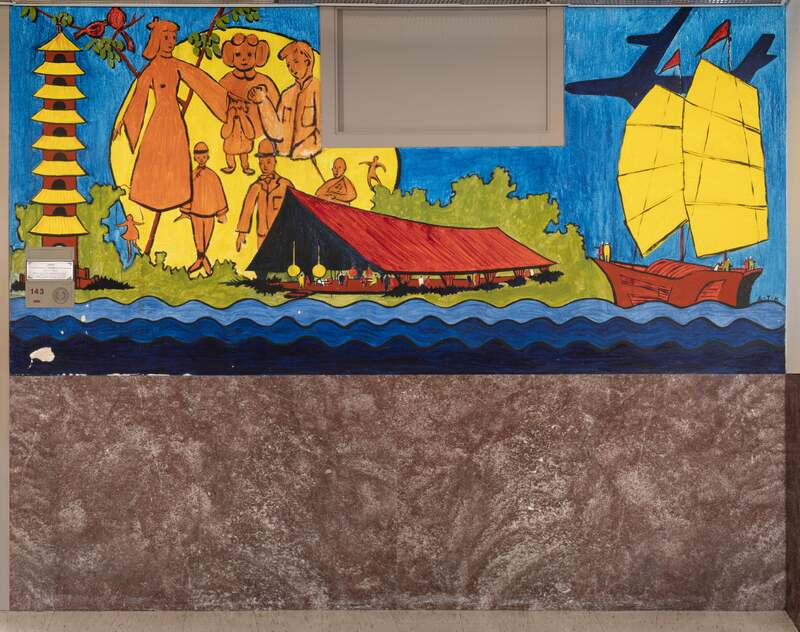
This mural was painted by one of the many Asian students who enrolled in Texas Southern during the 1980s. A wooden ship with sails is seen in contrast with a modern airplane on the right side. On the left, a tower suggestive of a pagoda imbues a sense of history and culture.
In this interview, Texas Southern art alumnus Robert Pruitt discusses his time as an art student (1993-2000) and as an artist later on. During Pruitt’s time at TSU, he learned from Dr. Alvia J. Wardlaw and Professor Harvey Johnson, the latter of whom’s drawing classes were particularly influential on Pruitt and his practice. The artist also discusses his hopes for the future and his desire to create a body of work that speaks to the vitality of African Americans.
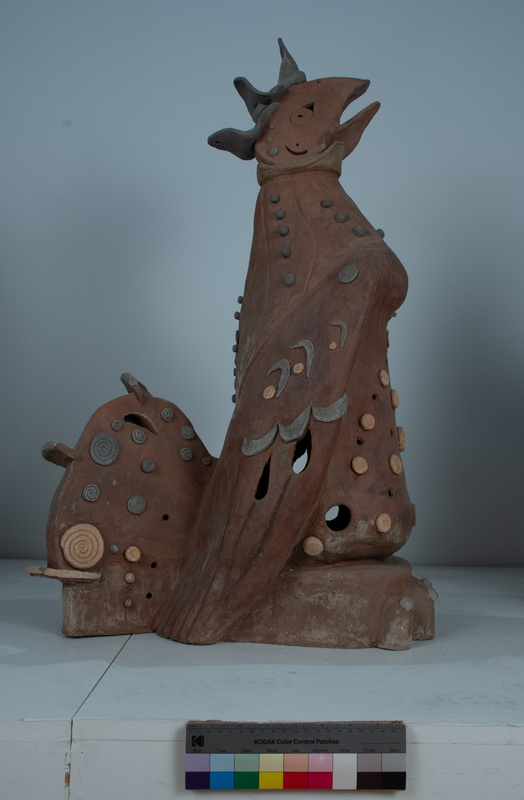
Scott’s sculpture depicts a large rooster crowing. The artist uses multiple colors of clay in his piece. Like other sculptures created for classes that Professor Simms taught, “Rooster” features numerous embellishments throughout the work, including various nodules and swirls. Creating sculptures of this style requires multiple firings in the kiln.