University Museum at Texas Southern Permanent Collection
Title
University Museum at Texas Southern Permanent Collection
Date Modified
2025-09-22
Description
The University Museum at Texas Southern has collected a rich body of artwork by students, faculty, alumni, and outside artists. Dr. John T. Biggers, who founded the art department at Texas Southern University in 1949, established a tradition of collecting a selection of works from every graduating senior art student. Over the years, the collection has grown to include more than a thousand pieces of student artwork. Also included are works donated by alumni of the art program and art faculty members, including iconic artists John Biggers and Carroll Harris Simms. Lastly, there is a small but significant body of work by outside artists that has been donated by various collectors.
Contributing Institution
Texas Southern University
About This Record
The HCAC public history focused digital archive cataloging is an ongoing process, and we may update this record as we conduct additional research and review. We welcome your comments and feedback if you have more information to share about an item featured on the site, please contact us at: HCAC-DigiTeam@si.edu
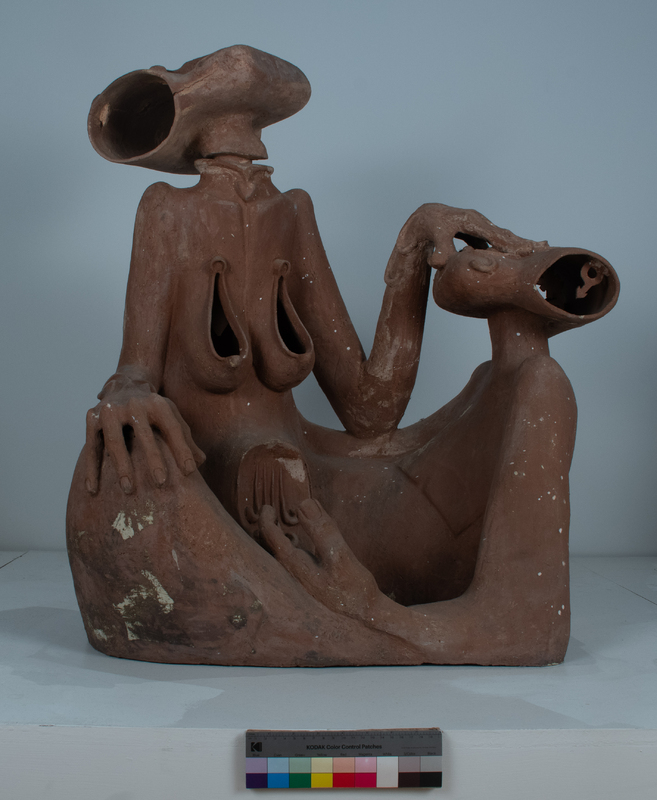
This terracotta was created by an unknown Texas Southern art student. The form suggests a surreal male and female pair warmly embracing each other. The artist employs negative space uniquely in this sculpture; additional gendered embellishments can be seen within the open heads. These exterior decorations were required by Professor Carroll Harris Simms.
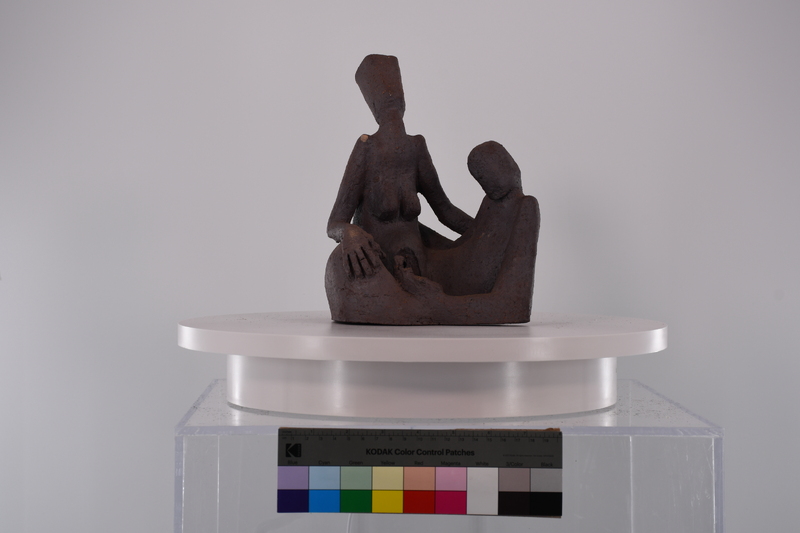
This maquette shows a human-like couple with enlarged heads and hands. The artist suggests their intimacy by joining their lower bodies together. The full-scale sculpture features finer details, such as modified head shapes, embellishments, and greater use of negative space.
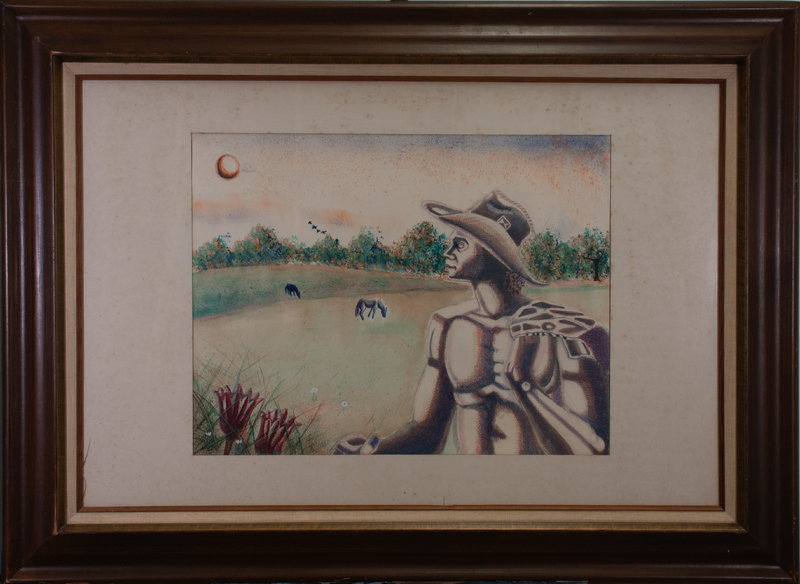
This piece by Bennie Settles shows a man wearing a cowboy hat, looking out onto a mostly empty field with two horses grazing. Settles' works in the permanent collection frequently showcase his style of using rounded shapes and gradients to depict his subjects' muscles and deep care for portraying Black hair.
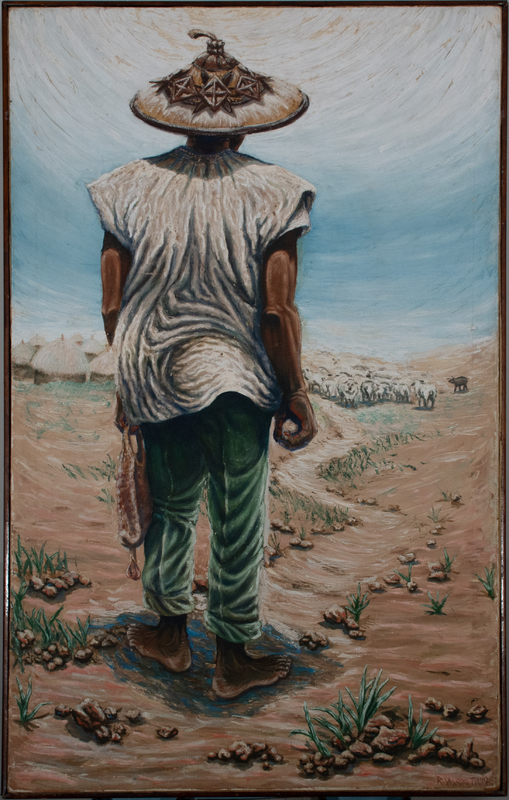
Thomas’s painting shows a barefooted man, looking upon a village and a herd of sheep from a distance. The movement of wind is depicted through his garments swaying around his body. Thomas has a particular way of creating movement in his paintings, especially in the clothing and scenery in his artworks.
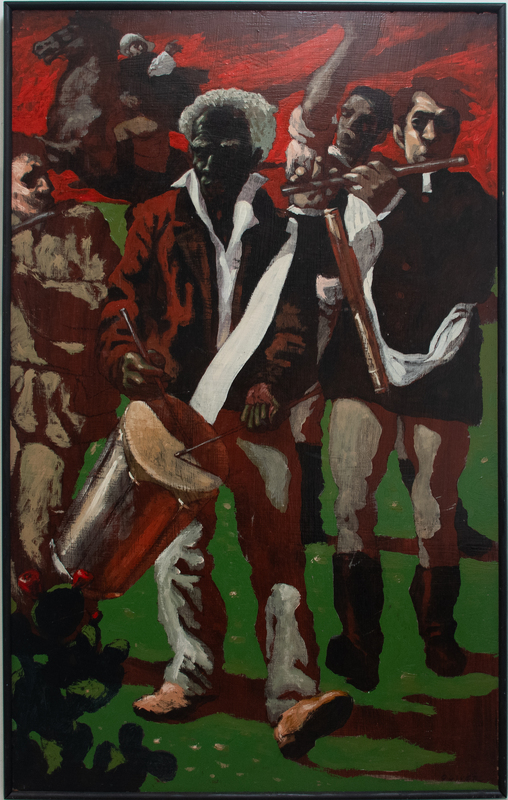
Oliver's painting depicts a group of men marching and playing drums and flutes, seemingly as part of a military expedition. The scene is believed to be drawn from the Battle of San Jacinto, the culminating battle of Texas's war against Mexico. The Black man may be Dick the Drummer, a free Black man who was part of the Texas army band.
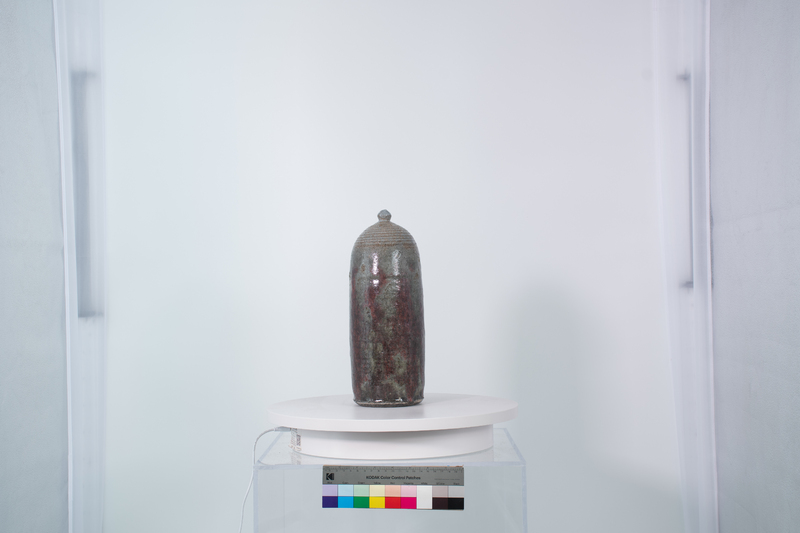
Simms’ ceramic vessel is round and stout, with ridges and a node at the top, and has a maroon and gray glaze. Carroll Harris Simms worked alongside Dr. John T. Biggers to establish the Texas Southern University Art Department. Simms taught sculpture, ceramics, and jewelry-making classes.
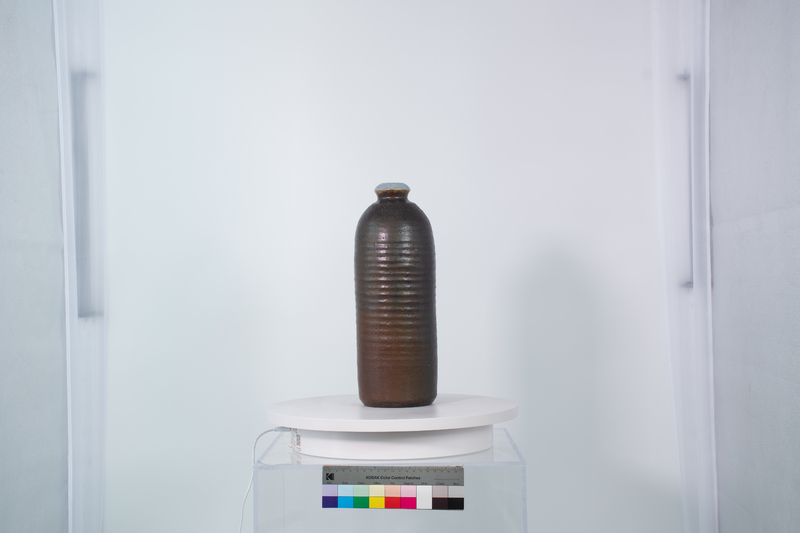
Simms’ ceramic vessel is hollow, with an opening at the top, and has ridges and a dark maroon glaze. Carroll Harris Simms worked alongside Dr. John T. Biggers to establish the Texas Southern University Art Department. Simms taught sculpture, ceramics, and jewelry-making classes.
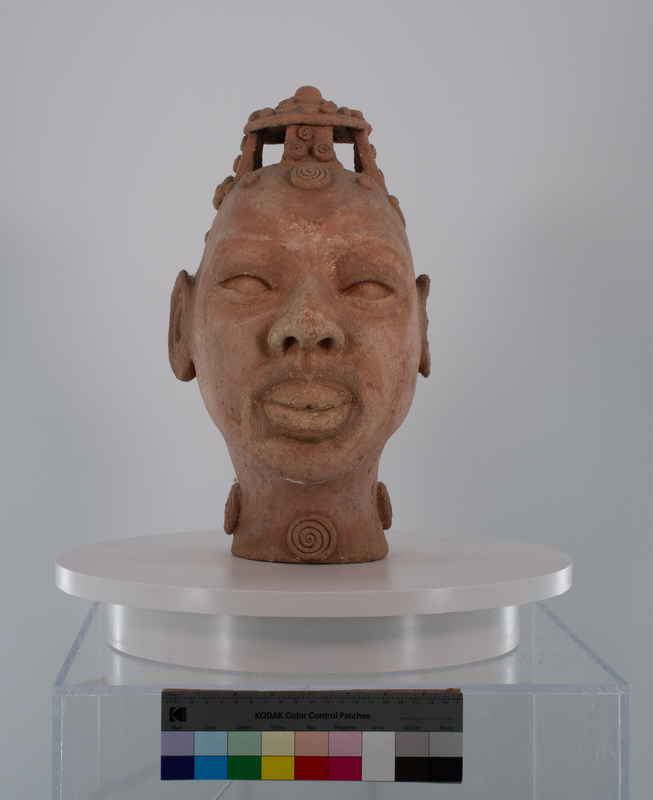
Ellison’s bust was created during his time as an art student at TSU. Under the instruction of Professor Carroll Harris Simms, artists would create self-portraits embellished with decorations like spirals and accentuated crown pieces, like in Ellison’s sculpture. These busts are inspired by Nok terracotta sculptures and Ife busts, which Simms saw during his travels to Western Africa.
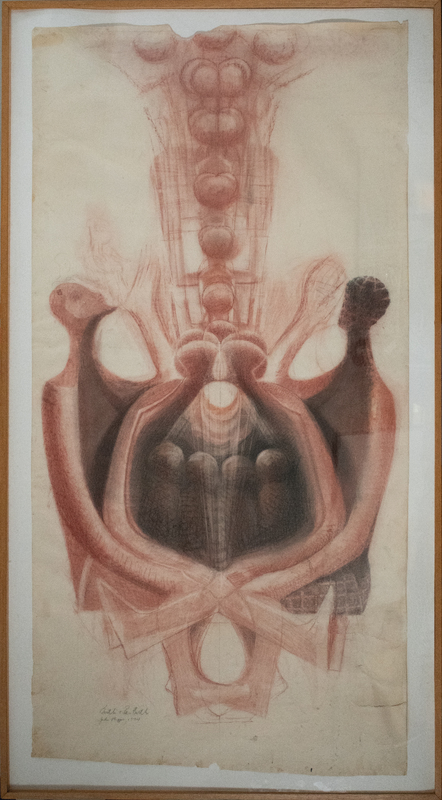
Biggers’ drawing shows several linked and overlapping human figures, with babies within the open space their bodies create. Above their heads, children divide and multiply like cells. The lower half of the drawing resembles the shape of the female reproductive system. Biggers called this form the "morning star." A very similar image to this piece appears in Biggers’ mural Family Unity. His artwork often emphasizes themes of motherhood, family, and life cycles.
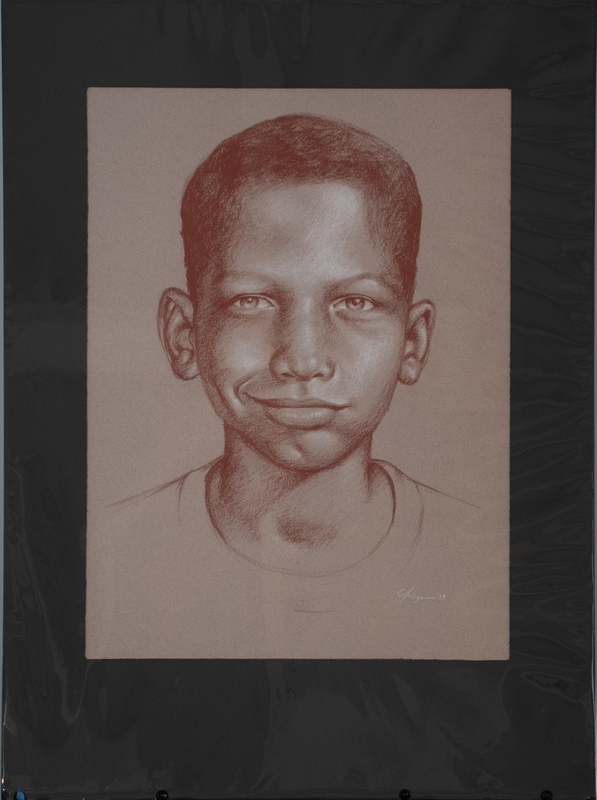
Onyeiwu’s drawing is of a young boy wearing a smirk on his face. Onyeiwu creates incredible, realistic portraits with fine details. Originally from Nigeria, Onyeiwu received his undergraduate arts degree from Texas Southern, and has since returned to teach drawing and painting classes at TSU.
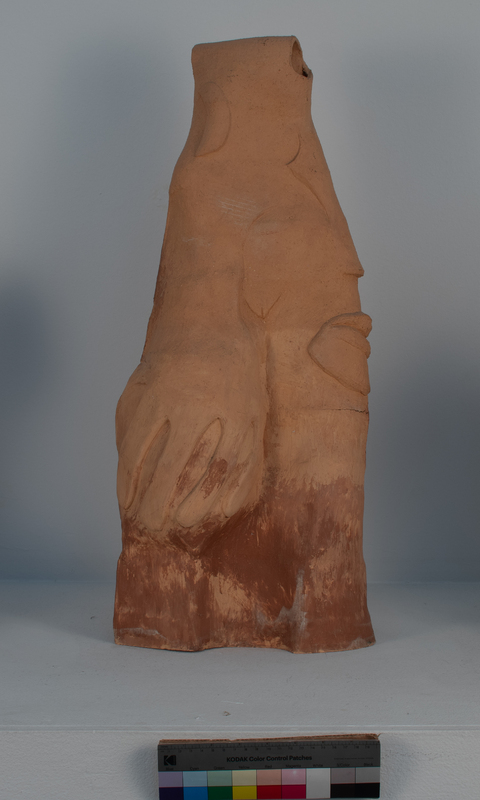
This sculpture is of an abstract side face profile, prominently featuring the nose and lips, with a large hand on one side of the sculpture. The oversized hand is an example of the influence of Dr. John Biggers’ style. This sculpture is two-toned due to varying levels of oxidation of the clay. The structure bears some resemblance to the Moai of Rapa Nui (also known as Easter Island heads).
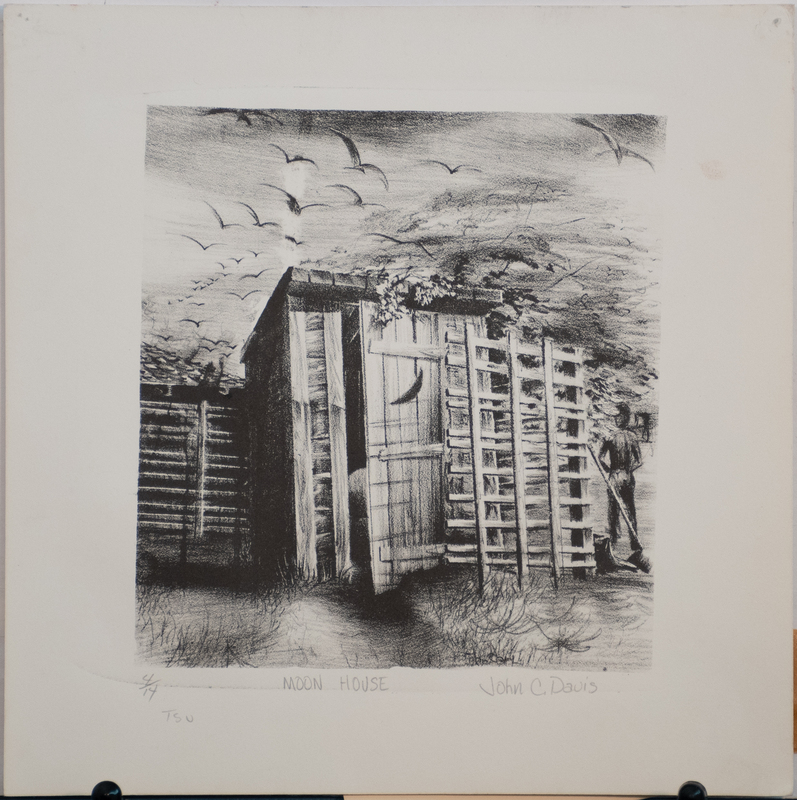
Davis’s print is of an outhouse, colloquially referred to as a moon house. In modern imagination, the crescent moon on an outhouse door has become an identifying symbol of frontier living. Davis’ print also shows a shirtless man zipping up his pants upon exiting the outhouse, while a huge flock of birds fly overhead.
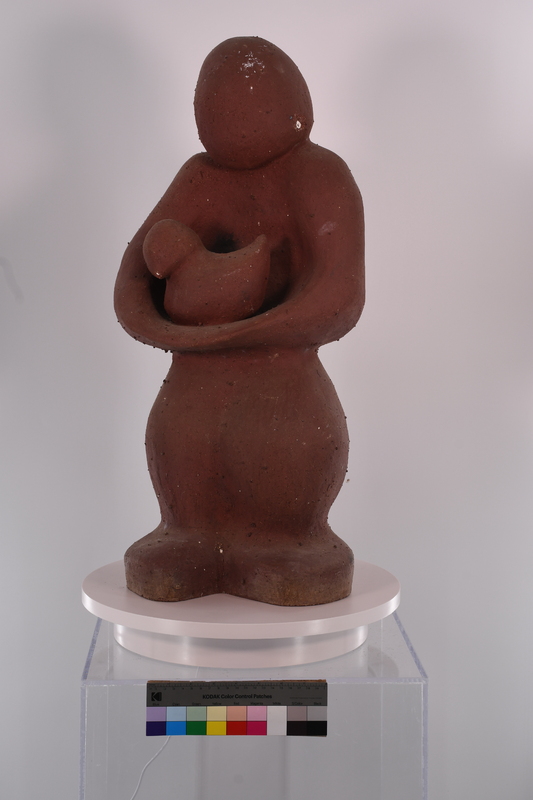
Windle’s terracotta portrays a figure embracing a bird in its arms. The exterior of the sculpture is smooth and lacking any of the decorative motifs typically featured on Texas Southern students’ terracottas. The embrace reflects the compassion of a mother and her child, while also displaying interspecies grace and kindness through the act of picking up this bird.
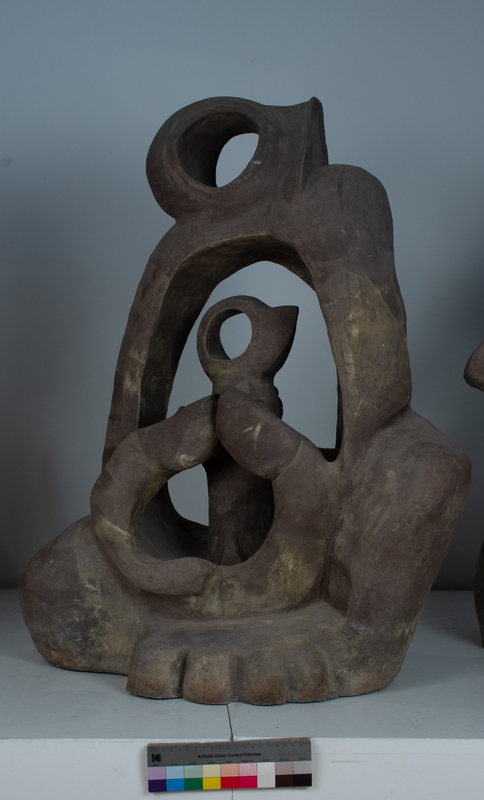
“Mother and Child,” by Warren Williams, reflects a theme of unity. The smaller figure is placed in the lap of the larger, held in place by two fingers connecting to form a circle. The sculpture’s form resembles a mother and child bird, perhaps perched in their nest. The mother-child relationship is an important motif in Texas Southern artwork.
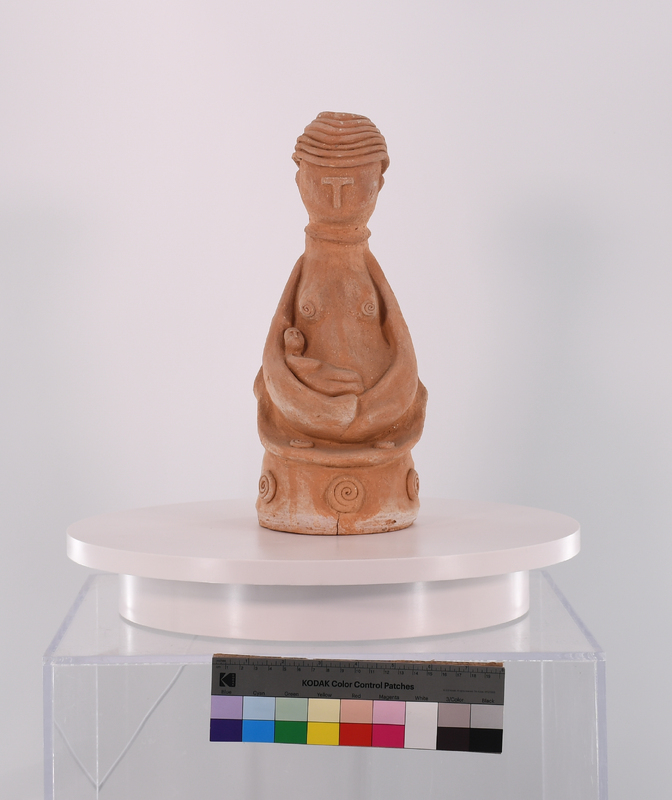
This terracotta maquette is of a woman cradling a child in her arms. The woman is shown naked, with simplified facial features. A circular base supports the sculpture, and spiral motifs are embedded throughout the piece. The crown of the head is topped with layered rings to indicate hair texture. The mother and child theme is prevalent in TSU’s terracotta collection.
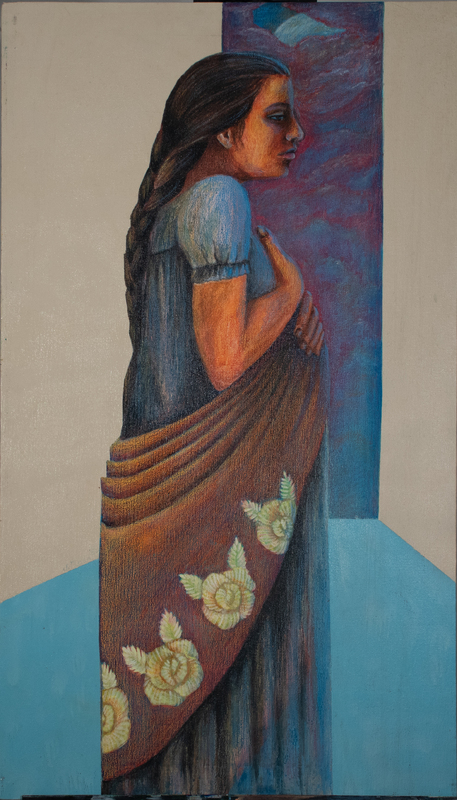
Mendoza's painting depicts an expecting mother gazing into the distance and wearing a traditional Mexican rebozo. Rebozos can be used by pregnant women to support their bellies, as this woman appears to be doing. Mother and child is a prevalent theme in art by Texas Southern Art Department students, found in drawings, sculptures, murals, and paintings.
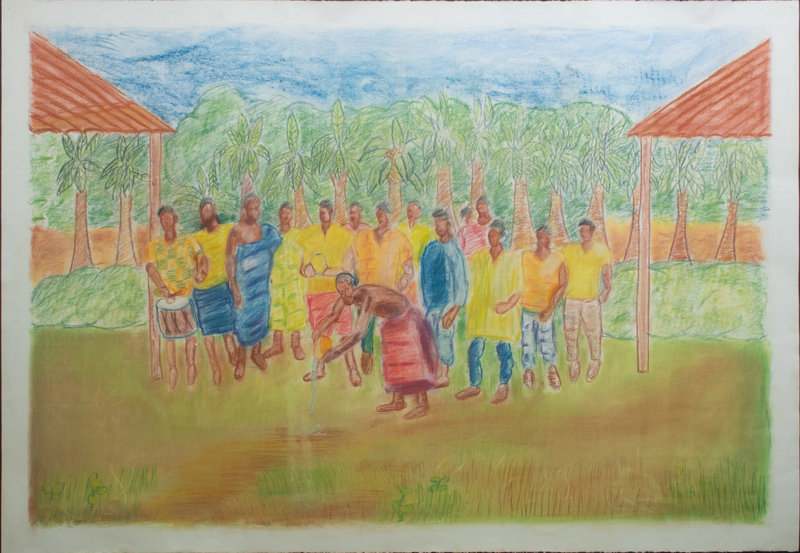
The work shows a group gathering for a libation ceremony in a field; as one member is pouring water into the ground, the other members are playing musical instruments. A libation ceremony is when liquid is poured into the ground as an offering to and in remembrance of a deceased loved one. This ceremony is practiced across the African diaspora.
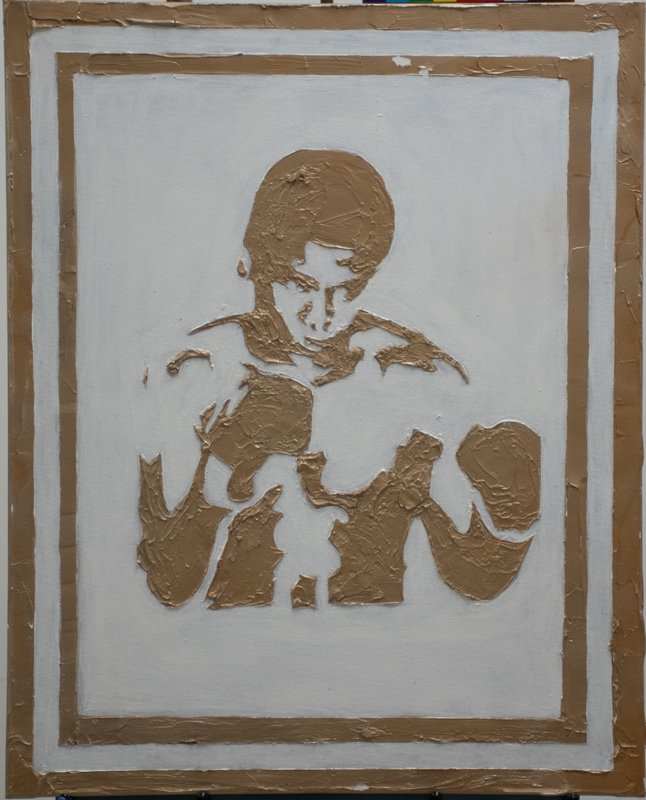
Morris’ painting is a golden portrait of boxer Muhammad Ali raising his fists and preparing for a strike. The painting is inspired by a photograph taken in the 1960s at the height of his athletic career. Ali gained acclaim, controversy, and celebrity not just for his boxing achievements, but also for his conversion to Islam, civil rights activism, and refusal to fight in the Vietnam War.
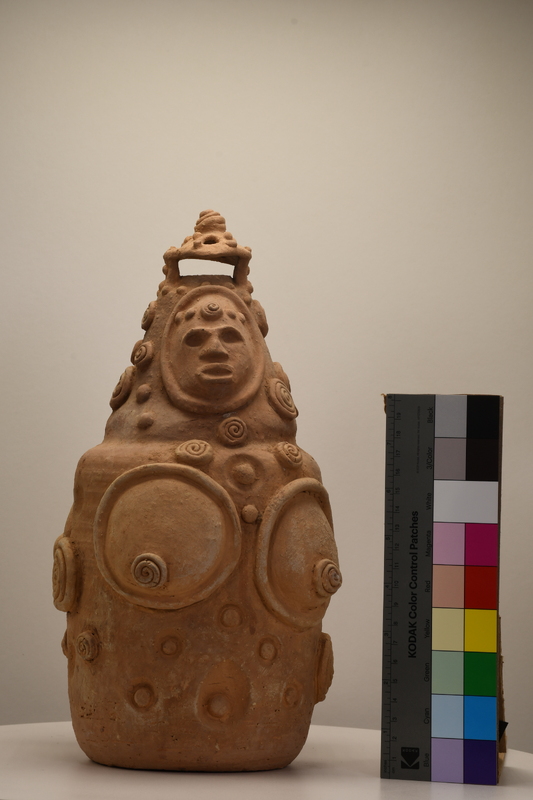
This is a maquette created by an unknown Texas Southern University art student. This maquette displays a stout figure with various swirls on the body. The swirls are a required component for the maquette project, as Carroll Harris Simms pushed his students to richly embellish their works.
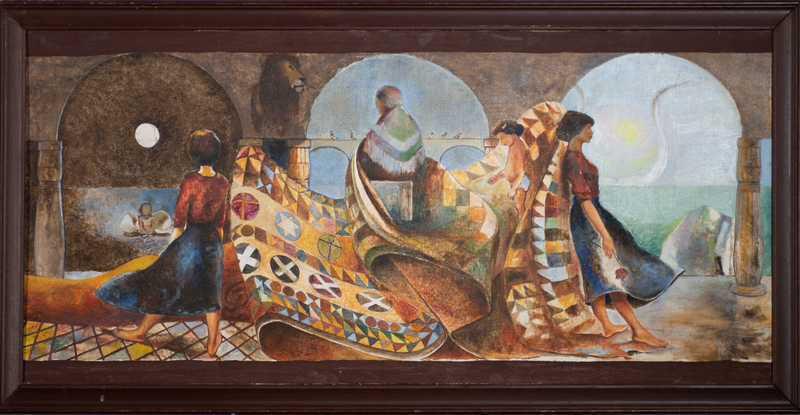
Curnell’s painting is a pre-study of her mural “Awakening” in Hannah Hall. The mural shows a reflection of Curnell’s past, present, and future life. She is seen pictured here as an infant, at her current age, and her future self as an elder. The quilt that stretches across the composition features various religious symbols, including the cross, the star of David, and the ankh.
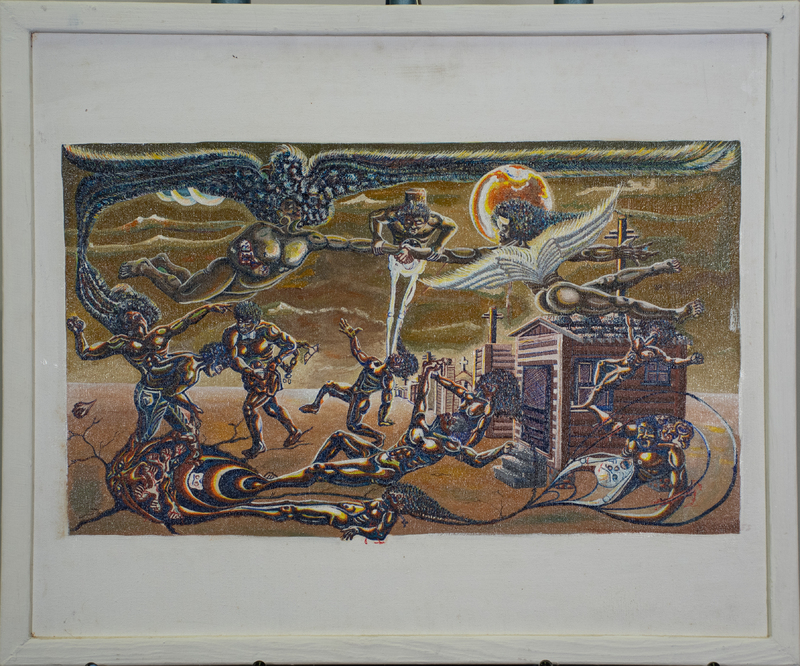
Settles' mural study depicts muscular, mostly naked men and women seemingly being sucked into a portal. An angel attempts to pull them away, while two men are stripped of their skin and bones. The figures’ hair is painted with great detail and seems imbued with special powers. The backdrop shows a horizon of shotgun homes. Settles’ final mural nearly replicates this earlier draft.
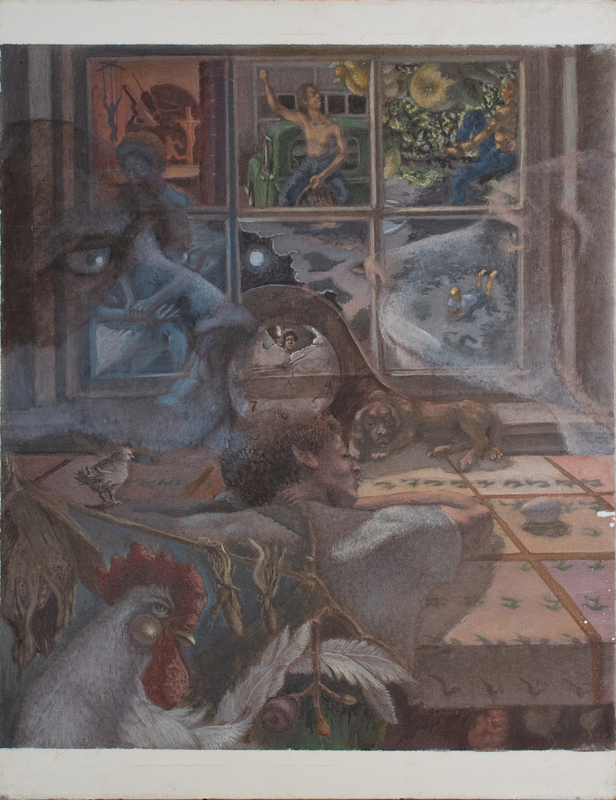
Samples' painting is a study of his mural created in Hannah Hall. The design unfolds like a dream, with each panel above the central figure (the artist himself), who is asleep on a table, revealing a constellation of scenes from the artists’ youth. Lower window panels evoke a harmonious existence with nature and animals, while upper panels reveal struggles with racism in the South and his mother’s death. The shadowy dogs along the sides of the study were not included in the final mural.
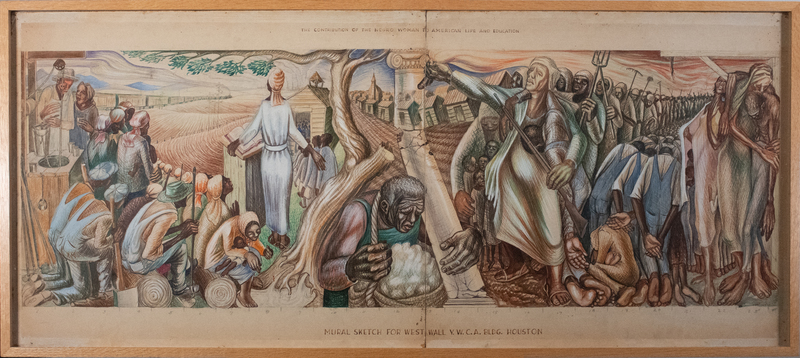
Biggers created this sketch while working on his mural, “The Contributions of the Negro Woman to American Life and Education,” for the Blue Triangle Branch of the YWCA. This mural was the culmination of his research for his doctoral dissertation at Penn State University. It features Harriet Tubman and Sojourner Truth leading enslaved people to freedom and educating African Americans, respectively.
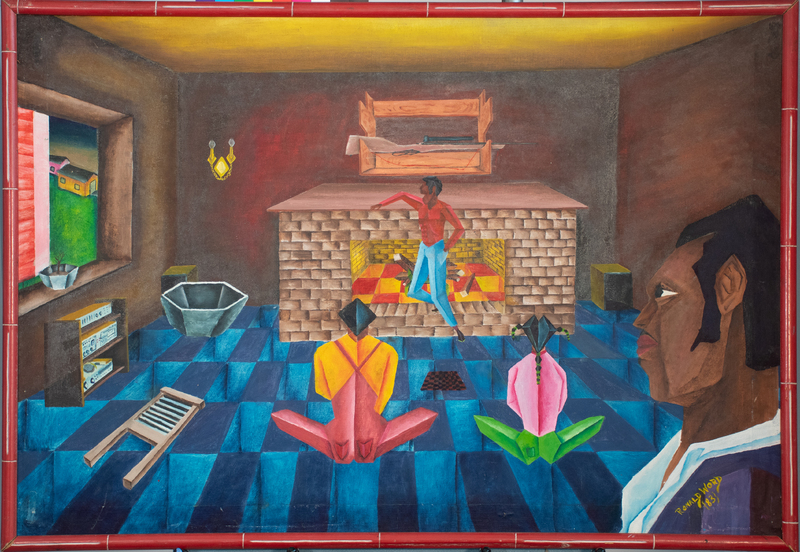
Word’s painting is a partial pre-study of his Hannah Hall mural. The painting, featuring a family in a small room with a fireplace, washboard, mounted gun, and radio, is done in a geometric style frequently seen in the art of Biggers’ students from the late 1970s and early 1980s. Word’s full mural design includes adjacent panels depicting a church, an abstract figure with a bubble-like head, and an homage to the Wizard of Oz.
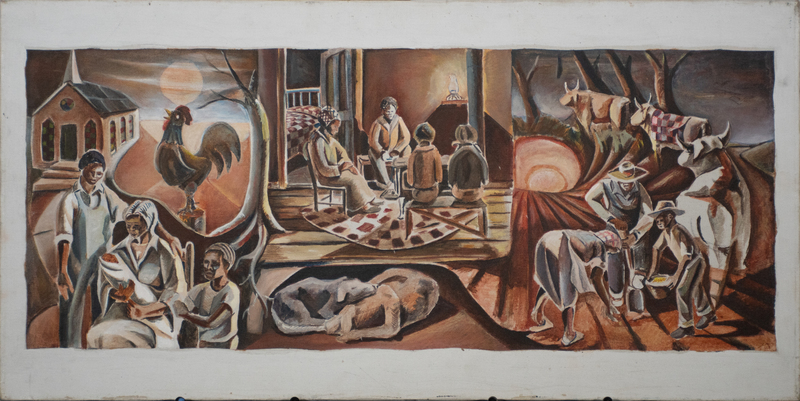
Williams’ painting is a pre-study for his mural. Across three scenes, the artist portrays birth, family home life, and farm work. This triptych style of composition appears frequently in the murals painted by students of Dr. John T. Biggers. The checkerboard motif that Williams uses in each panel is also drawn from Biggers’ teaching. Although Texas Southern is an urban university, many students hail from rural areas in Texas and these themes of country life appear repeatedly in student murals.
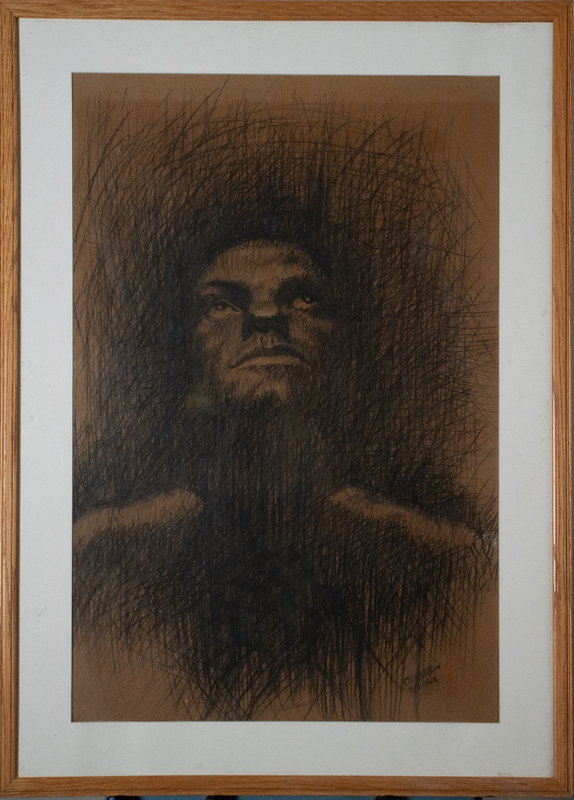
Oliver’s drawing is of a man looking upwards. This is a pre-sketch for a mural in Hannah Hall, which has a matching version with a woman and child. Oliver would find small spaces between other students’ murals and fill in the gaps with his own compositions. As a result, Oliver painted 6 murals in the building; no other student artist painted more than 2.
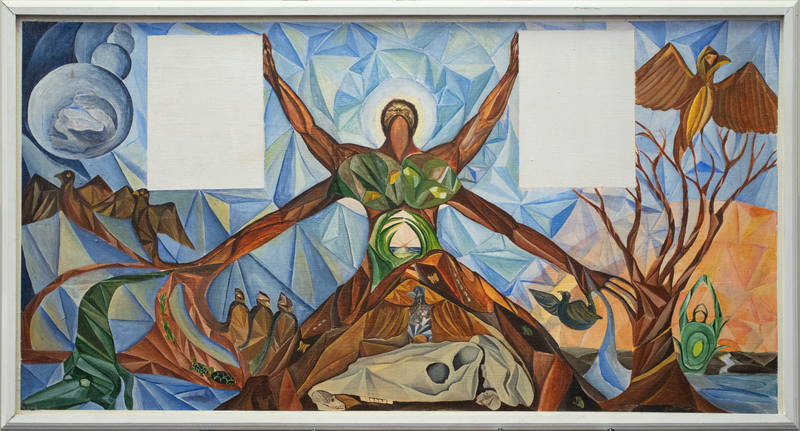
Sampson’s mural study depicts Mother Nature surrounded by birds, turtles, trees, fossils, and an expansive blue sky. This piece is painted in a geometric style that appears frequently in the work of students of Dr. John T. Biggers during the mid to late 1970s. Apart from some minor changes, Sampson’s final mural replicates the design in this earlier draft.
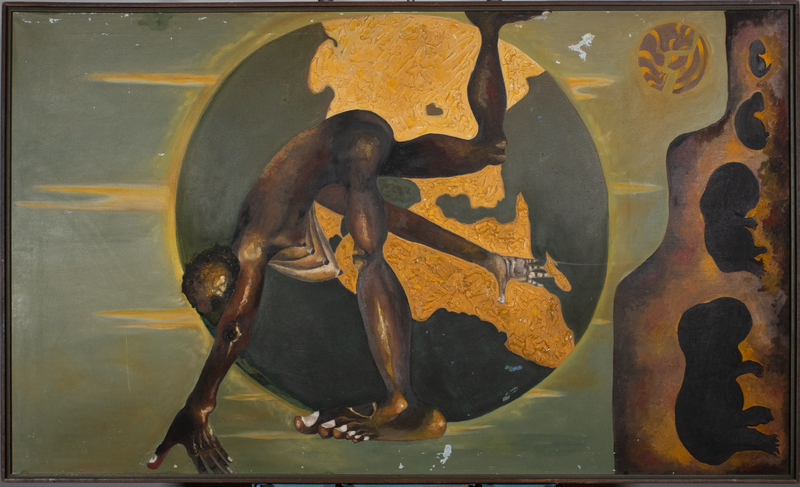
Tinker’s painting is a study of a section of her Hannah Hall mural. It depicts a naked woman bending over in front of a large globe. On the right side, the progression of human development, from embryo to fetus, is depicted. The final version of the mural features all of the pictured elements, but aligned differently and complemented by many additional images.
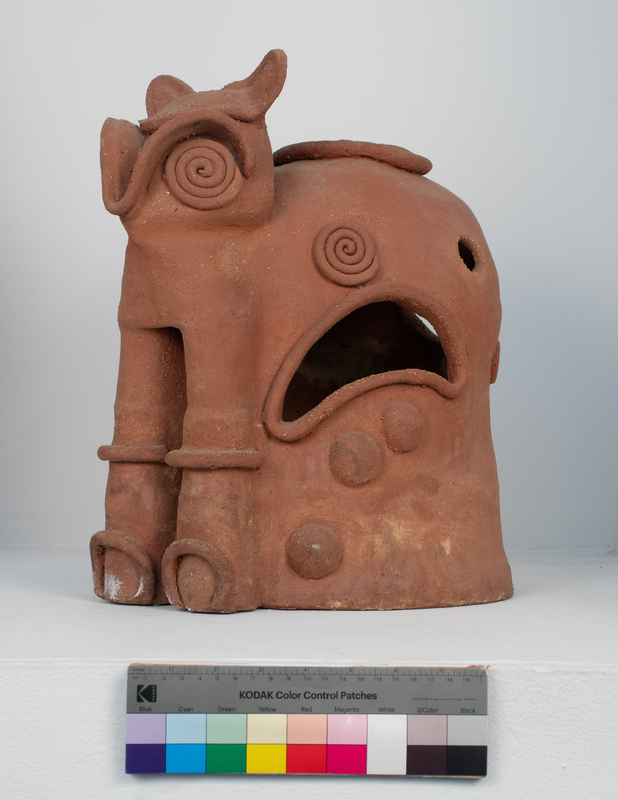
This terracotta features a snail-like creature with long legs, adorned with spiraled embellishments for the eyes and outer shell. The spiral motifs are placed in a symmetrical pattern on both sides of this sculpture. The clay is mixed with grog to create a better texture and prevent the terracotta from shrinking when fired.
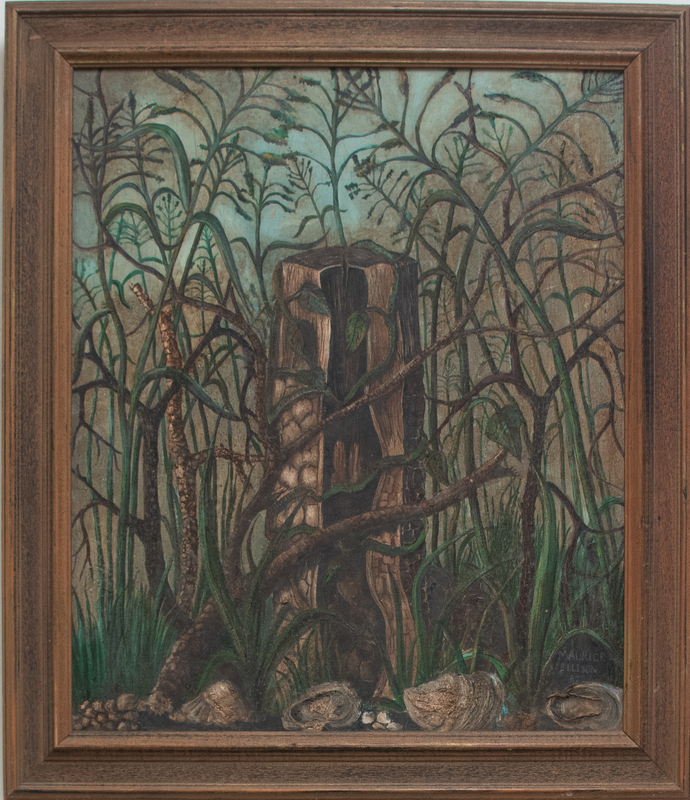
Ellison's painting is a nature scene featuring a bisected tree stump, with untamed growth all around it. At the bottom of the painting, there are several seashells, which the artist enhanced with raised, textural elements. Ellison graduated from Texas Southern University in 1972.