William D. Lamson was an architect/planner and demographic analyst for court cases dealing with school desegregation, voting rights, housing discrimination, and judicial redistricting. The collection consists of case files and maps he used in court as an ACLU expert witness in the Brown III case, a relitigation of Brown v. Topeka Board of Education (1954) that corrected resegregation issues caused by open enrollment school choice in 1992 for public schools in Topeka, Kansas.
Curated By
Garrad Lee
Contributing Institution
Jackson State University
About This Record
The HCAC public history focused digital archive cataloging is an ongoing process, and we may update this record as we conduct additional research and review. We welcome your comments and feedback if you have more information to share about an item featured on the site, please contact us at: HCAC-DigiTeam@si.edu
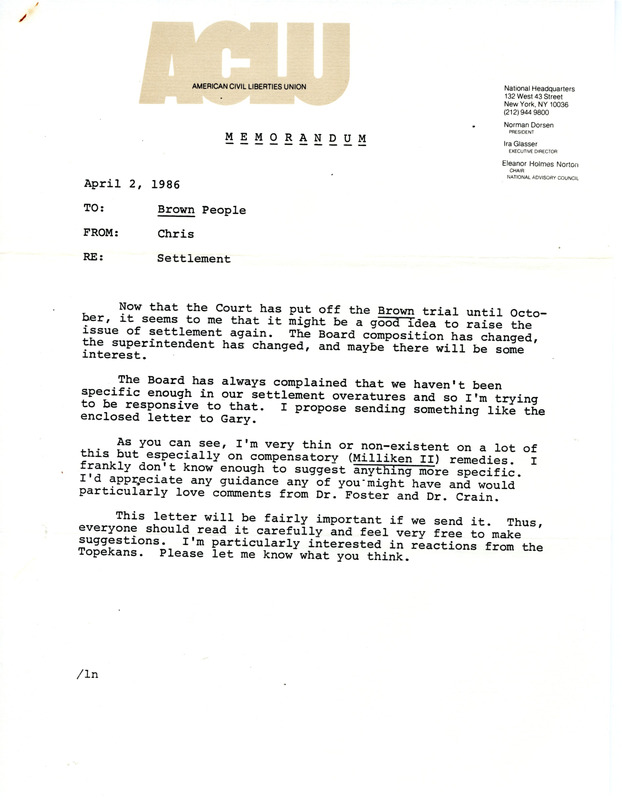
ACLU Attorney Chris Hansen writes to the members of the Brown Counsel team to inquire about their thoughts on a possible settlement. Attached is the court document containing the order of activities for the case between May and September 1986.
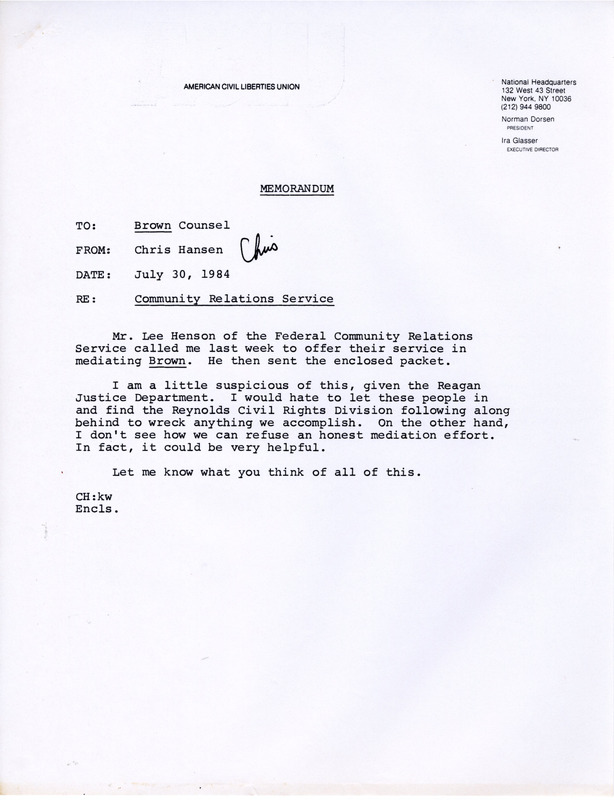
ACLU Attorney Chris Hansen writes to the members of the Brown III Counsel team to inform them that Lee Henson of the Federal Community Relations Service has offered their service in the case. Mr. Hansen is suspicious of this because of his opinion of the Justice Department under then-president Ronald Reagan.
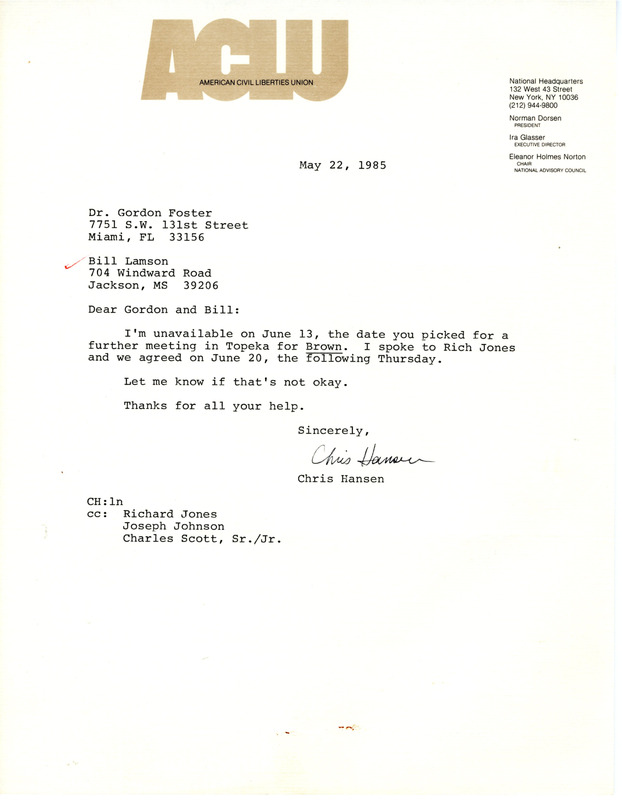
ACLU Attorney Chris Hansen writes to Dr. Gordon Foster and William Lamson to inform them that he is unavailable for the requested meeting date of June 13th, 1985, but can meet on June 20th instead. Dr. Foster and Lamson were to meet with the plaintiff team about their roles as expert witnesses in the Brown III case.
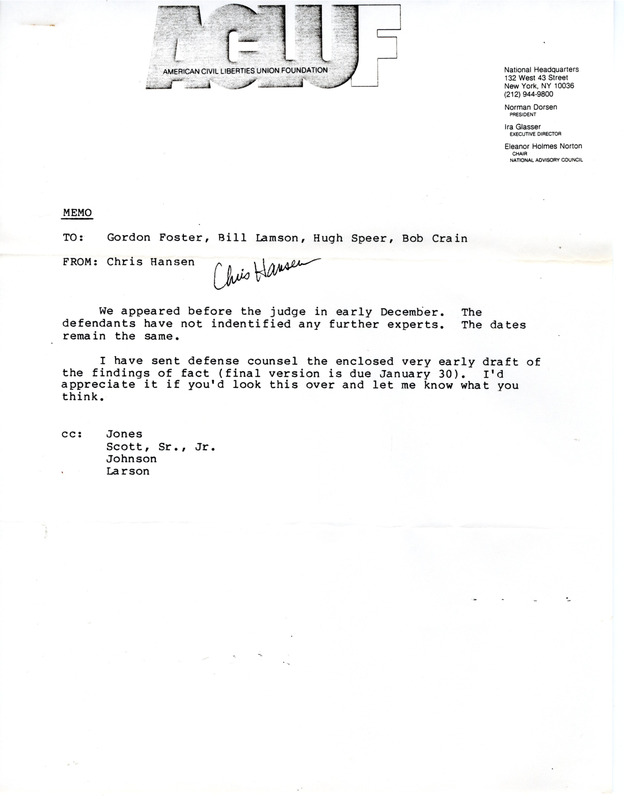
ACLU Attorney Chris Hansen writes to plaintiff expert witnesses Dr. Gordon Foster, William Lamson, Hugh Spear, and Bob Crain to inform them that dates and witness lists did not change after his appearance before the judge in early December. Attached is an early draft of findings of facts that he has shared with the defense.
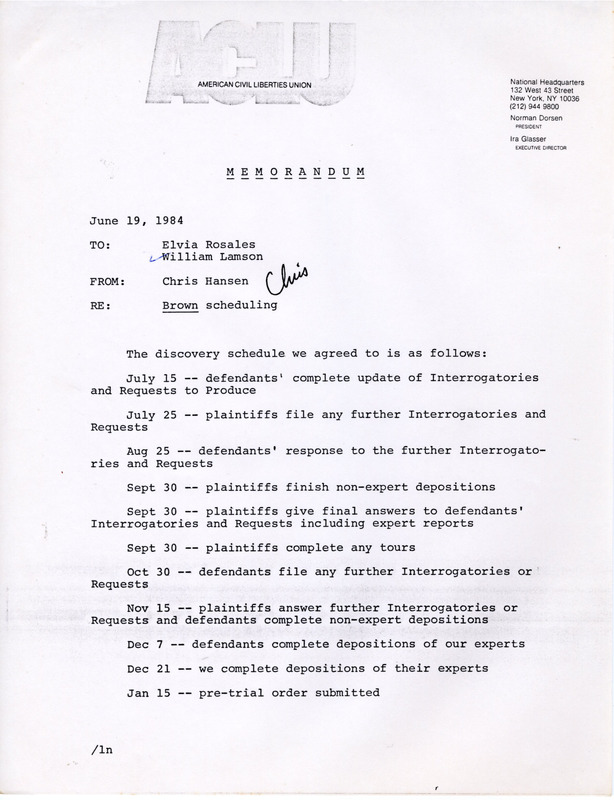
ACLU Attorney Chris Hansen writes to Elvia Rosales Arriola of the ACLU and William Lamson to outline the discovery schedule for the Brown III case. The schedule runs from July 15, 1984 to January 15, 1985 and includes depositions, due dates for interrogatories, tours of sites, and pre-trial orders.
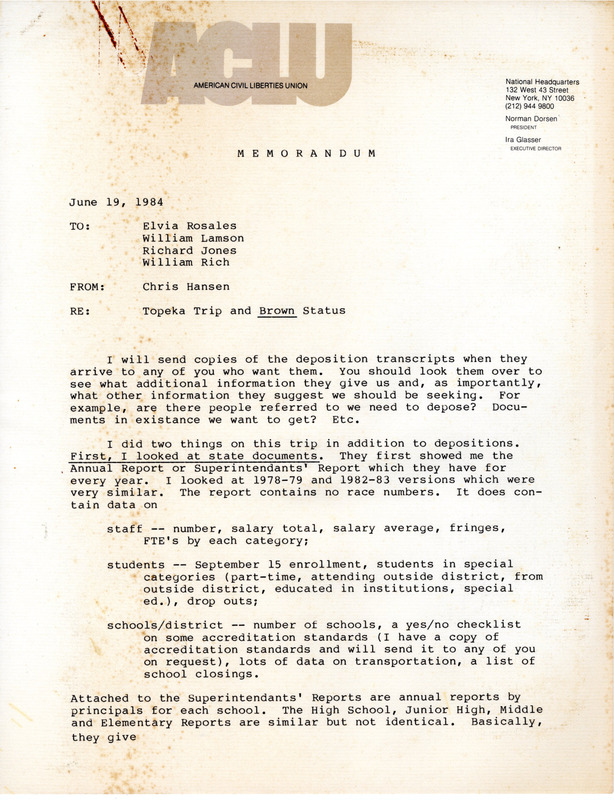
ACLU Attorney Chris Hansen writes to Elvia Rosales Arriola of the ACLU, William Lamson, Attorney Richard Jones, and Attorney William Rich to send an update on the round of depositions he completed. He also attached superintendent's and principal's annual reports for each school that he obtained on his recent trip to Topeka.
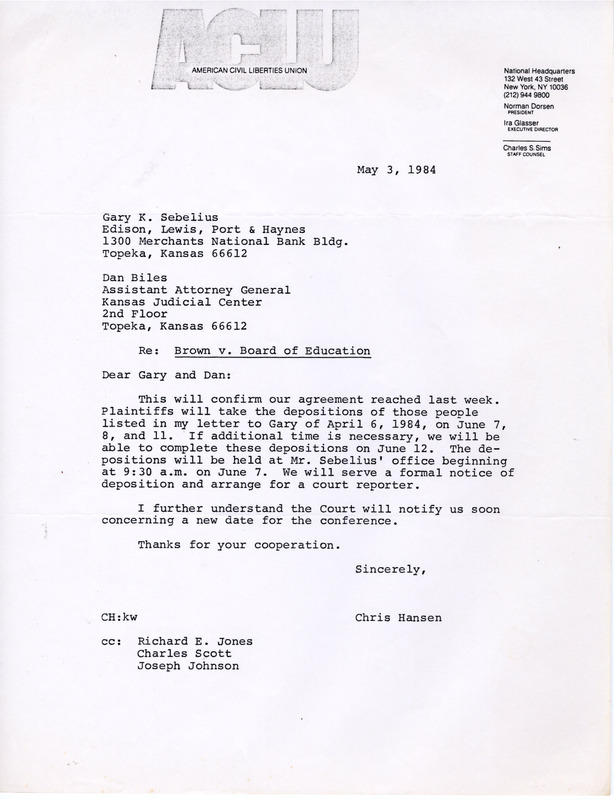
This letter from ACLU Attorney Chris Hansen to lead defense Attorney Gary K. Sebelius and Kansas Assistant Attorney General Dan Biles confirms deposition dates for June 7, 8, and 11, 1984, with a completion date of June 12. Hansen notes that formal notice of deposition will be served and a court reporter will be in the depositions.
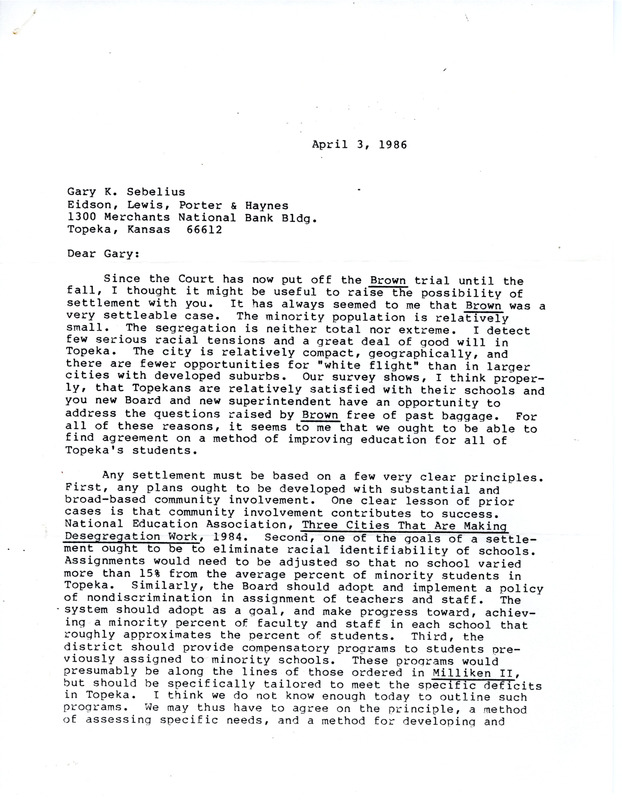
ACLU Attorney Chris Hansen writes to Lead Defense Attorney K. Gary Sebelius to outline a possible settlement for the case since the court has again pushed the date of the trial back. Mr. Hansen lists the principles on which a settlement would have to be based, including community involvement in any plans for the district.
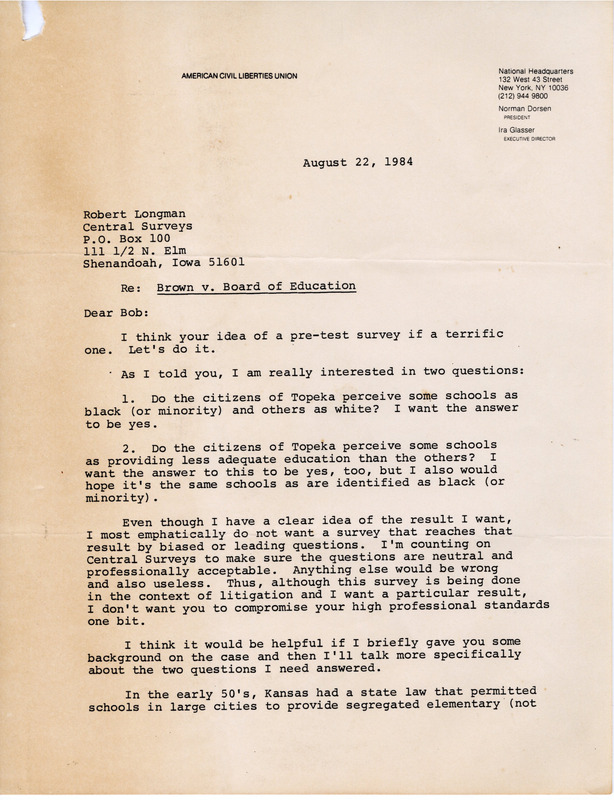
ACLU Attorney Chris Hansen writes to Robert Longman of Central Surveys Inc. to confirm a pre-test survey. Mr. Hansen gives background on the case and talks more specifically about the two questions he wants answered in the survey about Topeka residents' perception of whether schools are white or Black and if some schools are less adequate.
ACLU Attorney Chris Hansen sends William Lamson the order of activities for the case between December 1985 and March 1986. Also attached is the designation of fact witnesses by individually-named defendants associated with the State Board of Education.
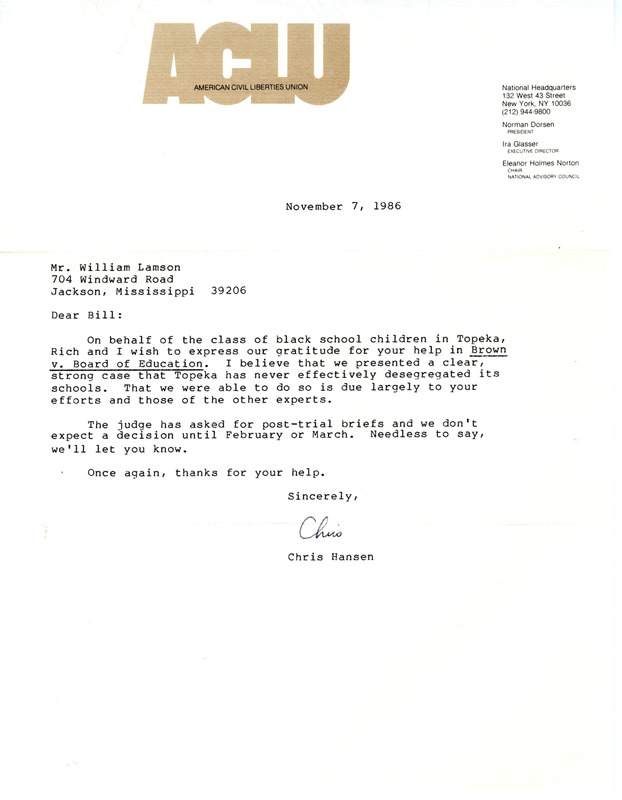
ACLU Attorney Chris Hansen writes to William Lamson to express his gratitude for working on the case. Hansen thanks Lamson on behalf of the class of Black school children in Topeka and writes that he feels the team presented a strong case that Topeka schools have never been fully desegregated and he expects a ruling sometime in early 1985.
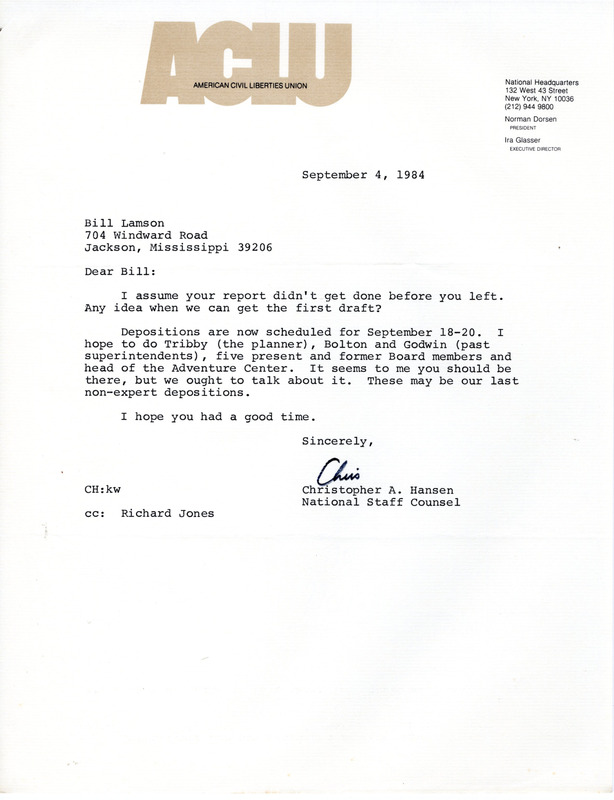
ACLU Attorney Chris Hansen writes to William Lamson requesting a first draft of a report and to alert him that depositions are now scheduled for September 18-20, 1984. Hansen writes that Lamson should be present at this round of depositions and they will discuss the matter further.
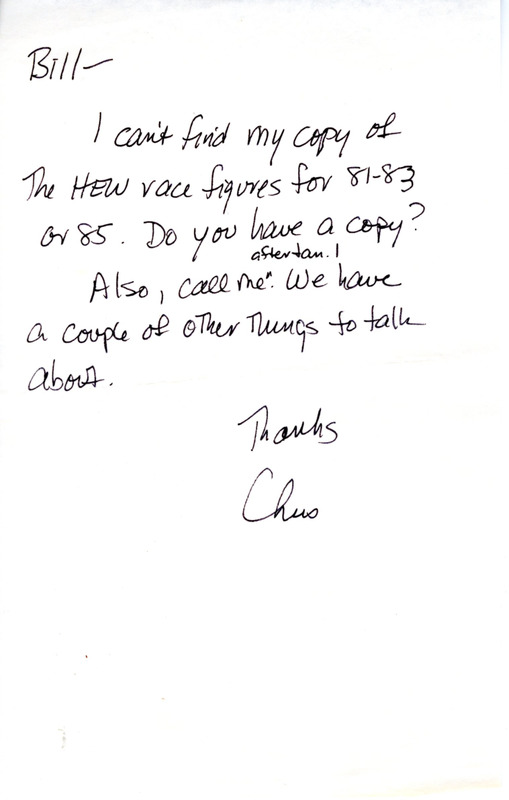
Handwritten letter from ACLU Attorney Chris Hansen to William Lamson asking Lamson if he has copies of the United States Department of Health, Education, and Welfare (HEW) race figures for 1981-1983 and 1985.
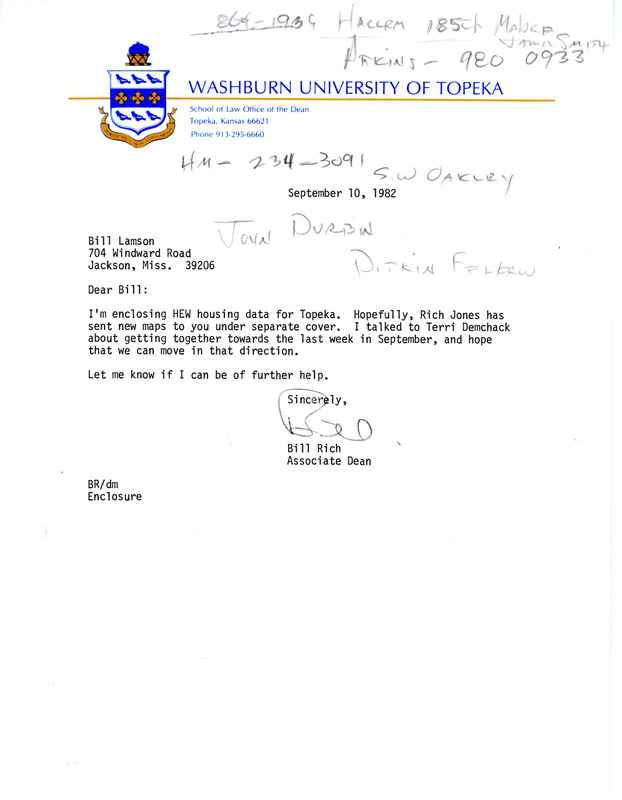
Associate Dean of Washburn University School of Law (Topeka, Kansas) William Rich writes to William Lamson to send him the United States Department of Health, Education, and Welfare (HEW) housing data for Topeka and to inform him that Attorney Richard Jones has sent him more maps as well.
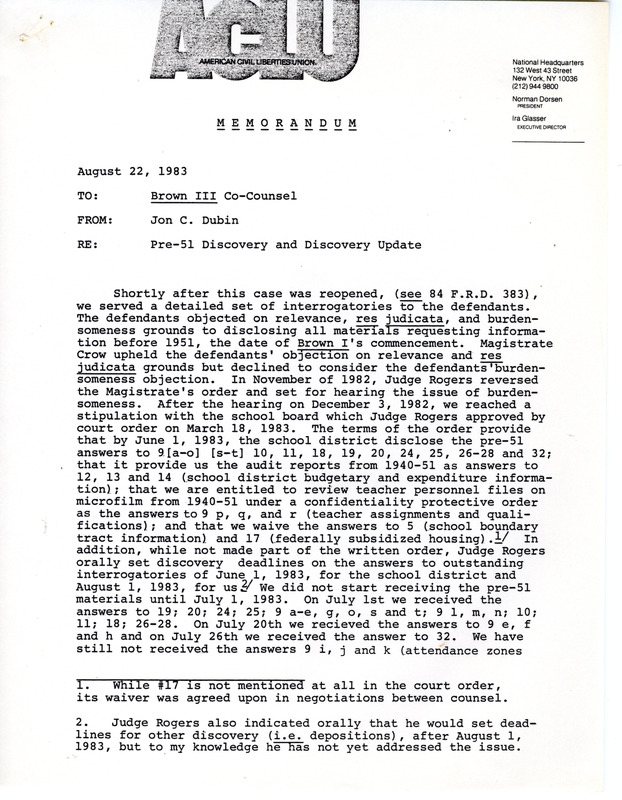
Attorney Jon C. Dubin of the ACLU writes to Brown III co-counsel attorneys to update them about pre-1951 discovery which had been previously ruled too burdensome for the defense to deliver, but a new ruling has made those documents available. Dubin includes a list summarizing the status of all requested documents.
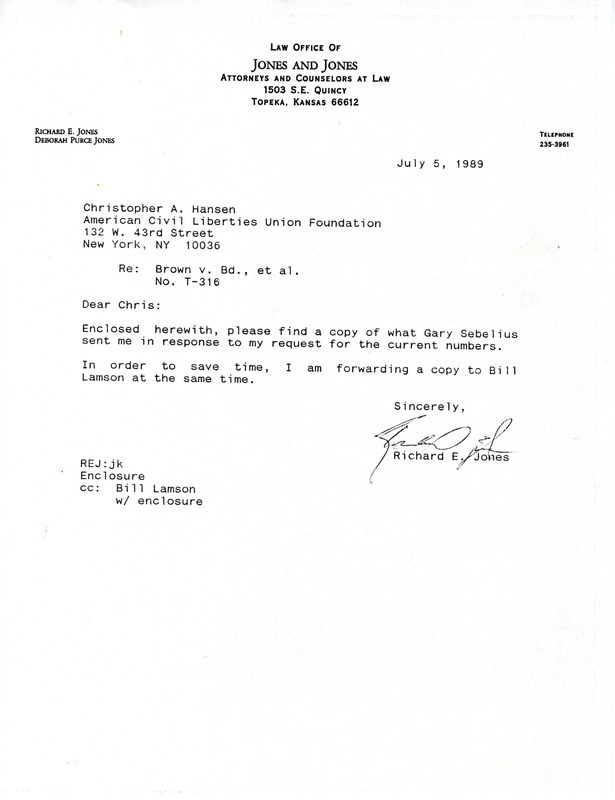
Letter from Attorney Richard E. Jones to ACLU Attorney Chris Hansen concerning data that Lead Defense Attorney K. Gary Sebelius sent to him. Jones notes that he also forwarded the data to William Lamson to save time.
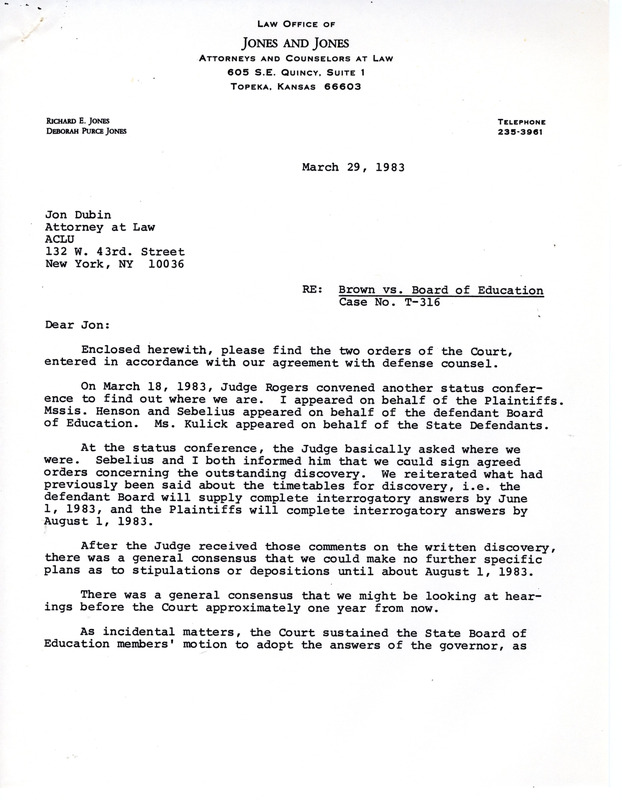
Attorney Richard E. Jones writes to Attorney Jon C. Dubin of the ACLU about his recent court appearance and the agreement that was made with the judge about proceeding with trial. The agreement was that depositions would be delayed until August of 1983 and the trial itself would probably commence in March of 1984.
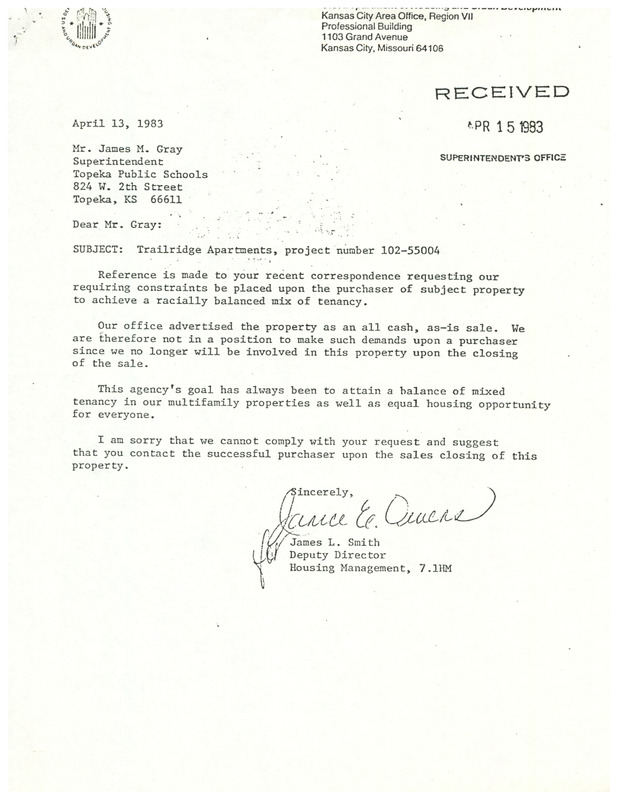
In this letter, Housing and Urban Development (HUD) Deputy Director Smith informs Superintendent of Topeka Public Schools James M. Gray that his department cannot make any demands upon a purchaser concerning racial balance since the all cash, as-is sale has been completed. Gray had earlier requested HUD assistance in the sale of a rental property.
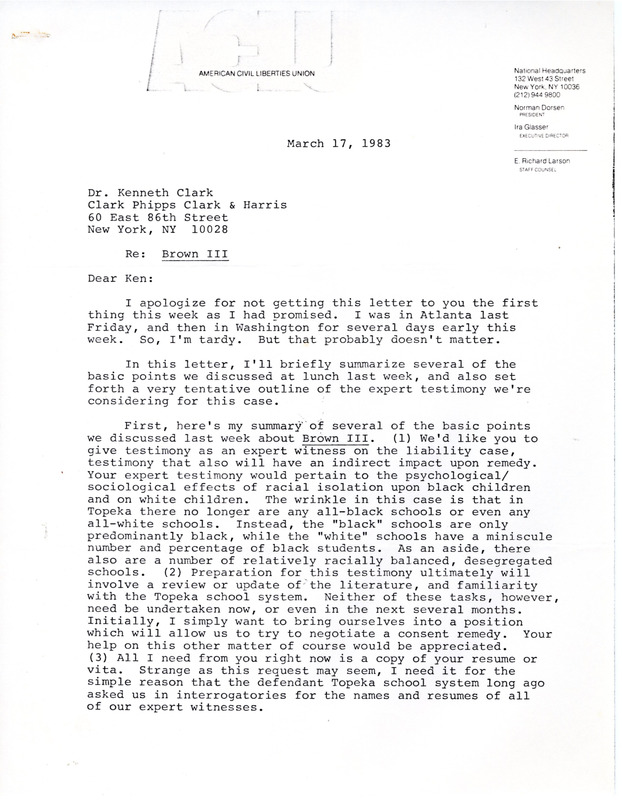
E. Richard Larson of the ACLU writes to Dr. Kenneth Clark of Clark, Phipps, Clark, & Harris to outline what the plaintiff team is looking for with Dr. Clark’s expert testimony in the Brown III case. They hope for Dr. Clark to speak to the psychological and sociological effects of racial isolation on students in segregated schools.
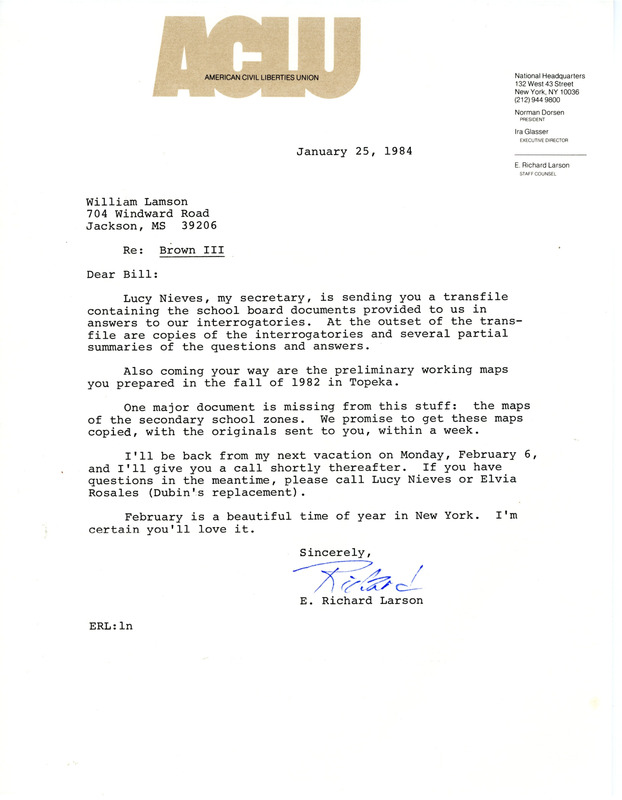
E. Richard Larson of the ACLU writes to William Lamson to inform him of some files and maps he is sending him including school board documents and preliminary working maps Lamson prepared in the Fall of 1982. Larson notes that the maps of Topeka secondary school zones are missing from these files and will be sent back at a later date.
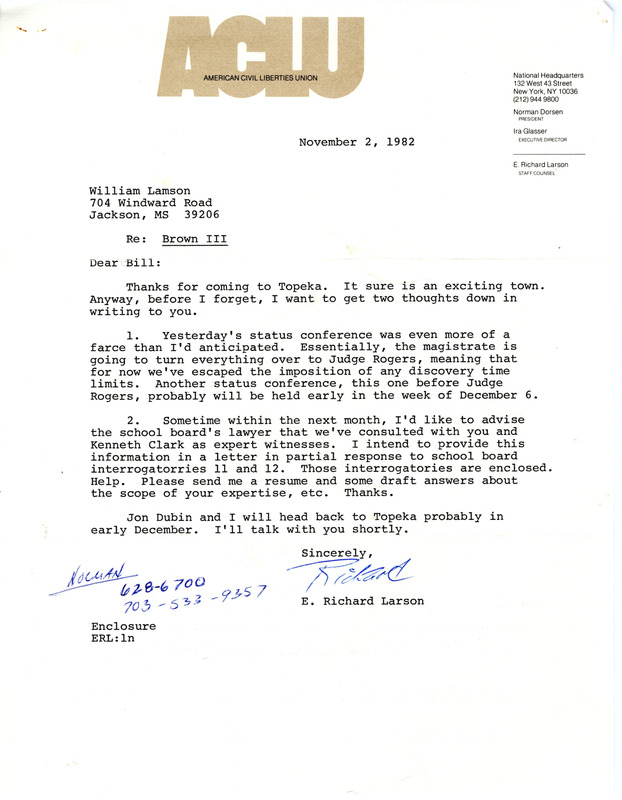
E. Richard Larson of the ACLU writes to William Lamson to thank him for coming to Topeka to work on the case. He also summarizes some of the things they talked about while there and asks Lamson to send over a resume and some information on his expertise in the matters involved with the case.
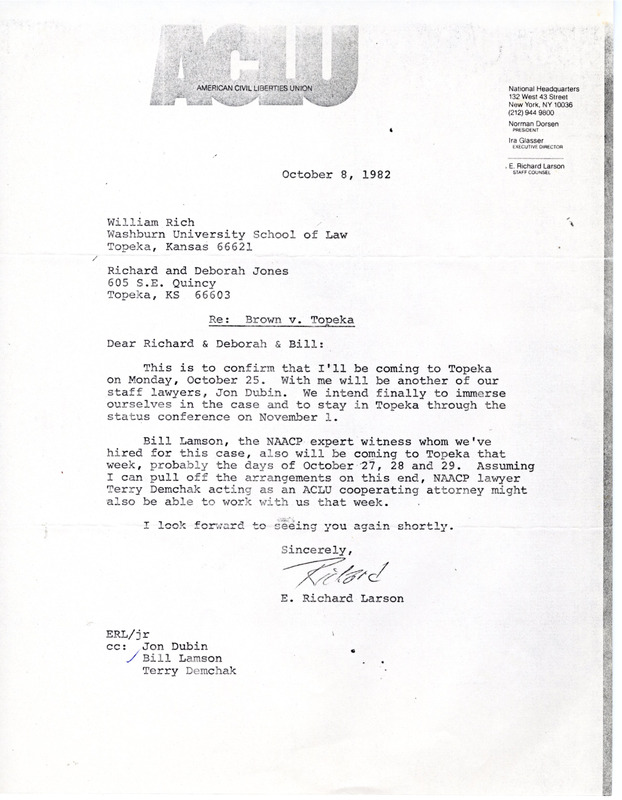
E. Richard Larson of the ACLU writes to William Rich of Washburn University School of Law (Topeka, Kansas), Attorney Richard Jones, and Deborah Jones to inform them that he will be in Topeka from October 25th through November 1st. Also, William Lamson will be coming to Topeka October 27th-29th and they intend to immerse themselves in the case.
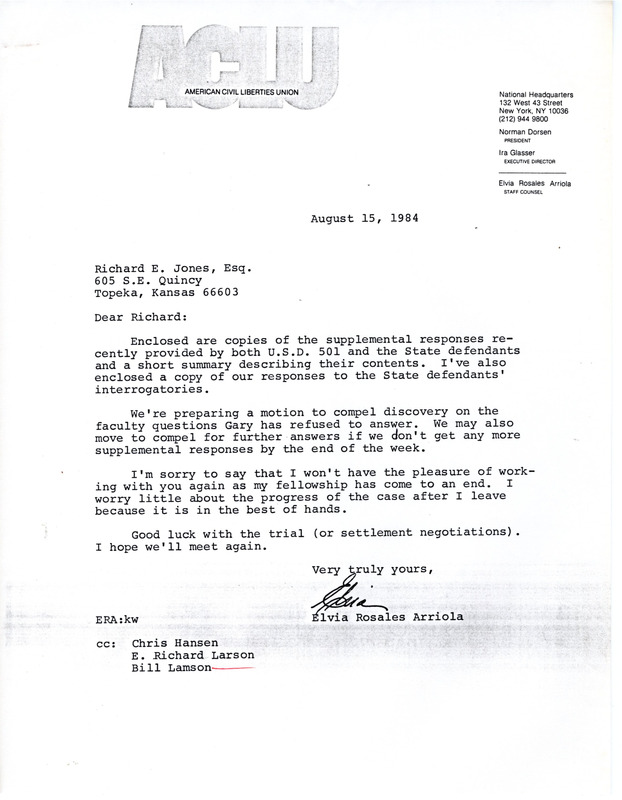
Elvia Rosales Arriola of the ACLU writes to Attorney Richard E. Jones to inform him that the ACLU is preparing a motion to compel discovery on questions a witness in the case refuses to answer. She also writes that her fellowship with the ACLU has come to end and will no longer be working on the case and knows the case is in good hands.
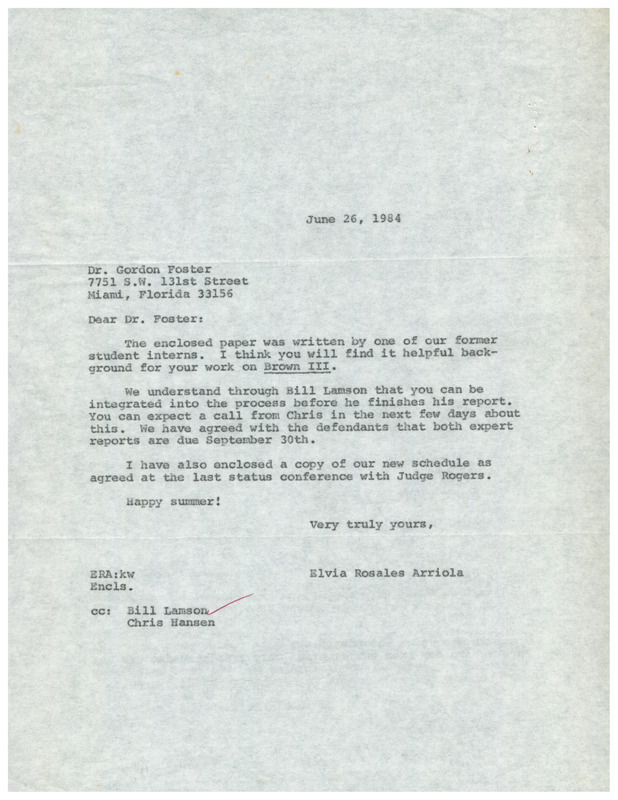
A cover letter for a student-intern written paper that Elvia Rosales Arriola of the ACLU believes will be helpful to Dr. Gordon Foster in the Brown III case. Chris Hansen of the ACLU and William Lamson are cc’d on the letter.
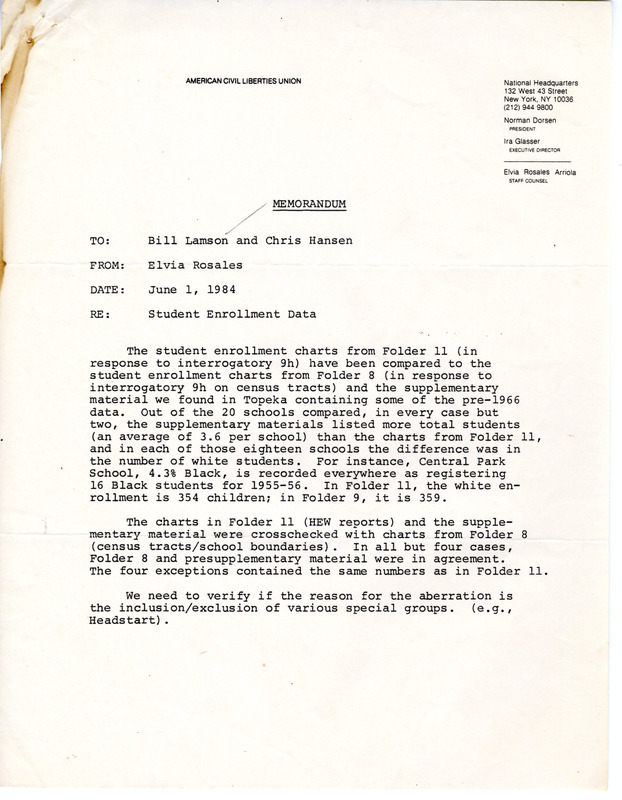
Elvia Rosales Arriola writes to William Lamson and ACLU Attorney Chris Hansen about discrepancies found in student enrollment number reports from different charts. A chart summarizing the discrepancies is included.
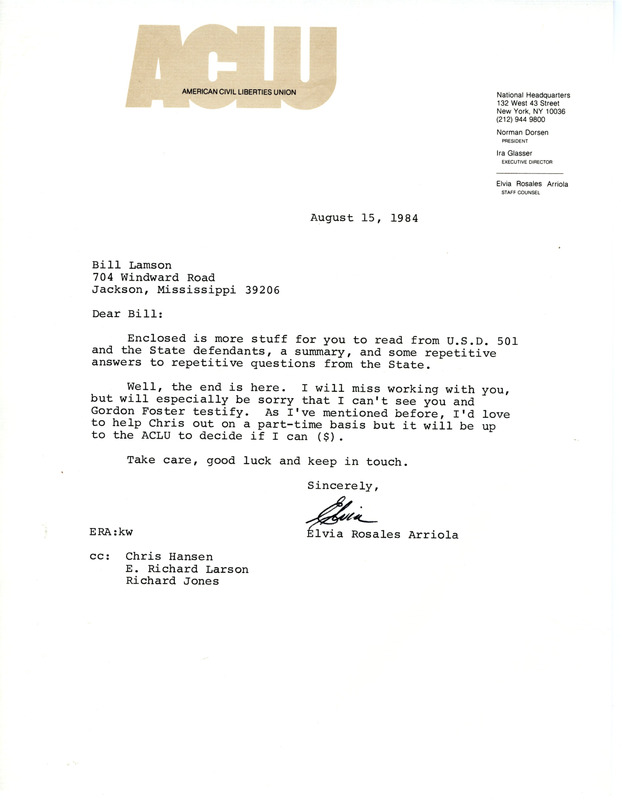
Elvia Rosales Arriola of the ACLU writes to William Lamson to inform him that her time working on the Brown III case has reached an end. She regrets that she won’t be able to see him testify in the case and hopes she can stay on at the ACLU part-time if the budget permits.
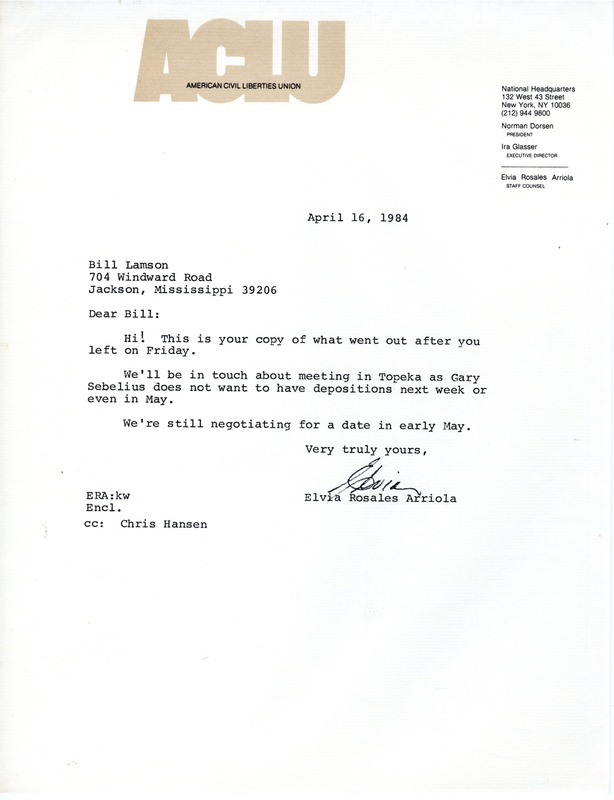
Elvia Rosales Arriola of the ACLU writes to William Lamson to update him on potential dates for depositions in May. She writes that lead defense attorney K. Gary Sebelius doesn’t want to hold depositions in May but the ACLU is trying to negotiate for an early May deposition date.
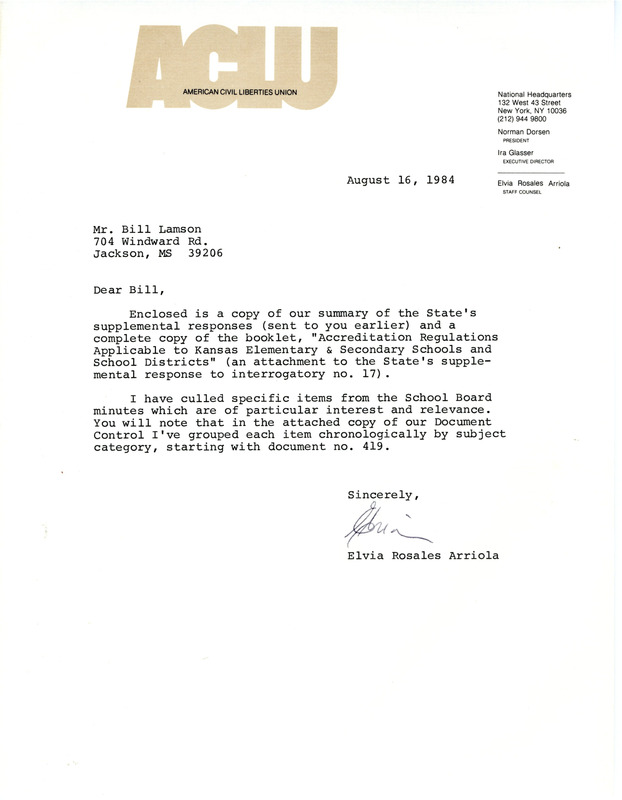
Letter from Elvia Rosales Arriola of the ACLU to William Lamson. Cover letter for a copy of the summary of the State of Topeka’s supplemental responses and a copy of the booklet "Accreditation Regulations Applicable to Kansas Elementary and Secondary Schools and School Districts."
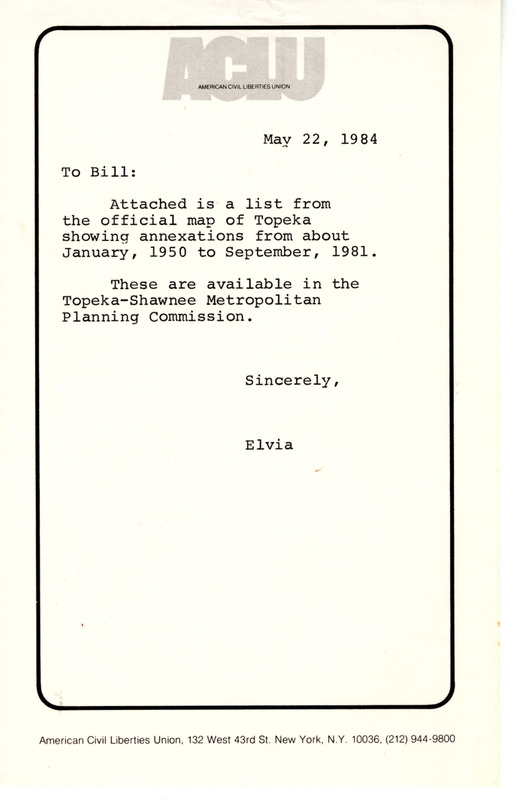
Letter from Elvia Rosales Arriola of the ACLU to William Lamson. Arriola informs Lamson that attached to the letter is a list from the official map of Topeka, Kansas, showing annexations from January 1950 to September 1981. She also indicates that maps are available in the Topeka-Shawnee Metropolitan Planning Commission.
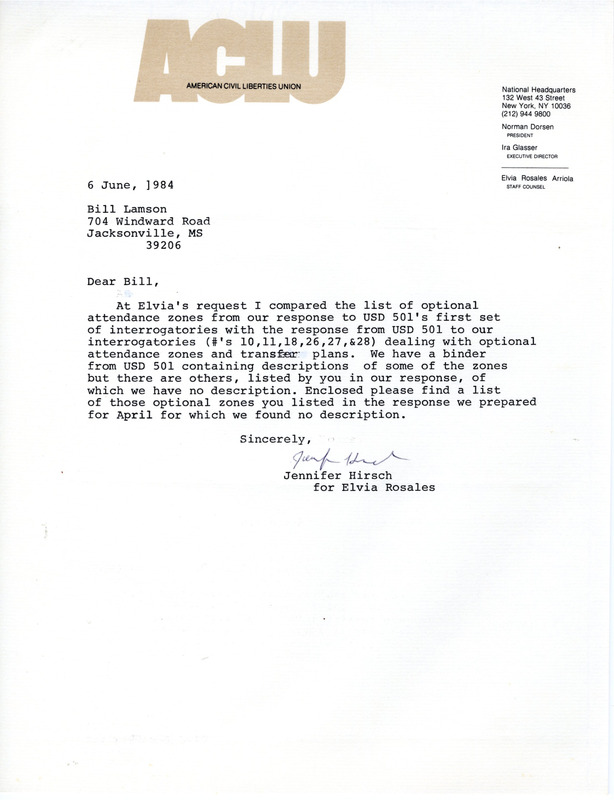
Jennifer Hirsch of the ACLU (on behalf of Elvia Rosales Arriola) writes to William Lamson seeking descriptions for data he compiled for their response to Topeka School District’s first set of interrogatories. Some of the descriptions about data on optional attendance zones transfer plans are missing.