Frankye Adams-Johnson Black Panther Party Collection
Title
Frankye Adams-Johnson Black Panther Party Collection
Date Modified
2025-12-12
Description
Frankye Adams-Johnson is a former English Professor at Jackson State University and former active member of the Black Panther Party for Self-Defense in New York City, where she served as an officer in the New York State Chapter. This collection, created or collected during her involvement in the Black Panther Party, consists of personal journal notebooks, correspondence, newspaper articles, fliers, meeting documents and her collection of political and movement buttons.
Curated By
Garrad Lee
Contributing Institution
Jackson State University
About This Record
The HCAC public history focused digital archive cataloging is an ongoing process, and we may update this record as we conduct additional research and review. We welcome your comments and feedback if you have more information to share about an item featured on the site, please contact us at: HCAC-DigiTeam@si.edu
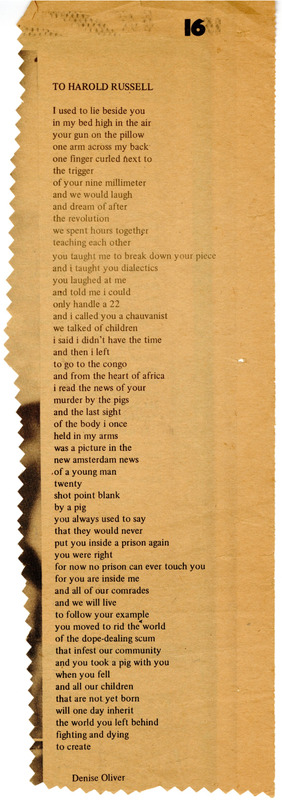
A poem written by Denise Oliver to Harold Russell after his death from a shootout with the Harlem police in April 1971. Harold Russell was a Black Liberation Army (BLA) member and one of many members who lost their lives in police killings.
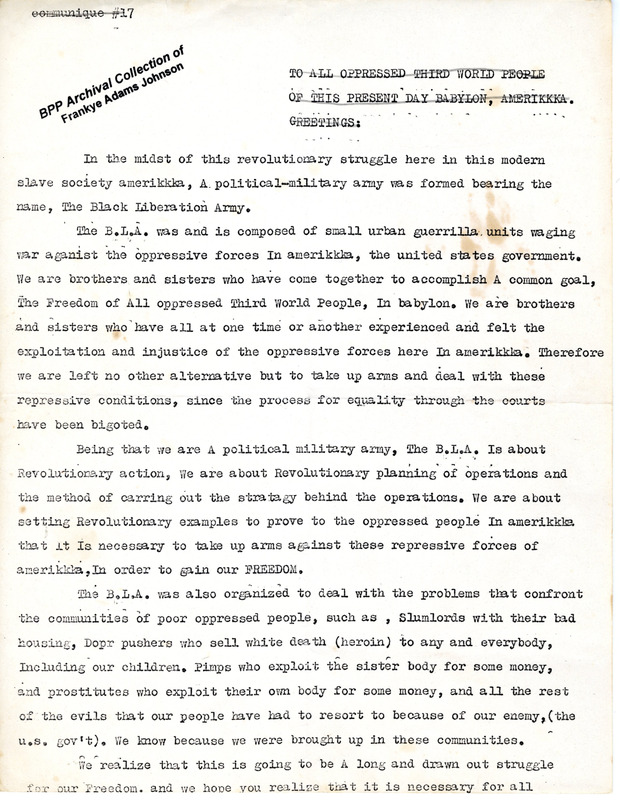
A rough draft of greetings to be given to people attending a Black Liberation Army (BLA) rally, with edits by an unknown person. The greetings outline the history and tenets of the BLA. “Communique #17” and “To All Oppressed Third World People of This Present Day Babylon, Amerikka. Greetings” on the top of page 1 were both crossed out.
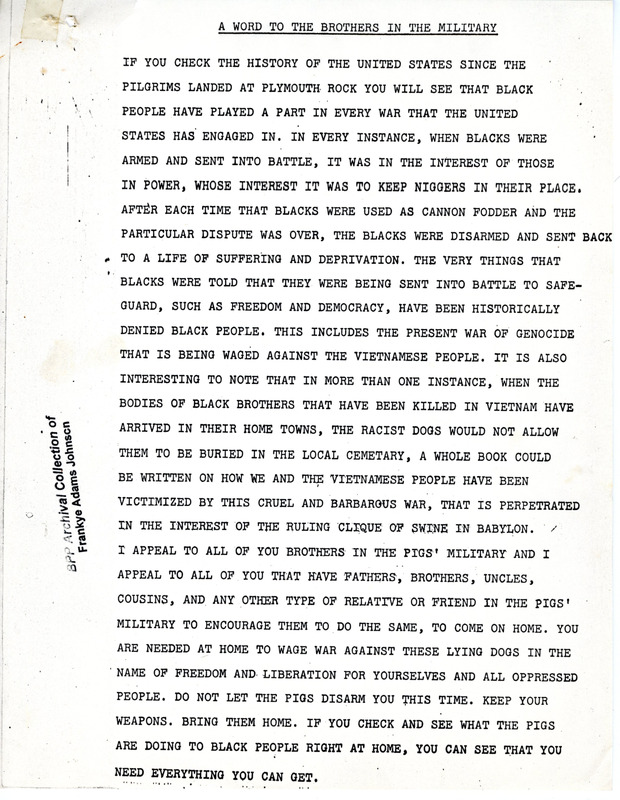
An essay encouraging Black members of the military to turn their weapons on their racist officers and come home with as many weapons as possible, like machine guns and grenades, for the liberation struggle. The author also suggests that the Black military members destroy machinery such as planes, tanks, helicopters, and ammunition dumps.
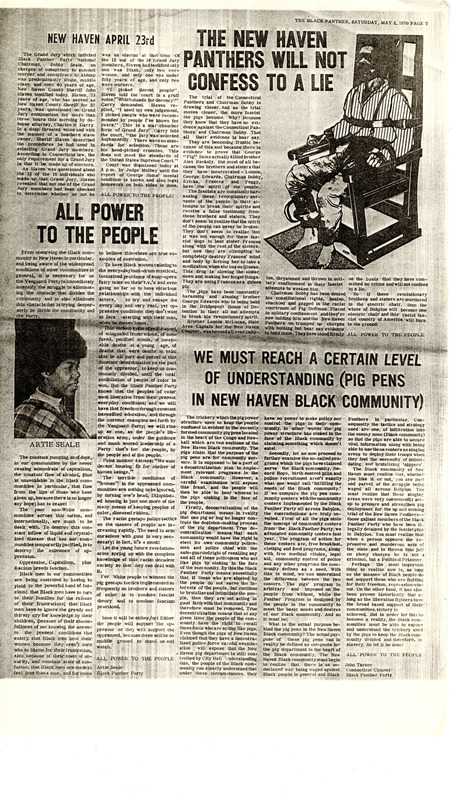
A newspaper article from The Black Panther written by party member and wife of Black Panther founder Bobby Seale. The article explains the psychological warfare committed on Black people as a way to divide and conquer the movement. The author states that the Black Panther party will act as a liberation army for the oppressed people.
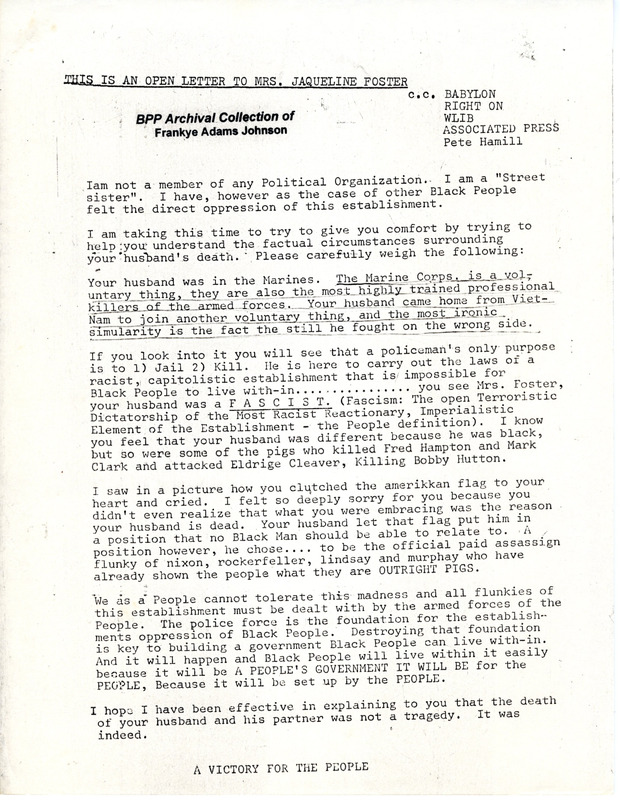
A letter to Jacqueline Foster, whose husband was recently killed in the line of duty as a police officer. The author writes that the officer, even though he was Black, was fighting on the side of the “racist, capitolistic (sic) establishment” and therefore his death was not a tragedy but “it was indeed a victory for the people.”
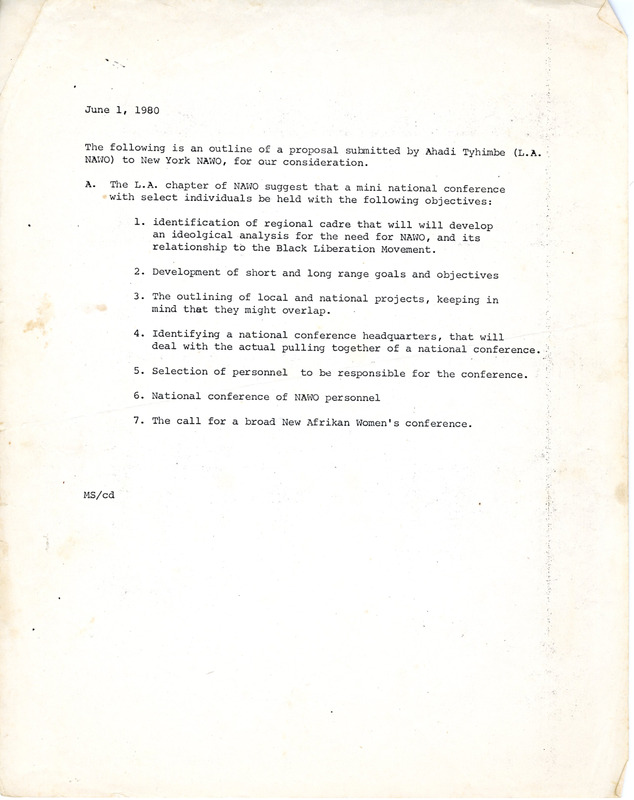
An outline of a proposal of objectives for a national conference submitted by Ahadi Tyhimbe of the Los Angeles New Afrikan Women’s Organization for the consideration of the New York New Afrikan Women’s Organization. Objectives include development of goals and objectives, outlining of projects, and selecting a city to host a national conference.
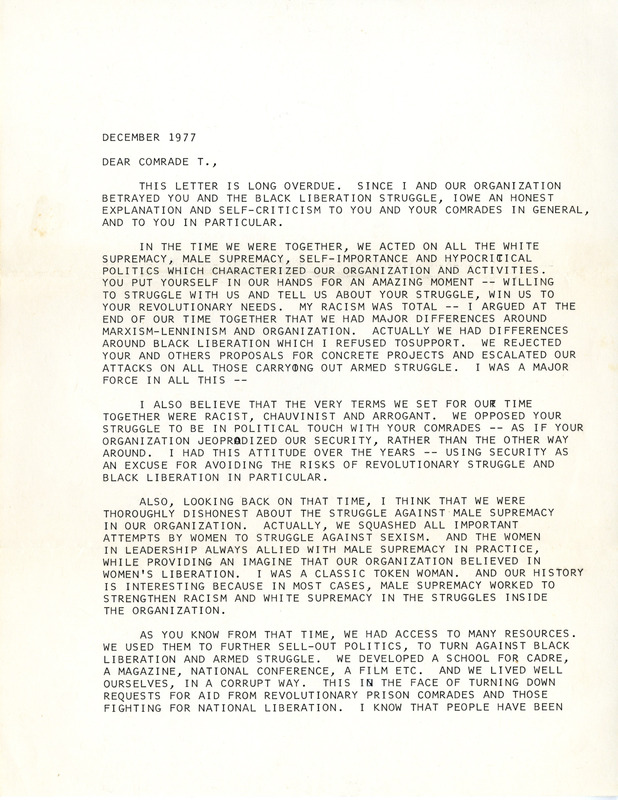
“J”, a White movement leader, writes to “T” to apologize, explain, and take responsibility for past behavior that was in retaliation to the Black Liberation struggle. “J” explains the connection between sexism and racism. “J” acknowledges that Comrade “T” always understood the organization was wrong.
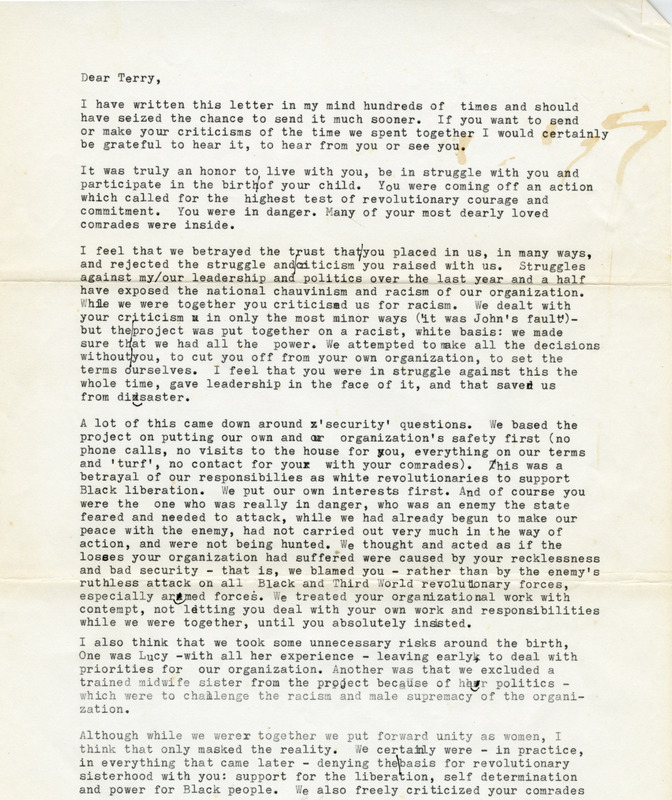
Maggie/Jean, a White revolutionary, writes to an unknown Black Liberation movement leader. The author is apologizing for the way White revolutionaries dealt with the struggle for Black liberation during the time they worked together. The writer says that the criticisms of their group exposed the national chauvinism and racism of their organization.
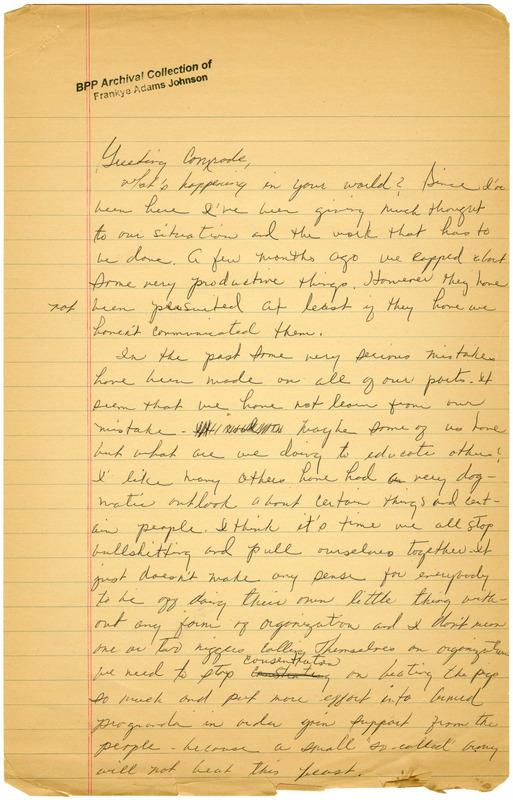
A letter from Terry to an unknown recipient. The author writes that they need to put past mistakes behind them to begin seriously organizing for the fight for liberation. He makes the argument that a propaganda campaign will be needed to gain the support of the masses.
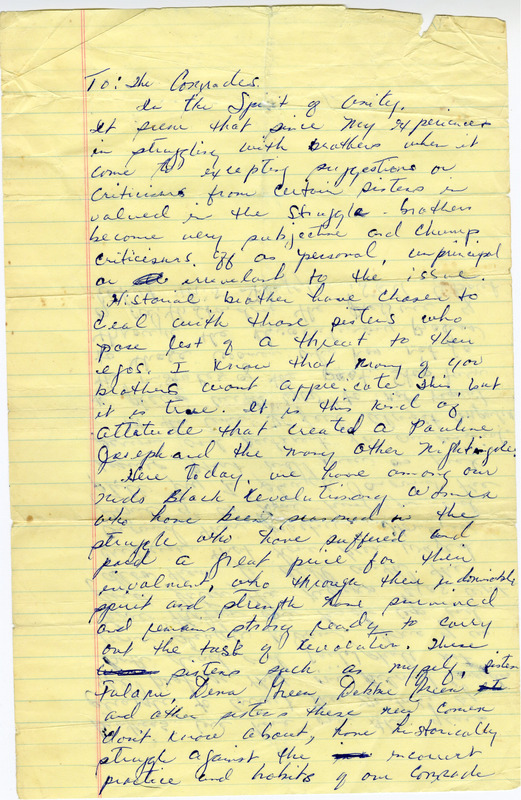
The unnamed sender addresses the comrades about the mistreatment of women in the Black Panther Party and explains the historical importance of women in the struggle as revolutionaries. The sender urges the revolutionaries to not make the same past mistakes.
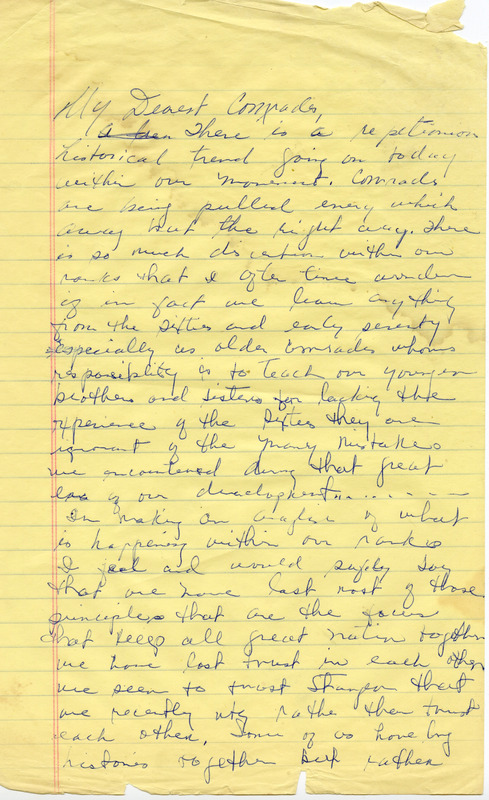
The unnamed sender writes about the lost trust among members, the wrong direction the Black Panther Party is headed, and the responsibility of the older members. The sender addresses the behavior of the New African People's Organization in New York and vows to expose the corruption.
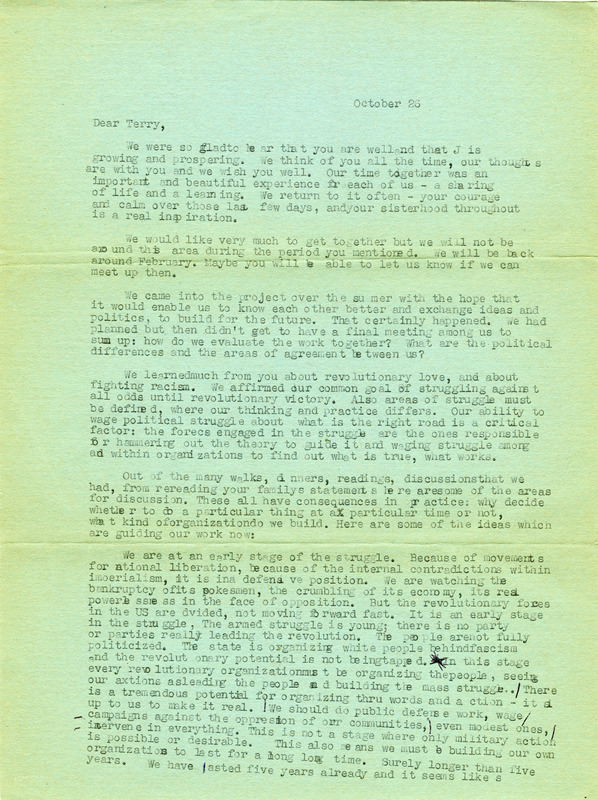
A letter from "M" to Terry. The author writes that it is the early days of the struggle and there is an opportunity to organize the people for revolutionary struggle, giving specific examples of work that can be done in communities to gain the support of the people. Tenets such as internationalism, organization, and Marxism-Leninism are discussed.
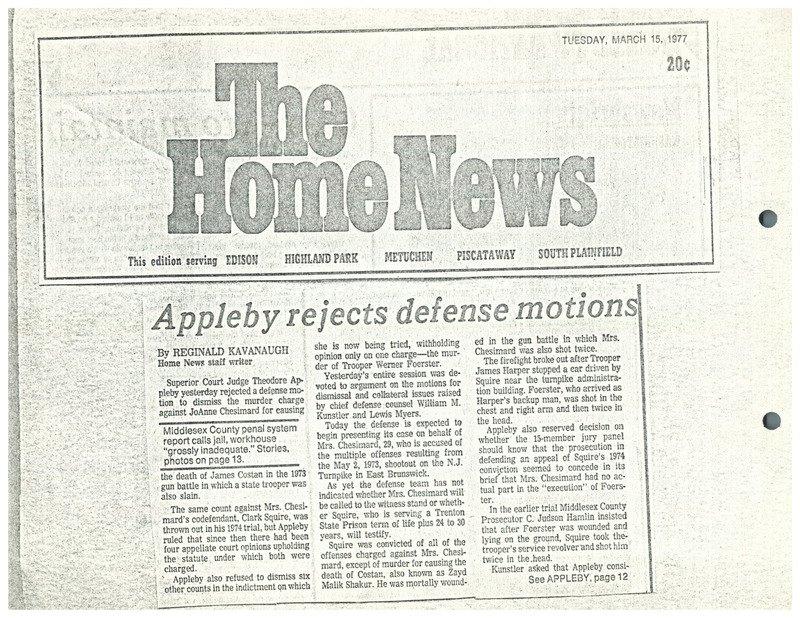
A newspaper article from The Home News about a day long juryless court session where defense lawyers made numerous motions to dismiss the indictments against Assata Shakur (JoAnne Chesimard) who was on trial for the 1973 killing of a state trooper. The judge rejected these motions and the attorneys are scheduled to call witnesses that day.
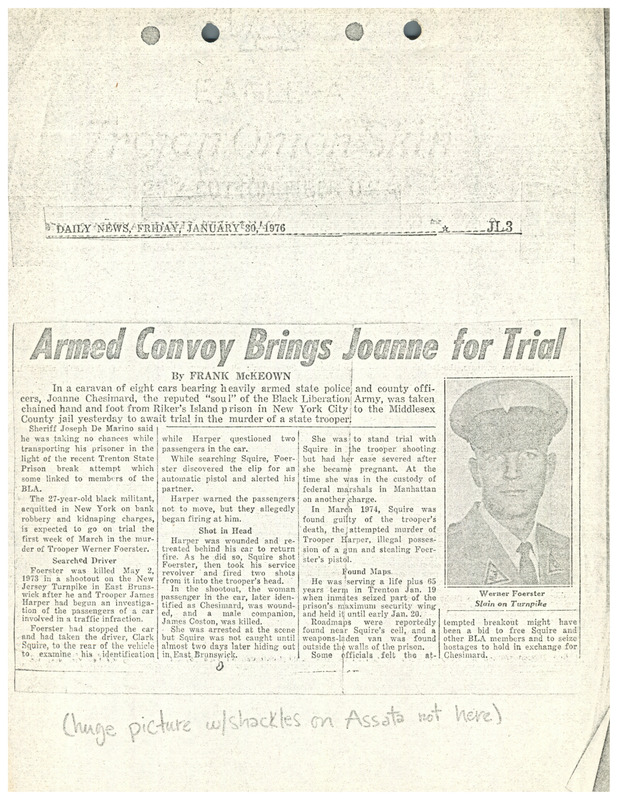
A newspaper article from Daily News about Assata Shakur (JoAnne Chesimard) being in New Jersey to stand trial for the May 1973 killing of a state trooper. Shakur was convicted in 1977 of killing the state trooper during a shootout, escaped prison in 1979, and is still wanted by the FBI.
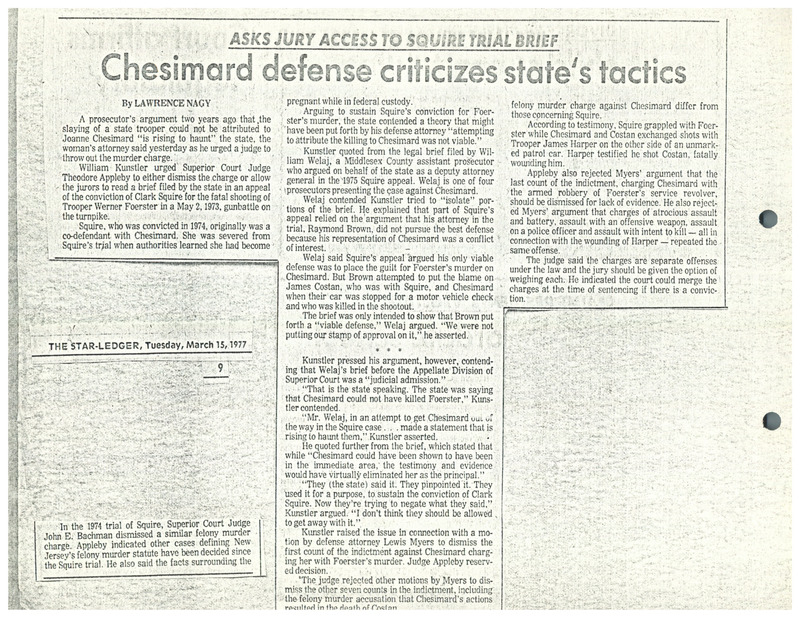
A newspaper article from The Star Ledger about the defense team for Assata Shakur (JoAnne Chesimard), who was on trial for the 1973 killing of a state trooper, opening their case by calling for dismissal of the murder charge on the grounds that she cannot be convicted since Clark Squire has already been convicted of the killing.
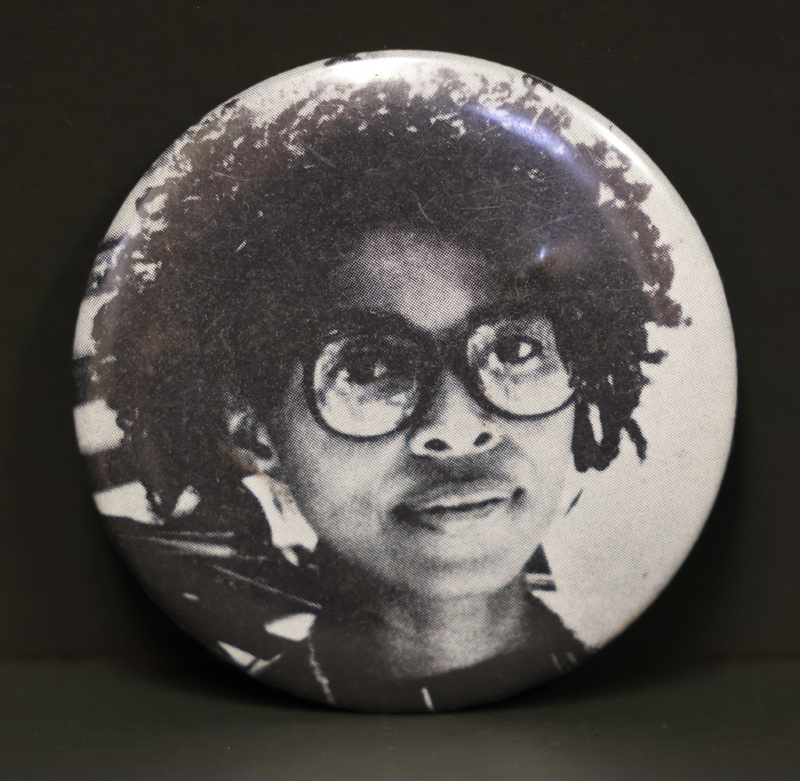
A button with a black and white photo of Assata Shakur. She is a political activist and was a member of the Black Liberation Army (BLA), an organization that engaged in armed struggle with the U.S. government. In 1977, she was convicted in a cop-killing case from 1973. Escaping prison in 1979, she has lived in political asylum in Cuba ever since.
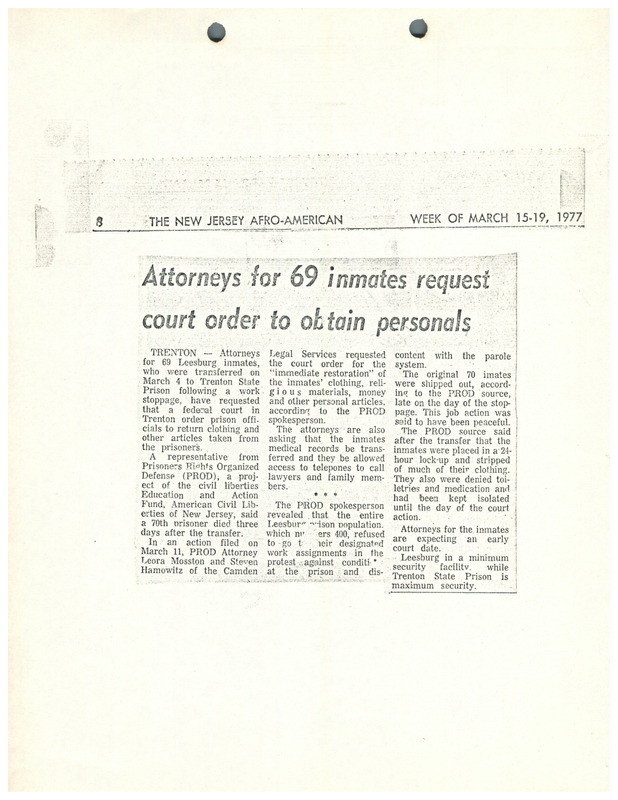
A newspaper article from The New Jersey Afro-American about prisoners who refused work assignments as a protest over living conditions. The prisoners were transferred and denied their personal belongings, telephone calls, and medical care. The group Prisoner’s Rights Organized Defense (PROD) asked a judge to restore everything for the inmates.
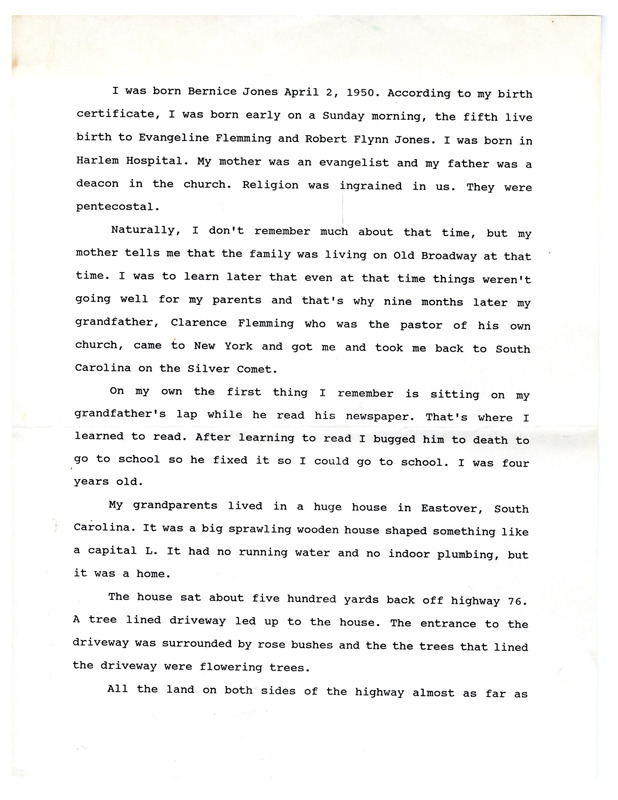
Bernice Jones (aka Safiya Bukhari) was a Black Panther Party member and vice president of the Republic of New Afrika. In this personal narrative, she tells her life story from the time of her birth in 1950 until her time in high school.
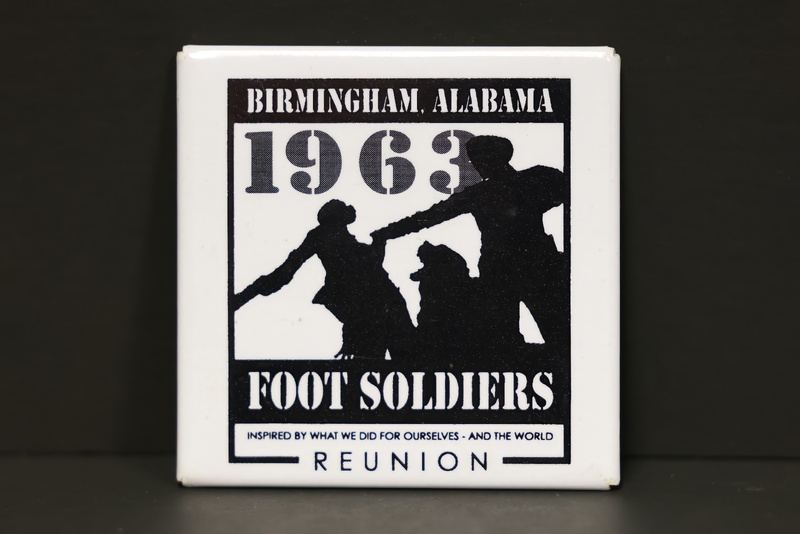
White square button for the Birmingham, Alabama, 1963 Foot Soldiers Reunion. There is also text on the button that says: "Inspired by what we did for ourselves-and the world." The 1963 Foot Soldiers were children marchers in Birmingham who encountered police resistance in the form of water hoses, attack dogs, and arrests.
A birthday card from Ashanti Alston, a Black Liberation Army (BLA) member who was imprisoned for 11 years for a robbery to raise money for the BLA, to Frankye Adams-Johnson (Malika). Ashanti Alston wishes her a happy birthday and gives her an update on her birthday gift.
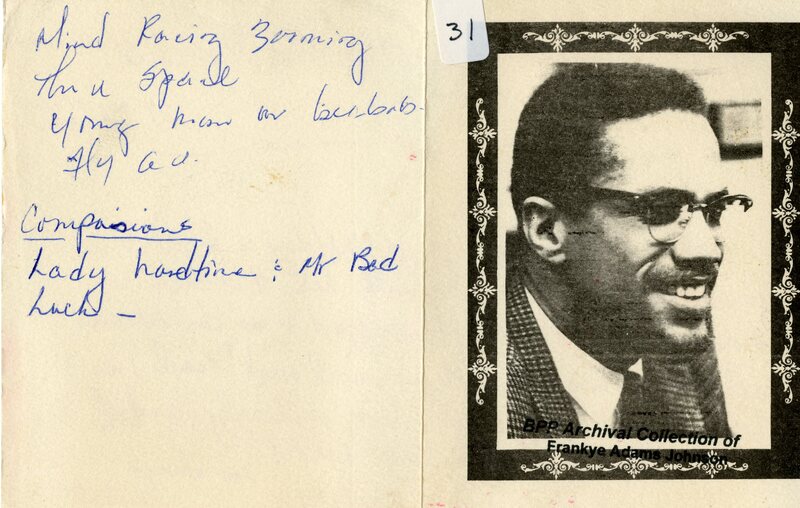
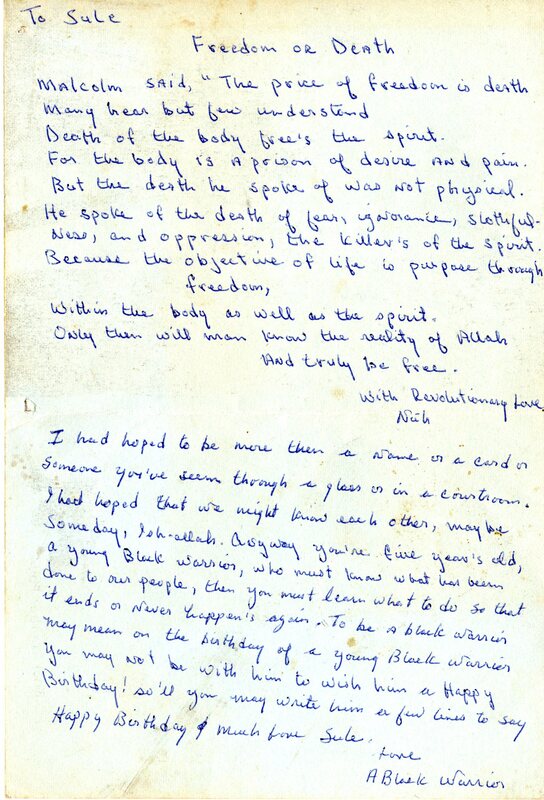
A birthday card from Nuh Abdul Qaiyum, who is imprisoned, to Sule for his 5th birthday. A photo of Malcolm X is on the cover. Nuh Abdul Qaiyum quotes Malcolm X and explains the importance of letting go of fear, ignorance, and oppression. He expresses disappointment that he is not free to wish Sule, “young Black warrior,” a happy birthday in person.
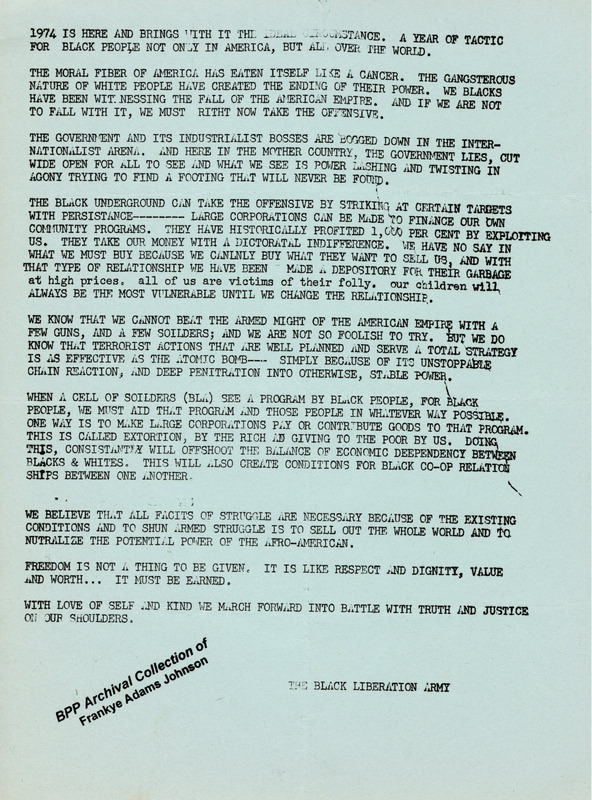
A directive from the Black Liberation Army (BLA) calling Black people in the United States to organize against the white power complex. The author writes that the end of the American empire is near and that the BLA will aid any programs that are for Black people, by Black people, including forcing corporations to contribute goods to the cause.
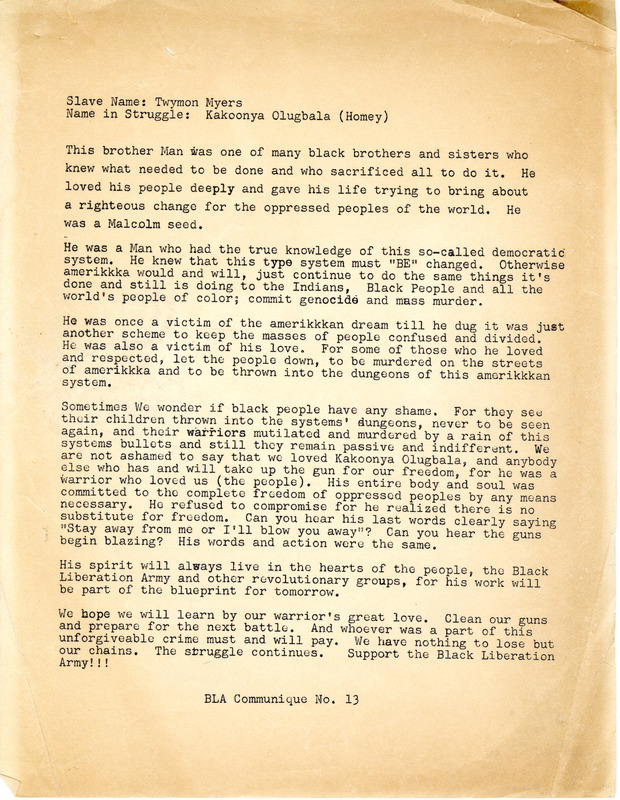
A memo from the Black Liberation Army (BLA) eulogizing Kakoonya Olugbala (Twymon Myers) who gave his life to the struggle against oppression. He was killed in a shootout with New York Police and FBI agents on November 14, 1973, after a long manhunt (he was on the FBI’s most wanted list) because of his involvement with previous police shootings.
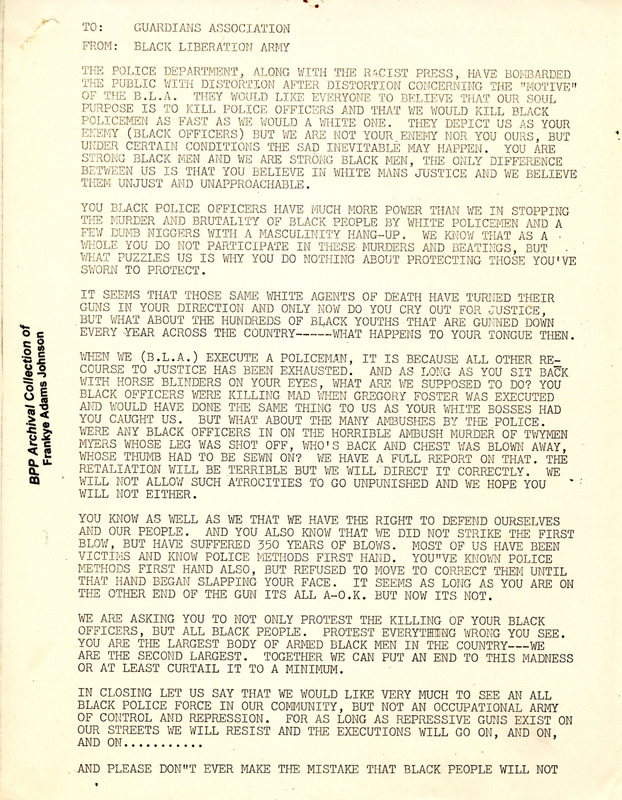
A memo from the Black Liberation Army (BLA) to the Guardians Association. The memo explains the BLA's stance on killing police and pleads with Black police officers to no longer side with their white counterparts. The Guardian’s Association is a fraternal organization primarily composed of Black law enforcement officers.
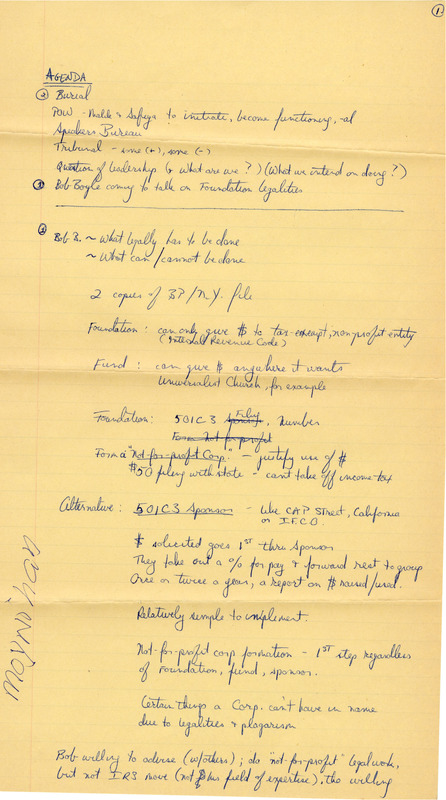
An agenda for a meeting of the Black Panther Foundation in 1987. The Black Panther Foundation discussed their leadership and a defined mission of the foundation. There is also a note about a meeting with Howard University about establishing a Black Panther Party archive.
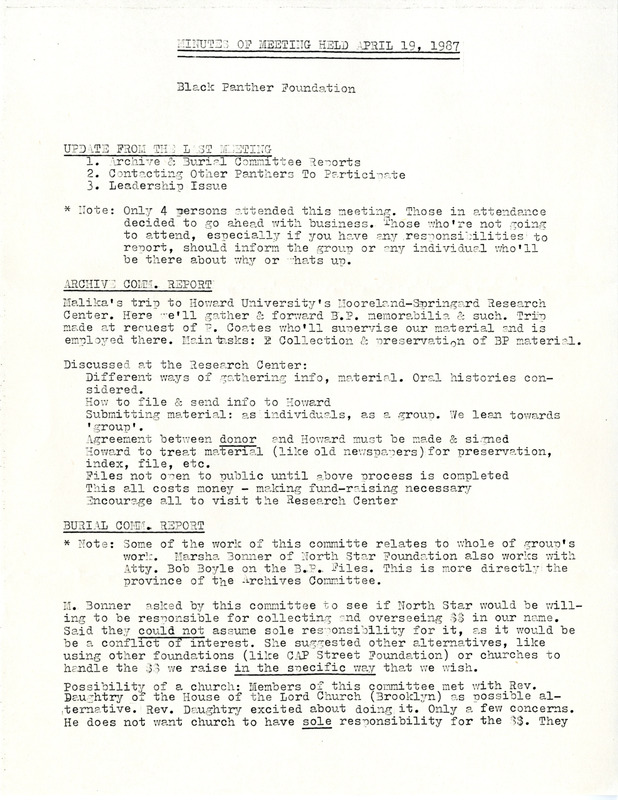
Minutes from a meeting of the Black Panther Foundation on April 19, 1987. Low attendance at the last meeting was briefly mentioned before a meeting regarding Howard University's Black Panther archive was discussed. Members discussed the burial committee, money, reaching out to new members, and the foundation’s responsibility.
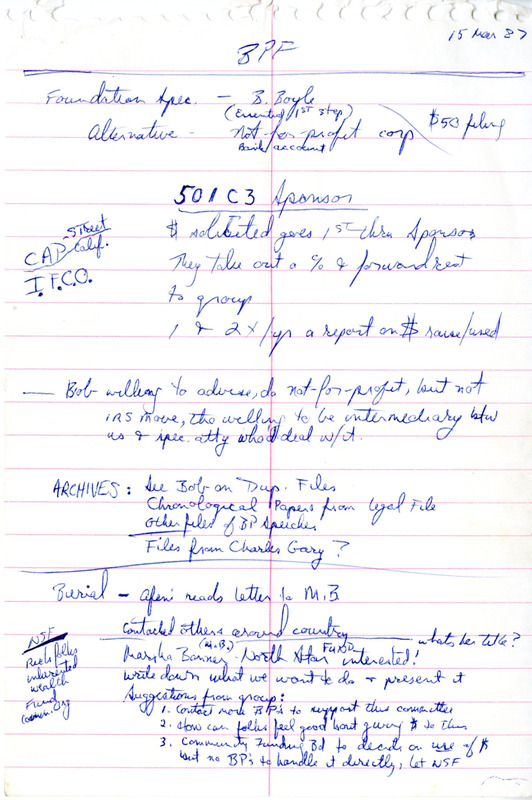
Handwritten notes of minutes from a March 17, 1987 meeting of the Black Panther Foundation. The meeting covered such topics as sponsors for the foundation, archives, burial, prisoners of war, speakers bureau, leadership, and criticisms.
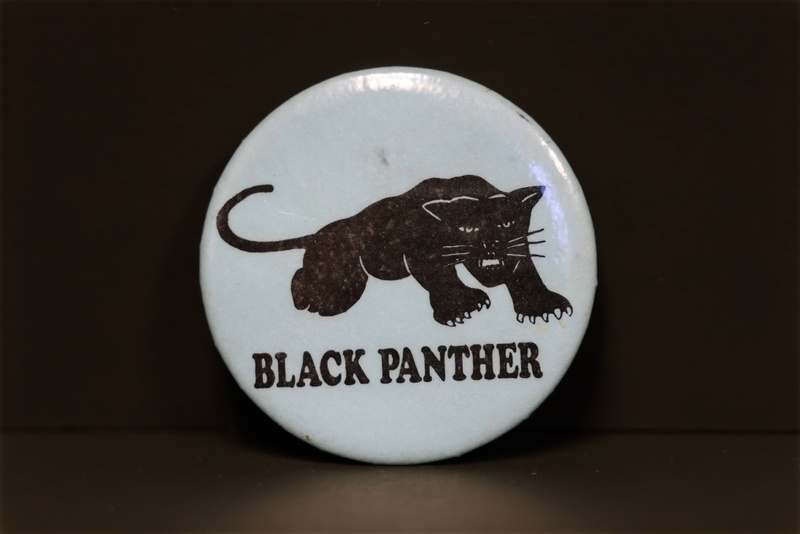
A blue button with the Black Panther logo and text that says “Black Panther.” The Black Panther Party for Self Defense was founded in 1966 by Bobby Seale and Huey P. Newton in Oakland, California. Rooted in Black Power and Marxist-Leninist ideologies, the Black Panther Party would soon spread with branches all over the United States.
A proposed budget and income statement prepared for the Black Panther Newspaper Committee. The budget totals $221,750 and covers everything needed to operate the paper for a year: salaries, equipment and supplies, communication, printing, travel expenses, attorney and accountant fees, and office rental.