Frankye Adams-Johnson Black Panther Party Collection
Title
Frankye Adams-Johnson Black Panther Party Collection
Date Modified
2025-12-12
Description
Frankye Adams-Johnson is a former English Professor at Jackson State University and former active member of the Black Panther Party for Self-Defense in New York City, where she served as an officer in the New York State Chapter. This collection, created or collected during her involvement in the Black Panther Party, consists of personal journal notebooks, correspondence, newspaper articles, fliers, meeting documents and her collection of political and movement buttons.
Curated By
Garrad Lee
Contributing Institution
Jackson State University
About This Record
The HCAC public history focused digital archive cataloging is an ongoing process, and we may update this record as we conduct additional research and review. We welcome your comments and feedback if you have more information to share about an item featured on the site, please contact us at: HCAC-DigiTeam@si.edu
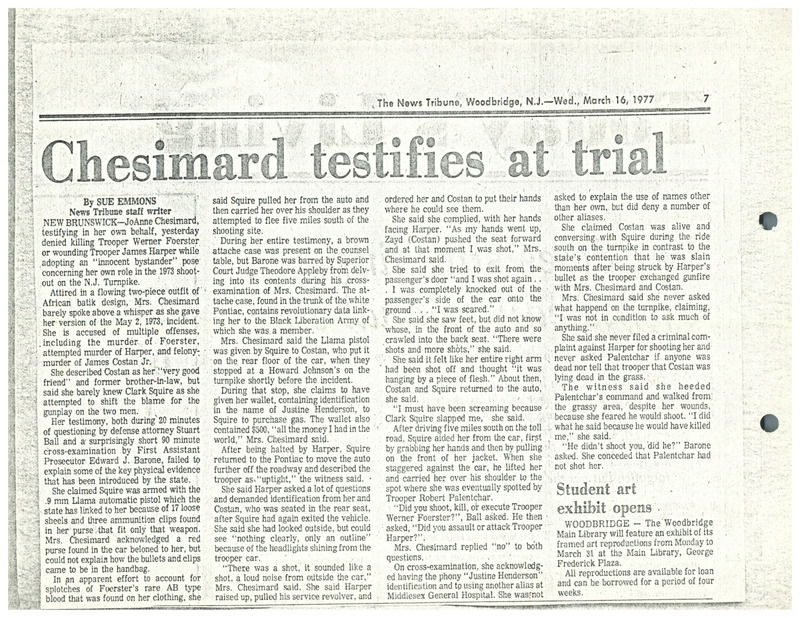
A newspaper article from The News Tribune detailing the testimony Assata Shakur (JoAnne Chesimard) gave during her trial for the 1973 killing of a state trooper. In her testimony, given during 20 minutes of questioning by the defense and 90 minutes of cross-examination, she denied shooting anyone and gave her account of what happened that day.
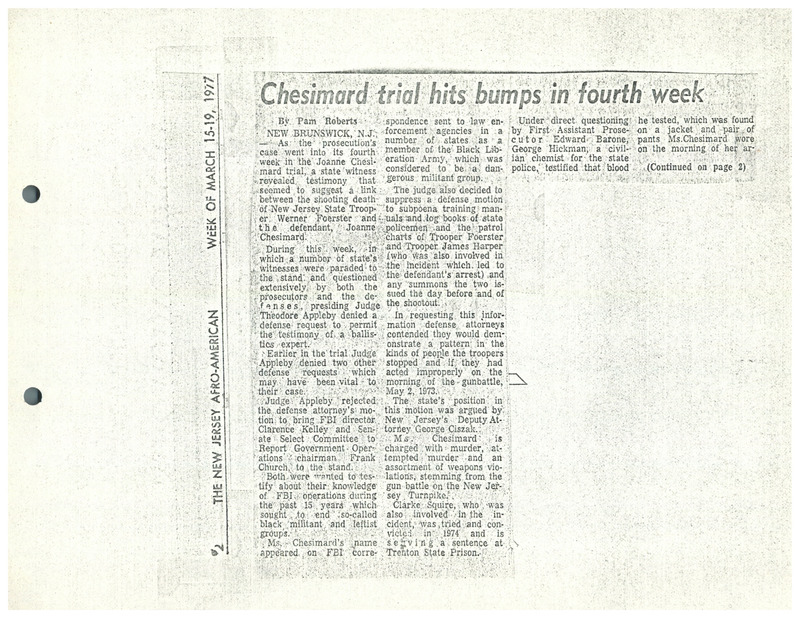
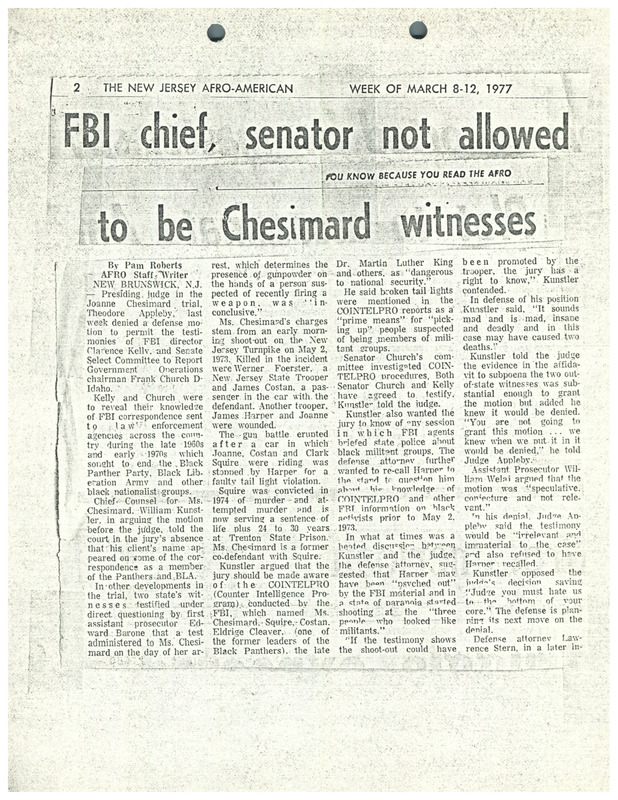
A newspaper article from The New Jersey Afro-American about Superior Court Judge Theodore Appleby barring the testimony of an FBI agent and senator in the trial of Assata Shakur (JoAnne Chesimard) for the 1973 killing of a state trooper. Attorney William Kunstler wanted to use the testimony to establish a police conspiracy against Black militants.
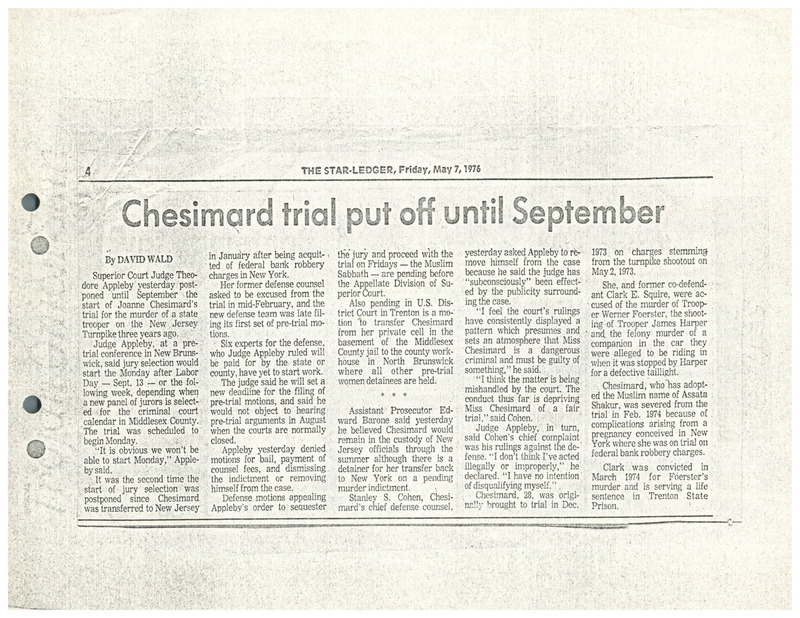
A newspaper article from The Star Ledger about Superior Court Judge Theodore Appleby postponing jury selection for the murder trial of Assata Shakur (JoAnne Chesimard) for the 1973 killing of a state trooper until September after her new defense team was late to file pre-trial motions.
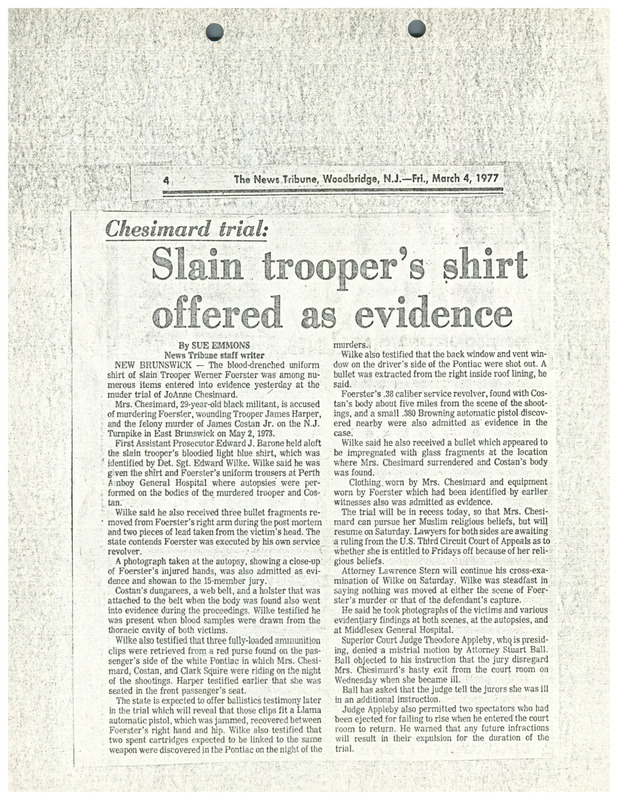
A newspaper article from The News Tribune about items entered into evidence by the prosecution in the Assata Shakur (JoAnne Chesimard) trial for the 1973 killing of a state trooper. The slain trooper’s bloodied uniform shirt was submitted into evidence, as well as bullet fragments pulled from the body, autopsy photos, and two firearms.
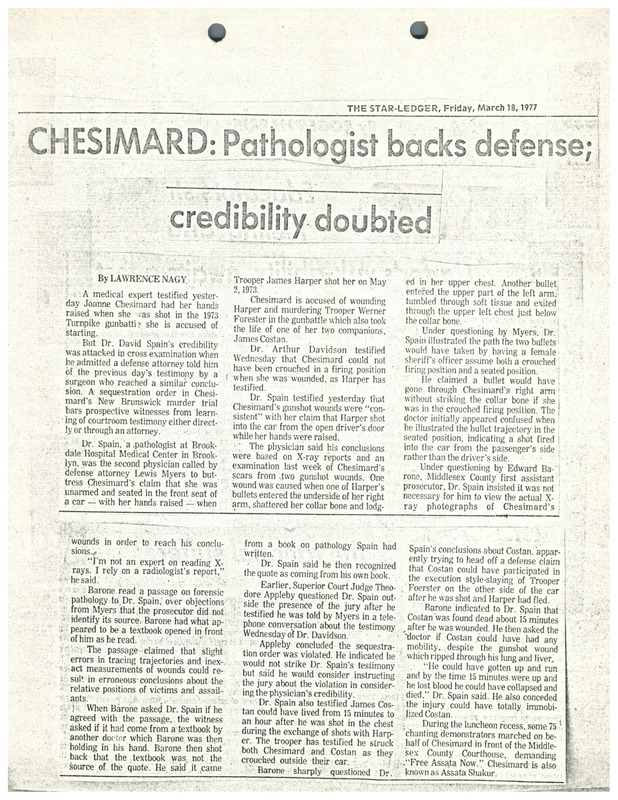
A newspaper article from The Star-Ledger about the testimony of defense witness Dr. David Spain during the trial of Assata Shakur (JoAnne Chesimard) for the 1973 killing of a state trooper. He testified about the wounds she sustained, arguing that she couldn’t have shot from a crouching position due to the position of her wounds from the shootout.
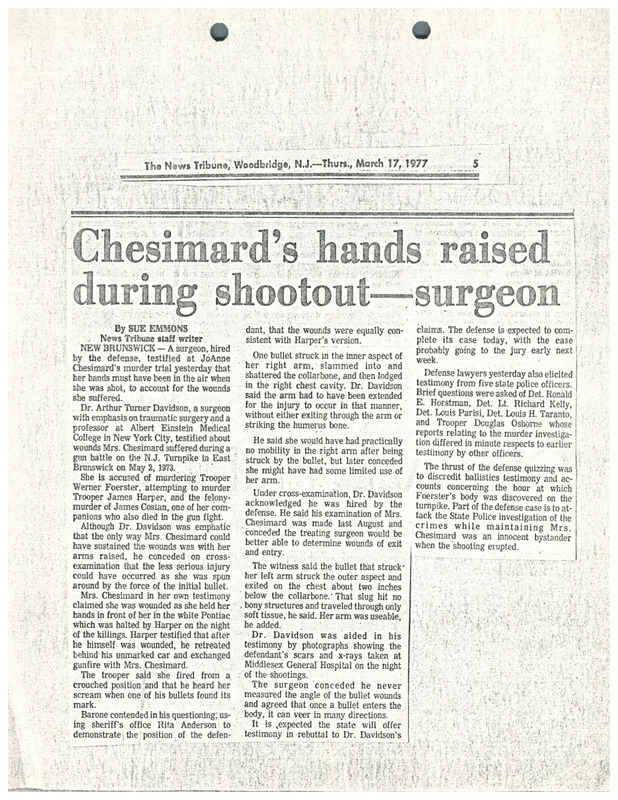
A newspaper article from The News Tribune about the testimony of defense witness Dr. Arthur Turner Davidson, a surgeon with emphasis on traumatic surgery, during the trial of Assata Shakur (JoAnne Chesimard) for the 1973 killing of a state trooper. He goes into detail about the injuries Shakur and the others sustained in the shootout.
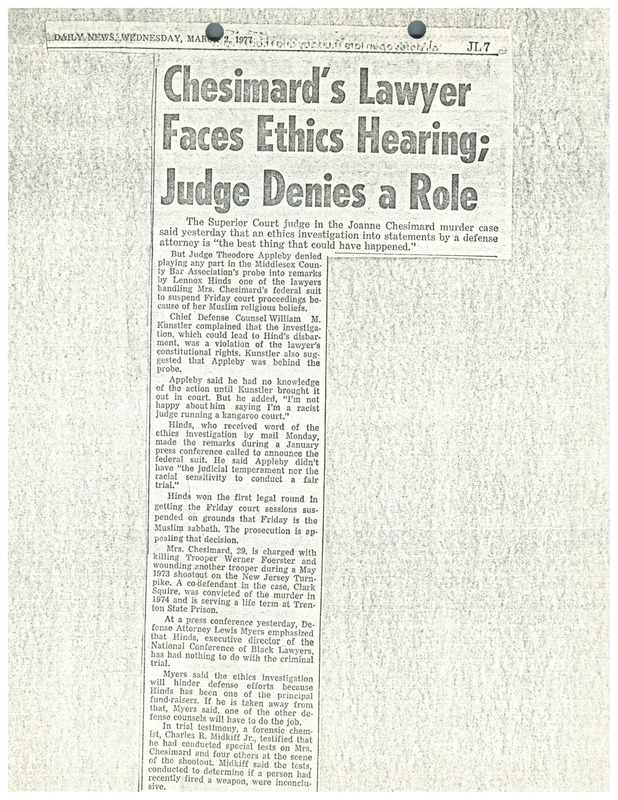
An article from Daily News about Lennox Hinds, president of the National Conference of Black Lawyers, speaking out against his critics for his support of Assata Shakur (JoAnne Chesimard) after being cited by The Ethics Committee of the Middlesex County Bar Association during Shakur’s trial for the 1973 killing of a state trooper.
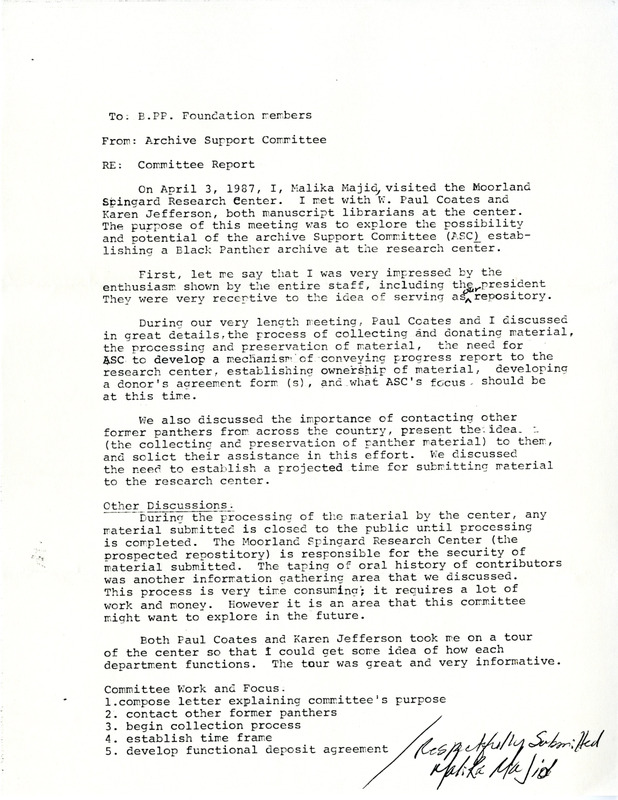
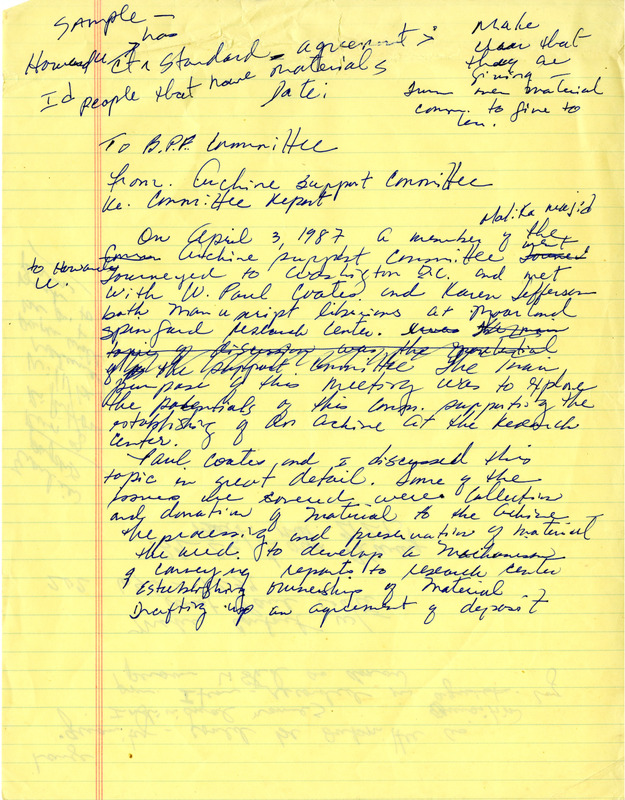
A committee report from Frankye Adams-Johnson (Malika) of the Archive Support Committee to the members of the Black Panther Party Foundation.The report gives details about her visit to the Moorland Spingarn Research Center on April 3, 1987. She met with the manuscript librarians there about the possibility of establishing a Black Panther Archive.
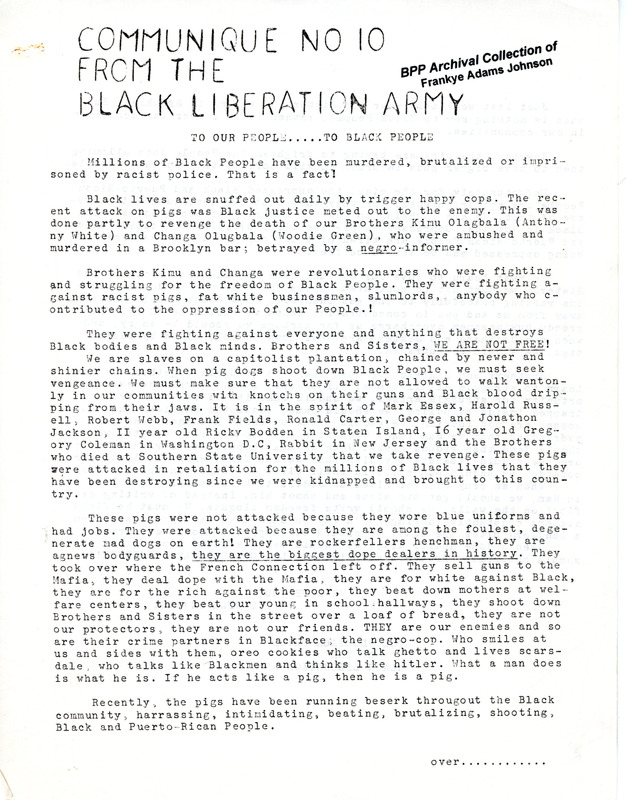
A memo from the Black Liberation Army (BLA) explaining recent killings of cops and outlining ways the people can fight back against different oppressors. The author writes that police officers are capitalist’s henchmen and gives examples and names of people in the Black community who have been murdered by the police.
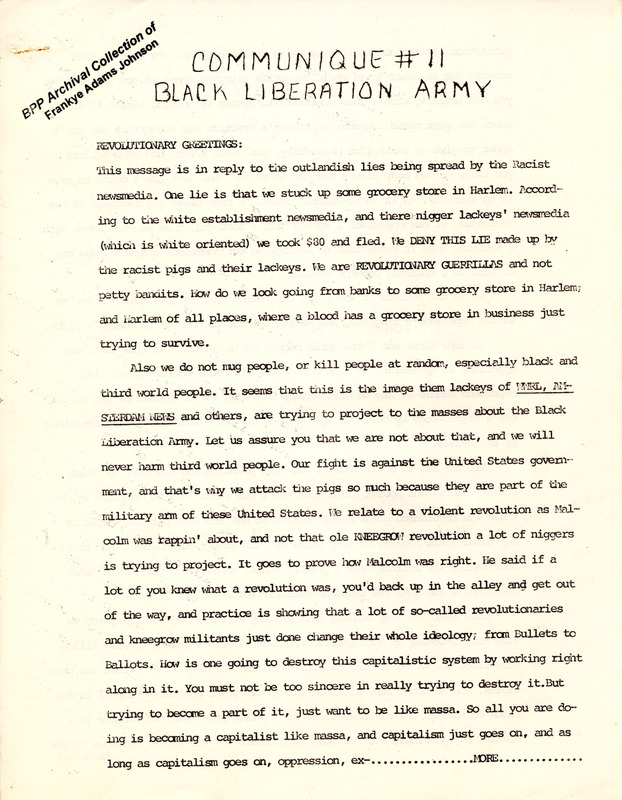
A memo from the Black Liberation Army (BLA) countering lies spread by the media about BLA committing crimes like robbing a grocery store in Harlem for $80 and randomly murdering people. The author writes that the BLA are revolutionary guerillas, not criminals and lists some of the things they take credit for: killing police, robbing banks, etc.
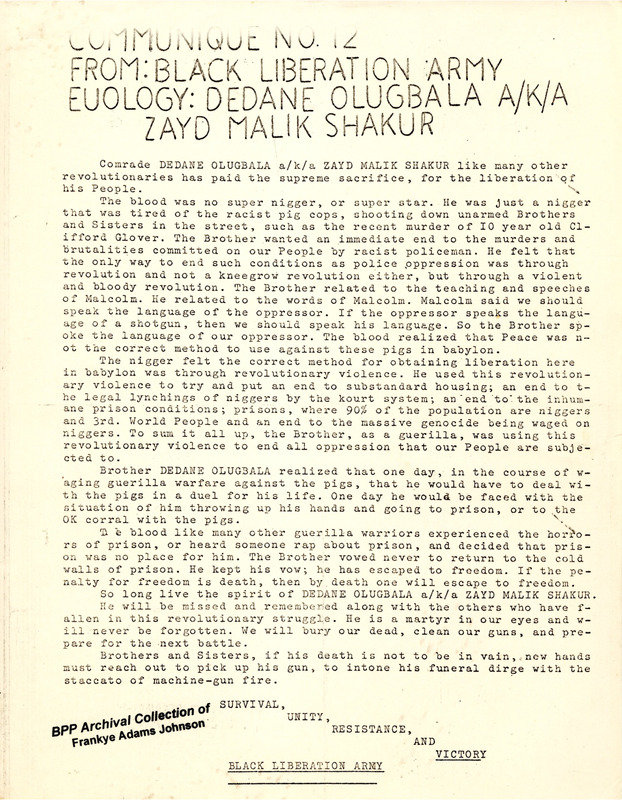
A memo from the Ungamana Tribe of the Black Liberation Army (BLA) eulogizing Dedane Olugbala a/k/a Zayd Malik Shakur, a BLA member who was killed by the police on May 2, 1973. He was minister of information of the New York Black Panther Party. The memo states that the time has come for retaliation against racist police violence.
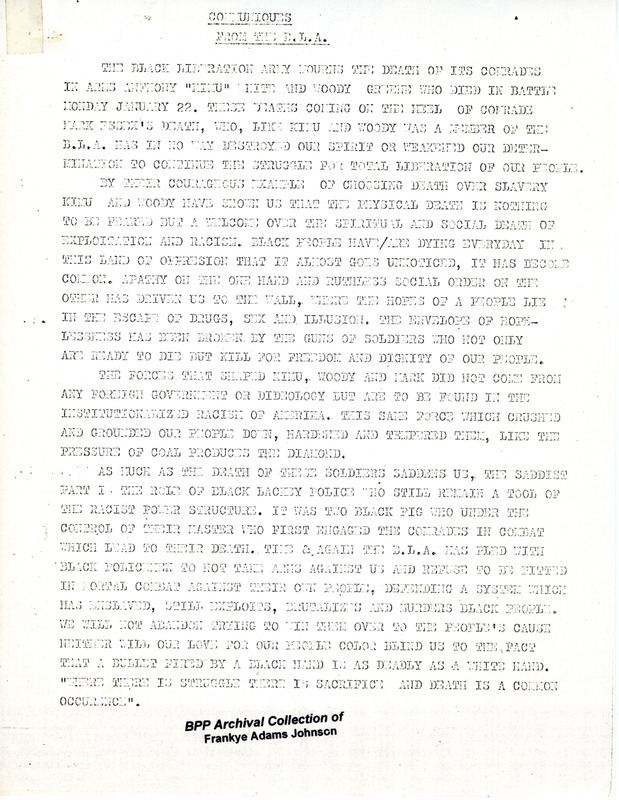
A communique from the Black Liberation Army (BLA) mourning the deaths of BLA members Anthony "Kimu" White and Woody Greene who were both killed by police. The author argues that the racist American system caused this to happen and that the spirits of White and Greene will live on in the new BLA assault teams to be named in their honor.
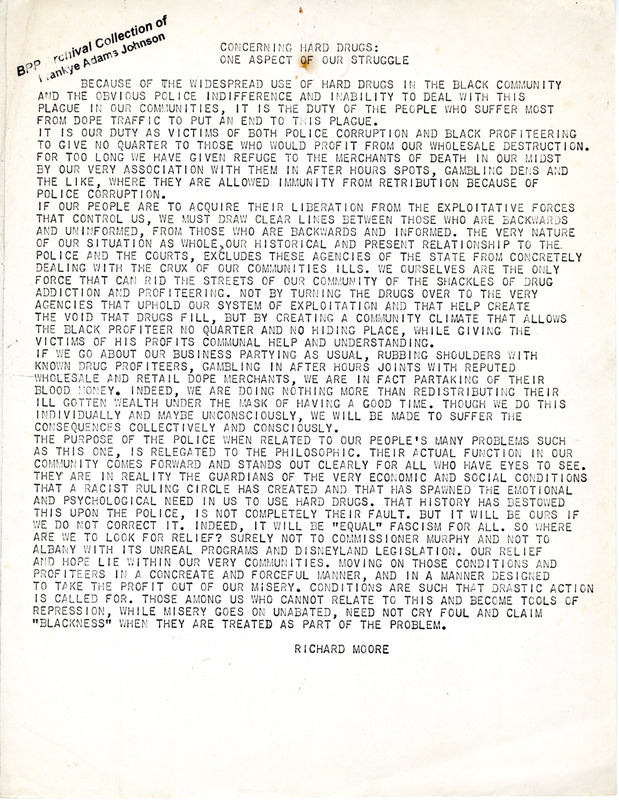
A memo by Black Panther Party leader, co-founder of the Black Liberation Army (BLA), and political prisoner Dhoruba Bin Wahd (Richard Moore) arguing that it is the duty of the people to put an end to the plague of drugs in the Black community by providing no quarter for for drug profiteers since corrupt police won't do anything about the problem.
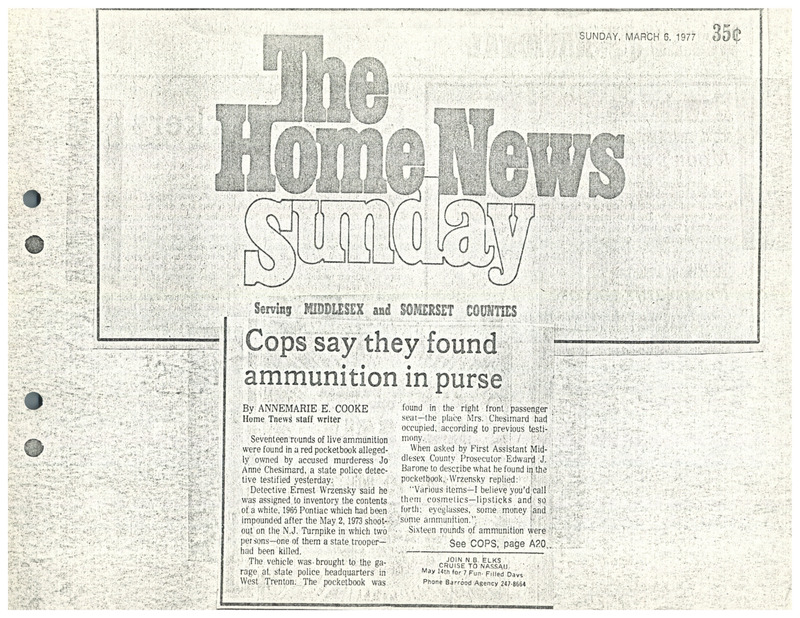
A newspaper article from The Home News about ammunition found in a purse and suitcase found in the car driven by Clark Squire and occupied by Assata Shakur (JoAnne Chesimard). Shakur was on trial for the 1973 killing of a state trooper and Squire had previously been convicted of the crime in a separate trial.
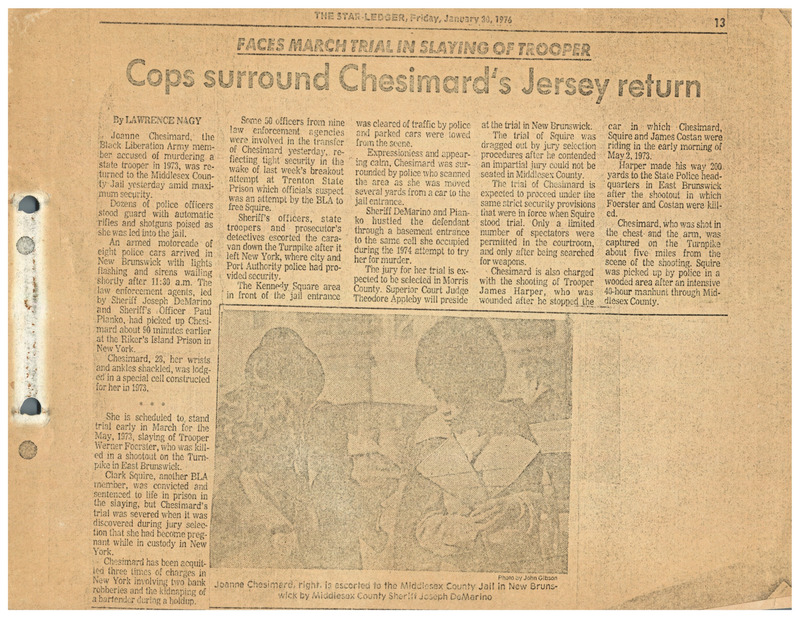
A newspaper article from The Star Ledger about Assata Shakur's (JoAnne Chesimard) return to the Middlesex County Jail from Rikers Island Prison to stand trial for the May 1973 killing of a state trooper. Shakur was convicted in 1977 of killing the state trooper during a shootout, escaped prison in 1979, and is still wanted by the FBI.
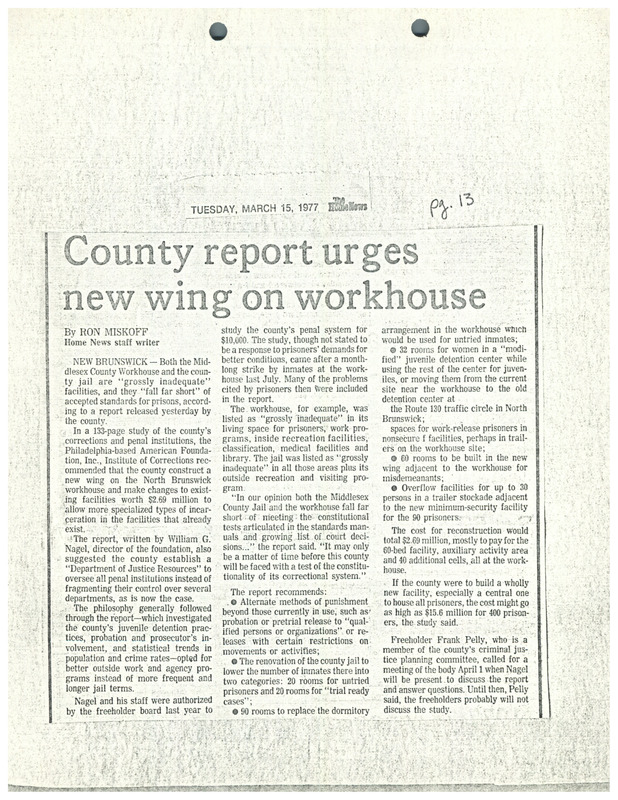
A newspaper article from The Home News about a 133 page report from American Foundation, Inc., Institute of Corrections that recommends a host of changes for the Middlesex County Workhouse and county jail after finding both facilities "fall far short" of standards for prisons.
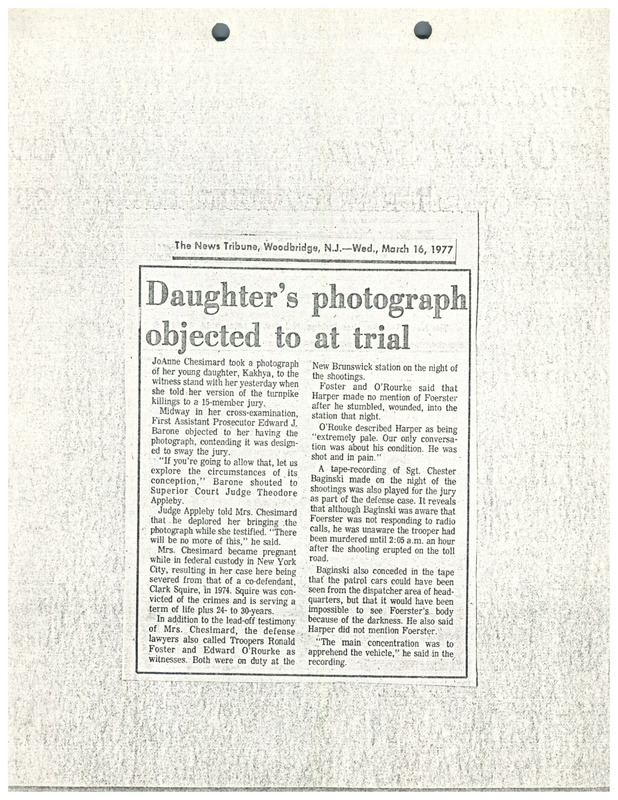
A newspaper article from The News Tribune about testimony in the Assata Shakur (JoAnne Chesimard) trial for the 1973 killing of a state trooper. The prosecution objected to Shakur taking a photograph of her daughter to the stand for her testimony, and the judge upheld the objection on the grounds he felt it might sway the jury.
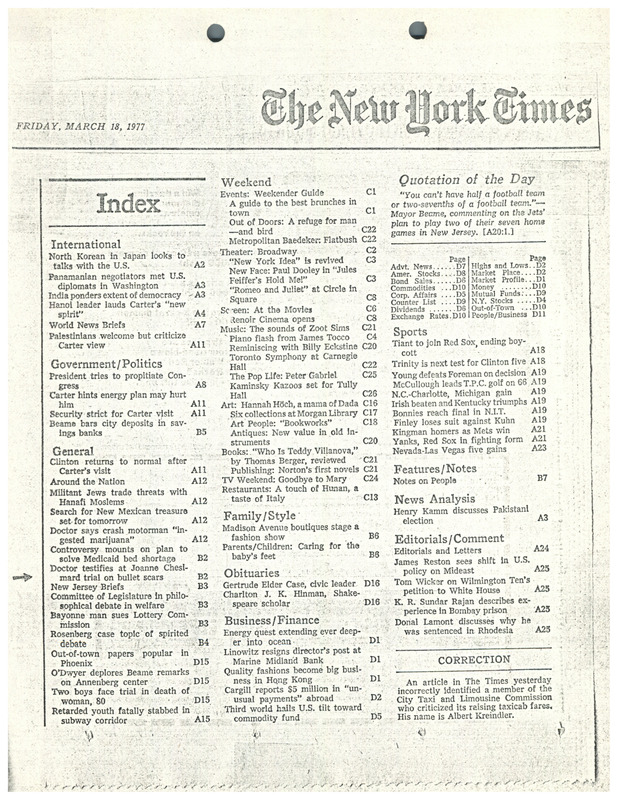
A newspaper article from The New York Times about the testimony of defense witness Dr. David Spain during the trial of Assata Shakur (JoAnne Chesimard) for the 1973 killing of a state trooper. He testified that the scar from a bullet hole on the body of Shakur shows that her arm was raised high in the direction of the gun that shot her.
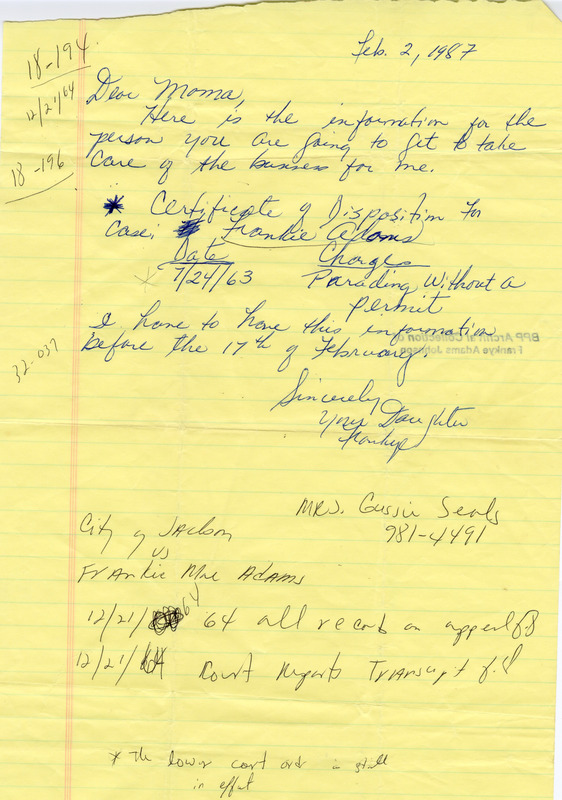
A draft of a letter from Frankye Adams-Johnson (Malika) to "Moma." Frankye Adams-Johnson is requesting her mother to pick up some court documents dating from 1963 and 1964.
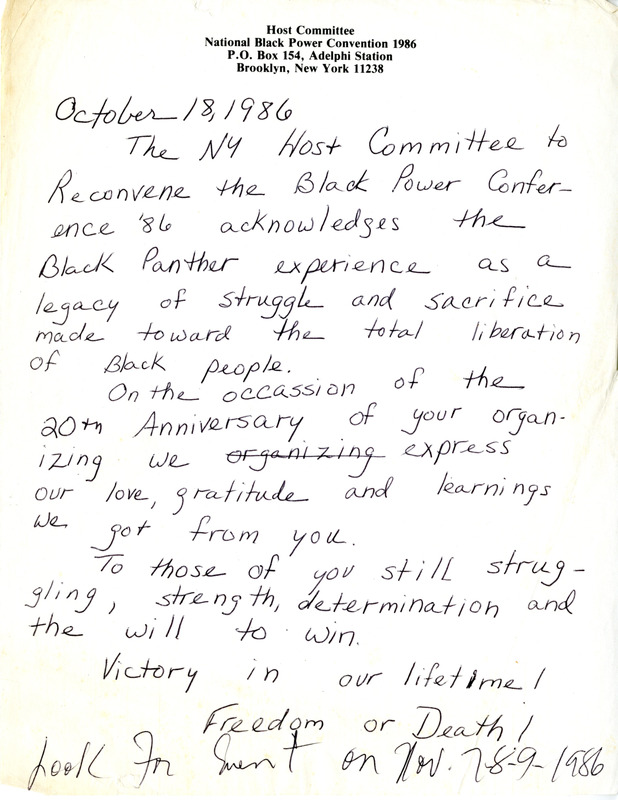
Draft of a Press Release from the NY Host Committee of the Black Power Convention of 1986. The NY Host Committee of the Black Power Convention recognizes the Black Panther experience for their struggle and sacrifice for Black liberation.
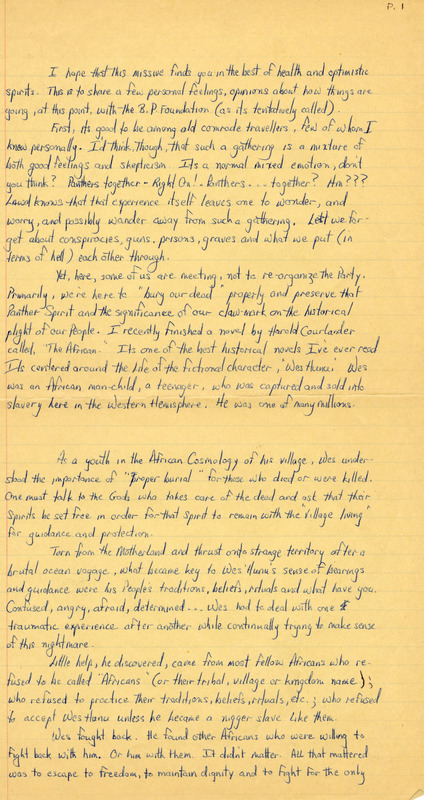
A draft of a speech about the Black Panther Foundation. The speech covers their purpose, preserving the Black Panther legacy, and the lasting effects of the struggle against oppression. The speech calls members to action to do the work for the foundation. The speech ends with a recap of the first few meetings and the members’ personal growth.
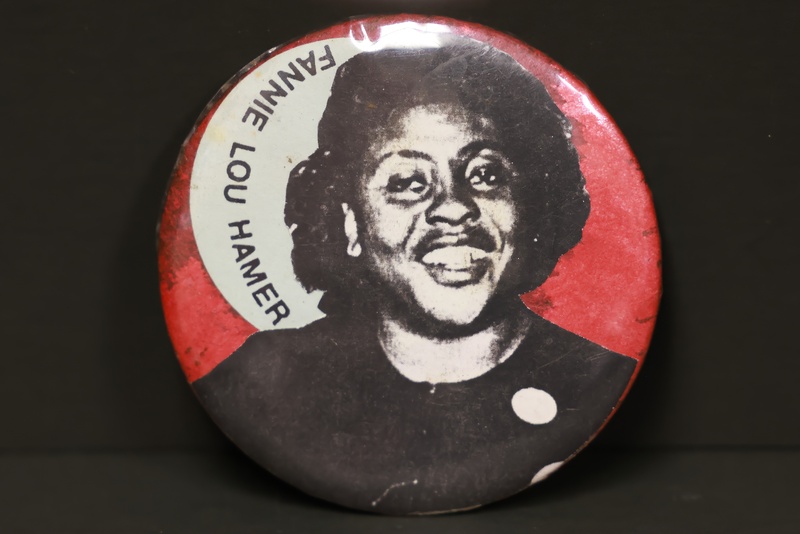
A red and black button with a picture of Fannie Lou Hamer and her name in print. Ms. Hamer was a renowned leader in Mississippi during the Civil Rights Movement. She worked with the Student Nonviolent Coordinating Committee (SNCC) to organize Freedom Summer in 1964 and was also vice-chair of the Mississippi Freedom Democratic Party.
A newspaper article from The New Jersey Afro-American about Judge Theodore Appleby barring the testimony of an FBI agent and senator. Chief defense attorney William Kunstler wanted to use the testimony to establish a police conspiracy against Black militants in the trial of Assata Shakur (JoAnne Chesimard) for the 1973 killing of a state trooper.
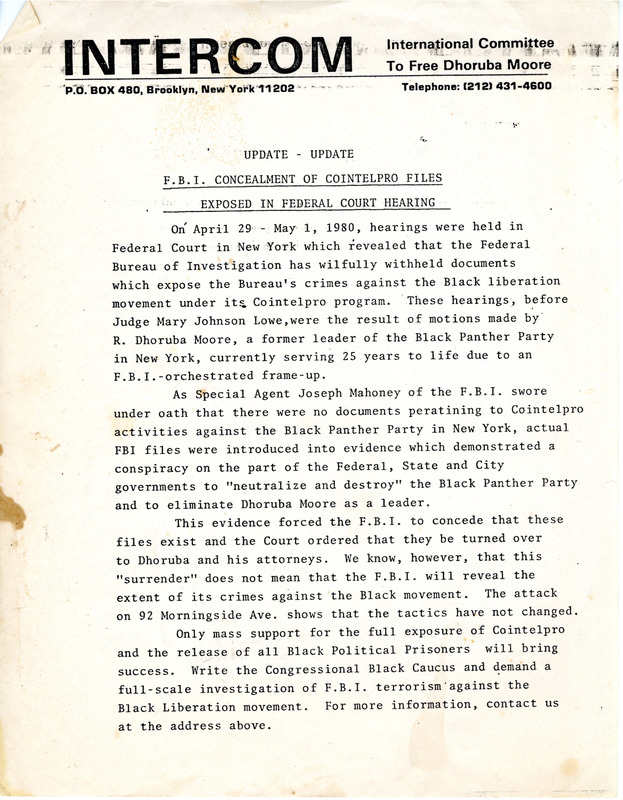
A memo from the International Committee to Free Dhoruba Moore (Dhoruba Bin Wahad a/k/a Richard Moore) asking for members to write to the Congressional Black Caucus to demand a full-scale investigation after evidence of the FBI's Cointelpro program was exposed in court during hearings that were the result of motions filed by Moore.
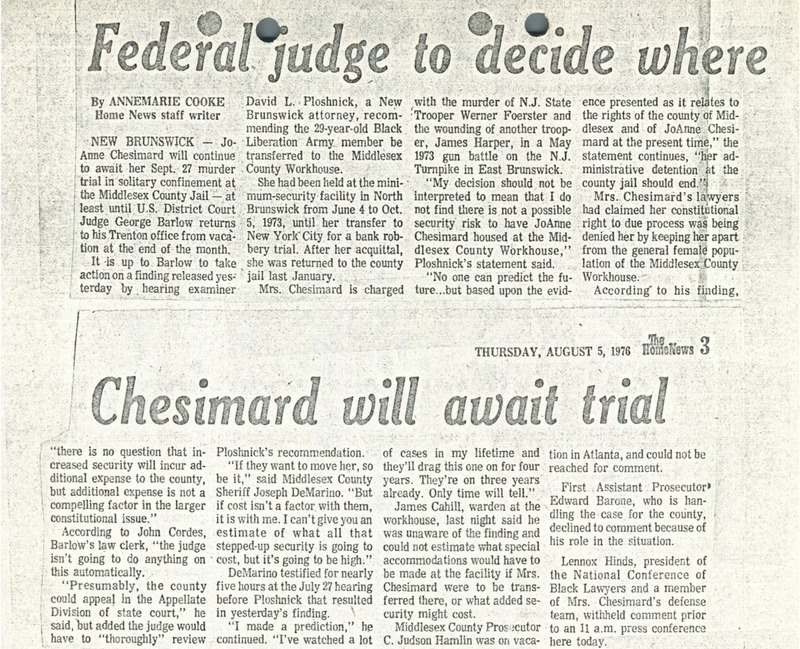
A newspaper article from The Home News about the murder trial of Assata Shakur (JoAnne Chesimard) for the 1973 killing of a state trooper. She will remain in solitary confinement at least until U.S. District Court Judge George Barlow returns from vacation at the end of August to take action on the motion to move her to women's general population.
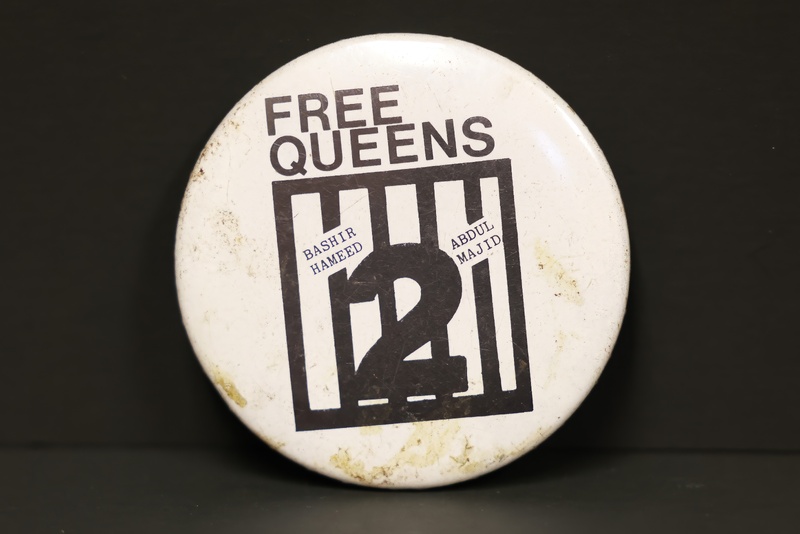
A white button in support of freeing the "Queens 2." Their names, Bashir Hameed and Abdul Majid, are listed on the button. The two members of the Black Liberation Army were sentenced to 33 years in prison for the 1981 murder of a New York cop. They were considered political prisoners because of discrepancies in their cases and convictions.
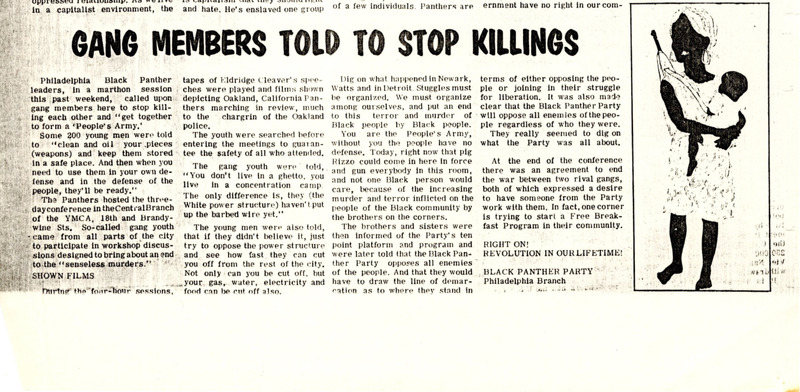
A newspaper article from The Black Panther that describes the calls from Philadelphia, Pennsylvania, Party leaders for gangs in the city to stop the violence and “get together to form a ‘People’s Army,’” This call was made during a three day conference in Philadelphia that brought together gang members and Party leaders to discuss ending violence.
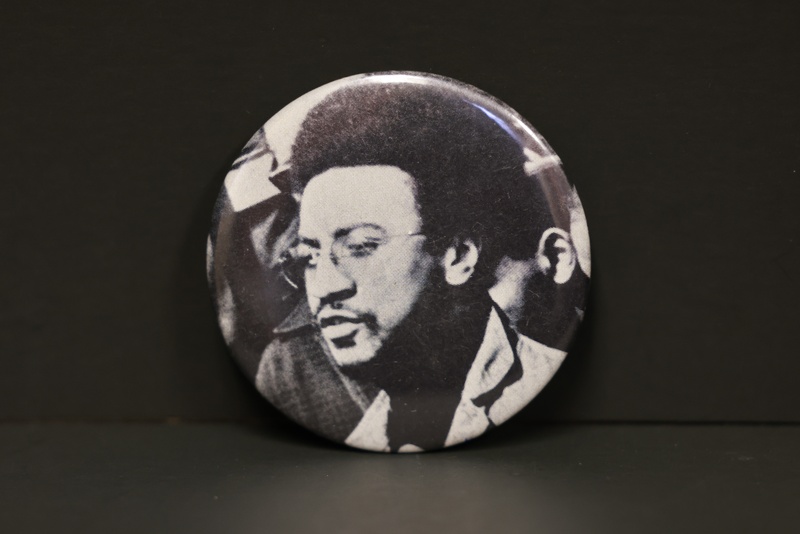
A button with a black and white photo of H. Rap Brown (Jamil Al-Amin). After organizing in Mississippi during Freedom Summer in 1964, H. Rap Brown became chairman of the Student Nonviolent Coordinating Committee (SNCC) in 1967. He continued SNCC’s adoption of Black Power ideologies which began under his predecessor Stokely Carmichael.
A short essay about the revolutionary killing of cops. The author, Frankye Adams Johnson (Malika), gives two recent examples of revolutionaries killing cops, saying the killers are urban guerillas who constitute the military arm of the Black Liberation Army (BLA). The tagline of the essay is “All Power to the New Urban Guerilla, War to the End.”
Handwritten notes and a draft of a committee report by Frankye Adams-Johnson (Malika) to the Black Panther Foundation Committee. The report gives details about her visit to the Moorland Spingarn Research Center on April 3, 1987. She met with the manuscript librarians there about the possibility of establishing a Black Panther Archive.