This collection showcases the rich legacies of HBCUs through artistic expression. Featured works include paintings, sculptures, murals, mixed media, prints, drawings, and fine art photography.
Date Modified
2025-12-17
About This Record
The HCAC public history focused digital archive cataloging is an ongoing process, and we may update this record as we conduct additional research and review. We welcome your comments and feedback if you have more information to share about an item featured on the site, please contact us at: HCAC-DigiTeam@si.edu
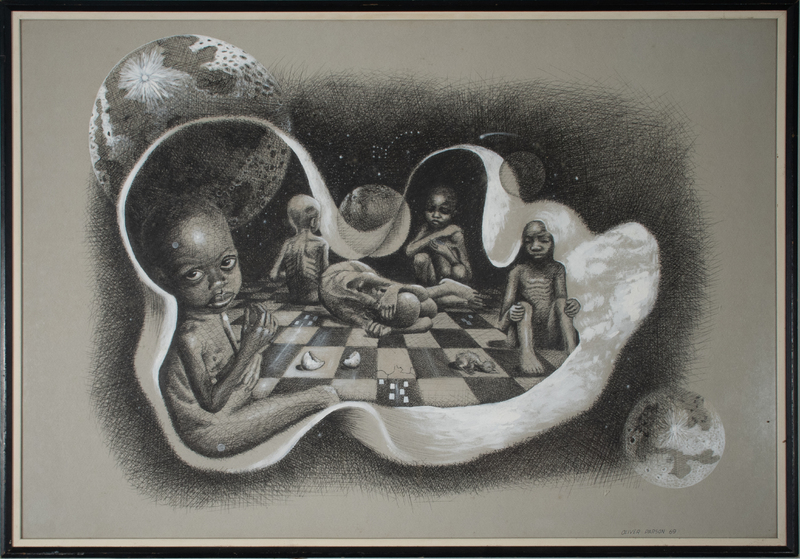
This drawing by Oliver Parson shows a group of emaciated children seated on a checkerboard patterned floor. There is also a chick, just hatched from its egg, that seems to be struggling to survive. Parson has an incredible talent for conveying powerful emotions in his works. The checkerboard and other sacred geometry imagery appear frequently in the works of Dr. Biggers's students.
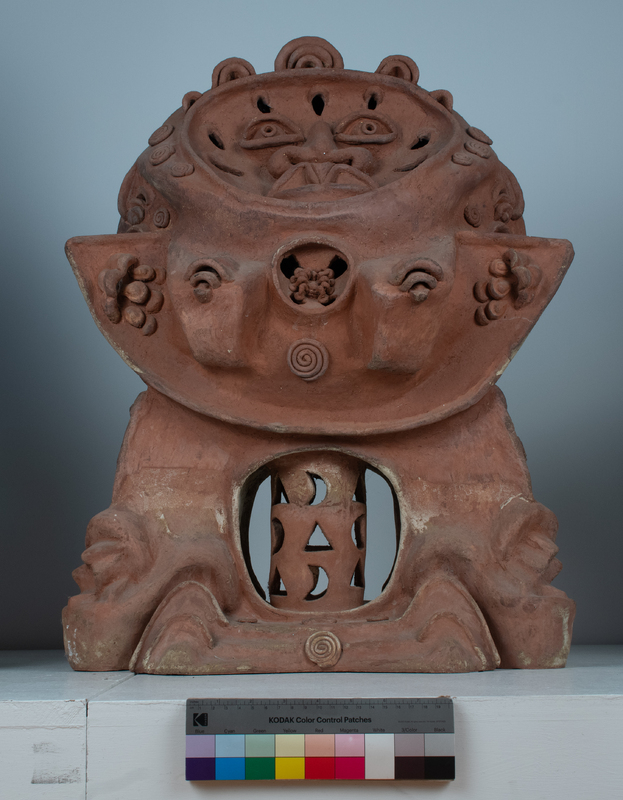
“Sun Stool,” created by Anthony Haynes, resembles an Ashanti stool, a seat for royalty of the Ashanti Empire. The sculpture is decorated with spiral embellishments, triangles, moons, and other indentations. Facial features are also included at the front head of the stool; the rear face of the stool resembles a baboon's face.
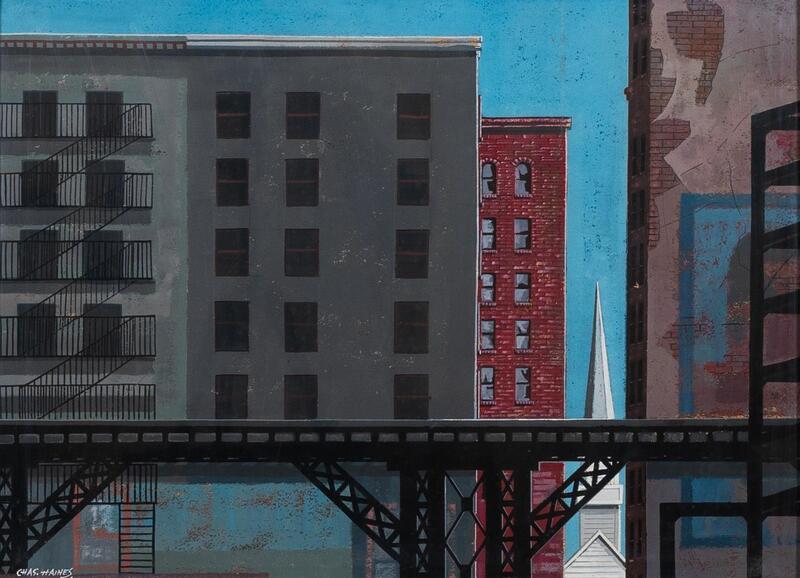
Charles E. Haines was an artist from Indianapolis, IN. Sunday Morning is an urban cityscape under a bright blue sky. In the foreground of the piece is an elevated railway and residential buildings, In the background is a red brick building and a church's spire.
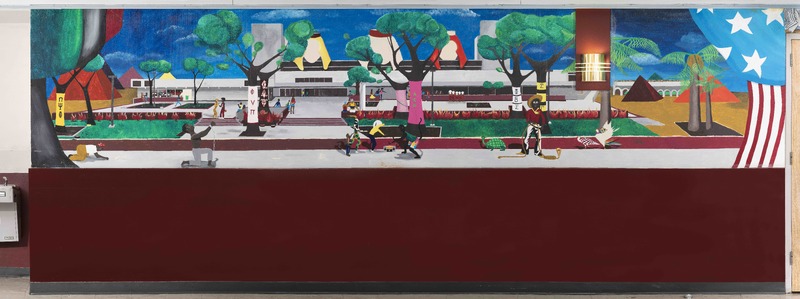
Focusing on the Sterling Student Life Center, the artist captures the lively activities of students and reflects the importance of Black fraternities and sororities in HBCU student life. Realism is paired with the surreal imagery of fantastic figures dancing around the music blasting from a boombox.
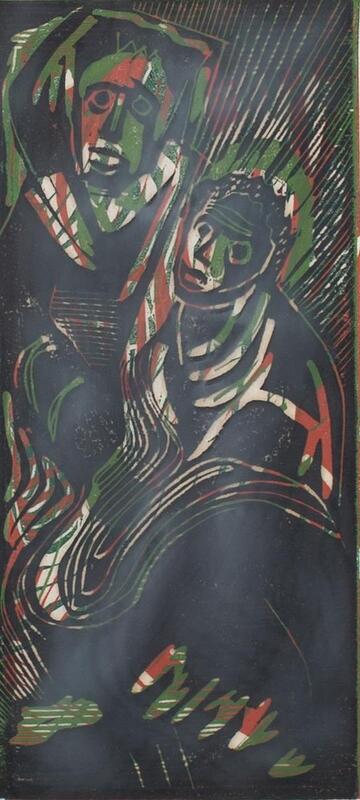
Charles W. Stallings was a painter, printmaker, sculptor, and educator from Gary, IN. Swamp Fever is a print of two swamp creatures. Stallings uses stark black, red, and green lines and shadows to create cartoon-like renditions of swamp creatures with shocked expressions.
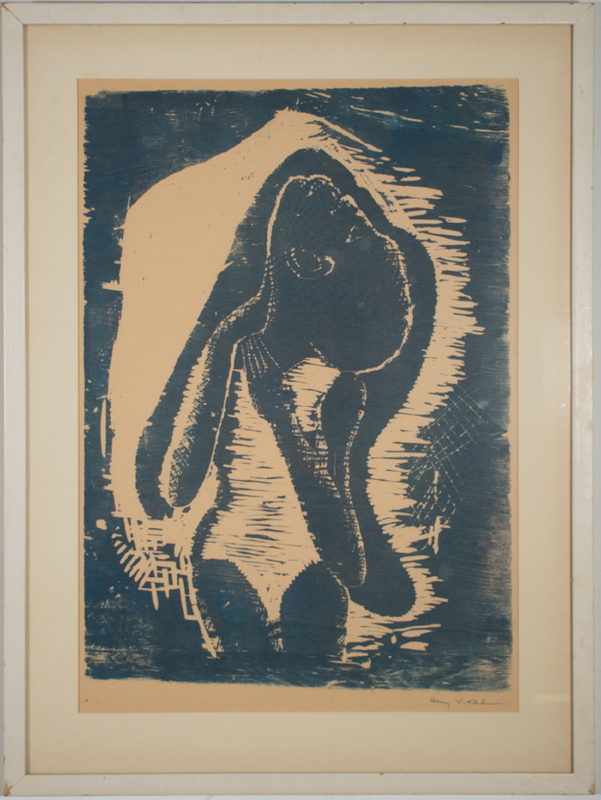
This print by Harry Vital shows a woman in a swimsuit tilting her head upwards. Dr. John T. Biggers taught students the craft of printmaking while he was a professor at Texas Southern University. Vital followed in Biggers' footsteps and became a longtime art professor at TSU.
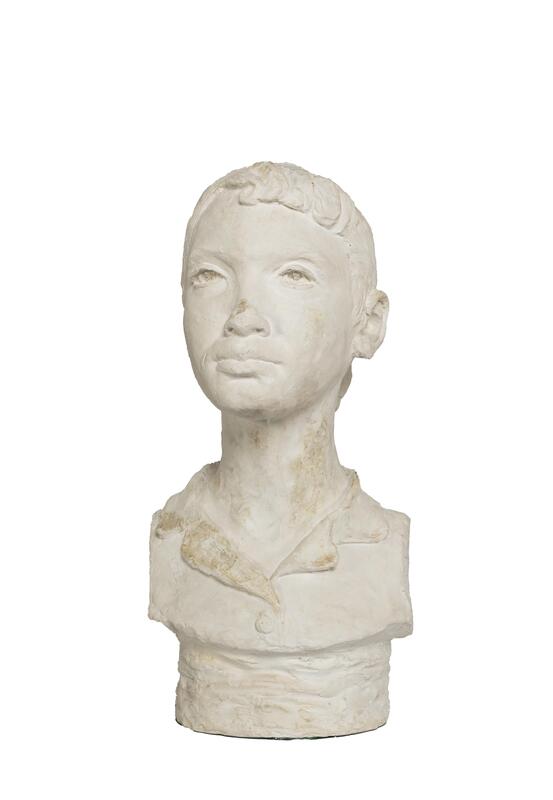
Jewell Woodard Simon was an internationally acclaimed artist, teacher, and poet from Houston, TX. Teen Enigma is a plaster bust of a young girl looking into the distance with her head raised. She is wearing a collared shirt with the top button clasped.
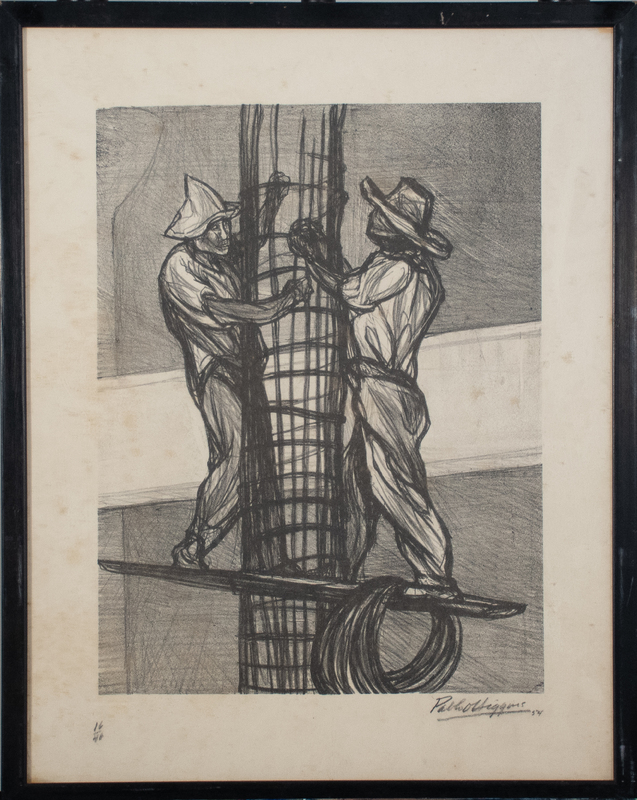
O'Higgins' print shows two men balancing on a board and working on a cylindrical structure. Unlike most of the works held by the University Museum, O’Higgins had no connection to Texas Southern; this piece was donated by a collector. O'Higgins was an established artist in the 20th century and was mentored by Diego Rivera.
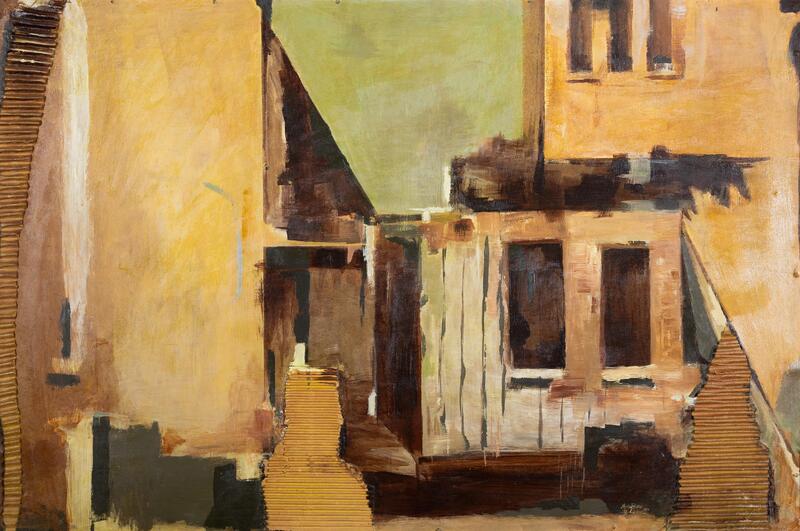
Shirley Bolton was a painter from Athens, GA. Tenement is a multimedia depiction of the entrance to a shared housing space. The dimensional browns of the buildings indicate the age and use of the tenement space. Three cardboard pieces on top of the painted surface add texture and form to the piece.
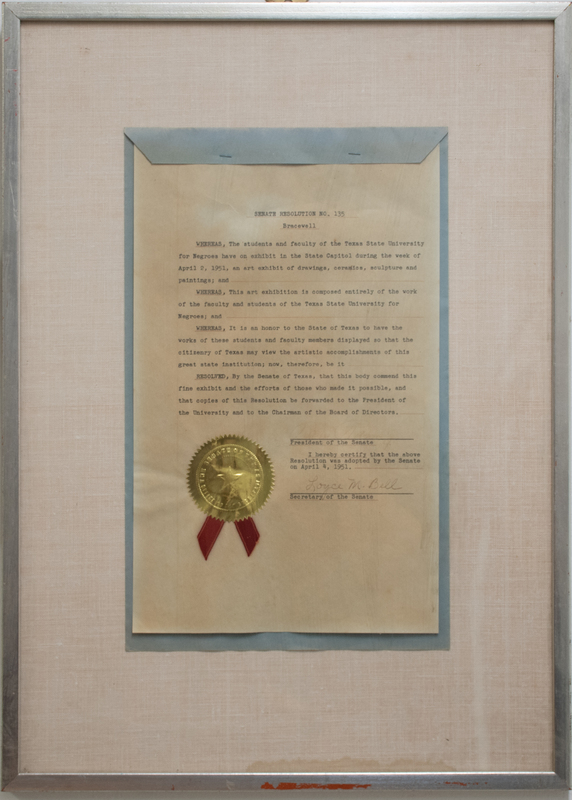
This Texas Senate resolution commends the art students and faculty of Texas State University for Negroes (now Texas Southern University) for their exhibition in the State Capitol in April 1951. It is notable that this exhibition took place years before desegregation.
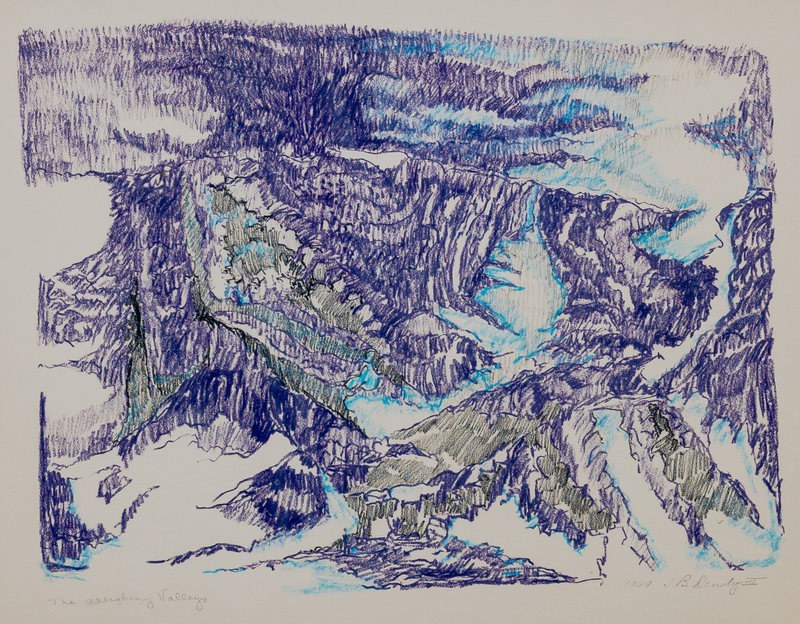
J. Brooks Dendy III was a painter, graphic artist, and educator from Pittsburgh, PA. The Allegheny Valleys depicts an aerial view of a mountain range, valley, and river in Western Pennsylvania.
James Newton was a painter, printmaker, scholar, and professor from Delaware. The American Sixties is an assemblage that symbolizes the political turmoil and militarization that arose in the 1960s after the Civil Rights Movement.
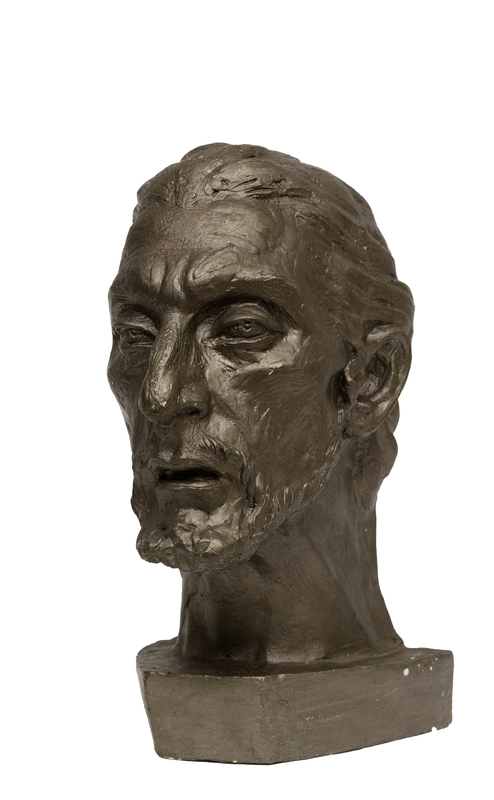
Richmond Barthe was a sculptor from Bay St. Louis, Mississippi. The Angry Christ is an intensely expressive bust of Christ. The bust is incredibly detailed, emphasizing Jesus of Nazareth's Semitic features.
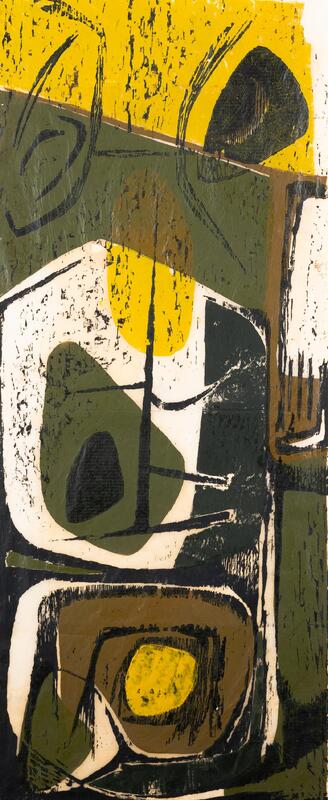
Harper T. Phillips was an artist from Courtland, AL. The Ant is a painting with numerous geometric forms and lines in a vertical composition. Each white, yellow, green, and black shape lay in pocketed areas overlapping black borders and lines.
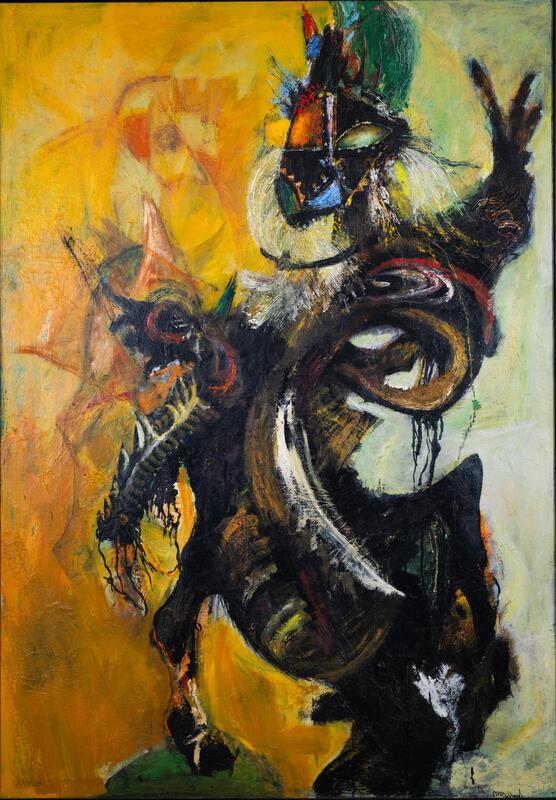
Geraldine McCullough was a renowned painter and sculptor from Kingston, AR. The Black Knight depicts an abstract figure riding a creature like a horse. The figure is primarily black, with a twisted torso, and has masquerade-like attributes. The creature is predominantly black, with both ominous and mythical characteristics.
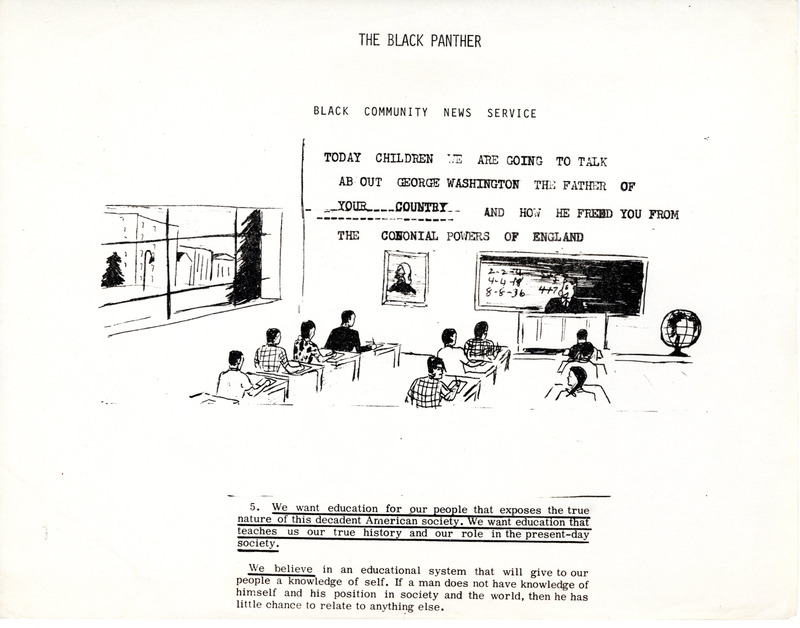
A political cartoon featuring a pig teaching a classroom of children with the quote “Today children we are going to talk about George Washington the father of your country and how he freed you from the colonial powers of England.” The 5th point from the Black Panther Party’s Ten-Point program is printed at the bottom of the page.
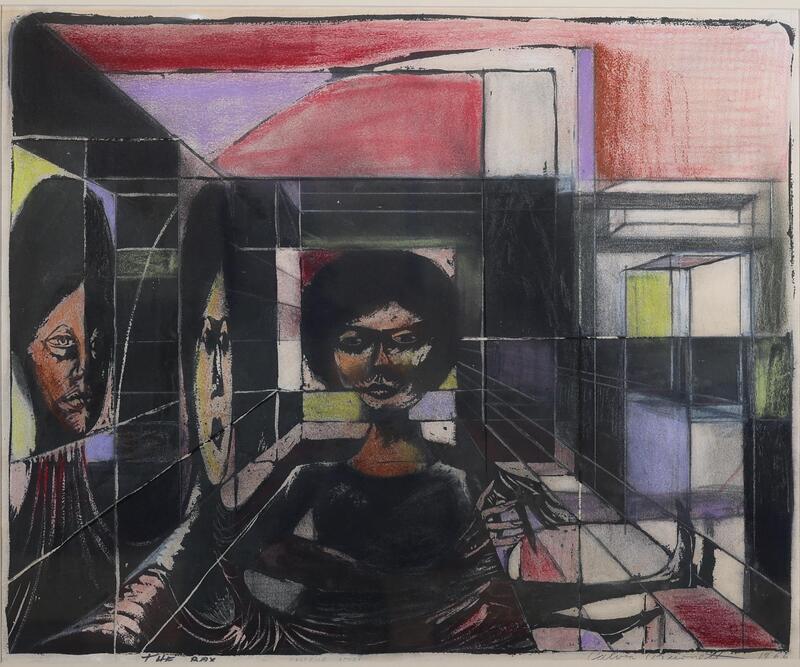
Calvin Burnett was a graphic artist, illustrator, painter, designer, and art teacher from Cambridge, MA. The Box is a surrealist drawing of a Black woman seated in a box. The drawing's geometric complexity and the woman's reflections evoke an uncanny feeling.
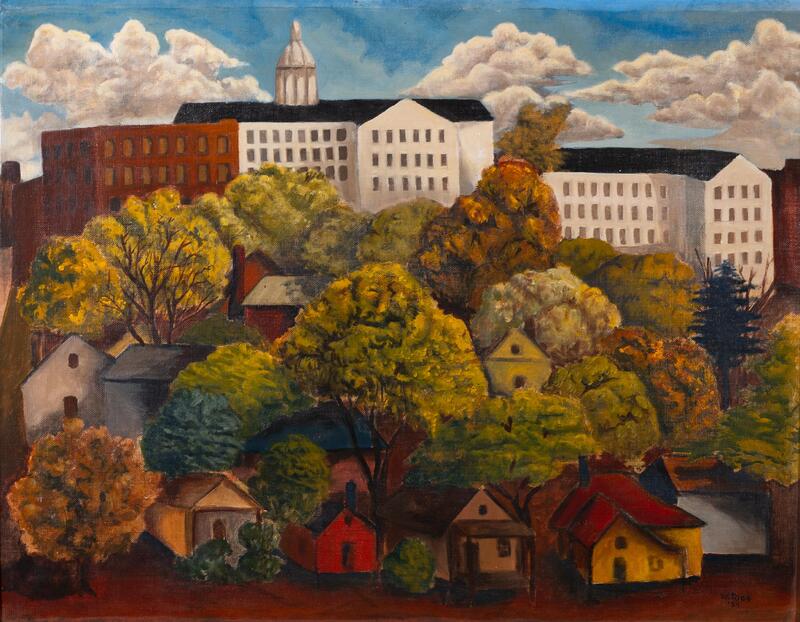
William E. Rice was an artist from Tallahassee, FL. The Capitol is a perspective painting of a residential area beside a Capitol building. In the foreground are several houses with multi-colored trees between them; in the background are larger buildings, including the Capitol, under a cloudy blue sky.
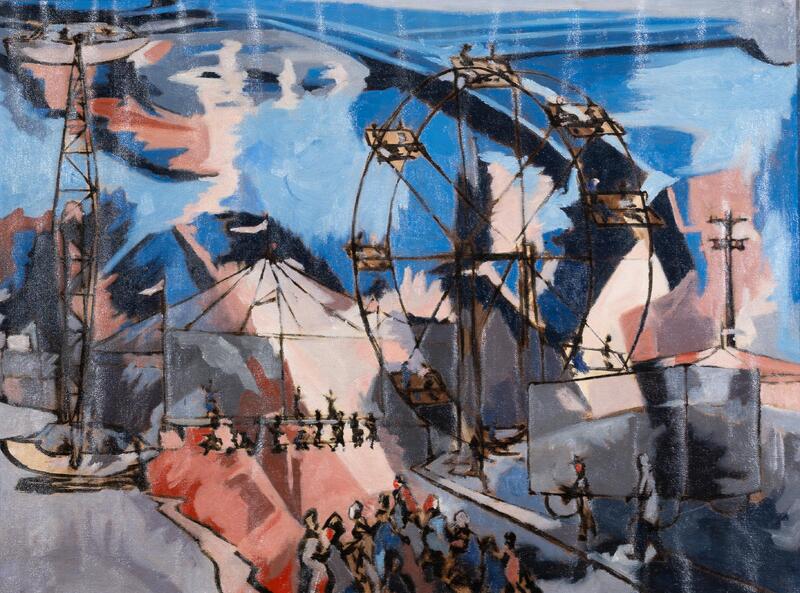
Maurice Strider was an artist and art educator from Lexington, KY. The Carnival shows a carnival landscape with crowds of abstracted human figures walking around and riding a Ferris wheel. The hue composition of blue, pink, and gray is similar to Cubism.
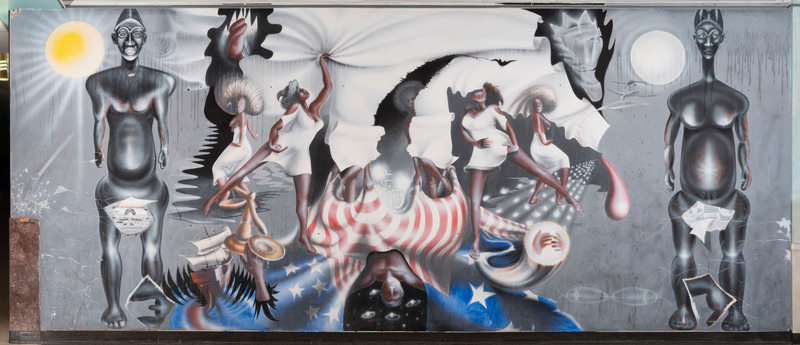
A commentary on the conflict between technology and progress, history and culture, Davis painted this mural in response to the destruction of several Hannah Hall murals to create windows into a new computer lab. Davis’ own mural was later damaged by subsequent construction, as foreseen in its design.
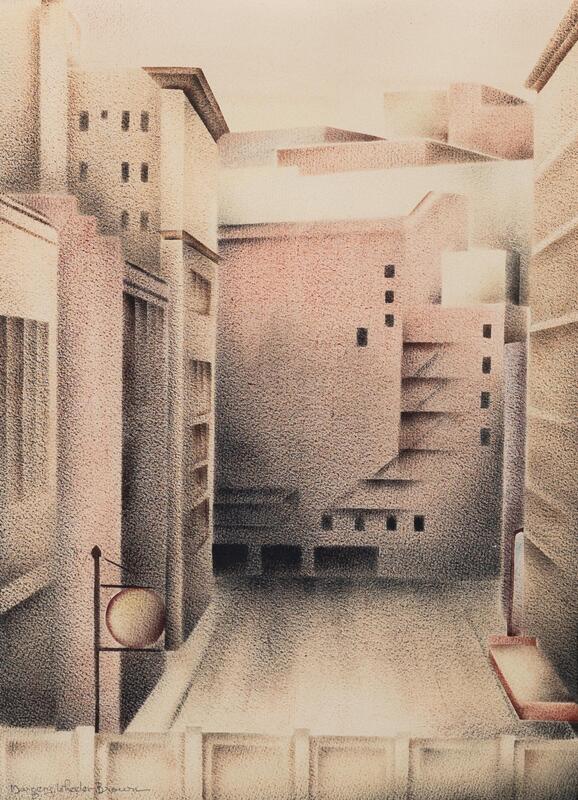
Marjorie W. Brown, born in North Carolina, was an artist who studied art at Spelman College. The City Is A Pattern is a watercolor artwork that shows the linear perspective of a city. Brown uses repeating lines and geometric shapes for buildings, windows, signs, and sidewalks to show a consistent landscape pattern.
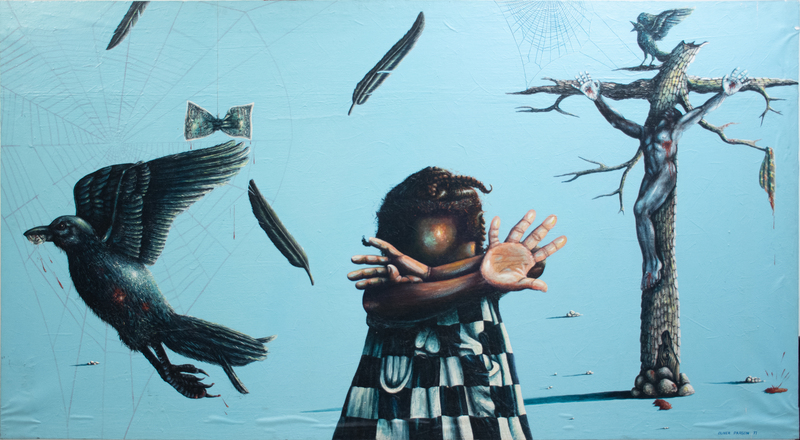
Parson’s painting shows a young girl shielding her face. To the left, a crow holds a coin and a dollar bill is on a fishing line; to the right Jesus is crucified, below a perched crow. The crows may allude to Jim Crow, which made racism law from after the Civil War until the 1960s; crows are also a symbol of death. The dollar bill as bait perhaps suggests the corrupting nature of money.
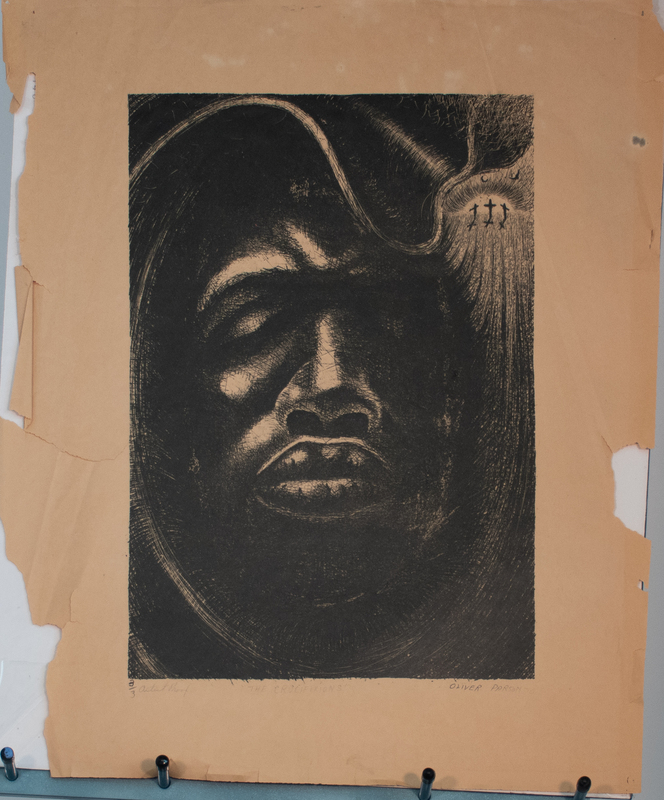
Parson's print shows a face with closed eyes and a solemn expression on its face. In the background, three crosses stand ominously, alluding to the crosses where Jesus, Dismus, and Gestas were crucified. Dark, crosshatched swirls fill the entire composition. Parson and other TSU students learned the crosshatching technique from Dr. Biggers and used it to create smooth, detailed shapes.
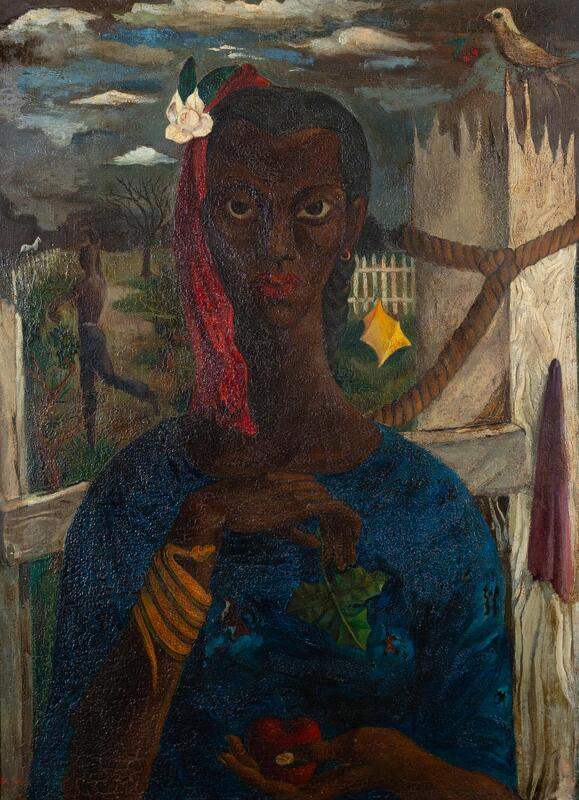
Frederick D. Jones, Jr. was a mid-twentieth-century artist from South Carolina. The Daughter of Eve depicts a woman wearing a ripped blue top, red lipstick, a snake bracelet, a red scarf, and a white magnolia in her hair. She holds a red apple and a green leaf and stares toward the viewer. Behind her is a white horse, a yellow tent, and a man dancing.
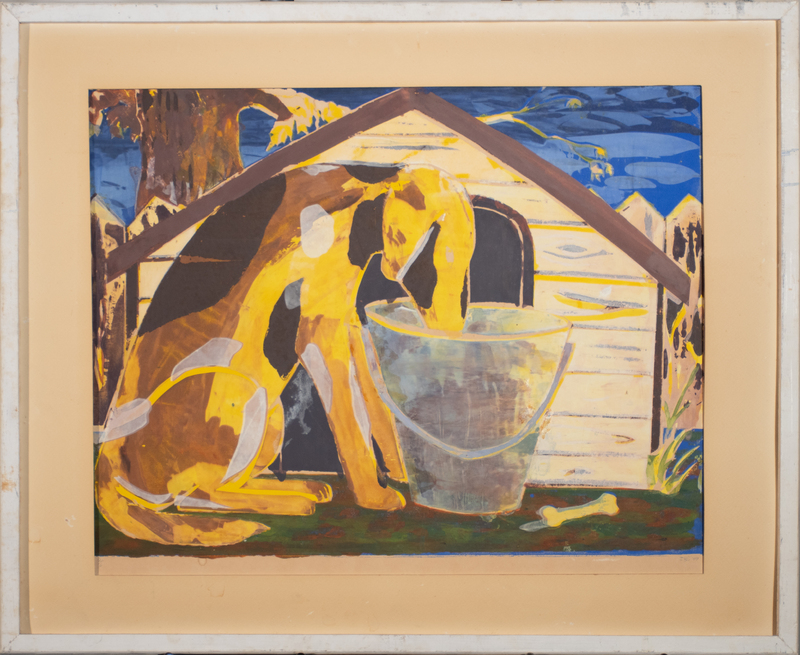
Sampson’s print shows a large, colorful dog drinking from a pail of water. The setting appears rural, with a wooden fence and a large tree in the background. Sampson’s artwork in TSU’s permanent collection often depicts nature and rural homes. More broadly, animals and the natural world are frequent subjects of the artwork of TSU students.
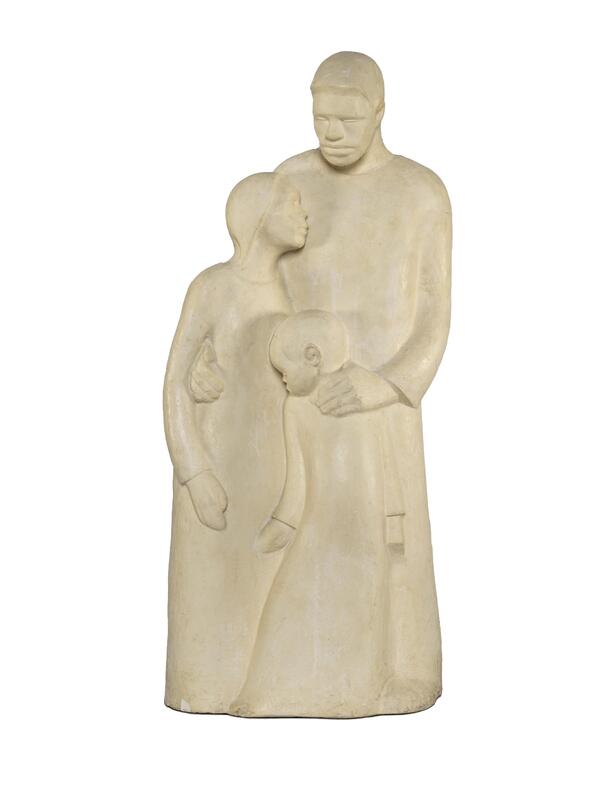
Howard E. Lewis was an Art professor and Korean War veteran from Columbus, OH. The Family is a freestanding Plaster sculpture of a family in an embrace. The father towers over his wife and child, looking down at them as his wife leans into his chest and their son into hers.
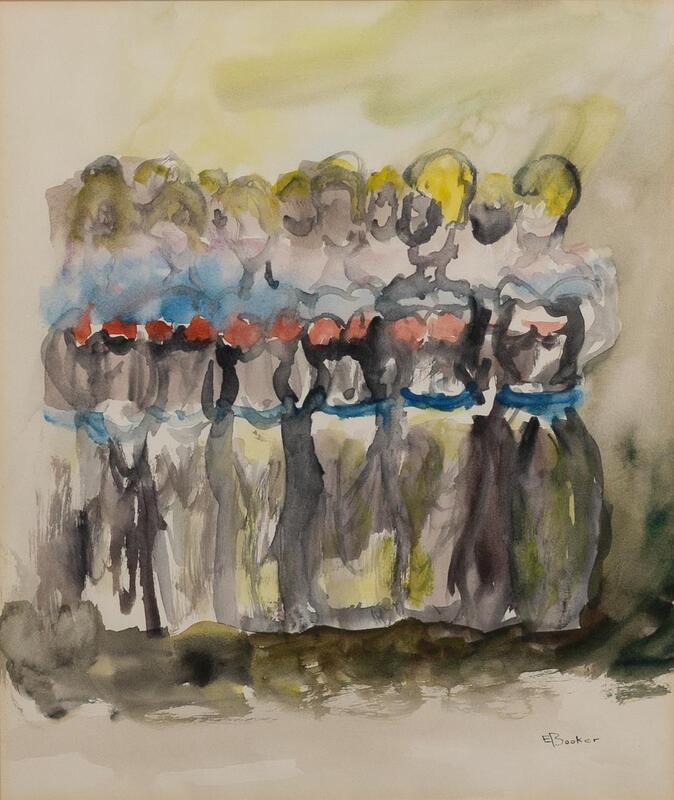
Eva Booker was an artist from Atlanta, GA. The Girls is an abstract depiction of a group of girls with blonde hair, red bikini tops, and low-waisted skirts.
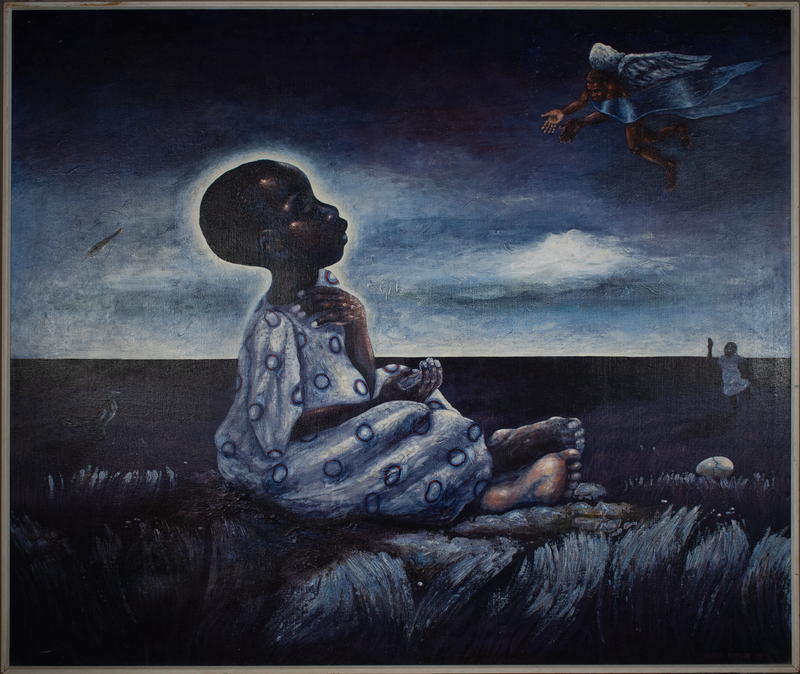
This work, by Oliver Parson, is a calm and dreamlike scene of a child sitting in a prairie, as an angel and a person both race towards him. Both figures may represent salvation; the person aims to rescue him from death, while the angel tries to save him from Earth. A faint glow emanates from the child.
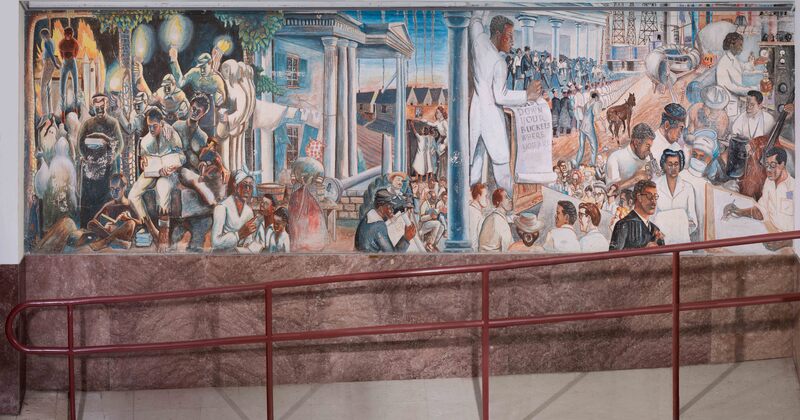
Washington’s mural is a timeline of Black education. On the left, he depicts slavery and lynching above enslaved people secretly reading. In the center, students write “Emancipation Proclamation” and Booker T. Washington delivers his "Atlanta Compromise" speech. The right depicts emerging Black professionals.
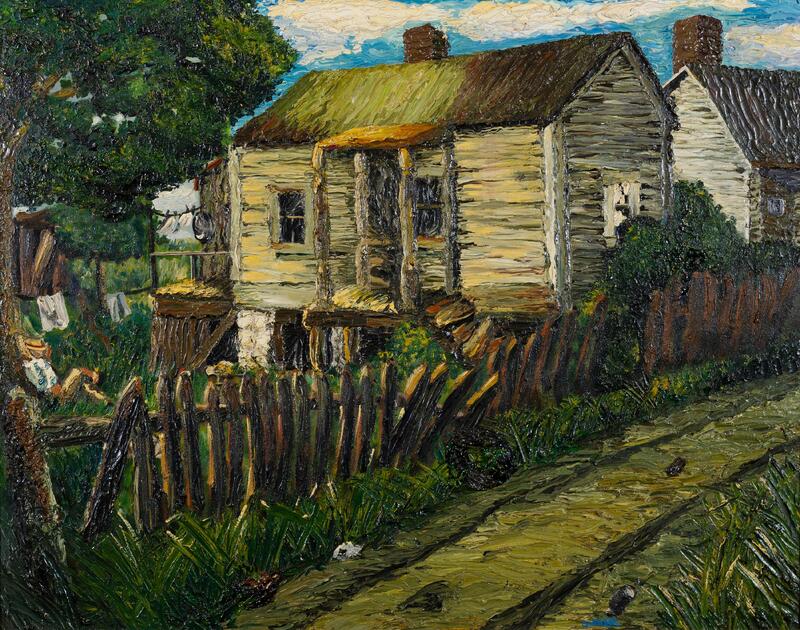
Clarence Laudric Shivers was an artist and career military man who participated in the Tuskegee Program from St. Louis, MO. The House by the Side of the Road depicts a rural home behind a picket fence. This piece conveys rural life as a man lounges on a tree while clothes dry on the line.