This collection showcases the rich legacies of HBCUs through the medium of text. It includes both published and unpublished items such as reports, correspondence, legal documents, books, letters, essays, government publications, and journals.
Date Modified
2025-12-17
About This Record
The HCAC public history focused digital archive cataloging is an ongoing process, and we may update this record as we conduct additional research and review. We welcome your comments and feedback if you have more information to share about an item featured on the site, please contact us at: HCAC-DigiTeam@si.edu
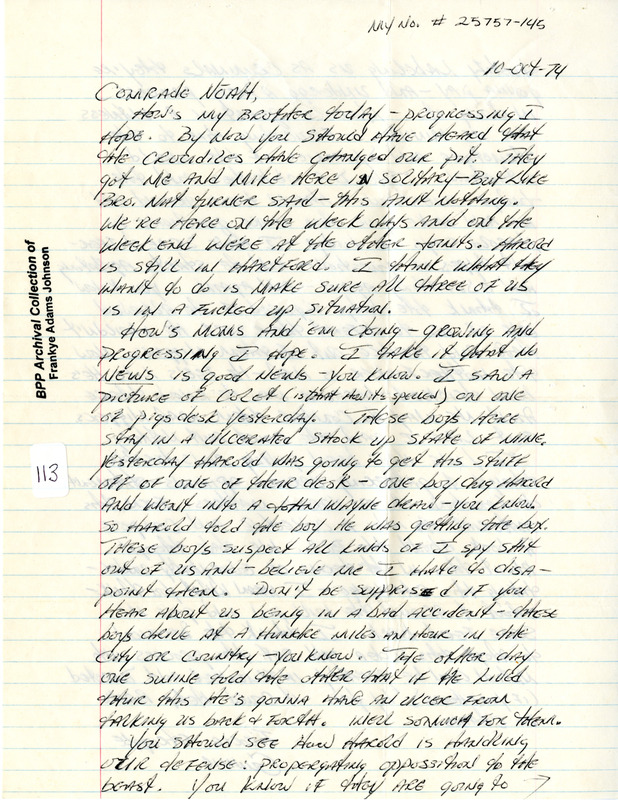
Gunnie James Haskins, a Black Liberation Army (BLA) member who was imprisoned for a robbery to raise money for the BLA, is writing to update Nuh Abdul Qaiyum of his current condition and the treatment of the other prisoners. He tells him of their court proceedings and gives his idea for a collaborative book about the BLA.
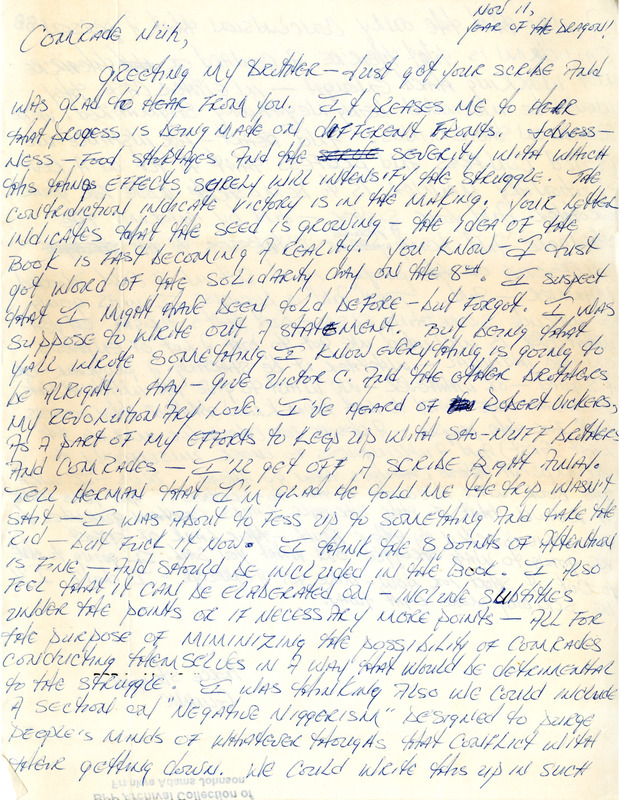
Gunnie James Haskins, a Black Liberation Army (BLA) member who was imprisoned for a robbery to raise money for the BLA, is writing to update Nuh Abdul Qaiyum to express happiness in the fact that their book is becoming a reality and the revolution is still happening in different ways.
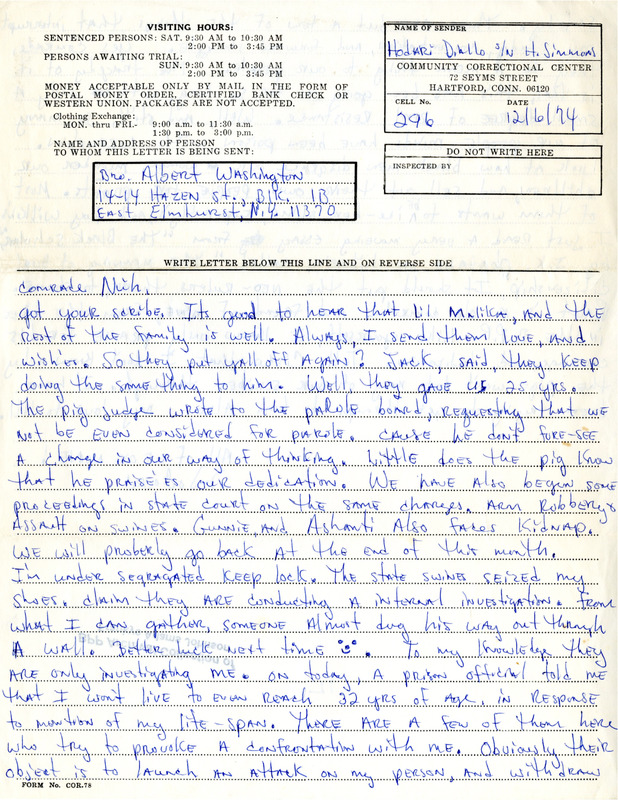
Harold Simmons (Hodari Diallo), a Black Liberation Army (BLA) member who was imprisoned for a robbery to raise money for the BLA, writes to Nuh Abdul Qaiyum to tell him he was sentenced to 25 years and is currently in segregated lockup, still being harassed by the police. He explores corruption in the community before mentioning an essay he read.
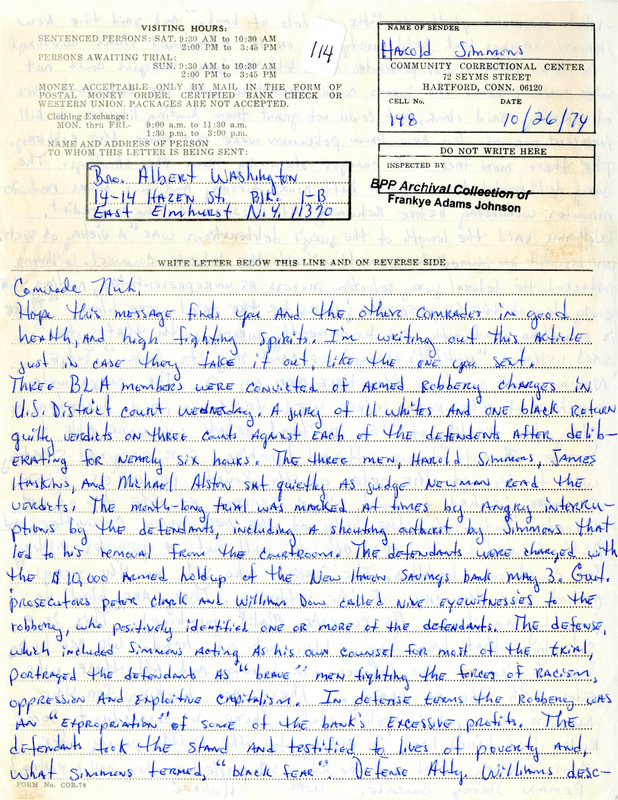
Harold Simmons (Hodari Diallo), a Black Liberation Army (BLA) member who was imprisoned for a robbery to raise money for the BLA, writes to Nuh Abdul Qaiyum. He copies an article detailing his and two other members' court proceedings. He explains their mission was to disrupt the court system, and believes they achieved a victory for the people.
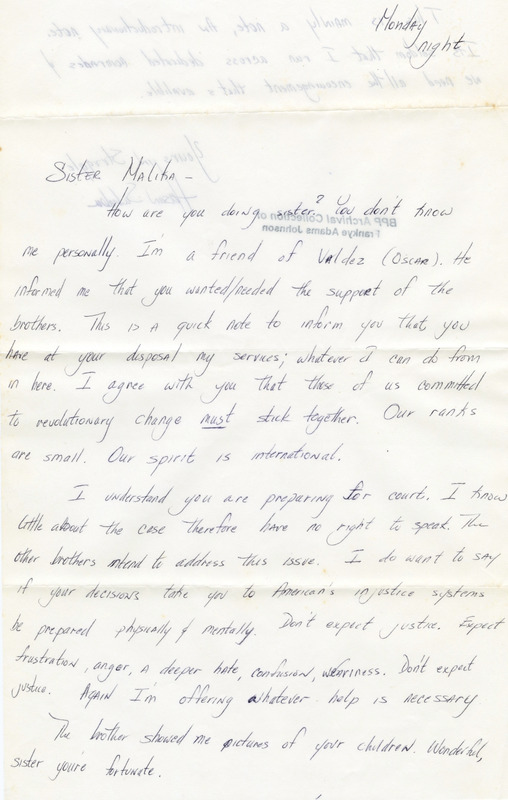
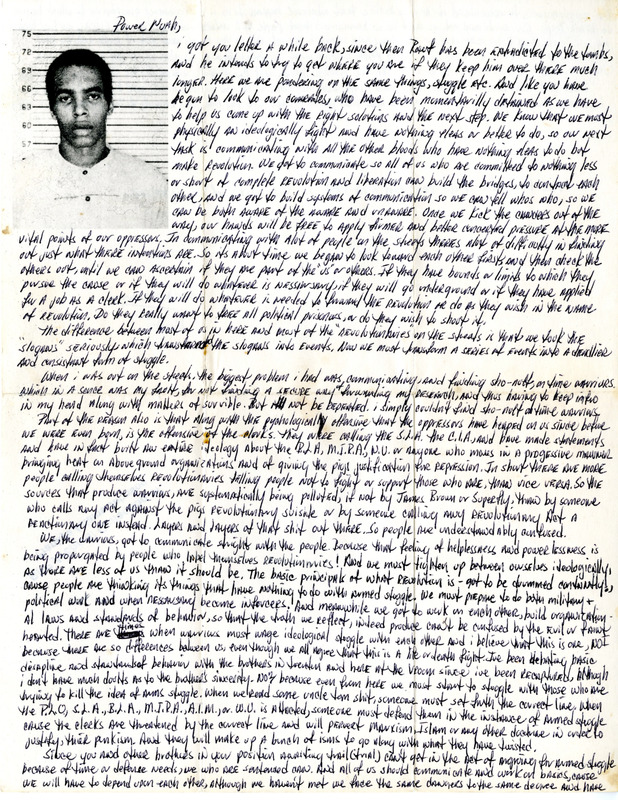
Hasan Sababa is writing to introduce himself as a fellow revolutionary. He makes himself and his revolutionary brothers available to her at their full disposal. He writes that he does not know the details of her case, so can’t speak on it, but does give his viewpoint of the American court system, telling her not to expect justice.
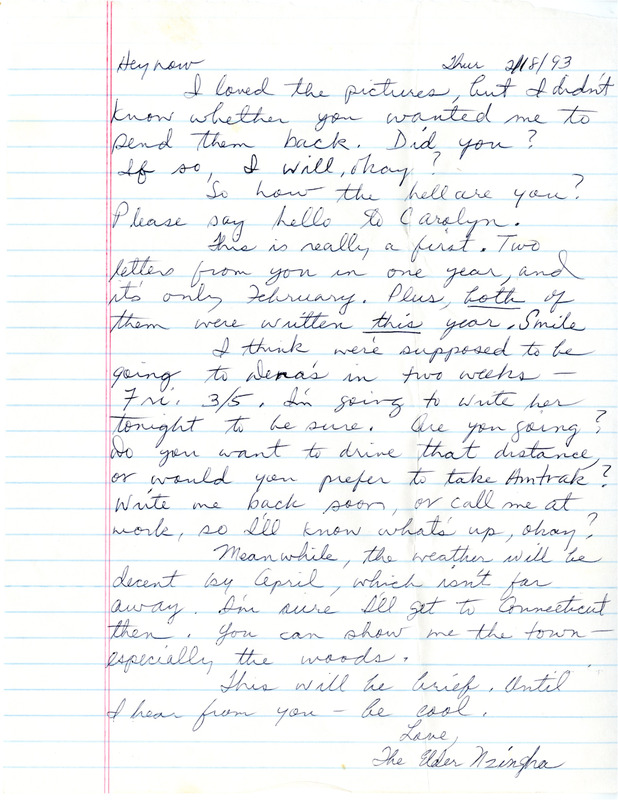
Helen writes her friend Frankye Adams-Johnson (Malika) to ask about some pictures she received from her asking if she wants them back. She also mentions that she will be traveling to Connecticut soon and will need to be shown around town. She signs the letter “The Elder Nzigha.”
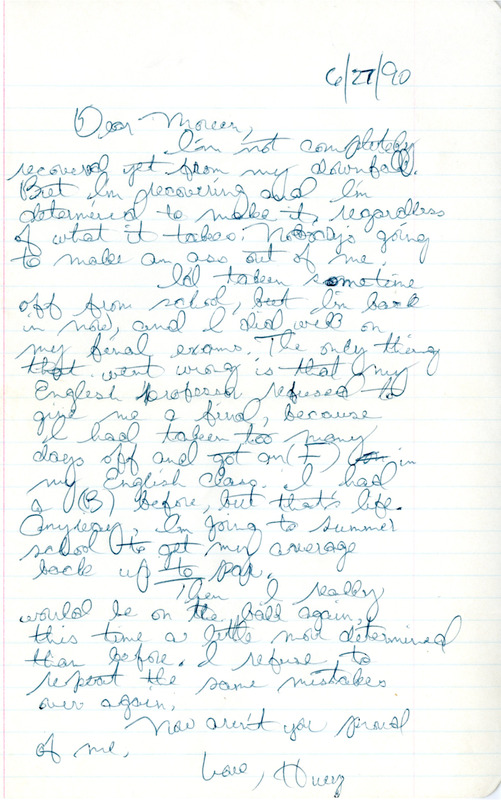
Huey G. is writing this letter to keep Maureen Glaser updated on his schoolwork and his performance in his classes. He says that nothing will hold him back from his education and that he will be taking summer classes to make up work he missed in a class.
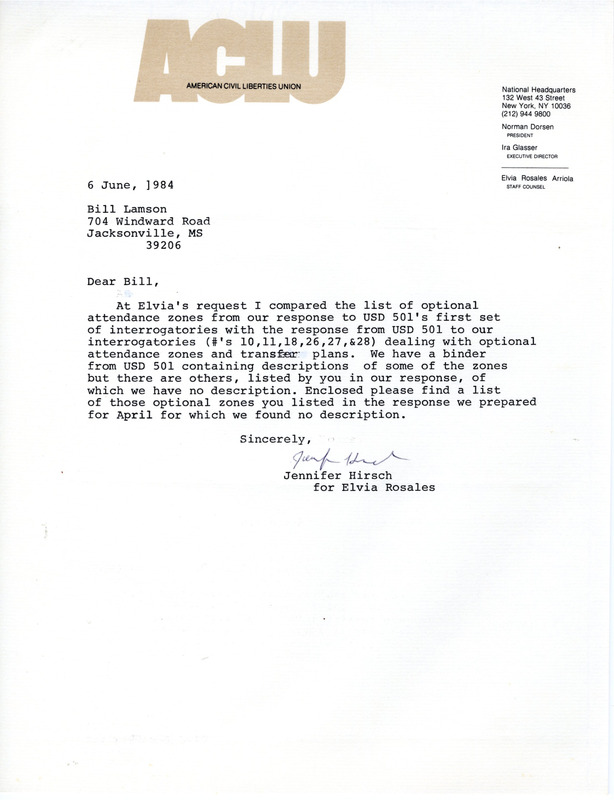
Jennifer Hirsch of the ACLU (on behalf of Elvia Rosales Arriola) writes to William Lamson seeking descriptions for data he compiled for their response to Topeka School District’s first set of interrogatories. Some of the descriptions about data on optional attendance zones transfer plans are missing.
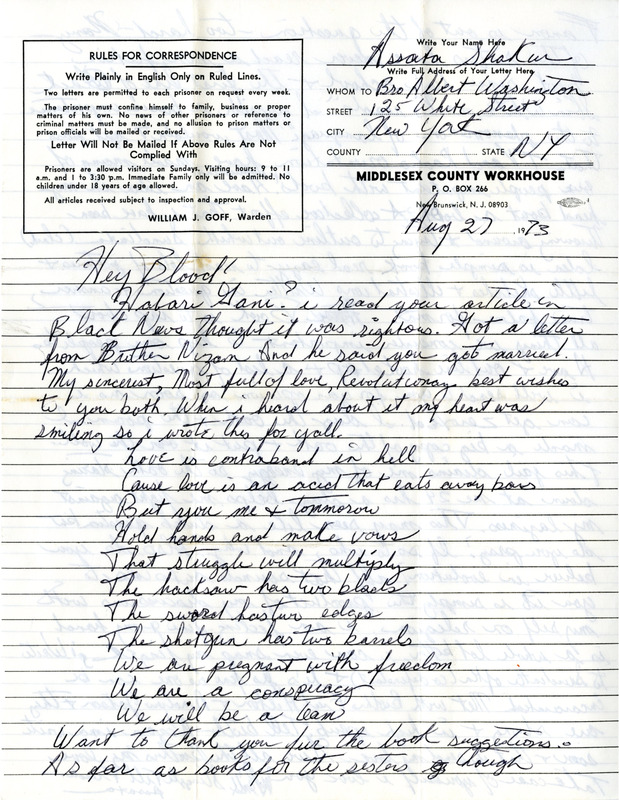
Written on Middlesex County Workhouse letterhead, where Joanne Chesimard (Assata Shakur) was being held in connection with a 1973 police shooting. She writes to Nuh Abdul Qaiyum that she heard about his marriage and wrote a love poem for them. She thanks him for his book suggestions and writes about the other prisoners attitudes’ toward books.
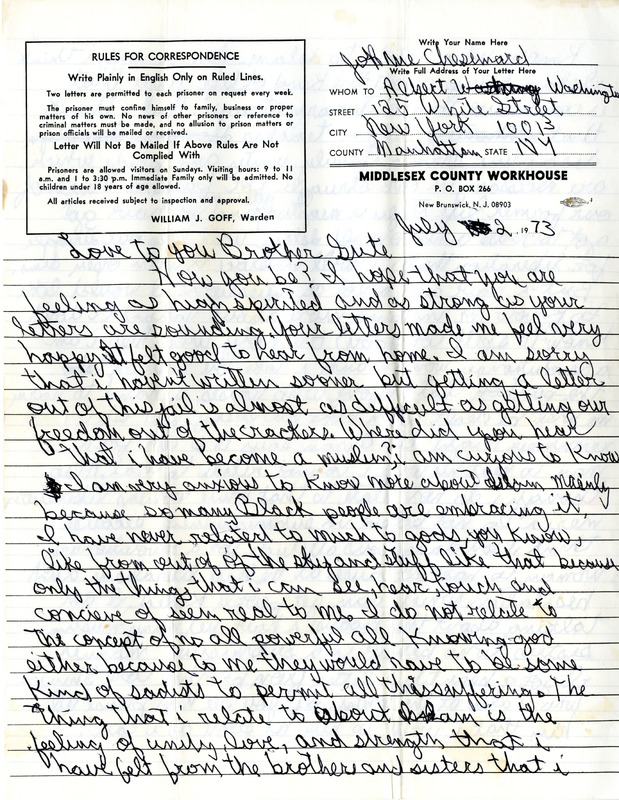
Written on Middlesex County Workhouse letterhead, where Joanne Chesimard (Assata Shakur) was being held in connection with a 1973 police shooting. She writes to Nuh Abdul Qaiyum in response to his letters and to catch up. She notes that she is hesitant toward religion, but believes Islam teaches the mental processes needed for revolution.
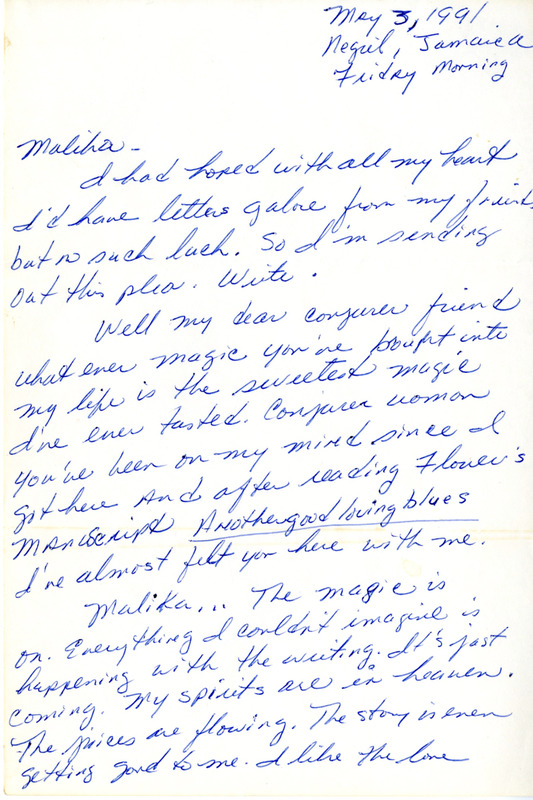
Joyce tells Frankye Adams-Johnson (Malika) about the wonderful experience she is having in Jamaica. She mentions their deep bond and shared divine mission of being novelists, and she tells Frankye Adams-Johnson that she is on the right path.
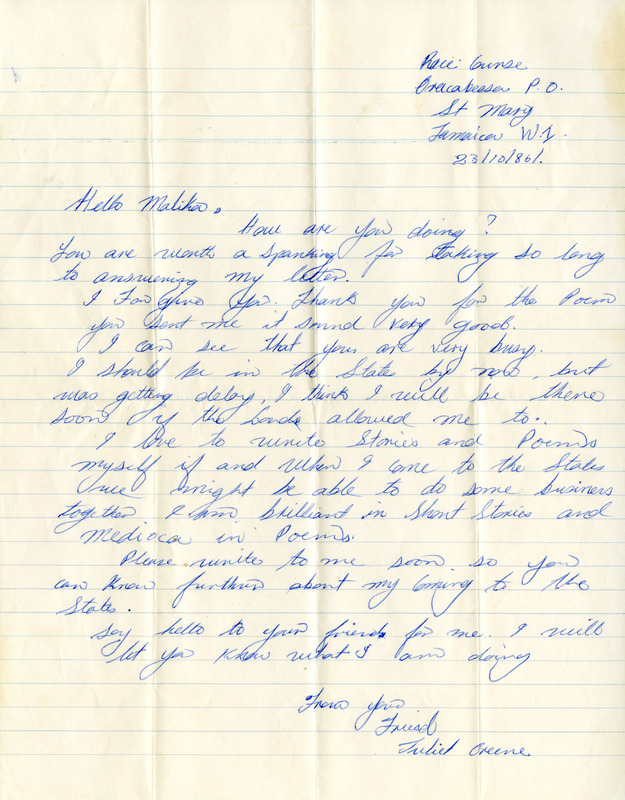
Juliet Greene is writing to keep Frankye Adams-Johnson updated of her travel to the United States after not hearing from her in a while. She thanks her for a poem and tells her of her skill in writing stories, and with their skills combined, they could make some money.
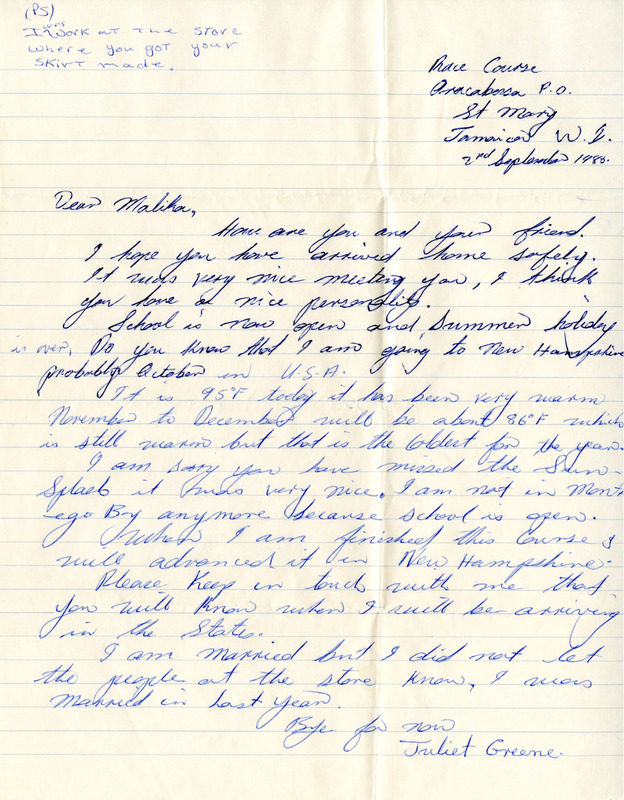
Juliet Greene is updating Frankye Adams-Johnson (Malika) on the current weather and school operations back in Jamaica after having a wonderful experience together. She also mentions that she will be in the U.S. soon to continue her education.
Kuwasi Balagoon (aka Donald Weems) was a Black Liberation Army Member (BLA) who was imprisoned in 1969. He writes to Nuh Abdul Qaiyum to detail the conscious change that the revolutionaries and prisoners need to undergo. He believes there are too many contradicting messages and they must maintain an organizational structure and single message.
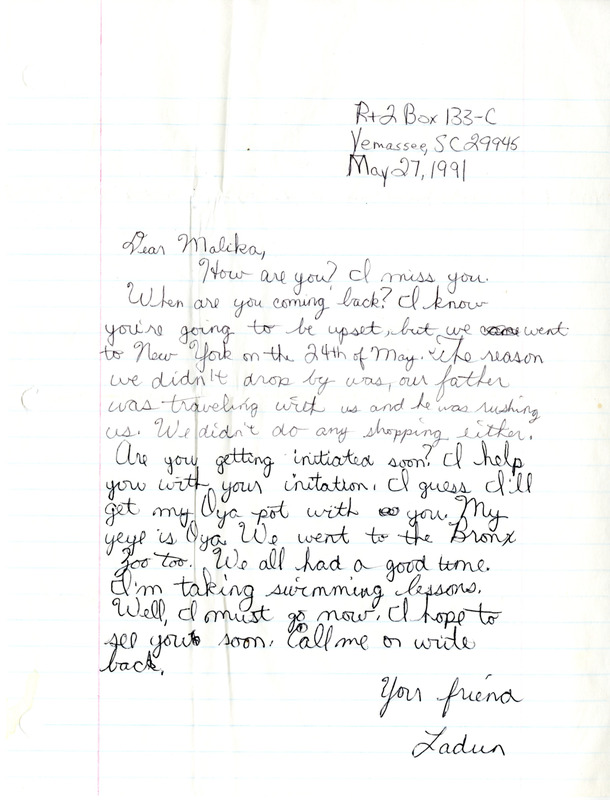
Frankye Adams-Johnson (Malika)’s friend Ladun Adaramola writes to apologize for not visiting the last time she and her family were in New York and that she hopes to see her soon.
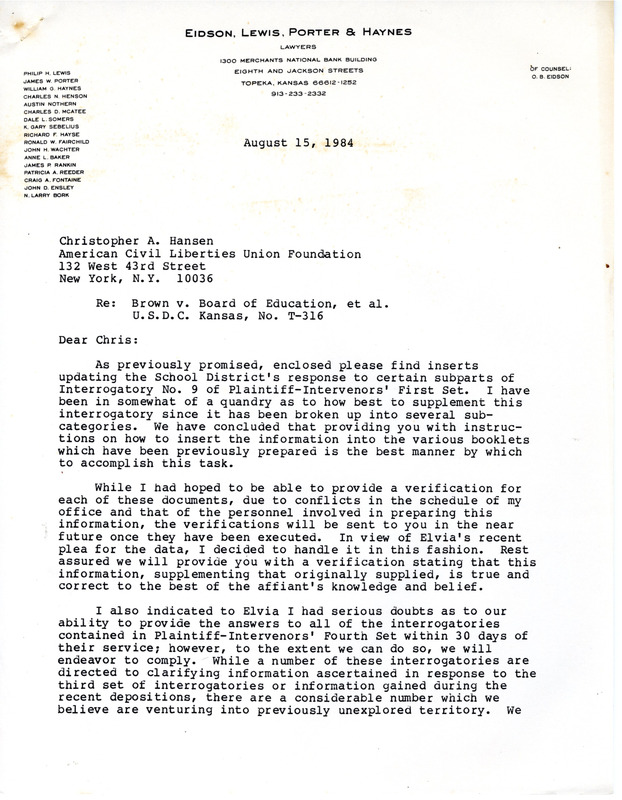
Lead Defense Attorney K. Gary Sebelius writes to ACLU Attorney Chris Hansen, stating that he might need more time to respond to certain interrogatories and that the scope of the discovery period might need to be narrowed.
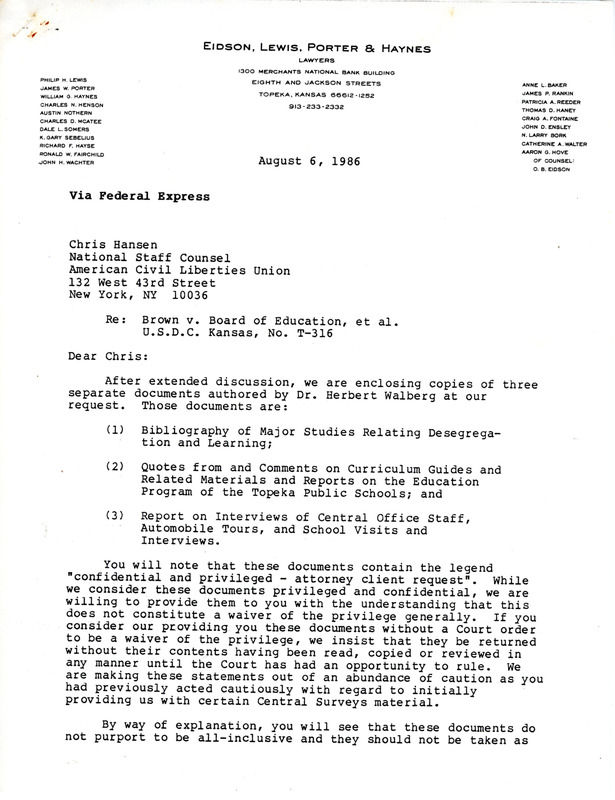
A cover letter from Lead Defense Attorney K. Gary Sebelius in response to ACLU Attorney Chris Hansen’s request for documents pertaining to the expert defense witness Dr. Herbert Walberg. Sebelius says he will send the documents before the deposition of Dr. Walberg even though they are marked “confidential and privileged.”
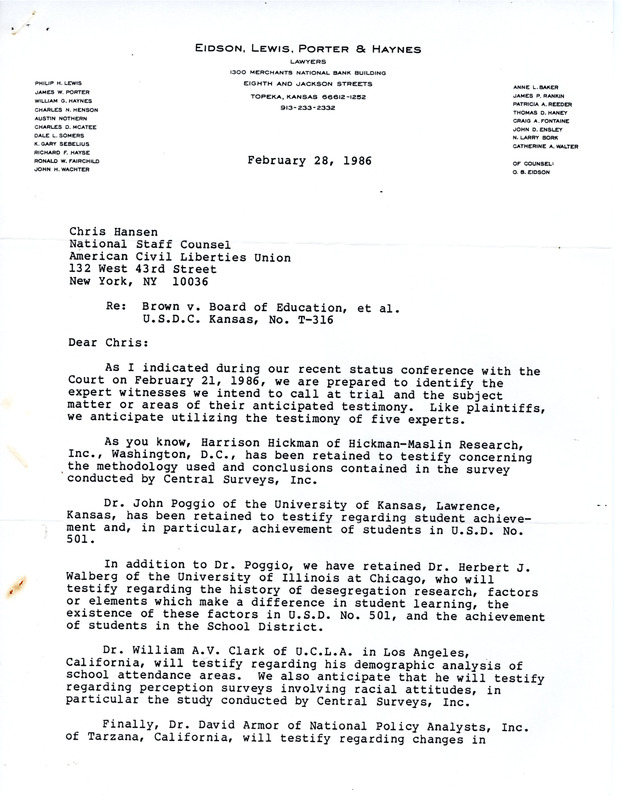
Lead Defense Attorney K. Gary Sebelius writes to ACLU Attorney Chris Hansen to provide a list of the 5 expert witnesses the defendants will call in the trial and also to request the names and subject matters for the plaintiffs' fact witnesses.
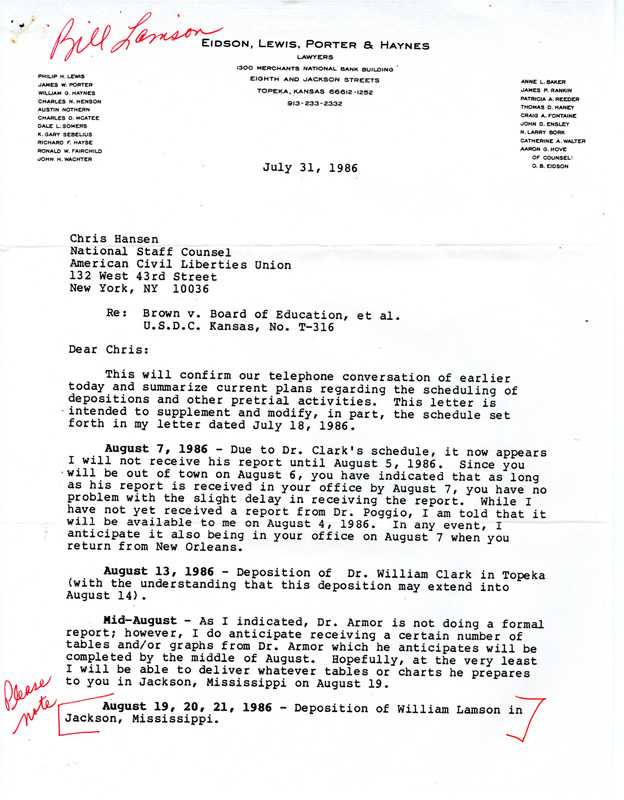
Lead Defense Attorney K. Gary Sebelius writes to ACLU Attorney Chris Hansen to inform him of changes made to the pre-trial deposition schedule. William Lamson's name is handwritten on the top of page one and refers to his deposition dates of August 19-21, 1986, in Jackson, Mississippi.
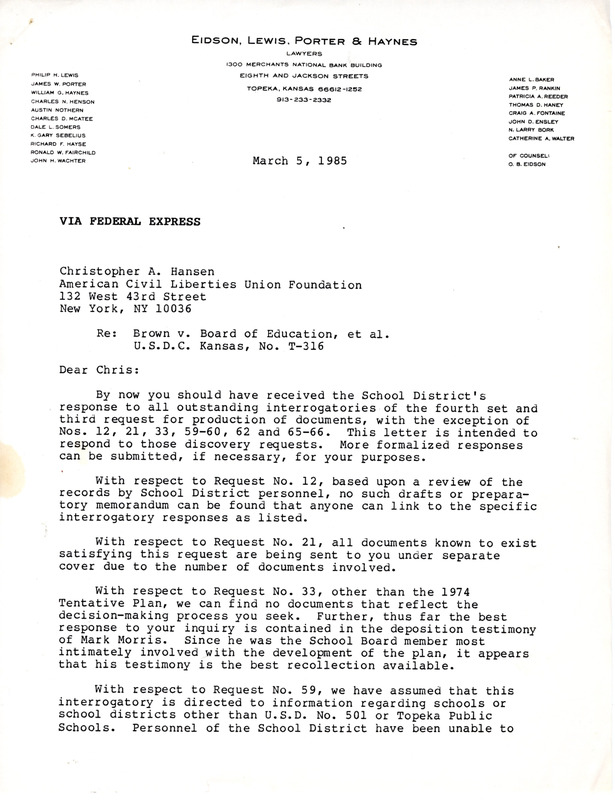
In this letter, Lead Defense Attorney K. Gary Sebelius responds to requests from ACLU Attorney Chris Hansen about several outstanding interrogatories of the fourth set and third request for documents. Sebelius offers explanations for some of the missing documents and also reports that some of the documents have already been delivered.
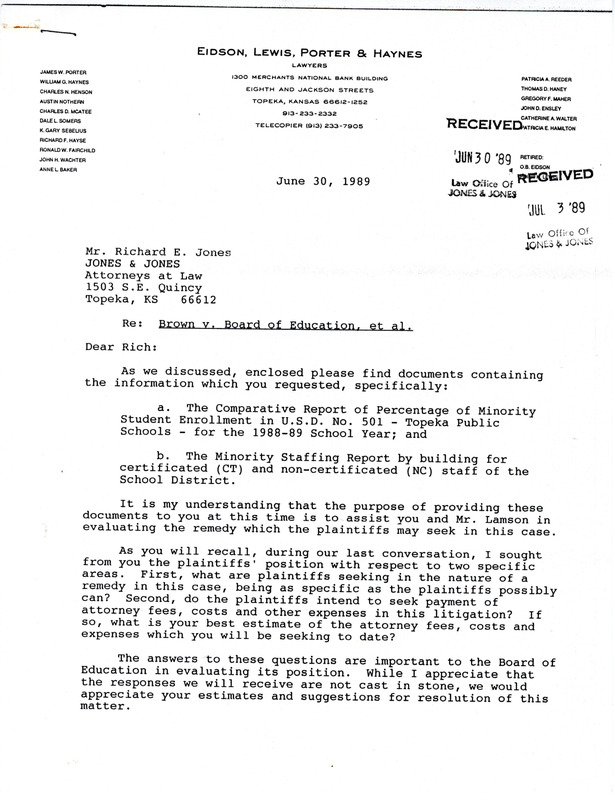
The letter contains several questions for Attorney Richard E. Jones as well as copies of two reports: comparative report on percentage of minority student enrollment in Topeka Public Schools for the 1988-1989 school year and a minority staffing report by building for certificated (CT) and non-certificated (NC) staff of the school district.
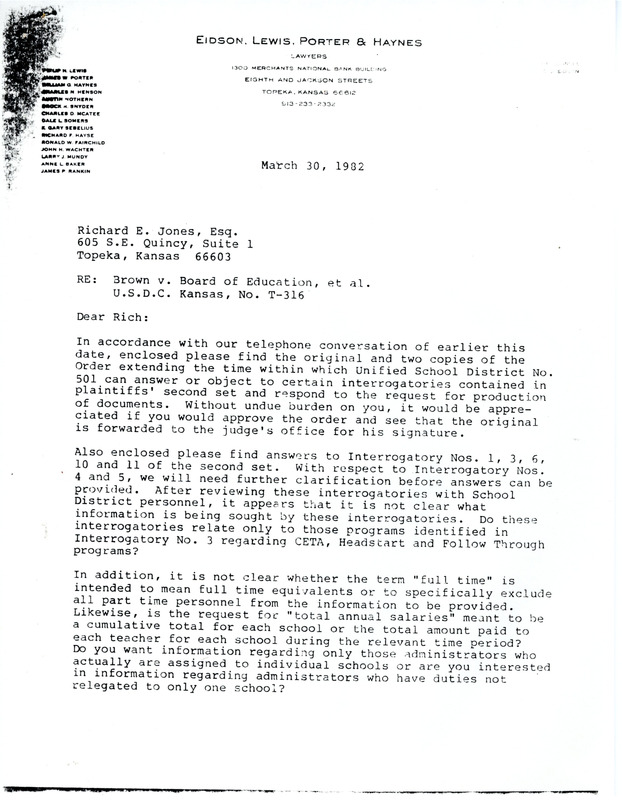
Lead Defense Attorney K. Gary Sebelius writes to Attorney Richard E. Jones. Mr. Sebelius is seeking clarification on a number of interrogatories and responses submitted by the plaintiff team. Specifically, there are questions on the meanings of some terms (“full time,” for example) and questions about cumulative vs. individual teacher salaries.
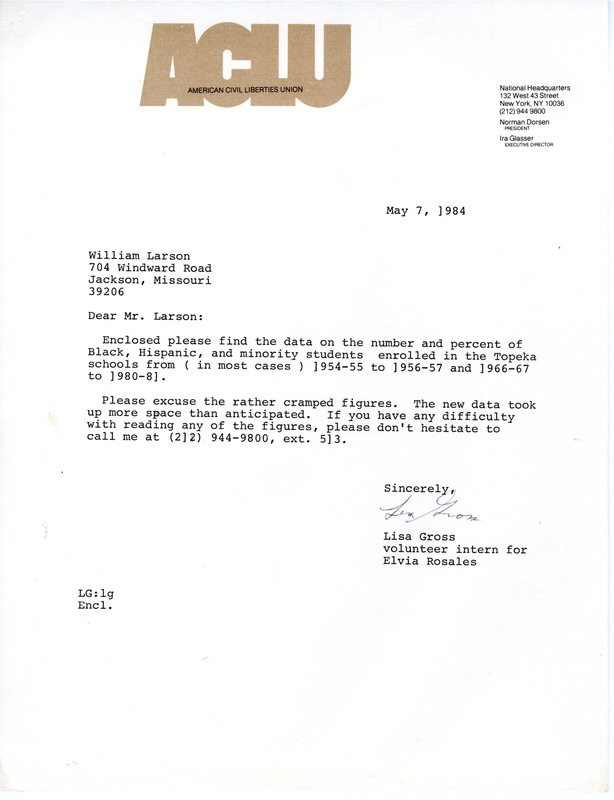
Lisa Gross, Volunteer Intern for Elvia Rosales of the ACLU, writes to William Lamson to inform him that she has enclosed data on the number and percent of Black, Hispanic, and minority students enrolled in the Topeka schools from 1954-55 to 1956-57 and 1966-67 to 1980-81.
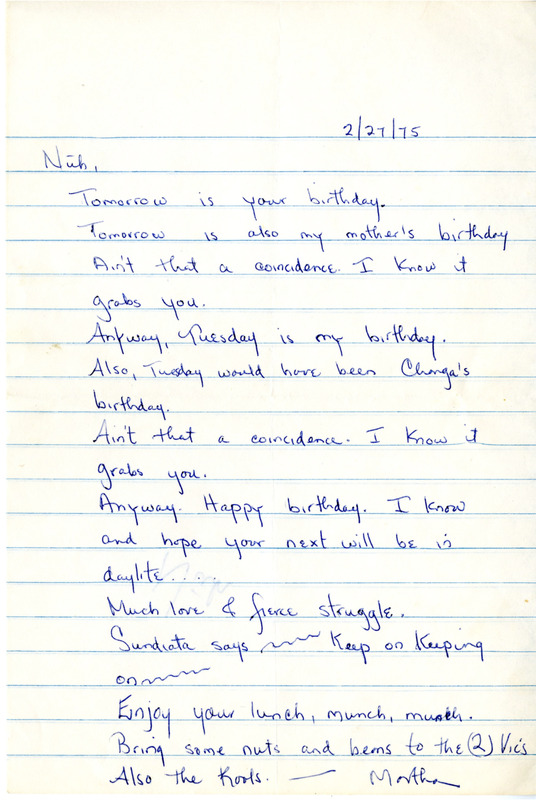
A letter to Nuh Abdul Qaiyum from Martha Pitts wishing him a happy birthday while he is in prison. The letter contains birthday messages from others as well, including Assata Shakur (Joanne Chesimard) and Sundiata Acoli. Both of those birthday wishes were relayed through Martha Pitts, who was a friend and confidant to each of them.
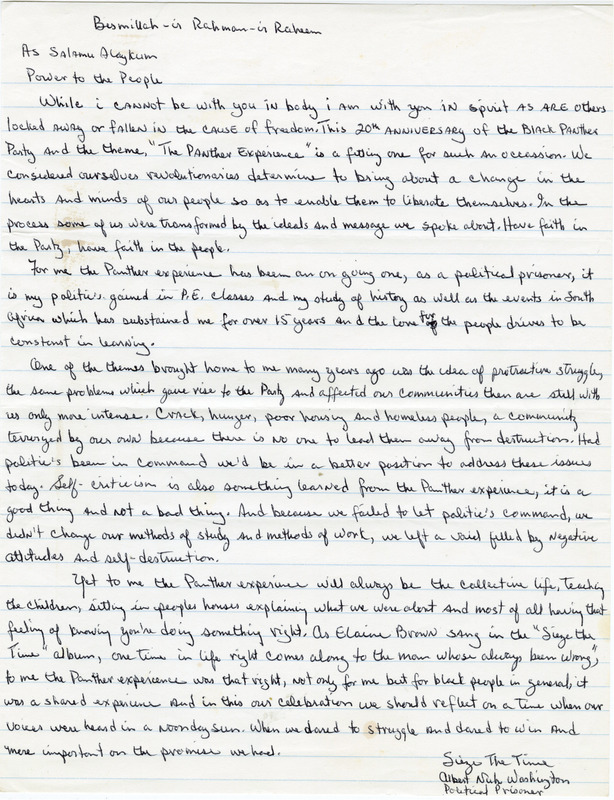
A letter from imprisoned Black Panther Party member Nuh Abdul Qaiyum on the occasion of the 20th anniversary of the Black Panther Party in 1986. He writes about the Black Panther Party, its impact, and its legacy. He explains the void that the Party left in the community after its end due to having no political power.
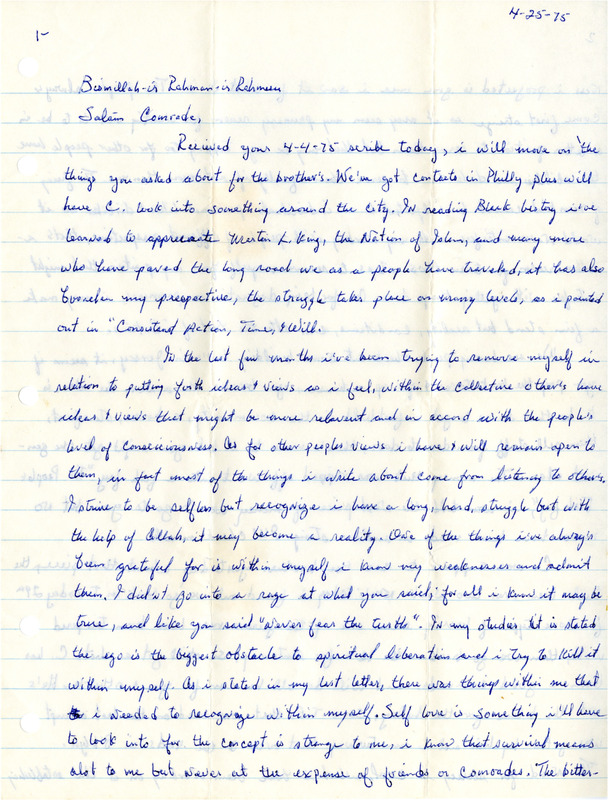
A letter from Nuh Abdul Qaiyum, who is imprisoned, to an unnamed fellow revolutionary. He notifies the recipient that he is ready to move whenever he is called. He also explains the many internal battles that he faces, his efforts in the community to gain control, and his upcoming legal proceedings.
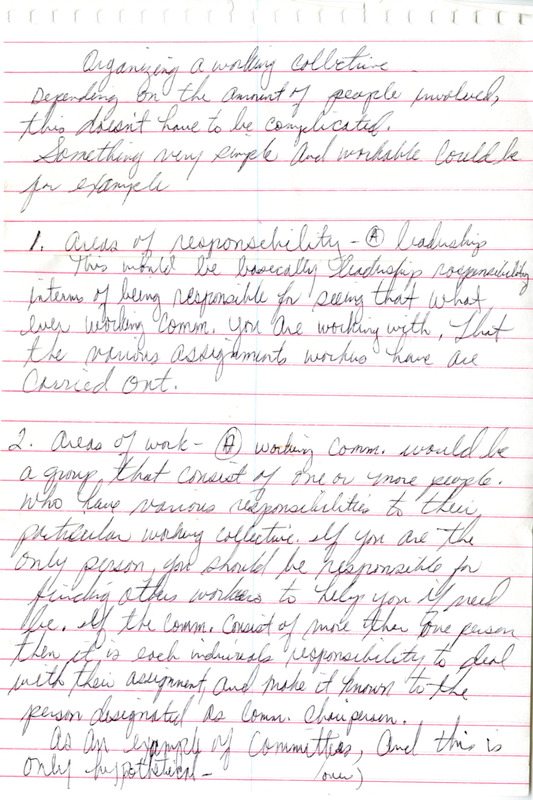
A letter from Nuh Abdul Qaiyum, who is imprisoned, to an unknown recipient. He gives an outline on how to organize the Black Panther Party members into organized units and working committees, based on the purpose the members serve, how these committees should interact with one another, and how leadership can create comradery in the members.
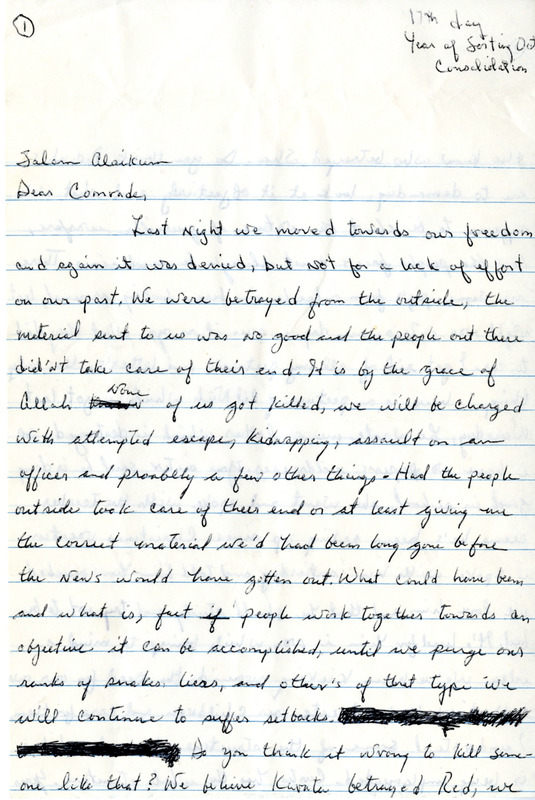
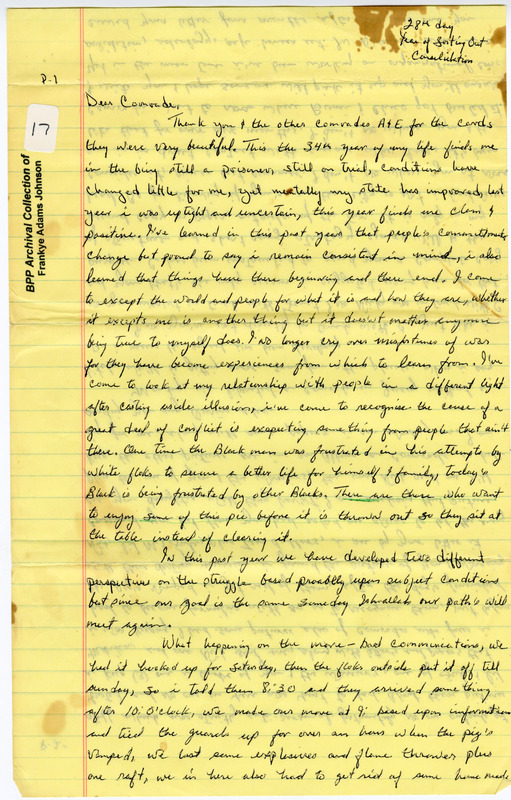
A letter from Nuh Abdul Qaiyum, who is imprisoned, to his wife Frankye Adams-Johnson (Malika). He details his latest attempt at freedom that fell short. He mentions his children and love for her before discussing legal proceedings and life. The letter is dated “17th day year of sorting out consolidation.”
A letter from Nuh Abdul Qaiyum, who is imprisoned, to his wife Frankye Adams-Johnson (Malika). He discusses the long time that it takes her to respond to his letters before updating her on various matters, events, and operations within the Black Panther Party. The letter is dated “28th day year of sorting out consolidation” and “Sunday the 2nd’”
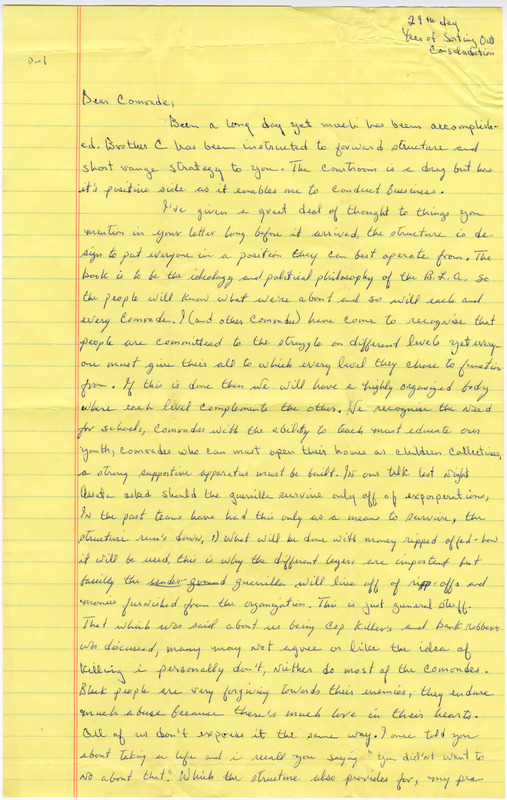
A letter from Nuh Abdul Qaiyum, who is imprisoned, to his wife Frankye Adams-Johnson (Malika). He explores the importance of a uniting structure among the revolutionaries and Black Liberation Army (BLA) and writes about Allah's power and keeping the faith. The letter is dated "29th day, year of sorting out consolidation.”