This collection highlights the vibrant and diverse environments of HBCU communities through a selection of documents, visual artworks, and oral histories.
Description
HBCUs signify the strength, self-love, and educational success of African Americans. From slavery to Jim Crow, these educational temples held a belief in Black excellence and became records of intellectual, creative, and humanistic prowess in the struggle for freedom.
Date Modified
2025-12-17
About This Record
The HCAC public history focused digital archive cataloging is an ongoing process, and we may update this record as we conduct additional research and review. We welcome your comments and feedback if you have more information to share about an item featured on the site, please contact us at: HCAC-DigiTeam@si.edu
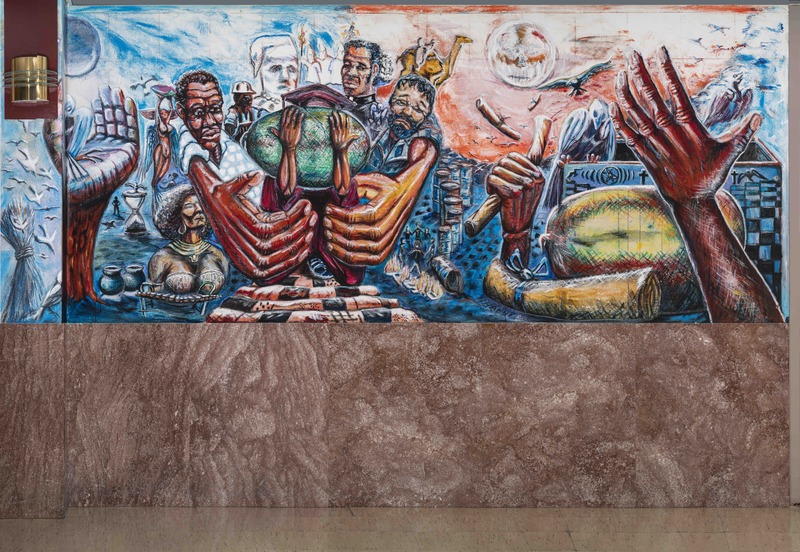
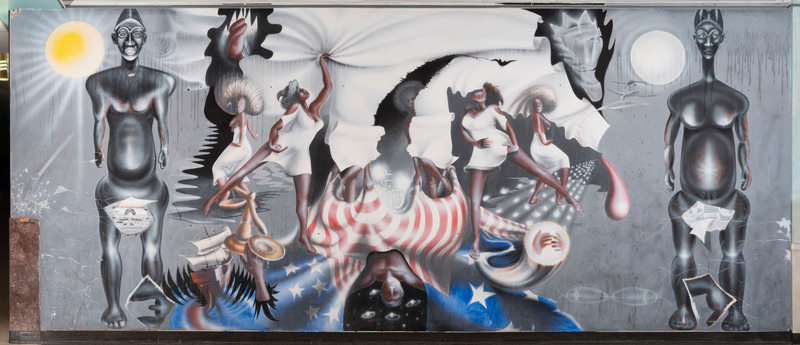
The artist boldly tackles the often stereotypical image of the watermelon while depicting the hypocrisy of organized religion in the Black community and the constant threat of the Klan. The large, reaching hands pull at a recent graduate, whose face is obscured by the watermelon they are holding.
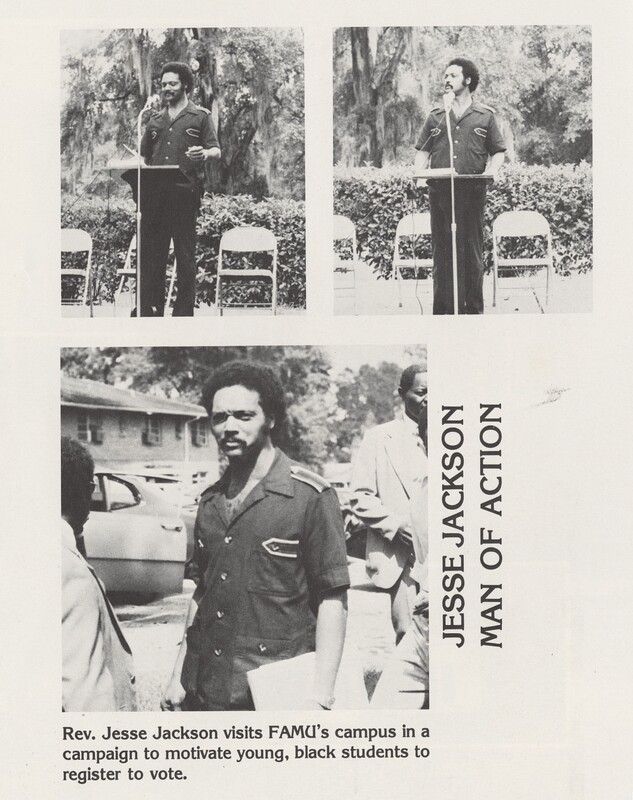
Reverend Jesse Louis Jackson was a civil rights leader who began activism in the 1960s. In the 1980s, he launched two presidential campaigns, ultimately losing the Democratic nomination, but not by expected large margins. In 1981, Jackson visited Florida A&M University to encourage students to register to vote.
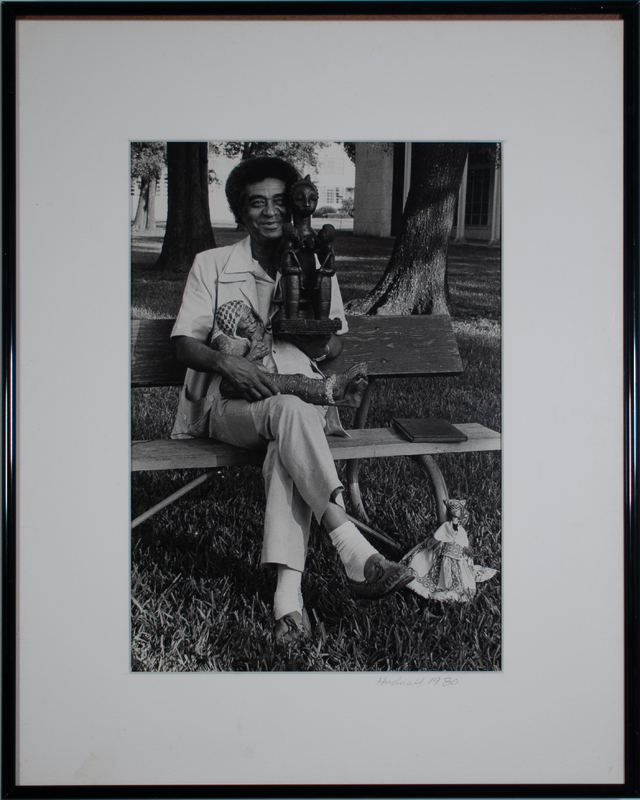
This photograph by Earlie Hudnall, Jr. shows John Biggers seated on a bench near Texas Southern's Fairchild Building. He holds a mother & child sculpture in his left hand and an Aunt Dicy sculpture in his right. A mammy doll is seen to his left on the ground. In 1955, Biggers illustrated J. Mason Brewer's version of the African-American folktale, Aunt Dicy Tales: Snuff-Dipping Tales of the Texas Negro.
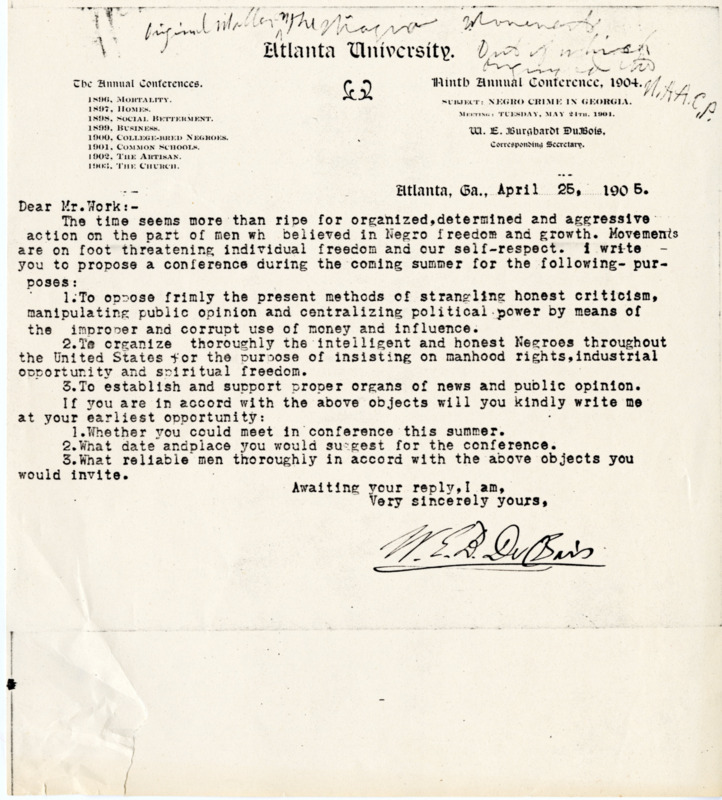
One-page letter from Dr. W.E.B. DuBois to Monroe Work asking him to attend a conference in the coming summer to discuss methods of uplifting the black community. The Niagara Movement and N.A.A.C.P. are written on top of the letter.
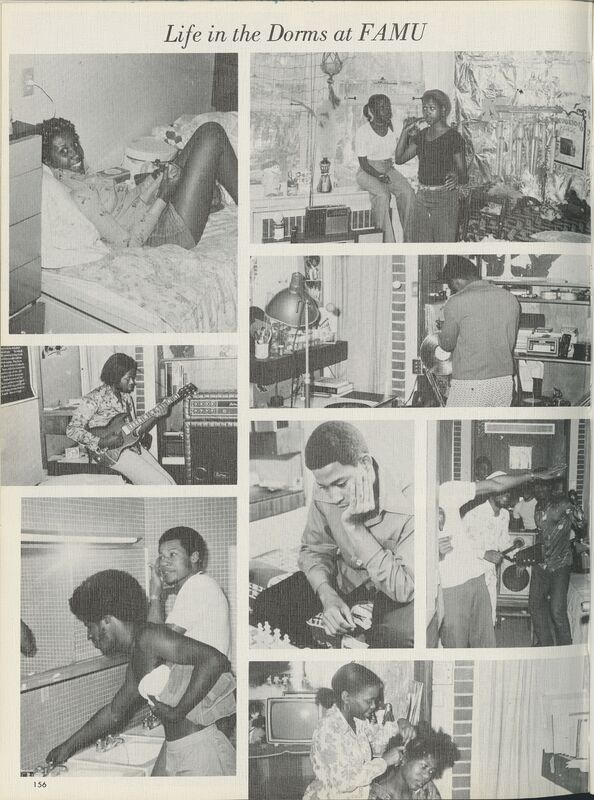
This black-and-white full-page spread featured in the 1975 Rattler Yearbook gives viewers a rare glimpse into the inner lives of Florida A&M University students. In dorm life, regular aspects of Black culture appear like braiding hair with roommates or playing chess. The next page also shows the inclusivity brought by the accessible cafeteria.
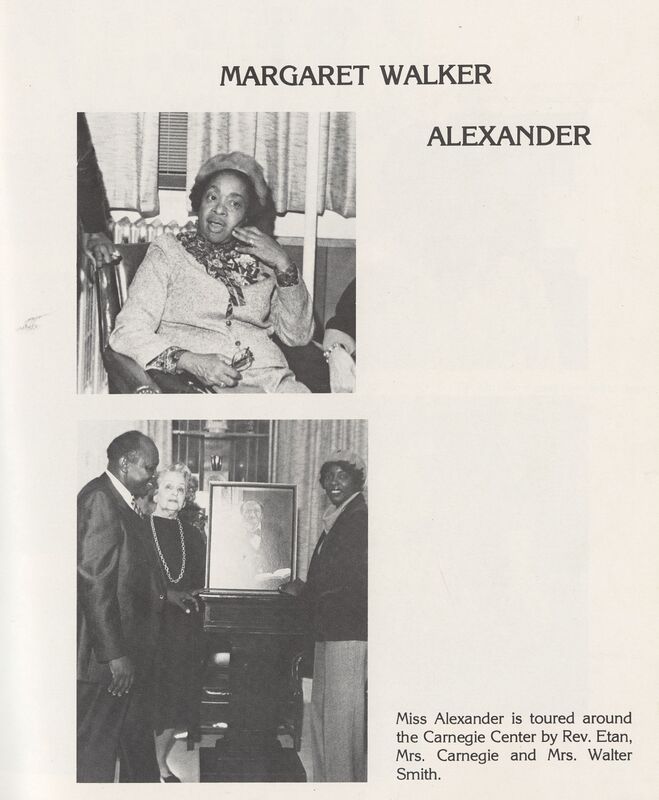
Margaret Walker was a poet best known for her role in the Chicago Black Renaissance, a Black literary movement. Her first poetry collection, For My People, won the Yale Series of Younger Poets Award, making her the first Black woman to do so. 1981, she visited the Carnegia Center, a.k.a Carnegie Library, at the Meek-Eaton Black Archives.
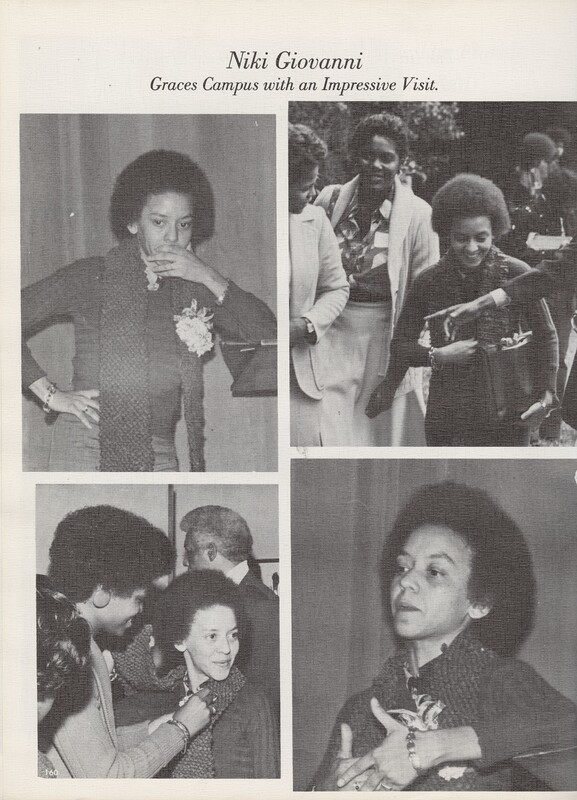
Nikki Giovanni, a highly awarded African American poet, visited the campus of Florida A&M University in 1975. In these images, Giovanni is seen being gifted a corsage by students, walking around campus, and speaking on a stage.
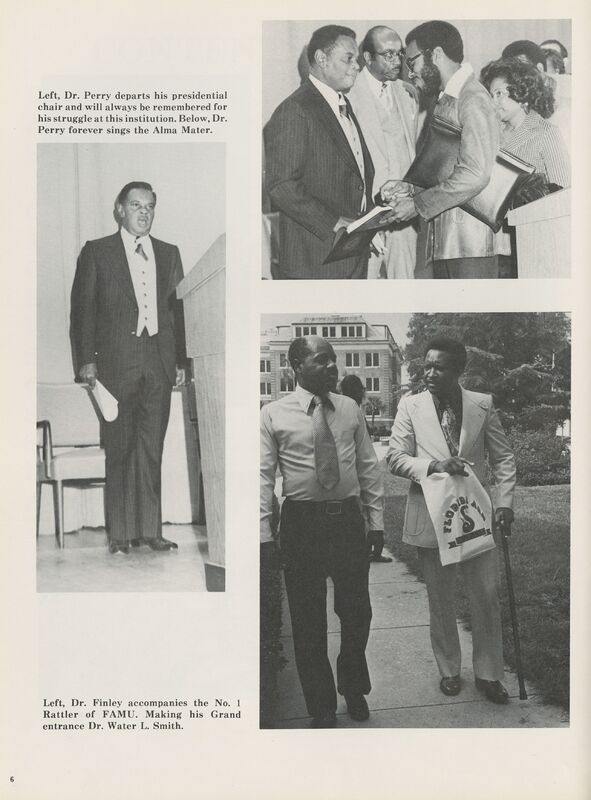
These images were featured in the 1978 Rattler Yearbook. It shows the transition of Florida A&M president Dr. Benjamin L. Perry to new president Dr. Walter L. Smith. Perry is seen singing the FAMU Alma Mater while Smith strolls around campus with faculty member Dr. Finley.
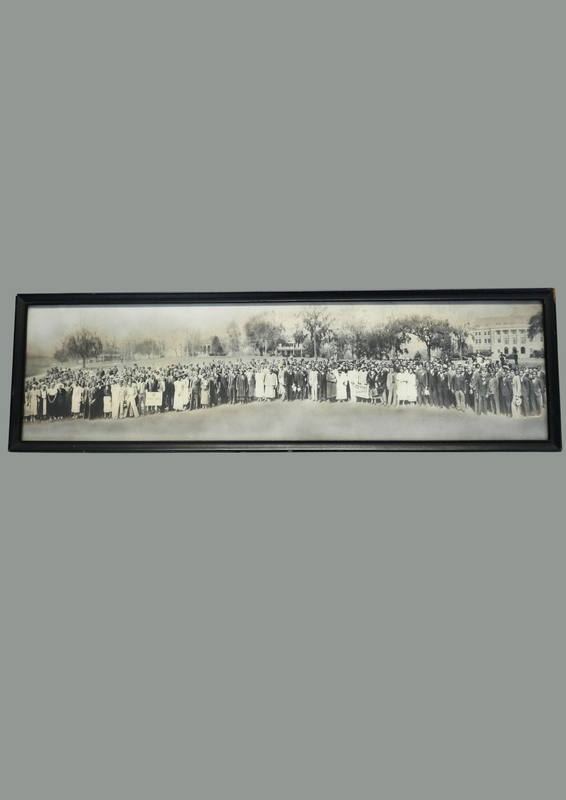
A 1934 panoramic group picture on the campus of Florida A&M University. The picture was taken in the midst of the Great Depression. It captures members of the Fourth State Basketball Tournament, and members of the 42nd Annual Florida State Teachers Association (FSTA), including Dr. Mary McLeod Bethune, founder of Bethune Cookman College.
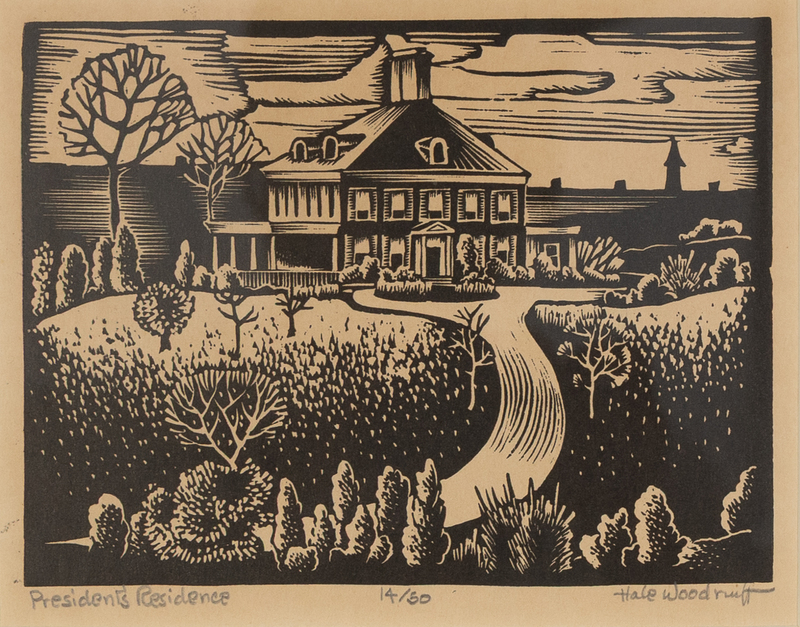
Hale Aspacio Woodruff was an artist and art educator known for his murals, paintings, and prints from Cairo, IL. "President's Residence" depicts the housing provided to Atlanta University's presidents affectionately known as Happy Hill.
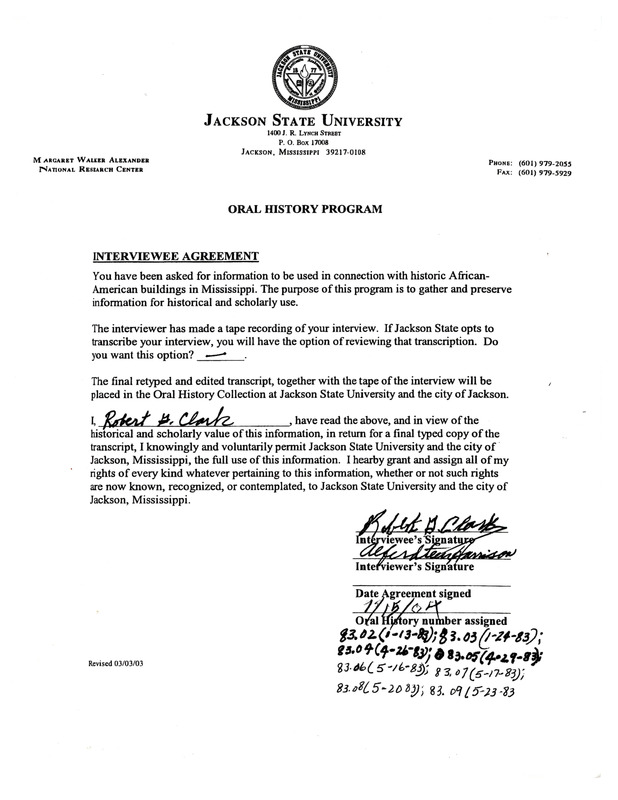
Rep. Robert G. Clark served in the Mississippi House of Representatives from 1968 to 2004. He was the first African-American member of the Mississippi Legislature since 1894. In this interview, Rep. Clark summarizes in detail his time at Jackson State College.
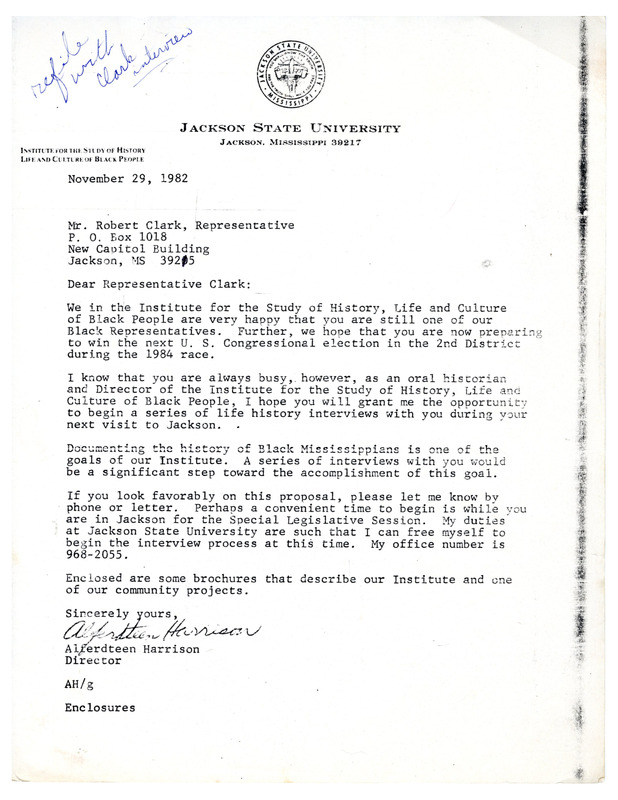
Collection of materials leading up to Robert Clark speaking on campus at Jackson State University for the 1983 Afro-American History Month Celebration. There are letters of invitation from Dr. Alferdteen Harrison as well as a biography of Robert Clark and the event program.
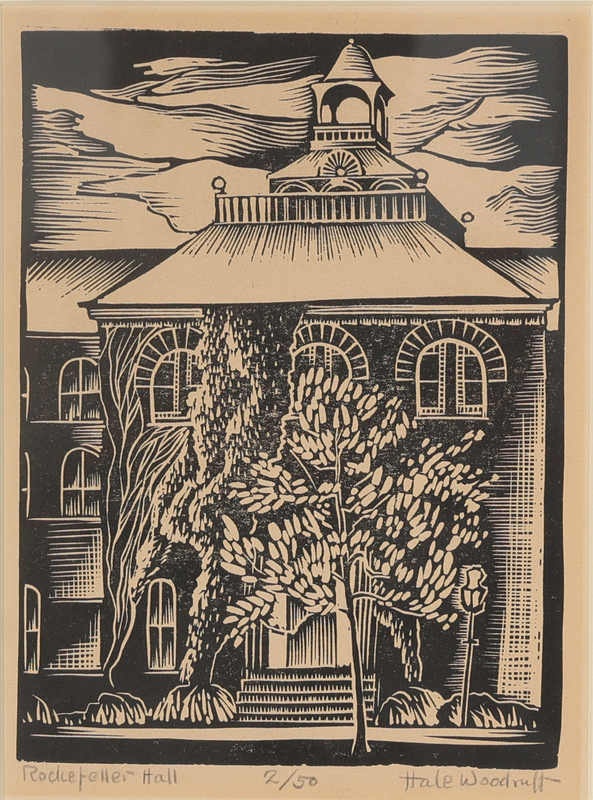
Hale Aspacio Woodruff was an artist and art educator known for his murals, paintings, and prints from Cairo, IL. "Rockefeller Hall" is Spelman College's oldest building, named after John D. Rockefeller and the Rockefeller family, who were major contributors to Spelman's founding and development. The five-floor building is located beside the President's Cottage and currently serves as an administrative building housing offices for the President, Vice President, Provost, and Academic Deans. Rockefeller is listed on the National Register of Historic Places .
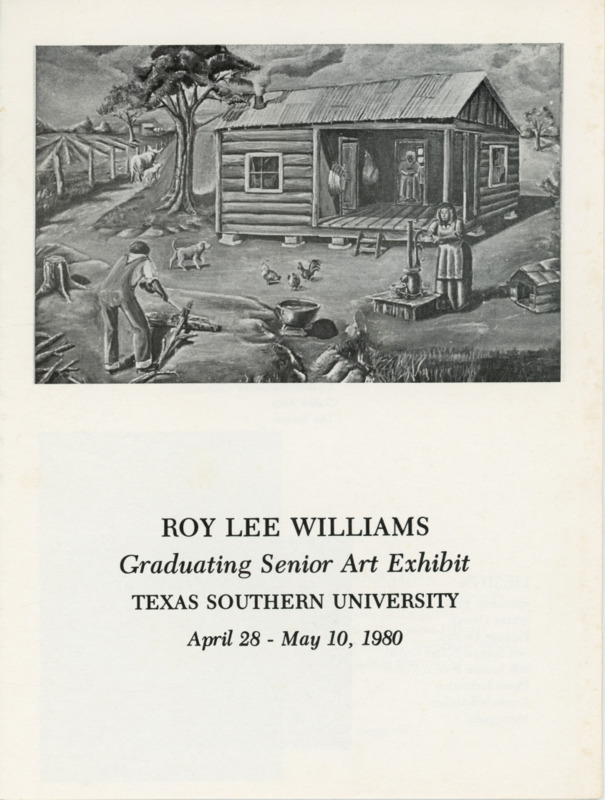
This is a brochure for Williams’ senior art exhibition. The culmination of the Texas Southern art curriculum is a senior exhibition where students showcase artwork created over the course of their undergraduate studies. The brochure features a portrait of Williams, a brief biography, a catalog of the artwork featured in the exhibition, and several photos of his paintings, designs, weavings, and sculptures.
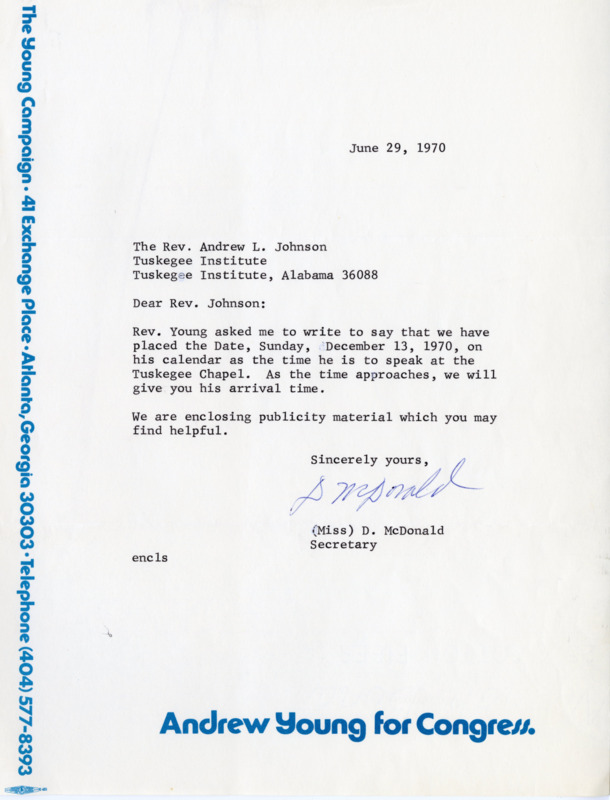
A Letter from Miss Dora McDonald to Chaplain Johnson that Congressman Andrew Young has saved the date of 12/13/1970 to speak at Tuskegee on his calendar.
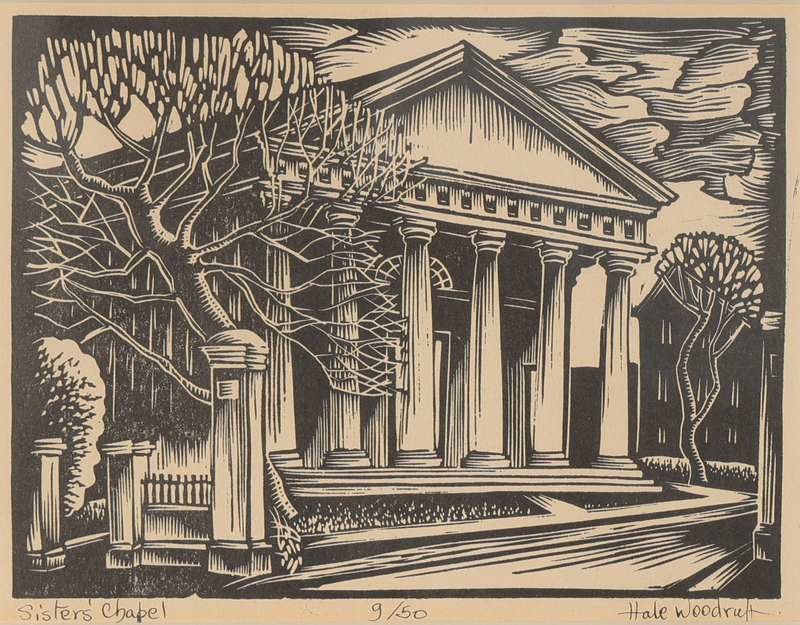
Hale Aspacio Woodruff was an artist and art educator known for his murals, paintings, and prints from Cairo, IL. "Sister's Chapel" depicts a religious building on Spelman College's campus. Sister's Chapel now serves as a center for students to engage in theology through Womanist theory and praxis.
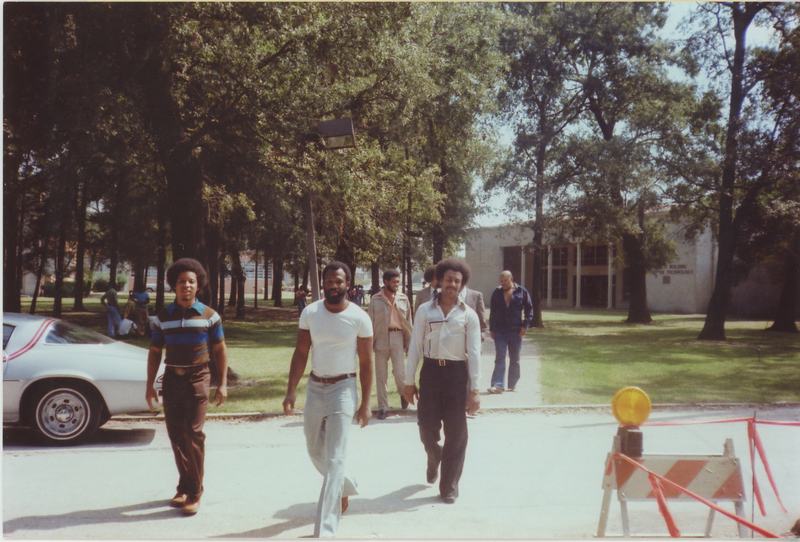
Pictured here, left to right, are Texas Southern art alumni Bert Samples, John C. Davis, Harvey Johnson, Leon Renfro, former art student Rickey Donato, and Professor Carroll Harris Simms walking on the campus of TSU. Johnson and Renfro would later go on to teach art at TSU.
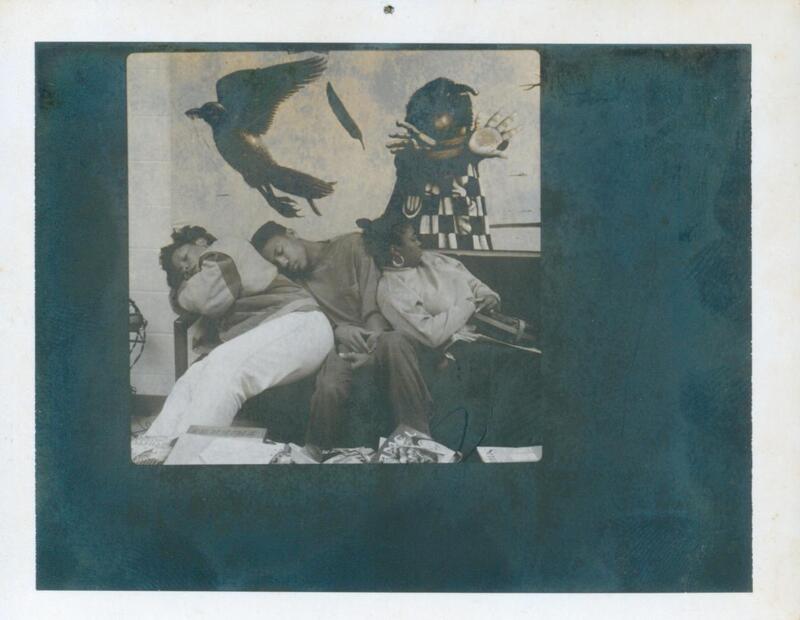
This photograph shows three students sleeping on a couch in the lounge of Texas Southern University’s John T. Biggers Art Center. Captured by longtime campus photographer Earlie Hudnall Jr., the students rest while Oliver Parson’s The Crucifix (Judas) hangs behind them. Selections from the Permanent Collection are displayed in the art building on a rotating basis. Hudnall was a student, mentee, and friend of Dr. Biggers.
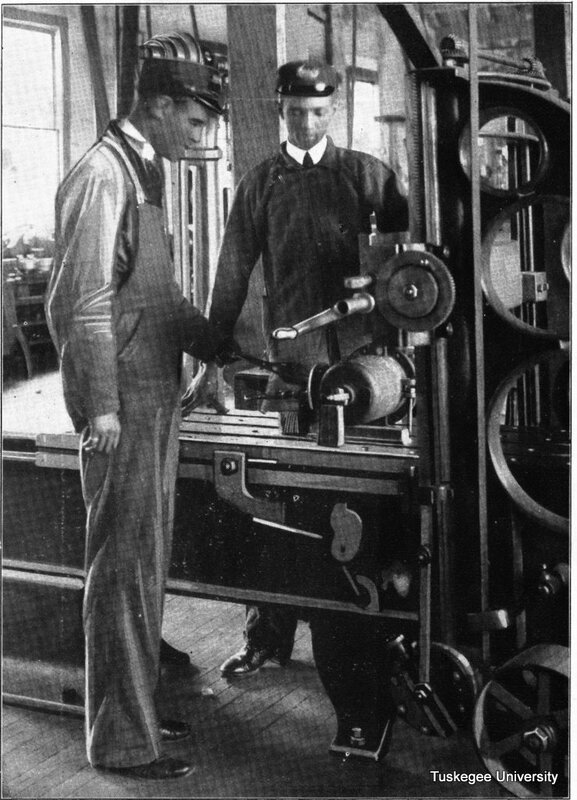
A black-and-white image of two male Tuskegee Institute students operating a planer machine in a metalworking or woodworking class in the early twentieth century.
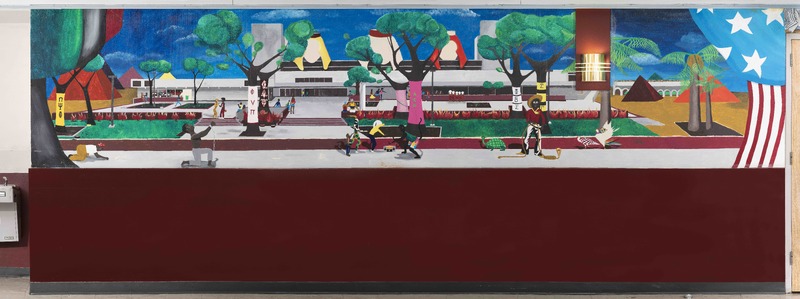
Focusing on the Sterling Student Life Center, the artist captures the lively activities of students and reflects the importance of Black fraternities and sororities in HBCU student life. Realism is paired with the surreal imagery of fantastic figures dancing around the music blasting from a boombox.
A commentary on the conflict between technology and progress, history and culture, Davis painted this mural in response to the destruction of several Hannah Hall murals to create windows into a new computer lab. Davis’ own mural was later damaged by subsequent construction, as foreseen in its design.
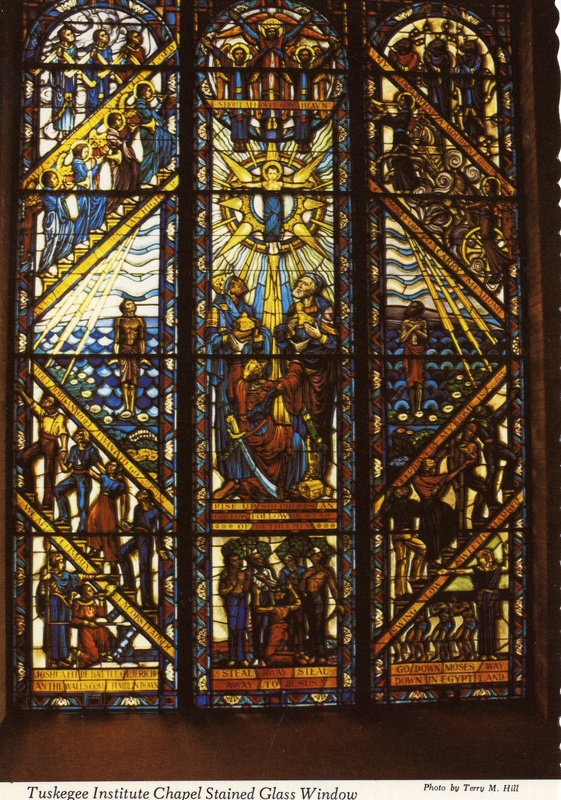
A colored image of the interior of Tuskegee Institute Stained Glass Window, taken by Terry M. Hill. This stained glass window, created by J & R Lamb of New York, depicts eleven Negro spirituals.
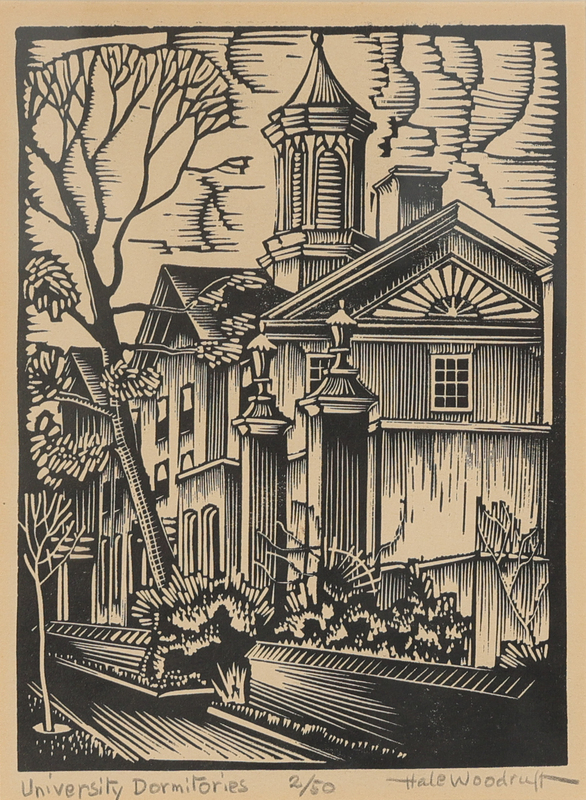
Hale Aspacio Woodruff was an artist and art educator known for his murals, paintings, and prints from Cairo, IL. "University Dormitories" depicts a student housing building likely on the campus of one of the colleges and universities historically associated with the Atlanta University Center (AUC): Atlanta University, Clark College, Morehouse College, Spleam College, or Morris Brown College.
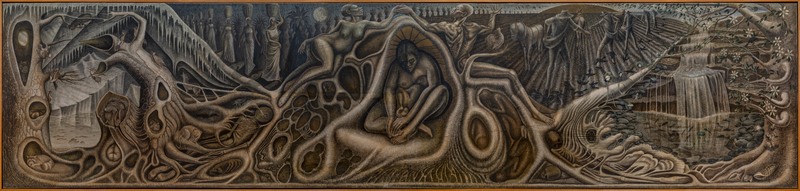
Biggers completed work on this mural in 1959 after returning from his UNESCO fellowship in West Africa. Originally installed in the Samuel M. Nabrit Science Building on Texas Southern’s campus, it is now located in the University Museum. Mother Nature is at the center of this work, surrounded by embryos and skeletons, animals and fish, and men and women. It speaks to the interconnectedness of life.
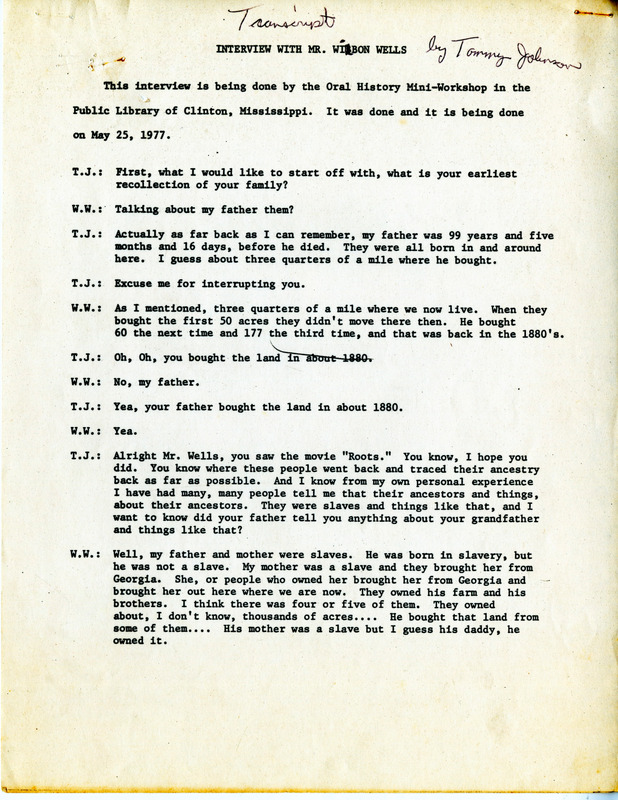
Mr. Wells had roots in the Clinton community, going back to his parents' ancestry in slavery. He discusses his time in the military during World War I, his education at Jackson State, and Black land ownership in Clinton, especially the amount of Black people who lost or gave up land during The Great Migration.