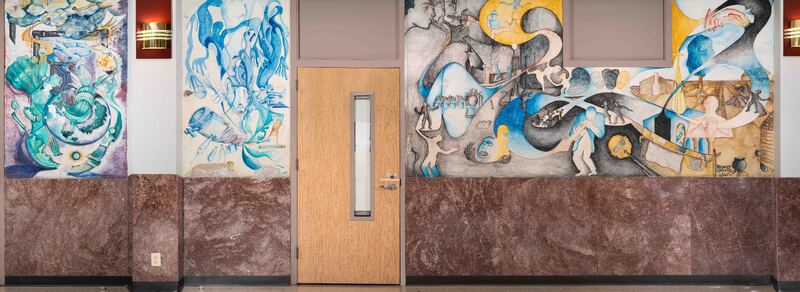
The Hannah Hall murals include more than 84 student murals painted on the walls of Texas Southern University's second-oldest building, a selection of which is featured in this collection. Created between 1951 and 2013, the murals cover a wide variety of subjects, including the Civil Rights Movement, Black power, religion, rural life in Texas, fantasy, and more. The mural program was created by Dr. John T. Biggers, founder of Texas Southern's art department.
Curated By
Ben Schachter
Rita Reyes
Contributing Institution
Texas Southern University
About This Record
The HCAC public history focused digital archive cataloging is an ongoing process, and we may update this record as we conduct additional research and review. We welcome your comments and feedback if you have more information to share about an item featured on the site, please contact us at: HCAC-DigiTeam@si.edu
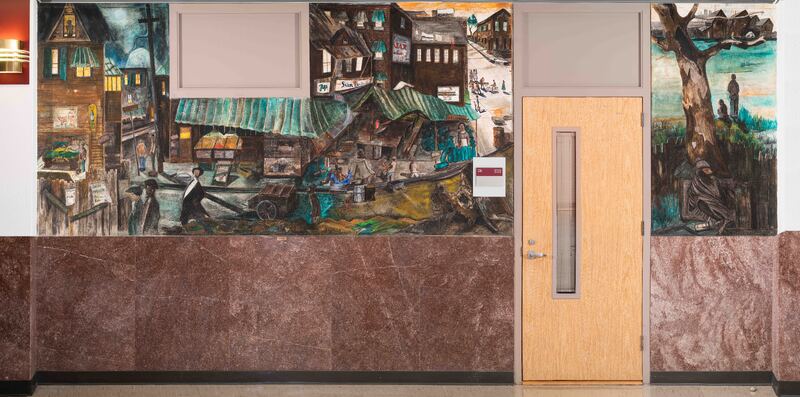
Taylor offers a snapshot of Houston’s Third Ward in the mid-20th century. Growing up in Third Ward, Taylor saw it grow and change. The scene is a busy one and depicts various storefronts and residents of the neighborhood. Taylor named the pool hall in the lower left corner after himself.
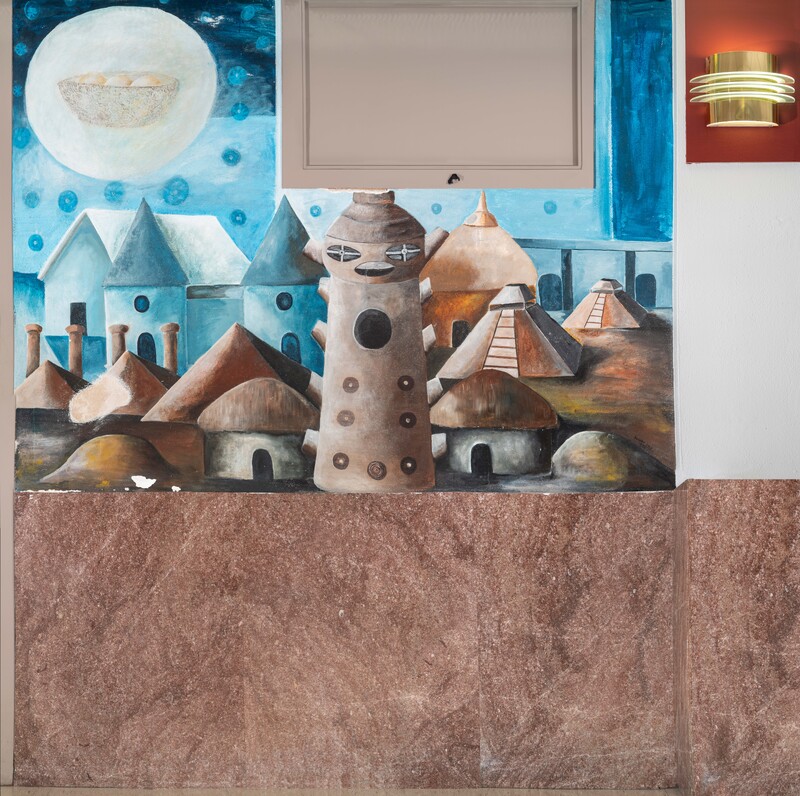
Lacy’s mural depicts houses from a variety of different civilizations and cultures, ranging from small circular huts to step pyramids. The center structure is a depiction of the terracotta sculpture she created under the instruction of Professor Carroll Harris Simms.
Gordon’s mural examines her own life and personal development. A wispy fabric running through the mural serves as a metaphor for her emerging self-awareness; this motif is found in some of her other works. Gordon’s mural showcases herself working on several art projects from her undergraduate period.
Burley’s vibrant mural explores cycles of life and focuses on women. The left conveys night and includes a female constellation. The right shows daytime, with plants and animals. A rainbow runs across, signifying unity. The large, detailed hand is a frequent motif in the art of Biggers’ students.
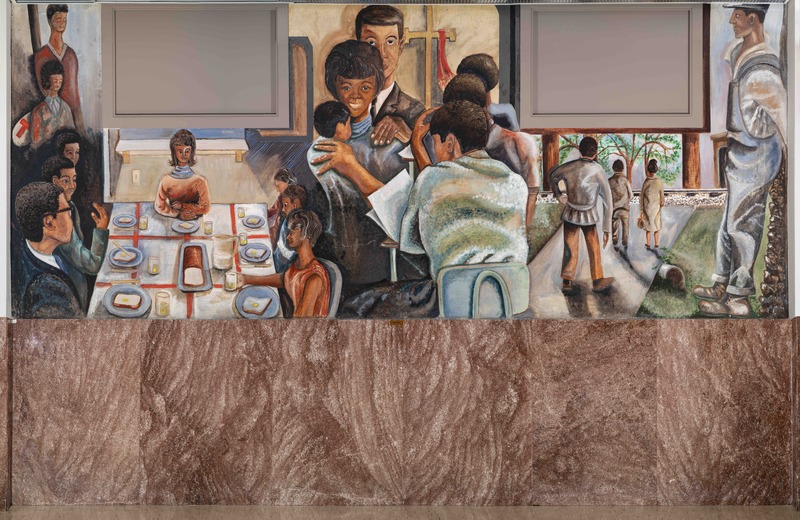
Mass depicts scenes of family life, including a gathering at the dinner table and church services. The laborer at the far right suggests the role of physical work in sustaining the Black family. As in other murals, architectural elements from Hannah Hall are incorporated in this mural.
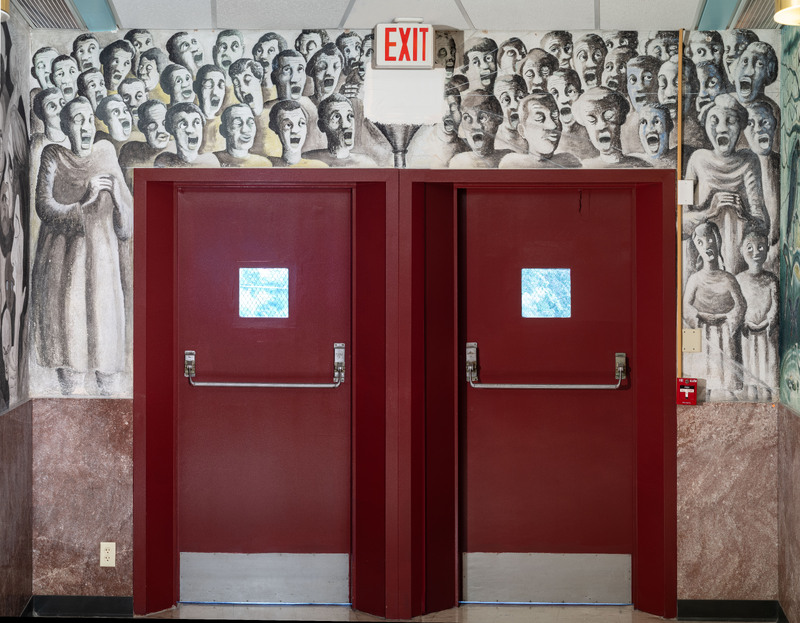
A full church choir sings passionately. Hatter chose this location to make use of the rectangular shape of the doorway, suggesting the arrangement of a choir standing on risers. The exit sign, which was previously embedded on the wall, cast rays of light across the choir members’ faces.
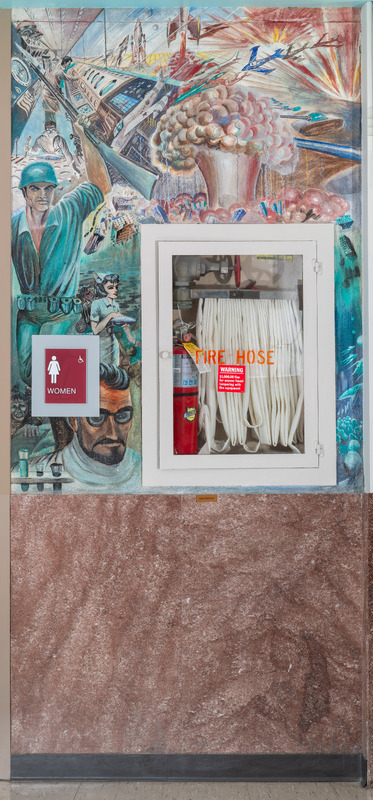
Portraying the brutality of war in the mid-twentieth century, McCowan, a veteran, integrates the wall’s architectural elements (a fire hose and extinguisher) to highlight the tension of the scene. The mushroom cloud above the fire hose highlights Cold War-era anxieties.
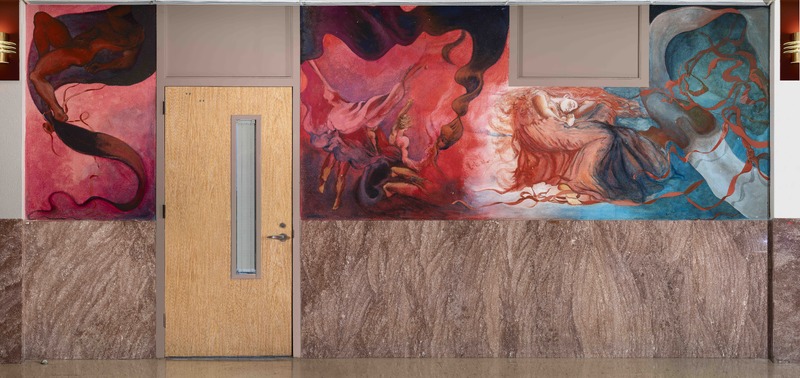
Oliver’s mural contains an homage to Frederic Leighton’s Flaming June. The central figure is surrounded by vast, flowing patterns of deep red, reddish-brown, pink, and aqua, in the midst of which two figures seem to struggle against the energized space, while the female figure remains in deep sleep.
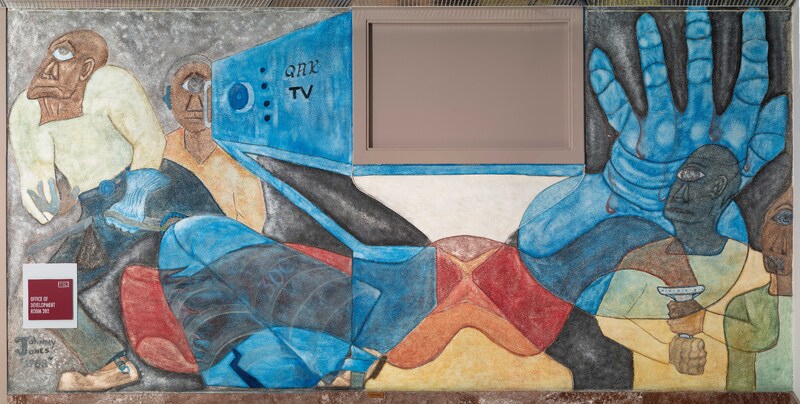
Jones’ surrealistic mural depicts bald, cyclops-like men conducting a television broadcast. Jones incorporated architecture into the design by using a window, since painted over, as the camera’s lens. A man beneath the camera carries a torch with a strong, flowing flame.
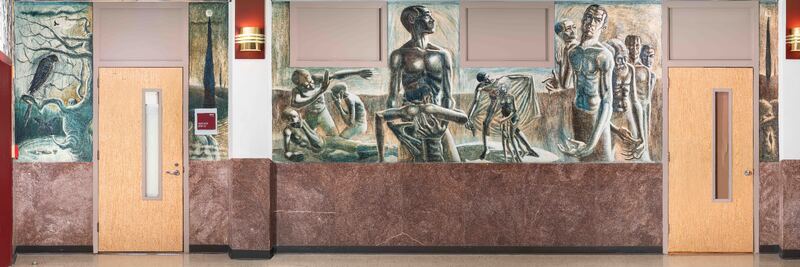
This is a universal scene of the despair and struggle facing a group determined to survive. The lone tree in the moonlight starkly symbolizes the darkness surrounding the scene (center left panel), while the tree rising from a swamp (leftmost panel) suggests hope with the bird, butterfly, and waterlily indicating transformative beauty.
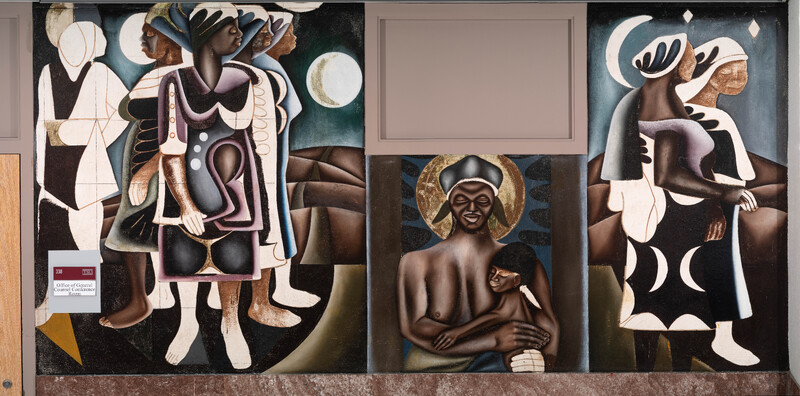
Cleinmann’s mural displays multiple generations of Black women, a manifestation of Biggers’ teachings about their importance. The mural is one of the few unfinished murals in Hannah Hall. Typically, unfinished murals were painted over. The mural was recently restored by conservators.
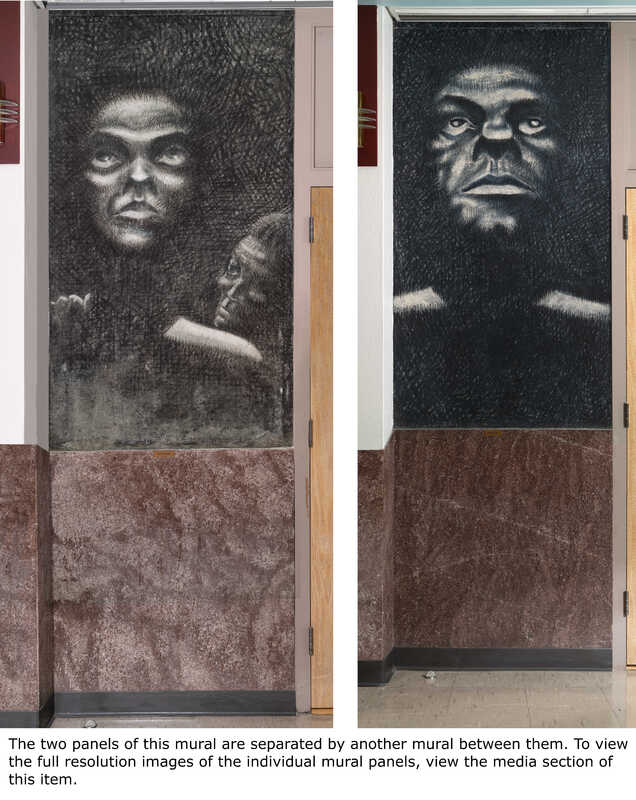
The graphic strength of Oliver's portraits is clearly evident in these two panels. By limiting his palette to black and white, the artist underscores the powerful gazes of the figures. Because of his enthusiasm and talent, Oliver was allowed to create additional murals when empty spaces were available.
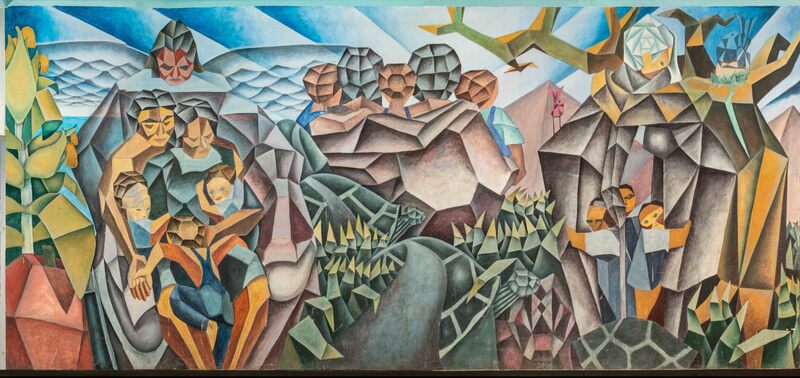
Sifuentes shows multiple generations of a family, painted in a geometric style. Sifuentes borrows visual symbols from his teacher, Dr. Biggers, including the tortoise (longevity) and the serpent (danger and rebirth). Guardian ancestors are represented by figures with angel wings.
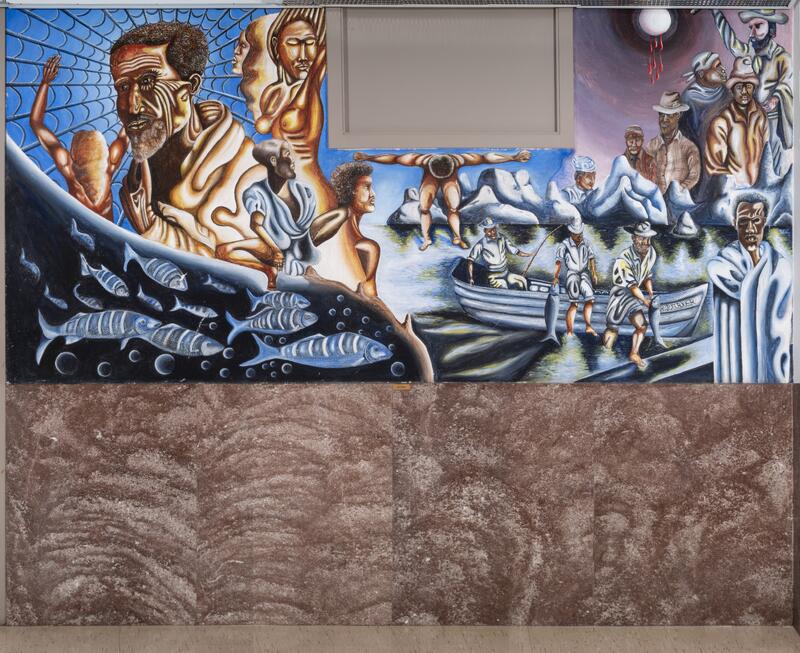
The mural shows fishing life along the water. In the middle and on the right, a man is doubled over from his burden, while a group of fishermen brings their catch to shore. On the left, an elderly man and other figures suggest the trials and challenges of the ancestors.
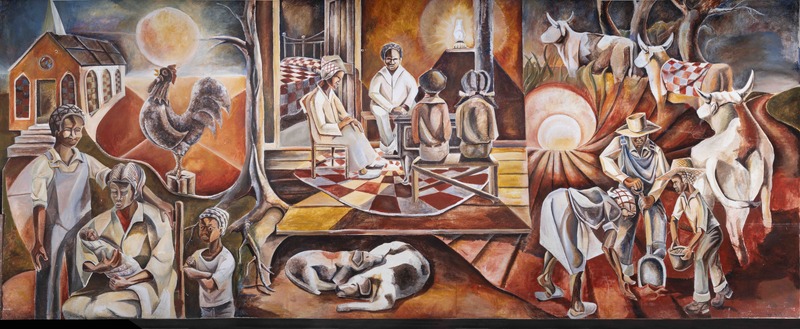
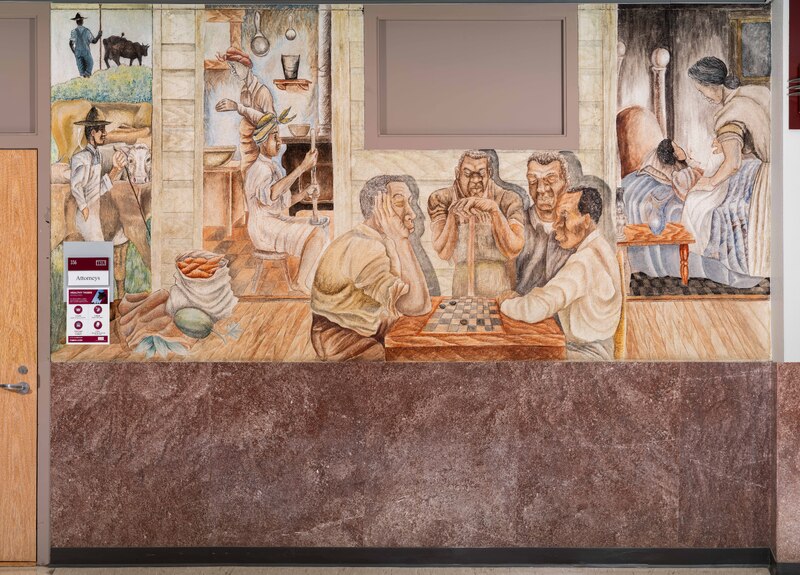
In a triptych style, Williams’ mural shows three central themes: a family gathered around a newborn (religion), seated near a hearth (home), and working together in the fields (labor). Black rural life is a major subject in the Hannah Hall murals.
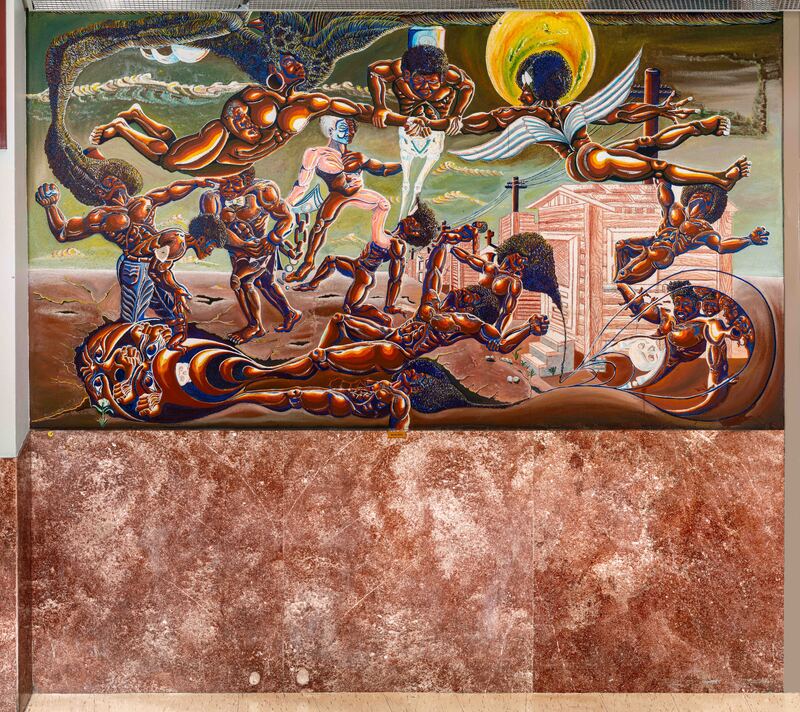
Set against a background of shotgun houses, Black people engage in a struggle to break free from chains and physical limitations. Extreme musculature and angel wings suggest supernatural strengths. A motif in Settles’ work is the power and beauty of Black hair.
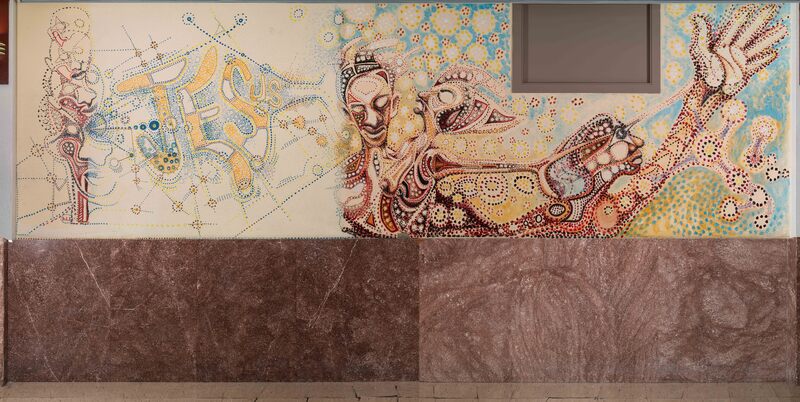
The only Hannah Hall mural in a pointillist style, it was partly destroyed during renovations. Edwards returned to repaint it. Perhaps because of the time demands of the pointillist technique, the repainted left side is less detailed than the right. Jesus, Mary, and Joseph are painted in abstract forms.
Ellison’s pair of murals speaks to political and social issues of the 1960s and 1970s. The murals express hope through resistance, in spite of the challenges facing Black America. In the middle, a bald eagle holds a broken lynch rope in its beak and “the law” in its talons.
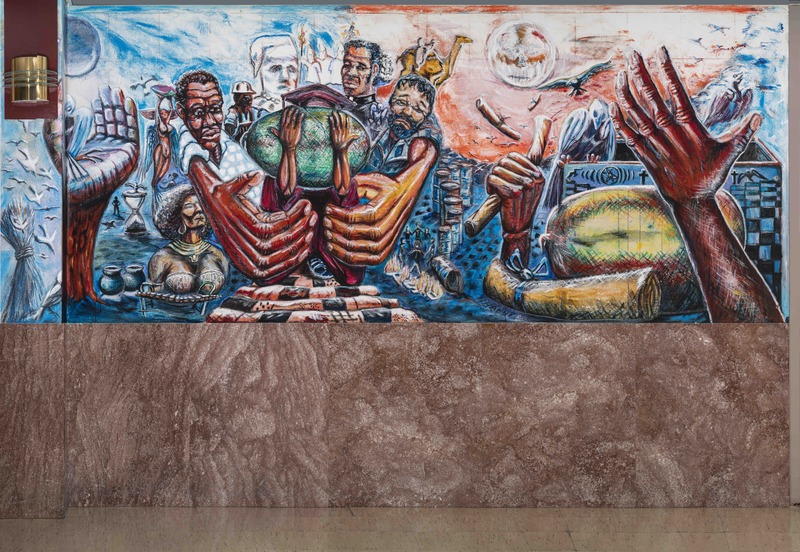
The artist boldly tackles the often stereotypical image of the watermelon while depicting the hypocrisy of organized religion in the Black community and the constant threat of the Klan. The large, reaching hands pull at a recent graduate, whose face is obscured by the watermelon they are holding.
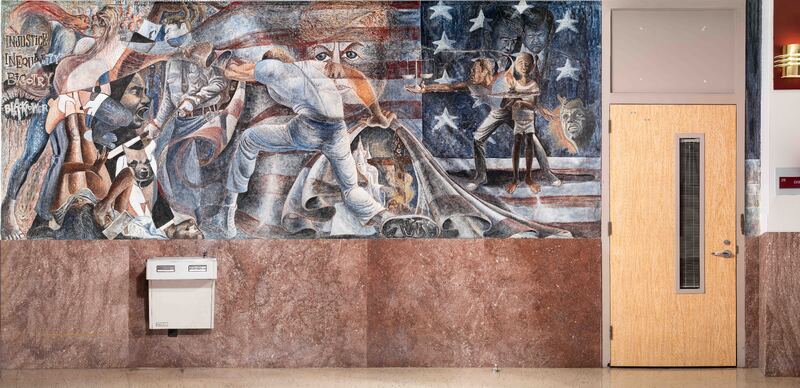
Mills’s mural depicts a nation in turmoil, with scenes of racial violence, and pushback by Black protestors. A figure lifts the American flag to reveal white supremacy. On the right side, Stokely Carmichael’s face bursts through the flag, alluding to the 1967 TSU Invasion. During the invasion, 488 TSU students were arrested and Houston Police fired almost 5000 bullets into the men's dormitory.
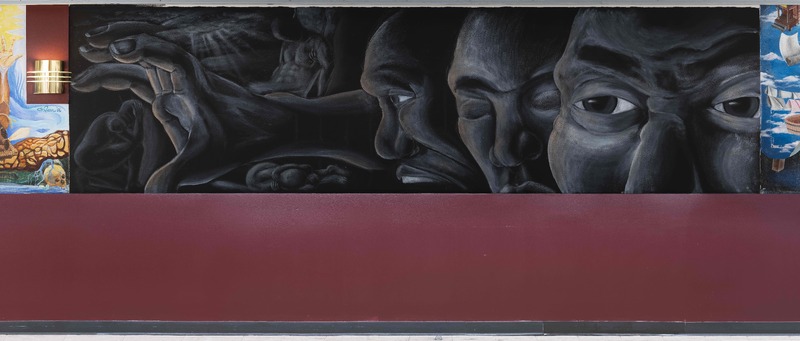
Lloyd’s scene closely focuses on three faces wracked with strong feelings. In the foreground, an angry man reaches out, while the middle figure turns completely inward, and the far right figure is deep in thought. These emotions are heightened by the dark hues in the composition.
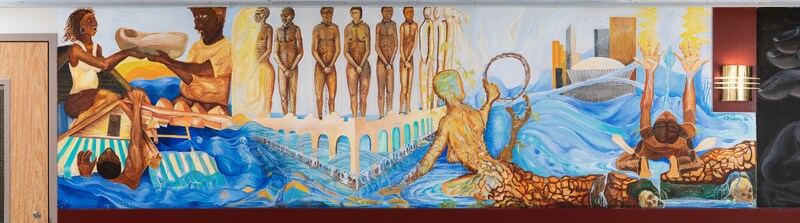
A native of New Orleans, Green transferred to TSU’s art program following Hurricane Katrina. His mural ties different aspects of New Orleans history and culture together through floodwaters. Enslaved ancestors stand at auction, and the city skyline, including the Superdome, is featured prominently.
Ross’s mural represents Black rural life in the early to mid twentieth century. The composition highlights the gendered division of labor, and how women’s work focuses on maintaining the home. Ross grew up in Huntsville, Texas, and this scene may represent his background and experiences.
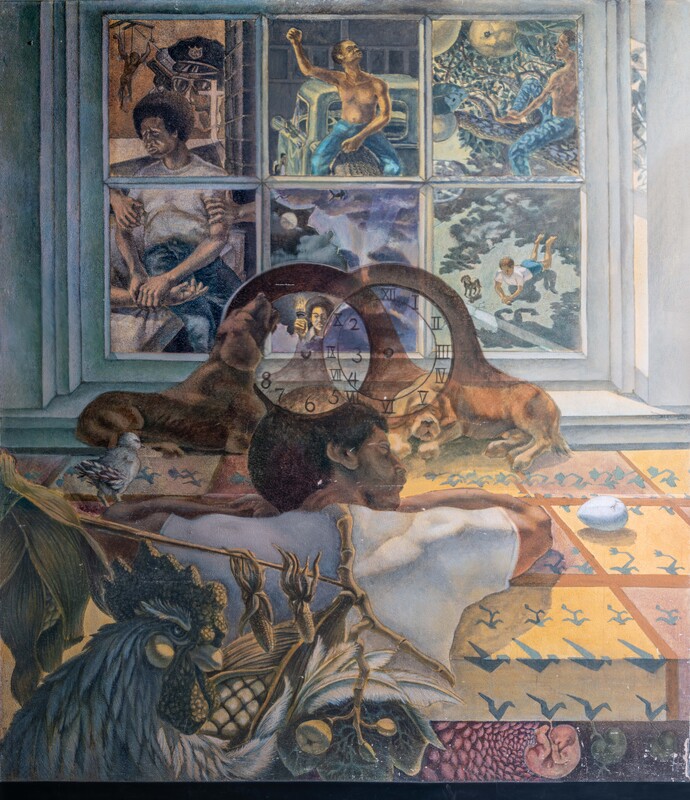
Samples’ mural unfolds like a dream, with each panel above the sleeping artist revealing a constellation of scenes from the artist’s youth. Lower window panels evoke a harmonious existence with nature and animals, while upper panels reveal struggles with racism in the South and his mother’s death.
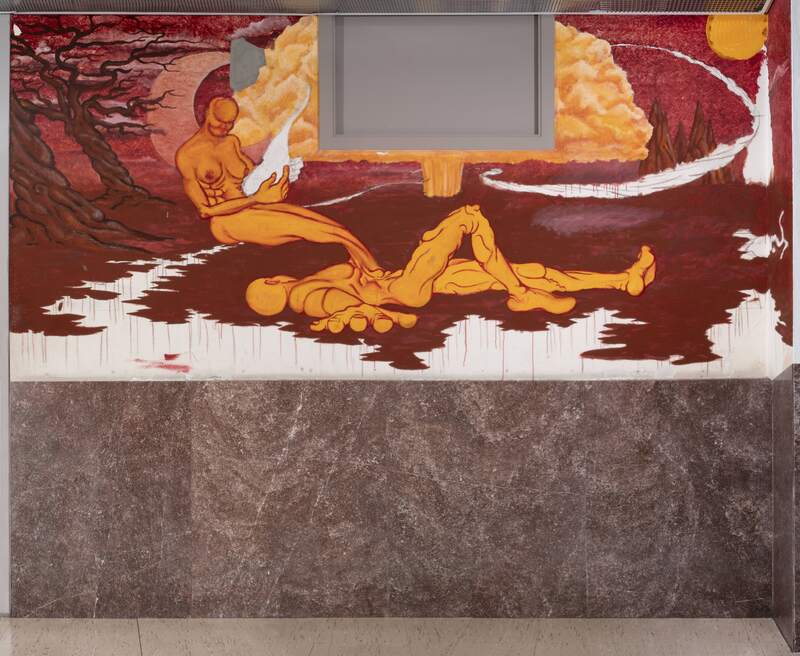
The red and orange-hued apocalyptic scene shows the moments after an explosion. In the middle, a dying woman’s soul leaves her body. The mural appears to have been left unfinished, as the baby, one hand, and parts of the foreground and background are not painted in.
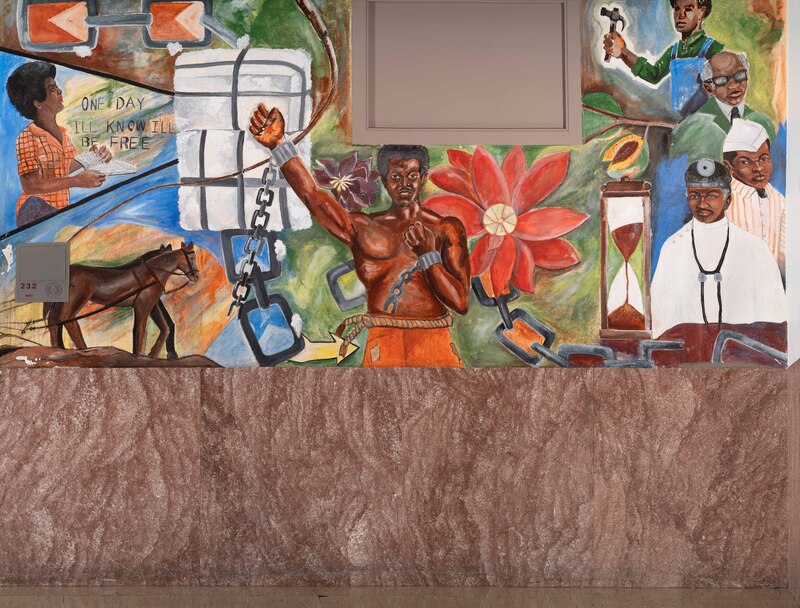
This mural reflects themes of emancipation and progress. The figure of a Black man raises his fist, while broken chains dangle from his waist. The bales of cotton and chains allude to slavery. Black men in various professions represent changes brought by emancipation.
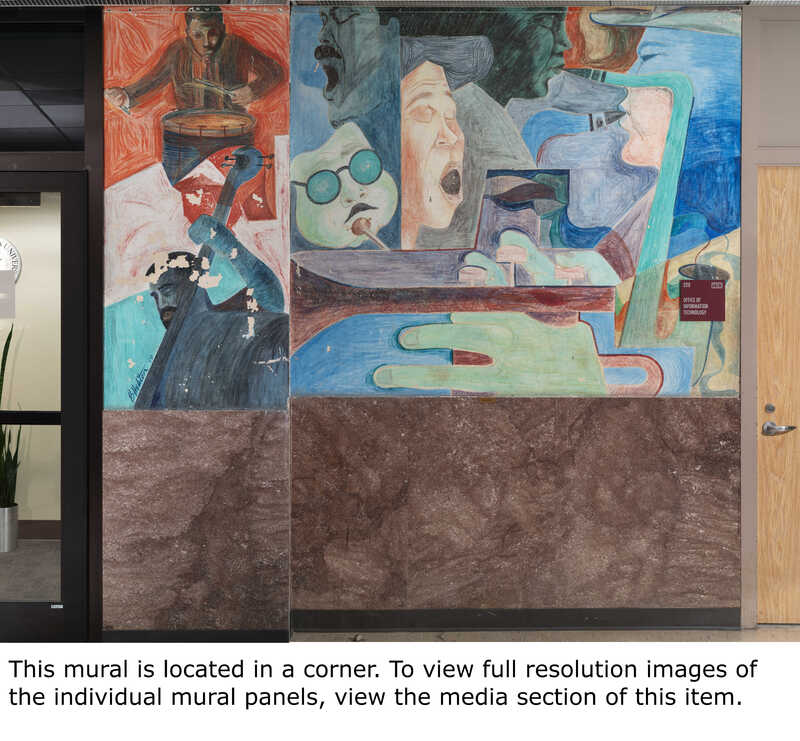
The mural captures the emotion and creative environment of a mid-20th century jazz club. Heliton chose a corner spot for his mural, which lends a sense of depth to the piece. The overlapping of patterns, portraits, and instruments suggests the intimacy of a small club interior.
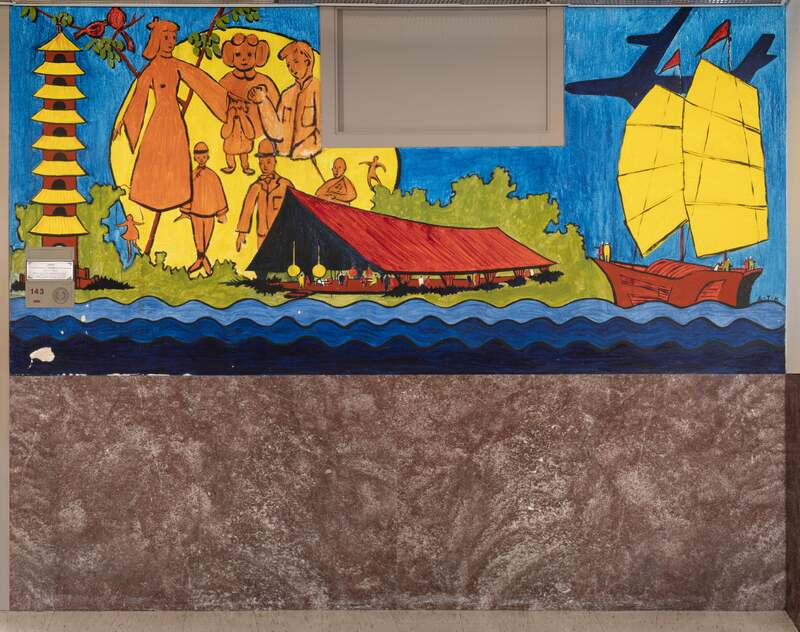
This mural was painted by one of the many Asian students who enrolled in Texas Southern during the 1980s. A wooden ship with sails is seen in contrast with a modern airplane on the right side. On the left, a tower suggestive of a pagoda imbues a sense of history and culture.
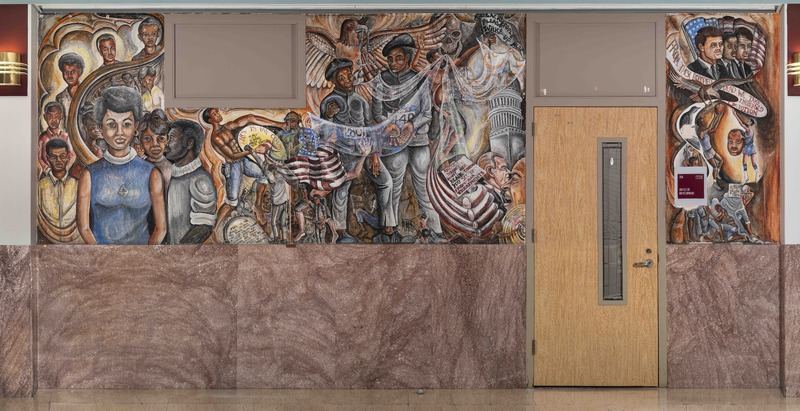
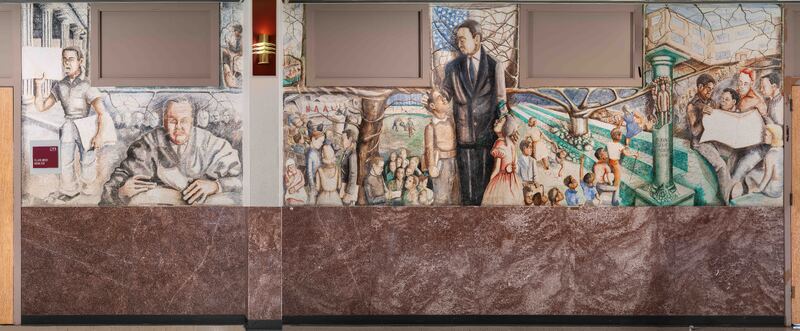
Royal’s mural illustrates the desegregation of public schools following Brown v. Board of Education (1954). In the center of the scene is attorney and future Supreme Court justice Thurgood Marshall, with Black students entering integrated schools. At the far left is Chief Justice Earl Warren.
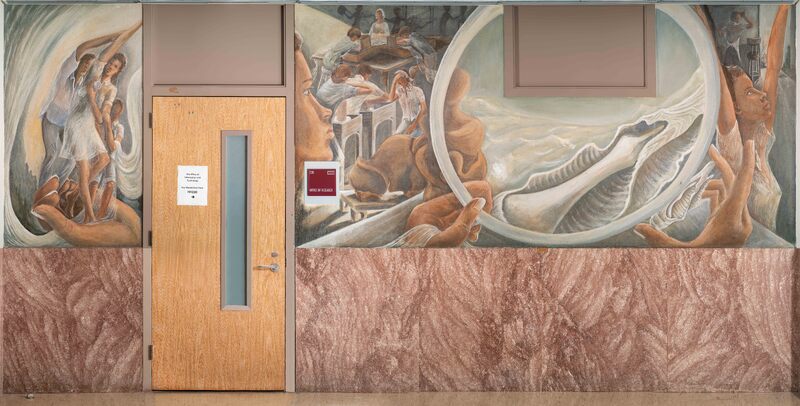
Goffney's intricate mural suggests themes of scientific discovery, fluid energy, and mid-century lifestyles. Scenes of nightlife and a rural church are featured on the right. Goffney signed his last name as Goeenet, perhaps his artist name.