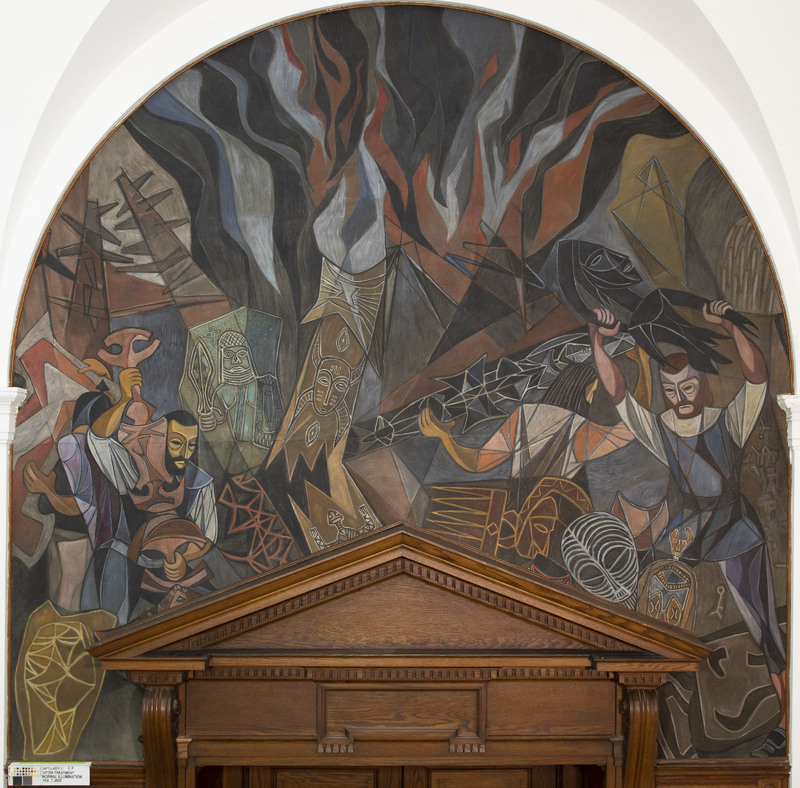
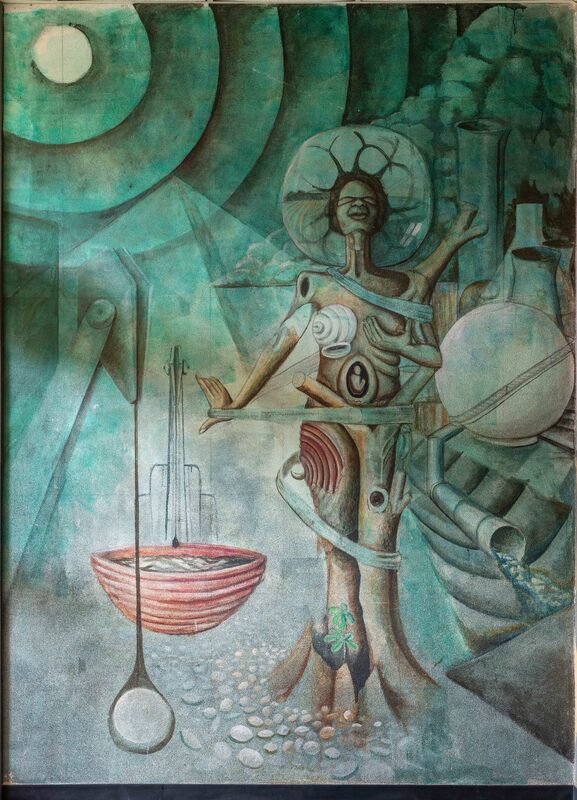
Hale Aspacio Woodruff was an artist and art educator known for his murals, paintings, and prints from Cairo, IL. "Dissipation," the third panel in the Art of the Negro mural series, portrays the theft and disruption of African art and culture by Europeans through colonization.
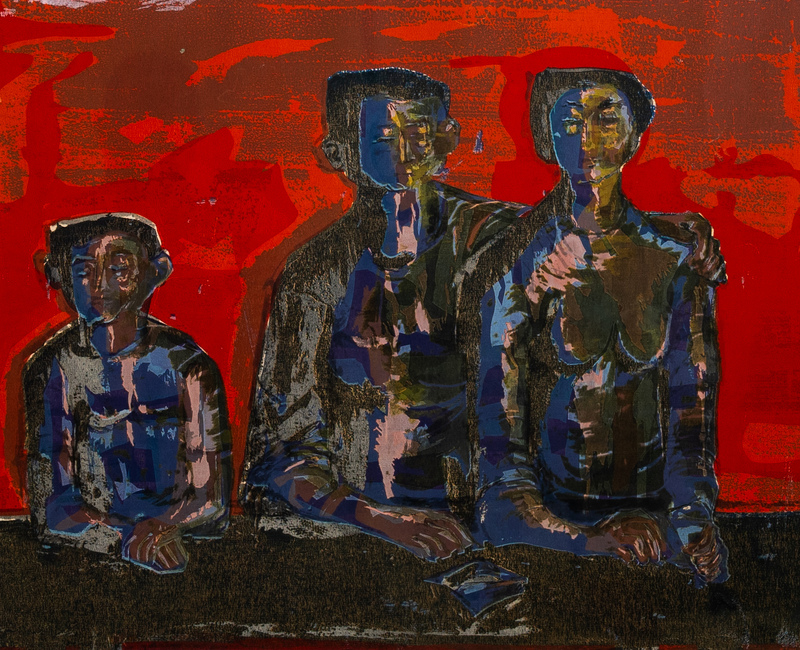
John Payne was an artist from New Orleans, LA. "Awaiting the Welfare Agents" is a mixed-media depiction of a traditional family with pensive expressions. They are sitting together preparing for a visit from a representative of the Department of Human Services.
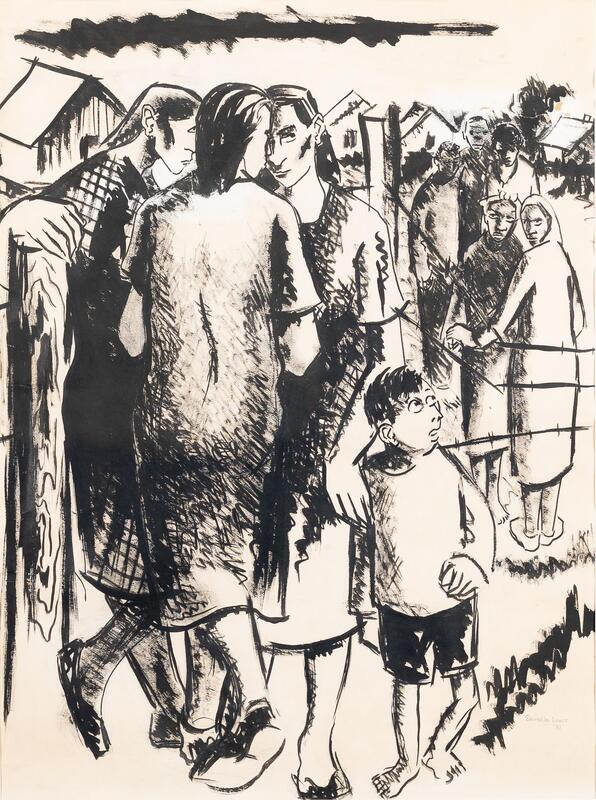
Samella Sanders Lewis was a printmaker, painter, sculptor, and art historian from New Orleans, LA. "Barrier" is a drawing that depicts the physical and social barriers between groups of people. In the foreground, three women and a boy suspiciously look at a group of townspeople who return their stare from the other side of a barbed wire fence.
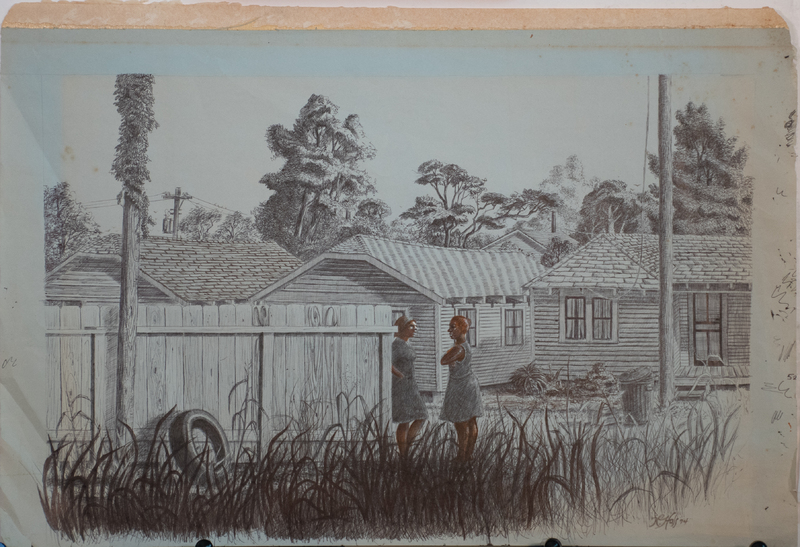
Hals’ drawing shows two women chatting on the street. Their environment, filled with shotgun homes and tall grass, resembles Houston’s Third Ward, the historically Black neighborhood that Texas Southern University calls home. TSU art students, at Dr. Biggers’ instruction, often looked to their surroundings for inspiration.
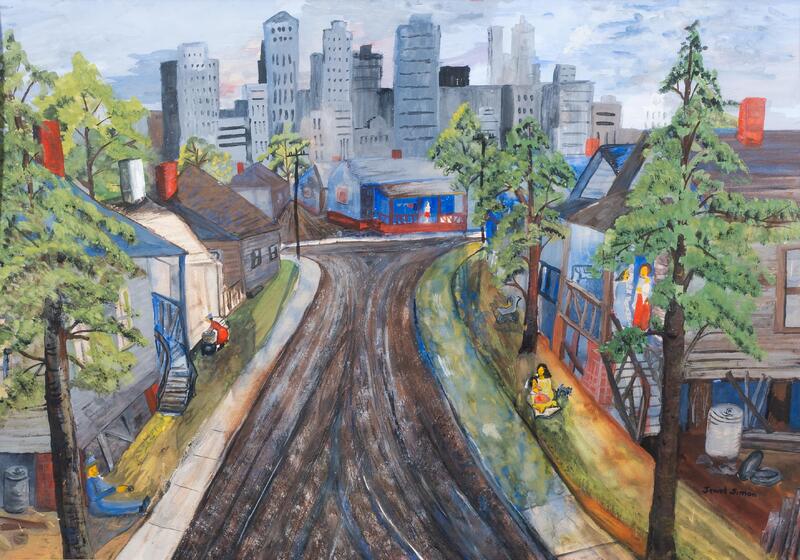
Jewell Woodard Simon was an internationally acclaimed artist, teacher, and poet from Houston, TX. "City Slums" depicts an elevated view of an urban landscape. In the middle ground is a residential area with a skyline in the background. Several people are outside in the neighborhood, including a mother and child and a woman washing clothes.
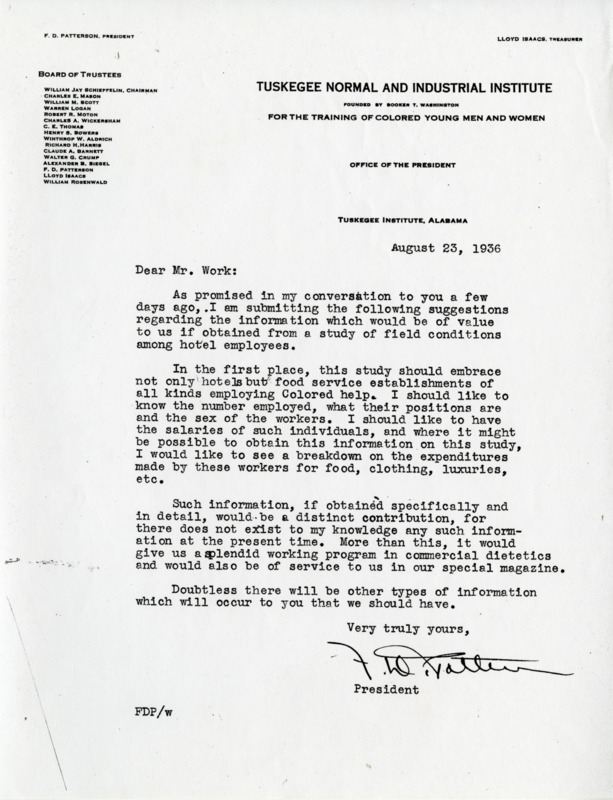
Correspondence regarding a "Study of the Trends and Tendencies in the Occupation of Negroes in the United States" by the Personnel Bureau at Tuskegee. Correspondence also refers to the Department of Labor's "National Works Project for Negro White Collar Workers."
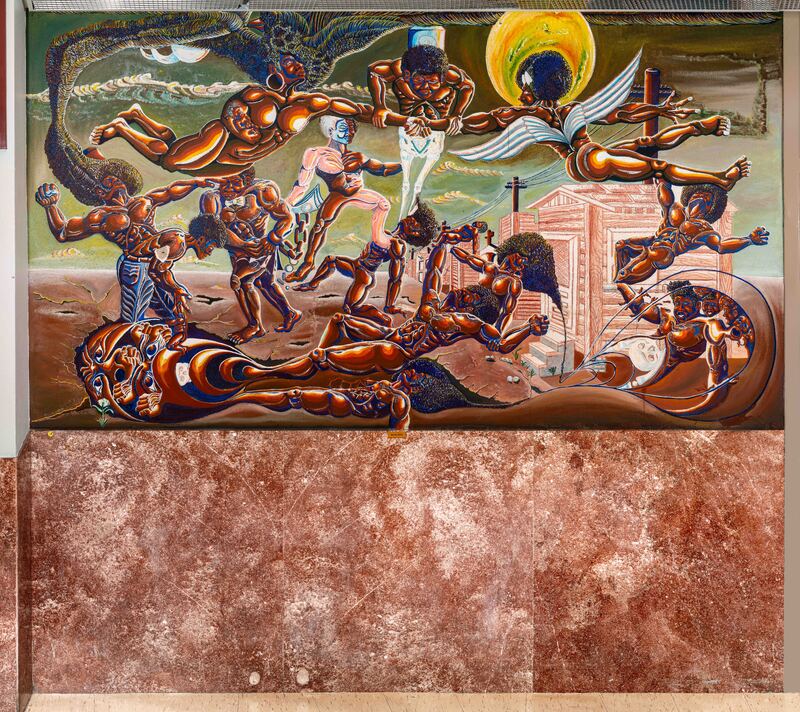
Set against a background of shotgun houses, Black people engage in a struggle to break free from chains and physical limitations. Extreme musculature and angel wings suggest supernatural strengths. A motif in Settles’ work is the power and beauty of Black hair.
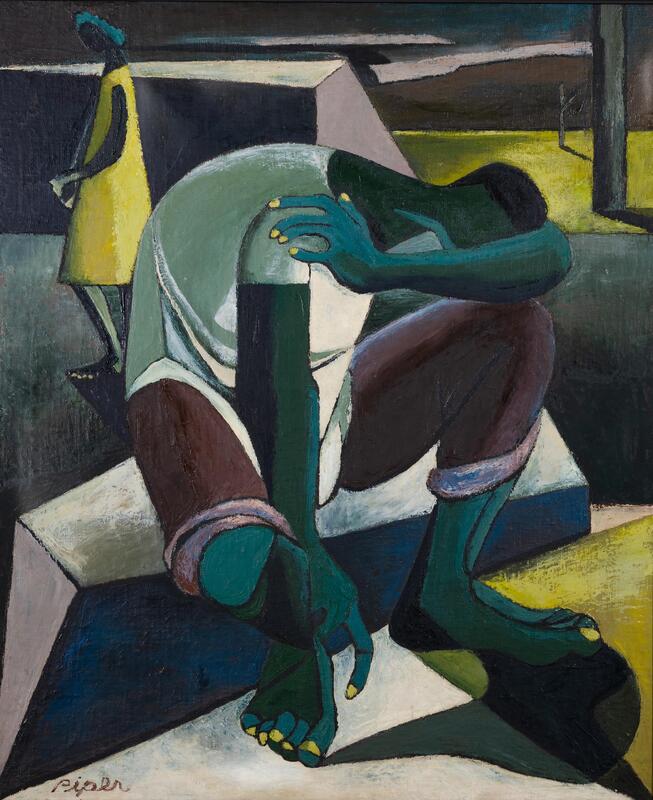
Rose Piper, an African-American artist, used her knowledge of art and geometry to explore the American South. "Grievin’ Hearted," a cubist painting, illustrates the sentiments of African Americans in the South. A man sadly hangs his head on his arm as he sits in the shadows. The girl in the yellow dress symbolizes hope for the future.
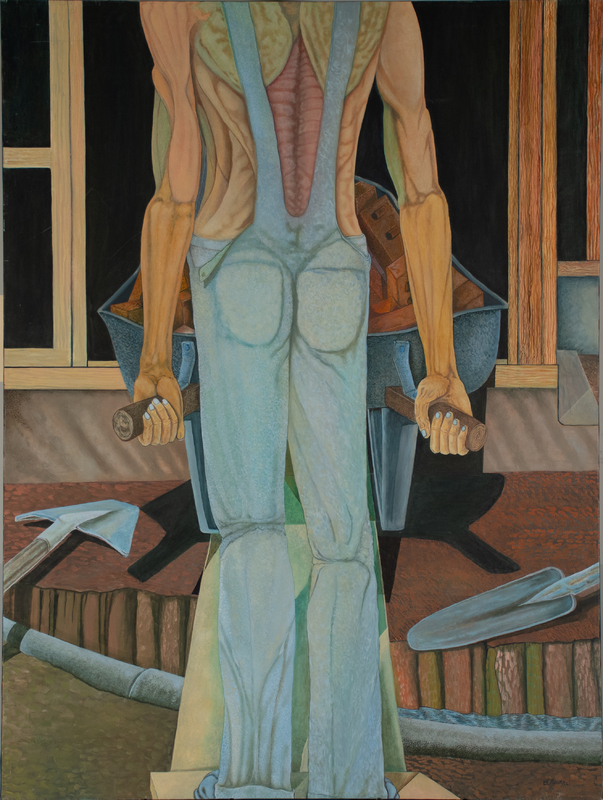
Renfro’s painting displays an image of a working man dressed in overalls from behind. The man is wheeling bricks towards a construction site. His bones and muscles are made visible in the composition, perhaps to highlight the physical demands of his labor. Dr. Biggers taught his students to portray the human form with care and detail, particularly oft-neglected features like hands and feet.
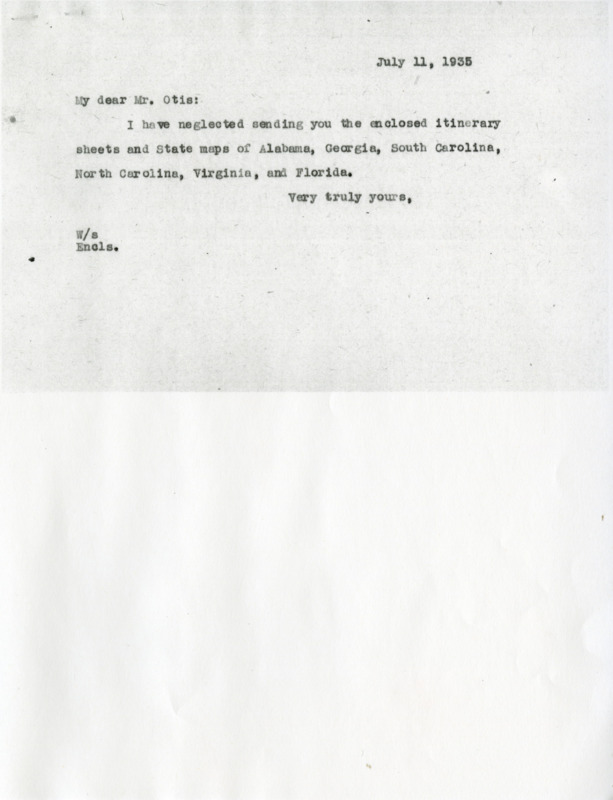
Four letters from Monroe N. Work to "Mr. Otis" regarding a "study of occupations in the Southern areas" in conjunction with the Agriculture Department. Three letters are dated July 1935, one letter is dated November 1935.
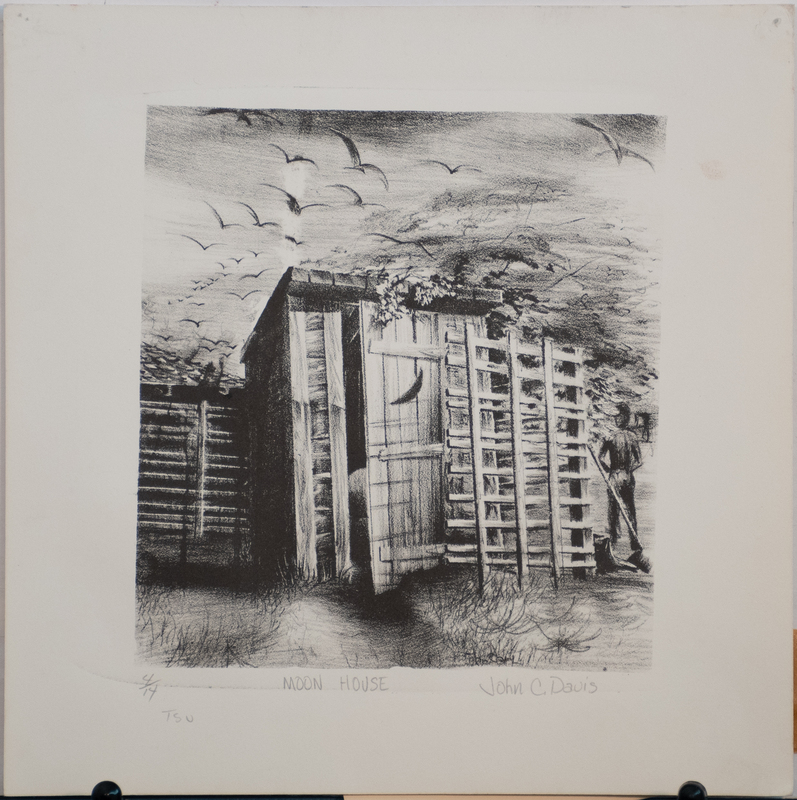
Davis’s print is of an outhouse, colloquially referred to as a moon house. In modern imagination, the crescent moon on an outhouse door has become an identifying symbol of frontier living. Davis’ print also shows a shirtless man zipping up his pants upon exiting the outhouse, while a huge flock of birds fly overhead.
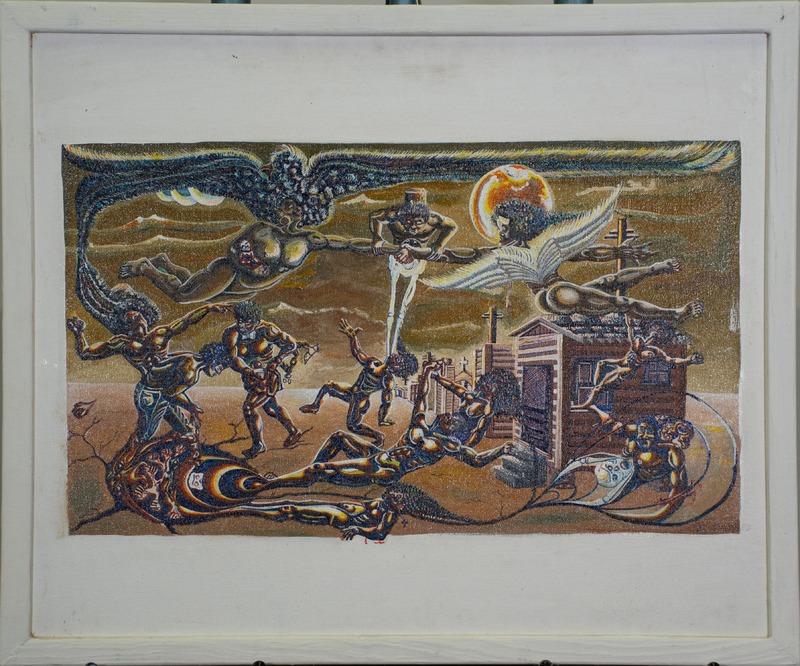
Settles' mural study depicts muscular, mostly naked men and women seemingly being sucked into a portal. An angel attempts to pull them away, while two men are stripped of their skin and bones. The figures’ hair is painted with great detail and seems imbued with special powers. The backdrop shows a horizon of shotgun homes. Settles’ final mural nearly replicates this earlier draft.
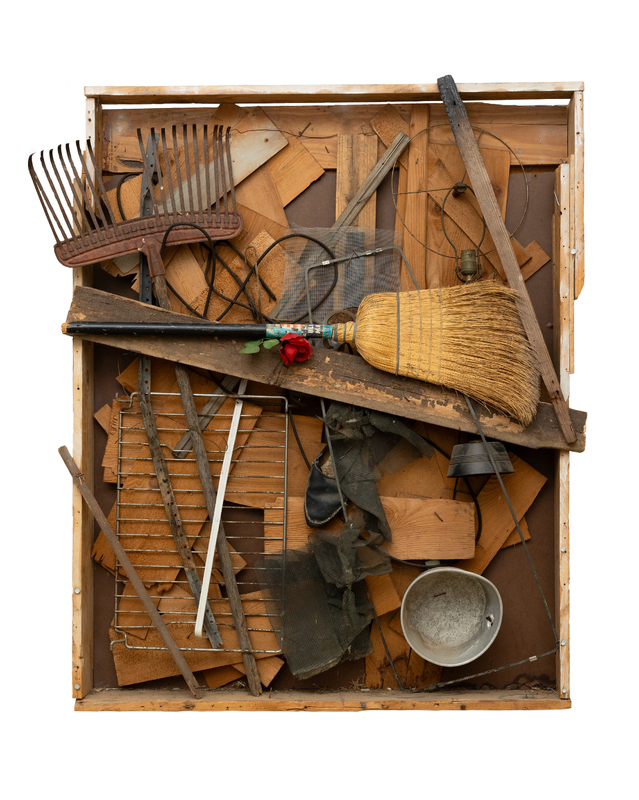
Dr. Arthur L. Britt was an artist and educator from Cuthbert, GA. Poverty Toy Chest is an installation that displays items impoverished children use for recreational play. It shows the disparity and ingenuity of people with little resources.
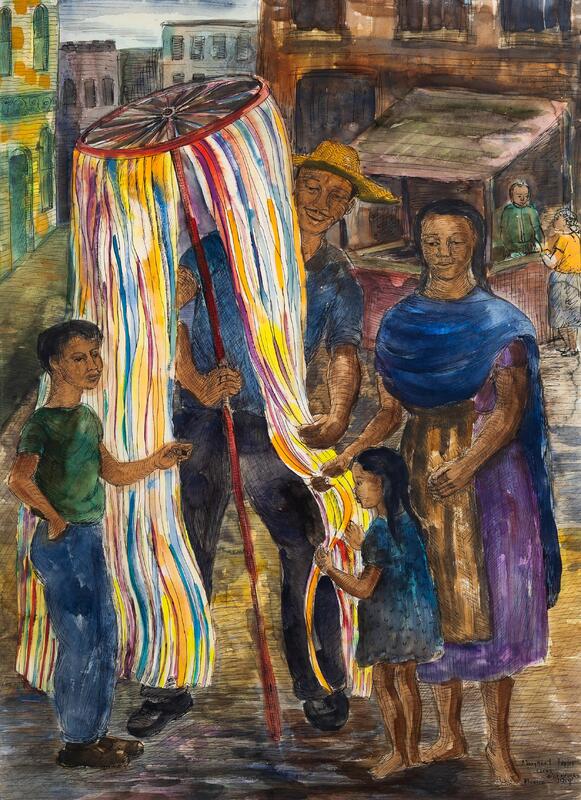
Margaret Taylor Goss Burroughs was an artist, historian, teacher, and writer from St. Rose, LA. Ribbon Man: Mexico City Market is a watercolor scene of a mother buying ribbons for her children. The ribbon seller joyously sells his colorful ribbons in the middle of a market in Mexico City, MX.
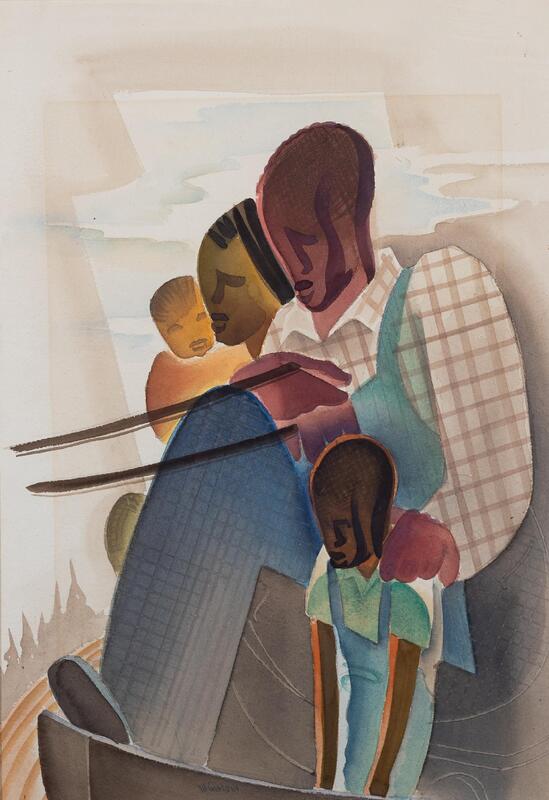
Born in Ohio, Vernon Winslow studied at the Art Institute of Chicago. Sharecropper’s Migration is a watercolor painting of a family with gestural features. With a muted red skin tone, the father rests his hand on his son’s shoulder to reassure him. The family wears a sad but hopeful expression as they ride on a horse carriage.
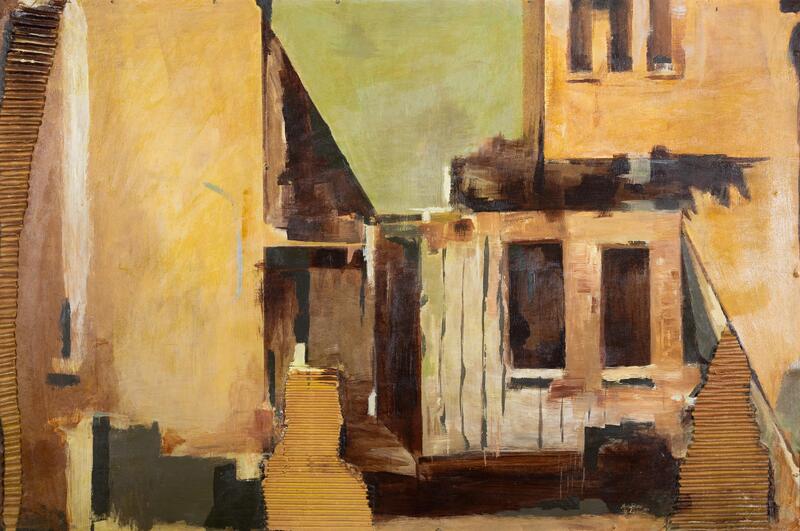
Shirley Bolton was a painter from Athens, GA. Tenement is a multimedia depiction of the entrance to a shared housing space. The dimensional browns of the buildings indicate the age and use of the tenement space. Three cardboard pieces on top of the painted surface add texture and form to the piece.
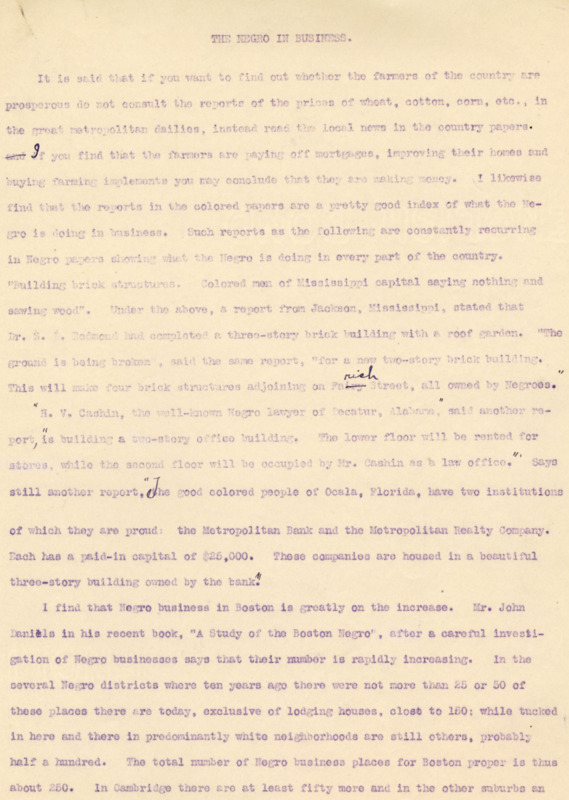
A nine-page article reviewing the state of Black businesses in over 15 states. More than 15 businessowners and industries are mentioned, along with information on business organizations and towns founded by African Americans. Undated, but latest date referenced is April 1914.
In this mural, Mother Nature is attacked by oil derricks, pollution, and industrialization. Jones painted this work as a response to the rapid expansion of oil drilling throughout Texas. Jones still engages with nature, now creating wood carvings from fallen timber after Galveston storms.
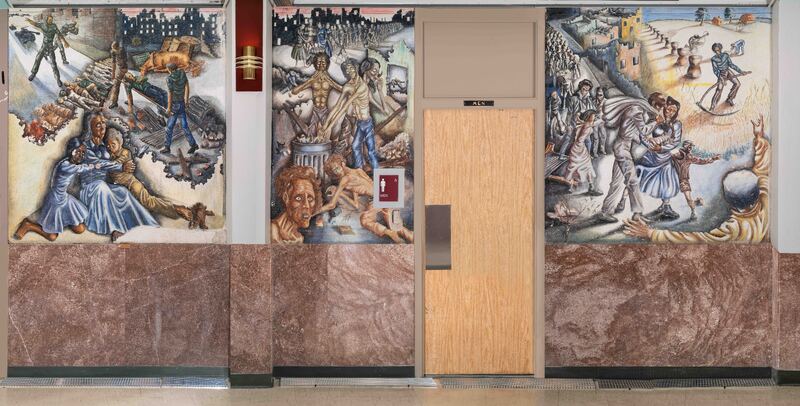
Michaux, a war veteran, was given the opportunity by Dr. Biggers to paint this mural during his first year as an art major. Reflecting on the devastation of the then-recent World War II, the mural depicts terror, hunger, and human compassion.