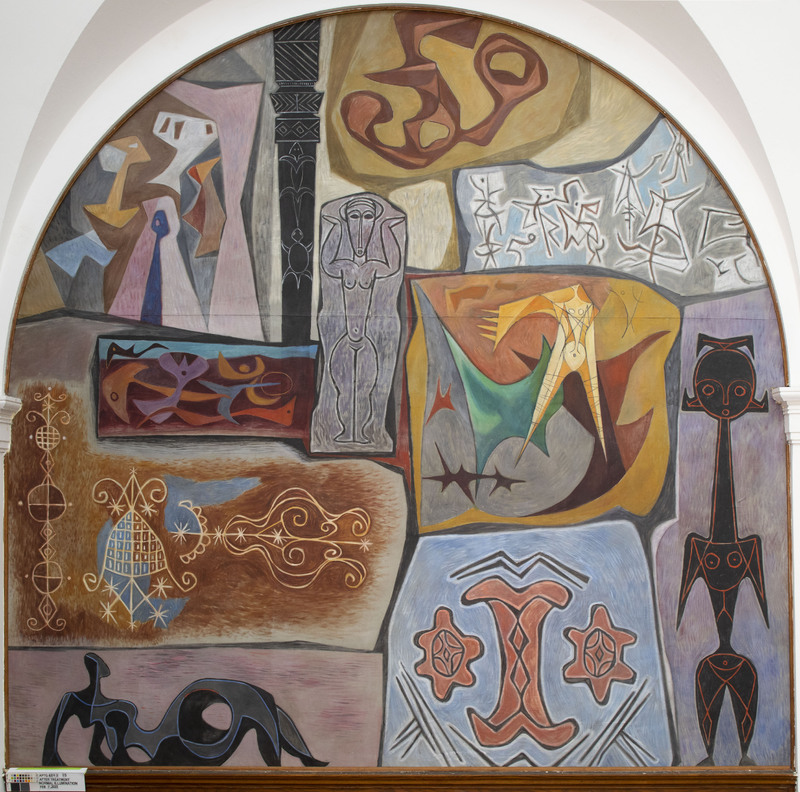
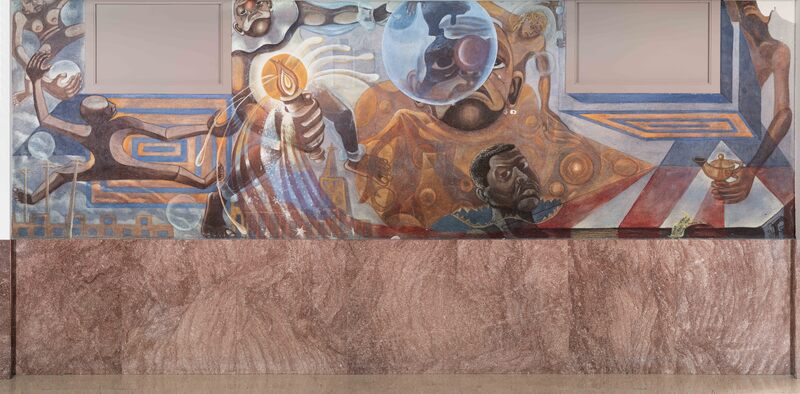
Hale Aspacio Woodruff was an artist and art educator known for his murals, paintings, and prints from Cairo, IL. "Influences," the fifth panel in the Art of the Negro mural series, conveys the role of traditional African art in the development of 20th-century Western art movements.
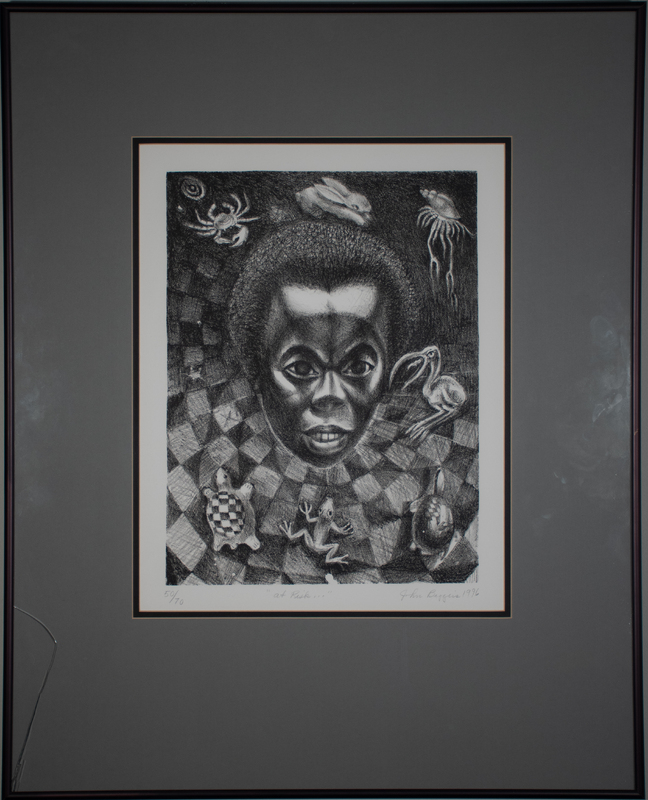
This Biggers print shows a person's head surrounded by animals and a checkerboard. Checkerboards and swirls are common motifs in Biggers' work, which he referred to as sacred geometry. The pictured animals are symbolic; for instance, tortoises represent longevity and rabbits represent bad omens.
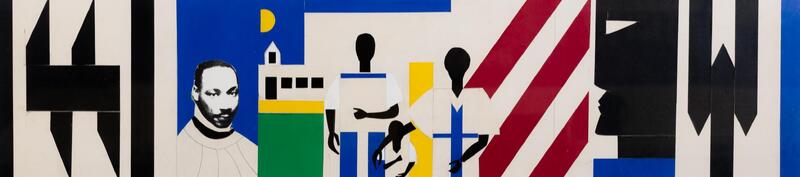
Romare Bearden was an artist, author, and songwriter from Charlotte, NC. "Atlanta Mural" is a maquette of a mural created for City Scenes '76-'77, the National Paint and Coatings Association bicentennial. Bearden includes the Kente symbol, Dr. Martin Luther King Jr's head, the silhouette of a Black family, a church, and a plot of land to represent the African American influence in the city.
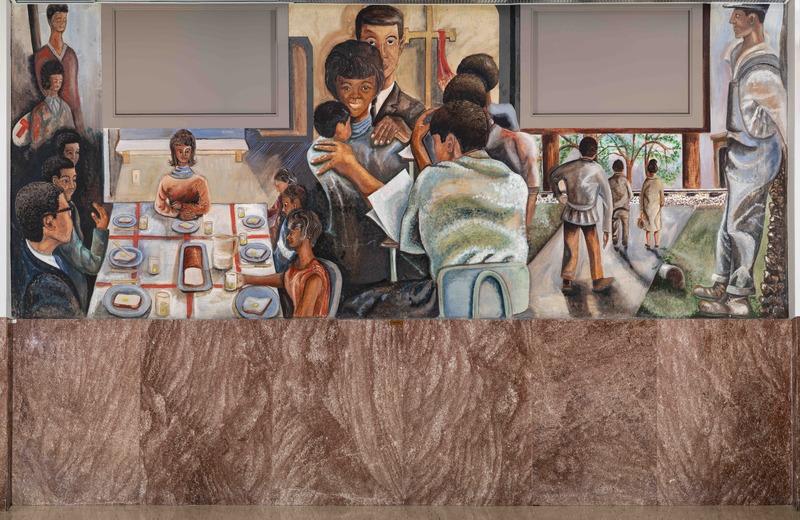
Mass depicts scenes of family life, including a gathering at the dinner table and church services. The laborer at the far right suggests the role of physical work in sustaining the Black family. As in other murals, architectural elements from Hannah Hall are incorporated in this mural.
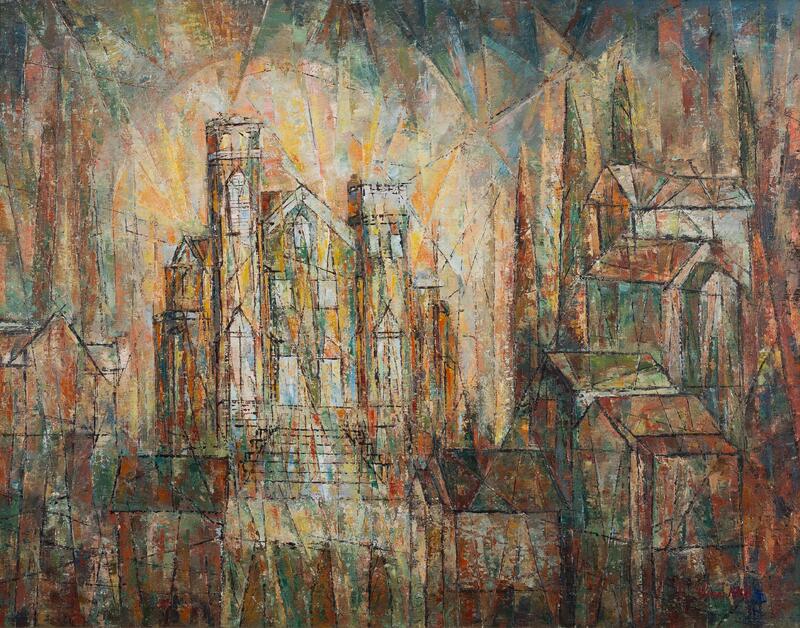
Leonard Jones was an artist from Winston-Salem, N.C. "Cathedral" is a cubist depiction of a cathedral and the town surrounding it. Jones uses a variety of light and dark colors that resemble the aesthetic of stained glass.
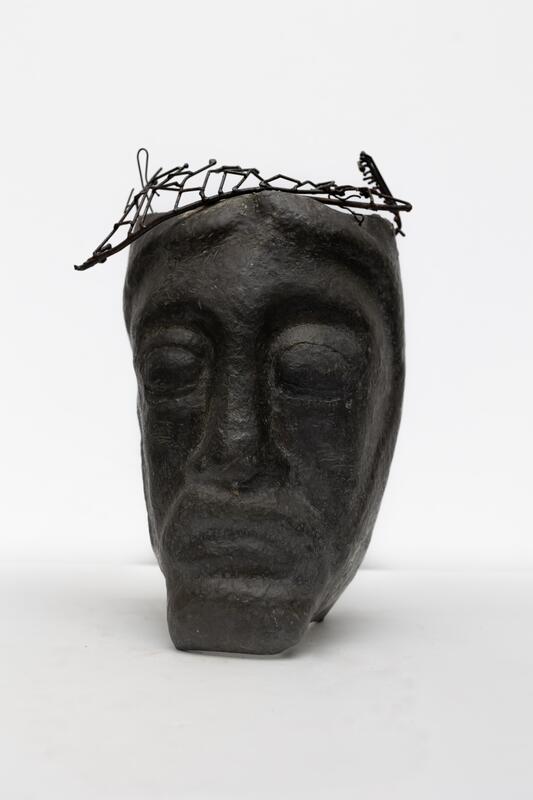
Dr. Eddie Jordan, Sr., was a Southern artist from Wichita Falls, TX. "Christ Crowned with Thorns" is a metal bust of Jesus with African features. The bust has a metal thorned crown installed atop it to depict Jesus' leading to his crucifixion.
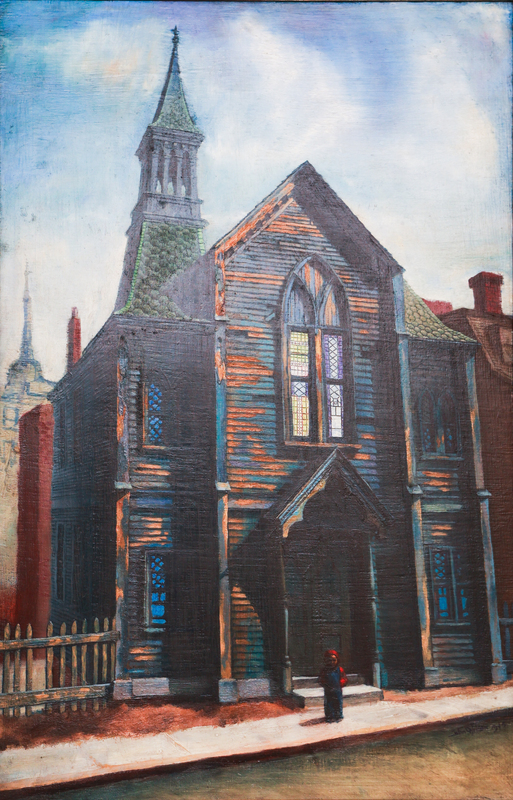
John Woodrow Wilson, a sculptor, painter, and printmaker from Roxbury, MA, was known for his creative portraits and stylistic approach to social justice. "Church" is a cityscape that centers an old steepled church under a cloudy, blue sky. There is a child dressed in red and overalls standing in front of the church's entrance.
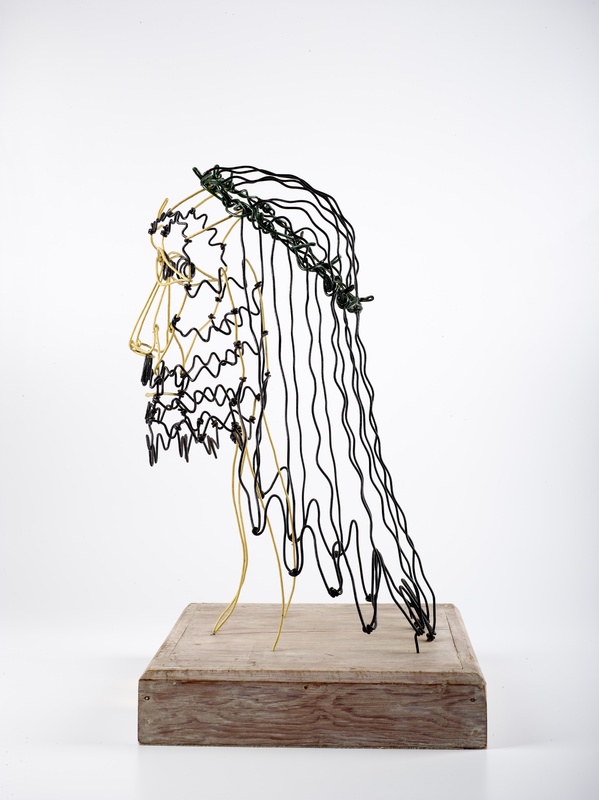
Hayward Oubre was a multimedia artist and educator from New Orleans, LA. During his time competing at the annuals, Oubre developed his artistic practice to include wire to set himself apart from his competition. "Crown of Thorns" is a metal wire framework depiction of Jesus that represents Oubre's skill in wire sculpture.
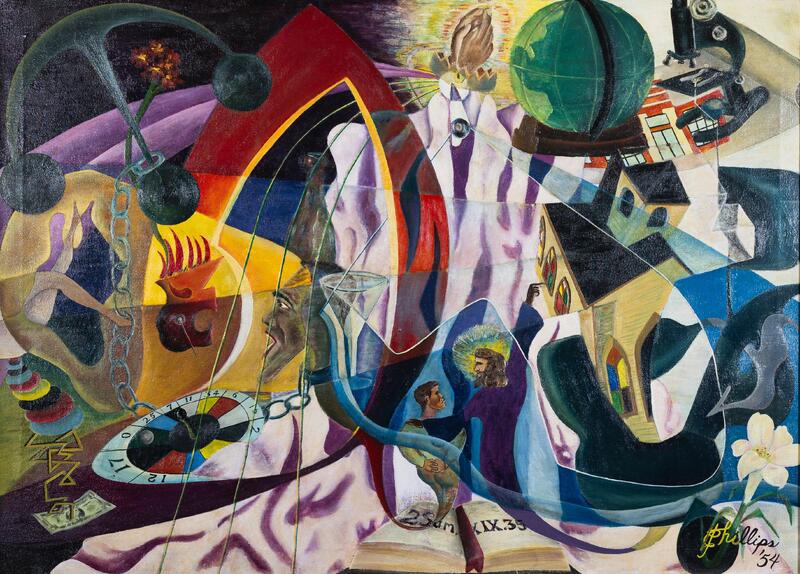
Harper T. Phillips was an artist from Courtland, AL. "Discernment" is a surrealist interrogation of the disciplines used to judge value in society. The left side has a dark background and features symbols of morality and mortality. The right side has a white background and features religious and scientific images and symbols.
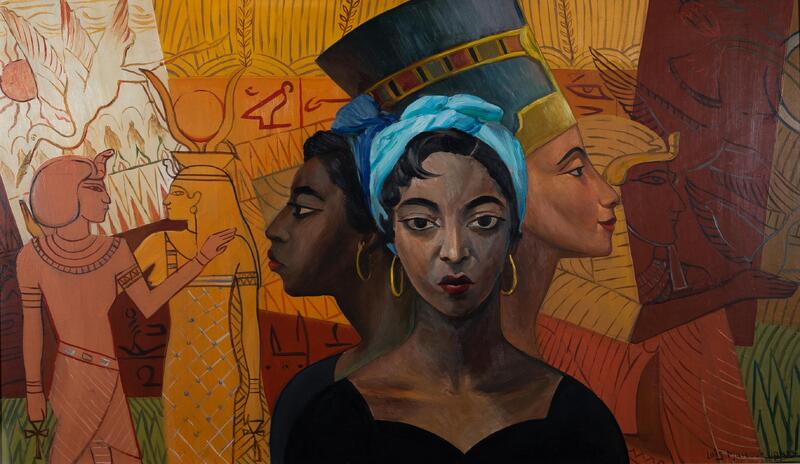
Lois Mailou Jones was an artist and art educator known for her costumes, textile designs, watercolors, paintings, and collages from from Boston, MA. "Egyptian Heritage" presents a genealogical and cultural heritage between contemporary Black people and Ancient Egypt. In the background, Jones uses Ancient Egyptian scenes and hieroglyphics. The painting is indicative of contemporary ideologies that reclaimed African heritage through Egypt.
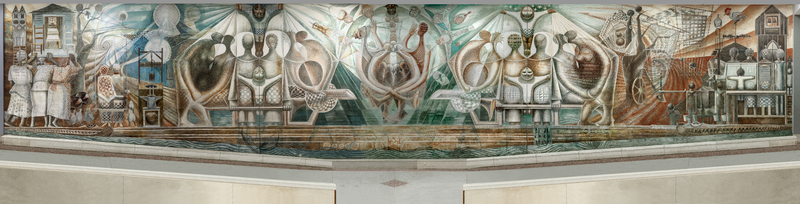
Texas Southern University students commissioned Biggers to paint this mural in the cafeteria of the student center. Composed of several distinct but interrelated images, Family Unity features several Afrocentric motifs that Biggers developed, including sacred geometry (checkerboards and spirals), shotgun houses, and husband-and-wife pairs. At the center is what Biggers called the “morning star,” which shows a couple embracing with their form suggesting a womb.
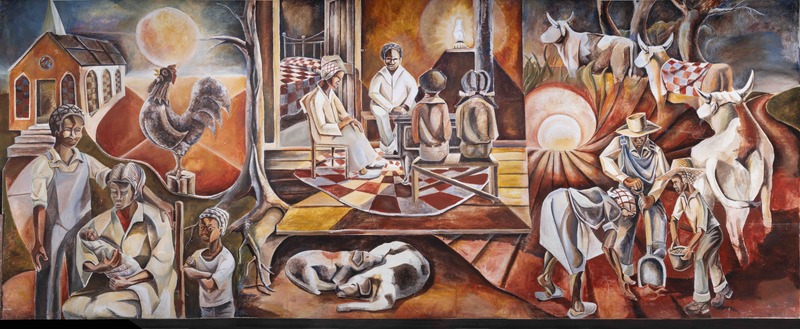
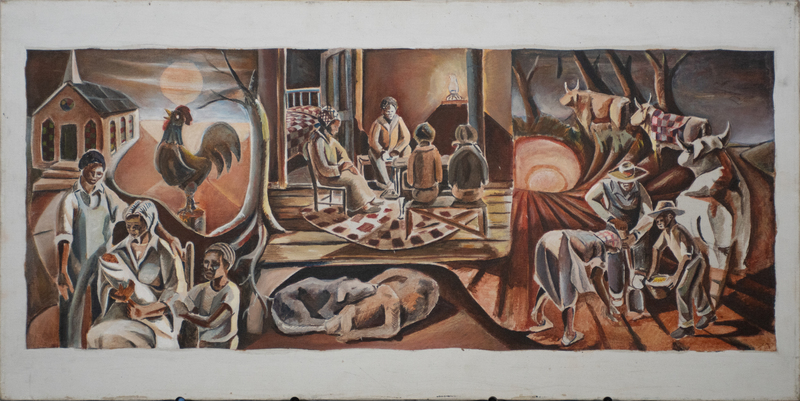
In a triptych style, Williams’ mural shows three central themes: a family gathered around a newborn (religion), seated near a hearth (home), and working together in the fields (labor). Black rural life is a major subject in the Hannah Hall murals.
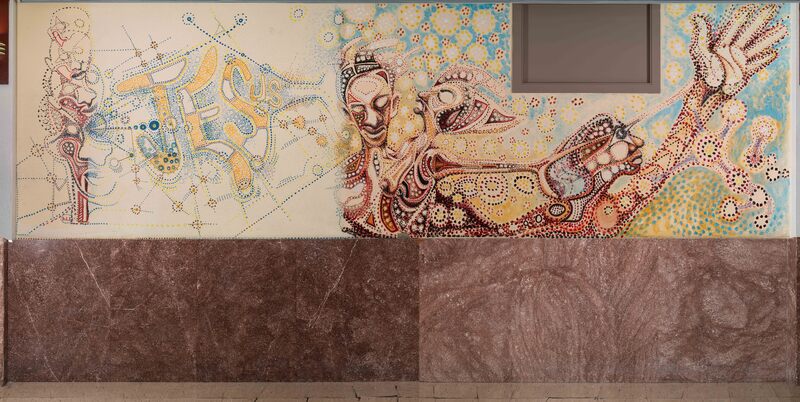
The only Hannah Hall mural in a pointillist style, it was partly destroyed during renovations. Edwards returned to repaint it. Perhaps because of the time demands of the pointillist technique, the repainted left side is less detailed than the right. Jesus, Mary, and Joseph are painted in abstract forms.
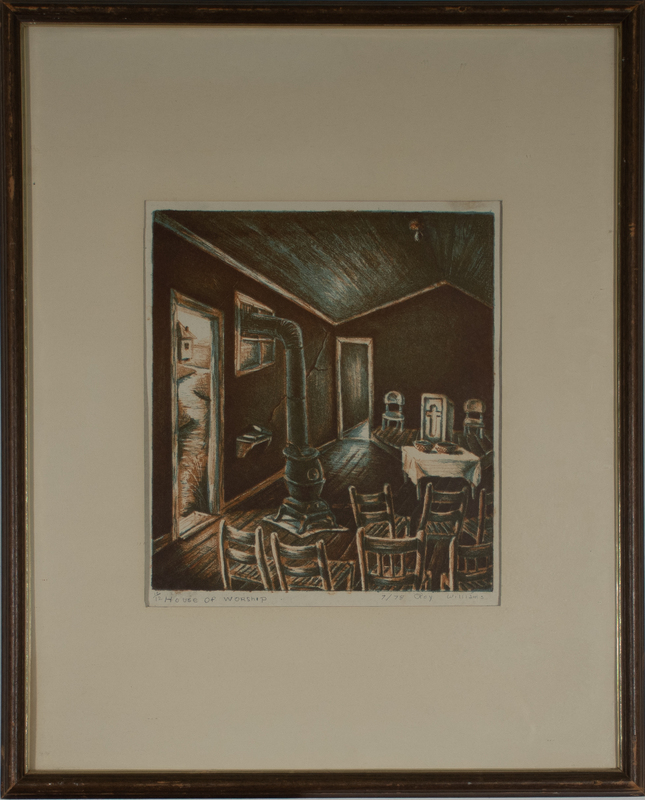
This print by Roy Williams depicts a modest Christian worship house. The door is open, and the seats are arranged as if a service is about to begin or has just ended. A fireplace warms the church, and a path out the door snakes through a field. Dr. John T. Biggers taught students the craft of printmaking while he was a professor at Texas Southern University.
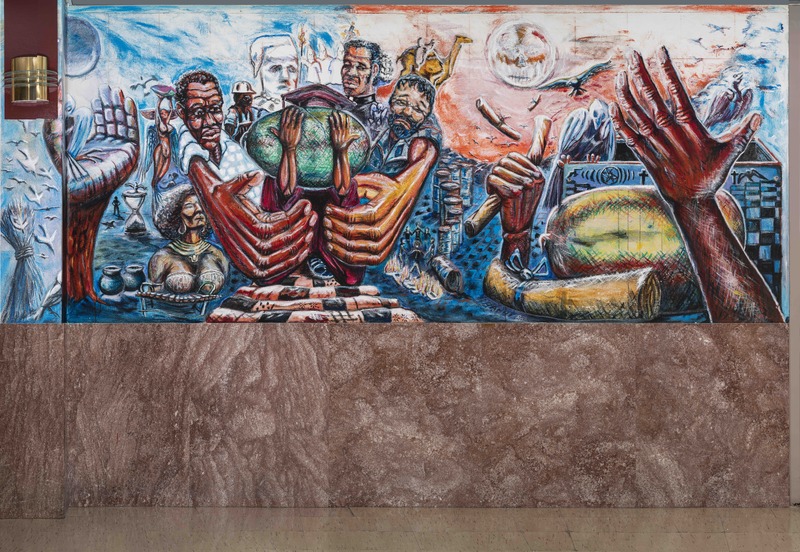
The artist boldly tackles the often stereotypical image of the watermelon while depicting the hypocrisy of organized religion in the Black community and the constant threat of the Klan. The large, reaching hands pull at a recent graduate, whose face is obscured by the watermelon they are holding.
In this interview, Texas Southern art alumnus Kermit Oliver discusses his time at Texas Southern (1962-1967) and his artistic philosophy & practice with Dr. Alvia J. Wardlaw, director and curator of the University Museum. He highlights the religious, personal, historical, and political influences that shape his artwork.
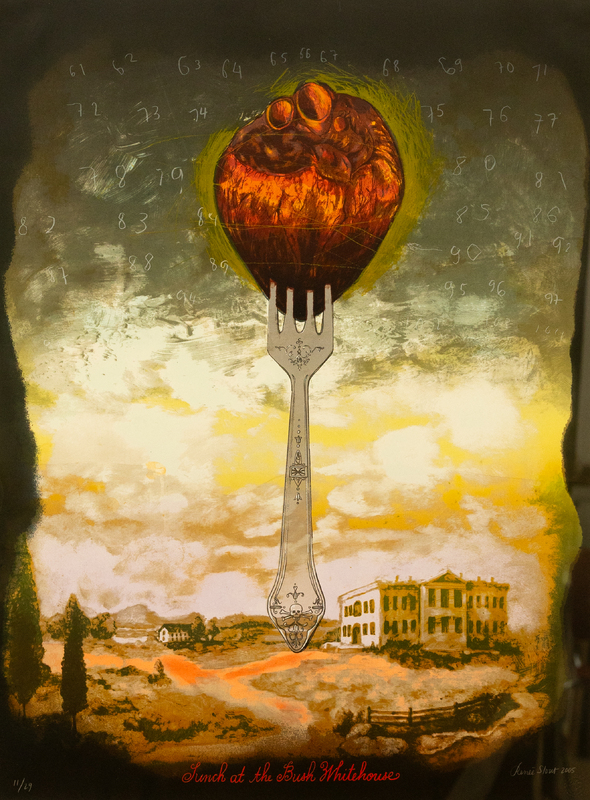
Renee Stout is an artist and sculptor from Junction City, KS. Lunch at the Bush White House is a conceptual gothic painting that explores the intersection of Stout's critique of the Bush administration and numerology from an atmospheric perspective. Above a plantation-like landscape, Stout depicts a heart impaled by an ornate fork.
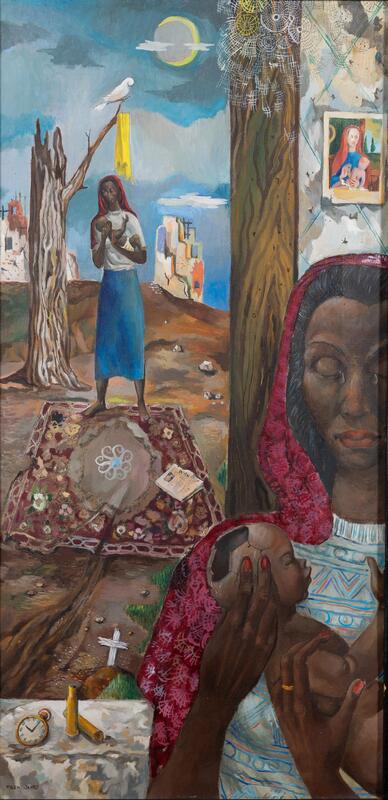
Frederick D. Jones, Jr. is a twentieth-century artist from Chicago, Ill. Madonna Moderne depicts surrealist vignettes of a Black Madonna and child. The piece shows a veiled mother holding an injured baby and the same pair at a gravesite in a war-torn landscape. Jones also includes symbols of purity, humanity, war, and mortality.
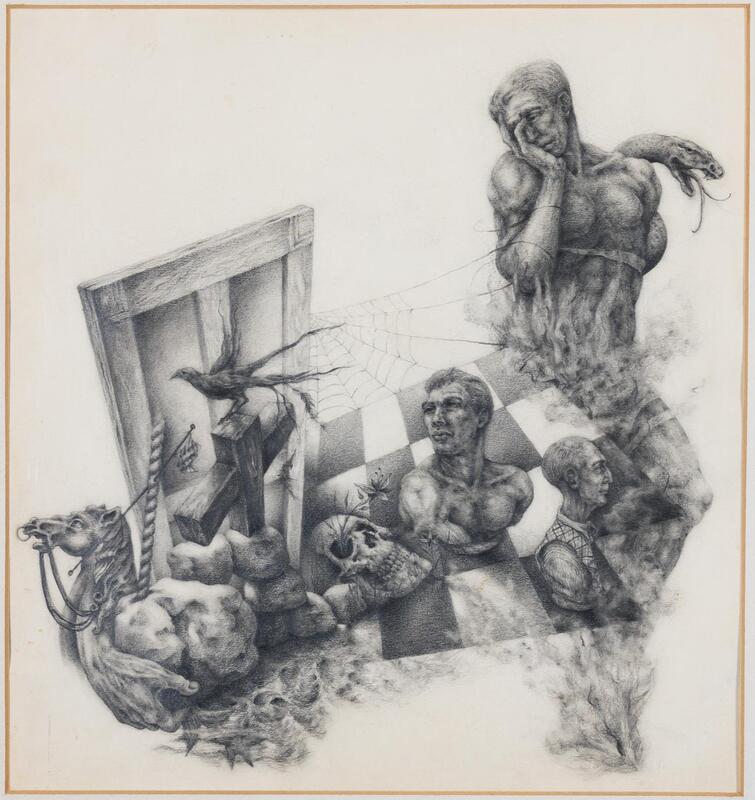
Patricia C. Walker was an artist from Worcester, MA. Man is a surrealist drawing that uses gothic symbols, such as the cross, crow on the tombstone, skull, and older man, to signify human mortality. It also uses Christian iconography, such as Adam and the Snake.
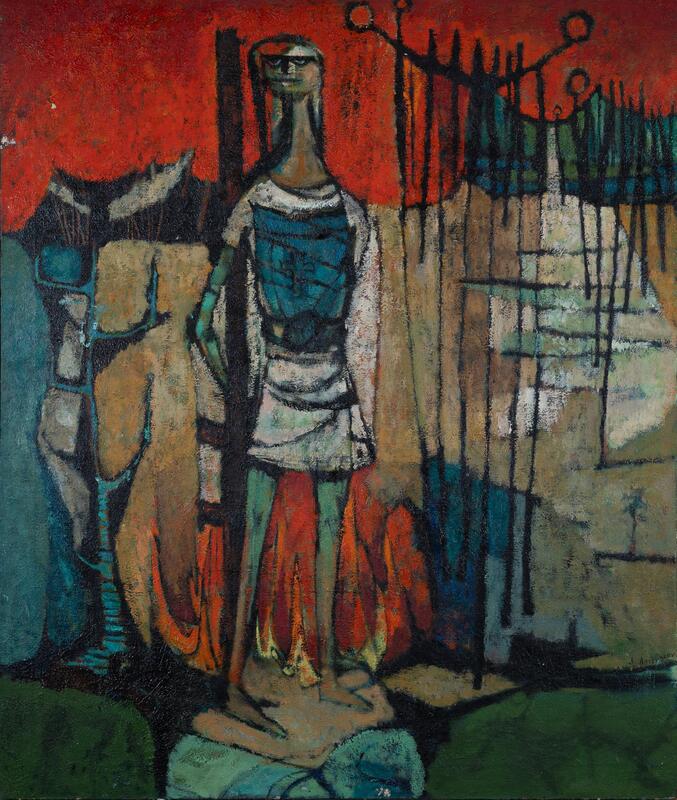
John Arterberry was an artist who worked in the art department at Langston University from Tallahassee, FL. Martyr shows a woman wearing a top with a cross and standing barefoot in a natural setting. The woman looks straight ahead, slightly smiling as a small fire sits behind her.
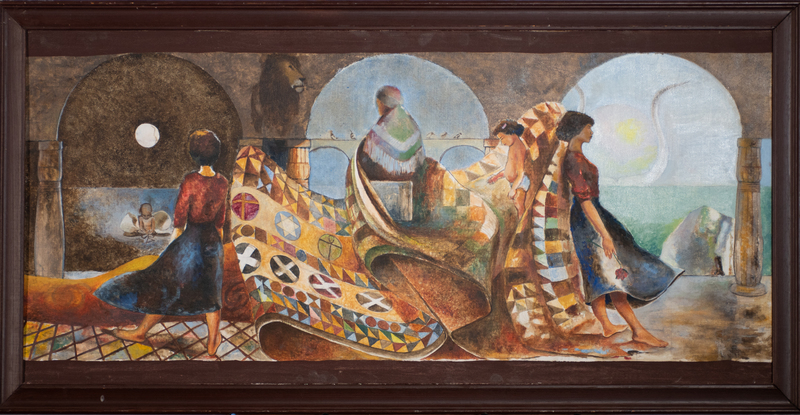
Curnell’s painting is a pre-study of her mural “Awakening” in Hannah Hall. The mural shows a reflection of Curnell’s past, present, and future life. She is seen pictured here as an infant, at her current age, and her future self as an elder. The quilt that stretches across the composition features various religious symbols, including the cross, the star of David, and the ankh.
Williams’ painting is a pre-study for his mural. Across three scenes, the artist portrays birth, family home life, and farm work. This triptych style of composition appears frequently in the murals painted by students of Dr. John T. Biggers. The checkerboard motif that Williams uses in each panel is also drawn from Biggers’ teaching. Although Texas Southern is an urban university, many students hail from rural areas in Texas and these themes of country life appear repeatedly in student murals.
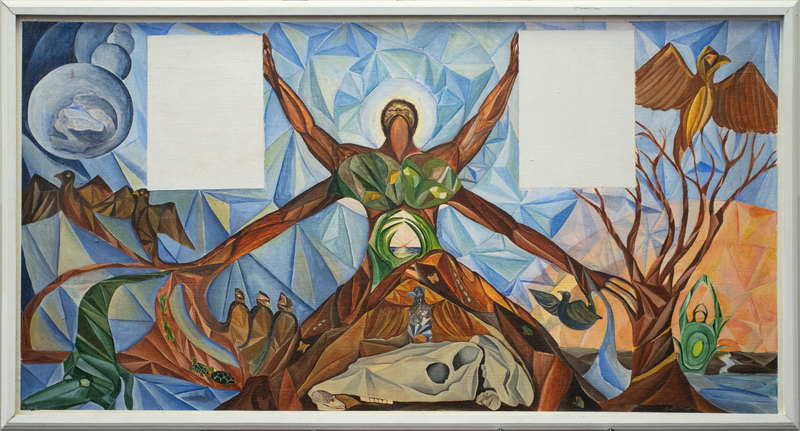
Sampson’s mural study depicts Mother Nature surrounded by birds, turtles, trees, fossils, and an expansive blue sky. This piece is painted in a geometric style that appears frequently in the work of students of Dr. John T. Biggers during the mid to late 1970s. Apart from some minor changes, Sampson’s final mural replicates the design in this earlier draft.
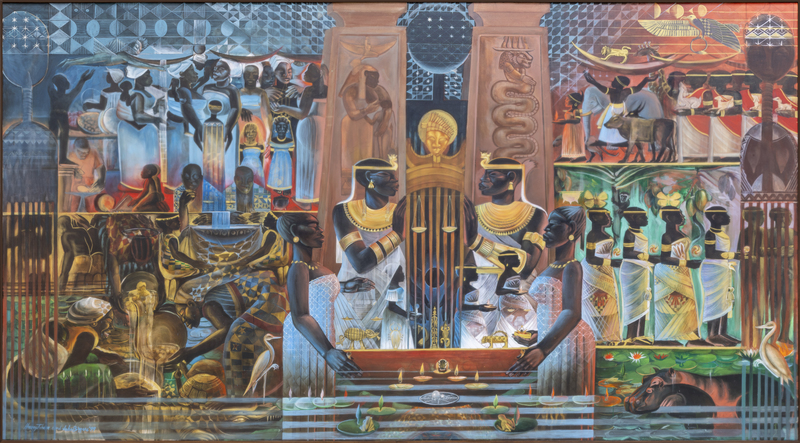
Biggers and Harvey Johnson, a former TSU art professor and student of Dr. Biggers, painted this mural in the lobby of the Jesse H. Jones School of Business. It speaks to the history of commerce and the wealth of Africa. NUBIA is full of visual symbols drawn from African art, including ceremonial combs, gold weights, and several meaningful animals, like the hippo, buzzard, sacred ibis, double crocodile, spider, tortoise, and more.
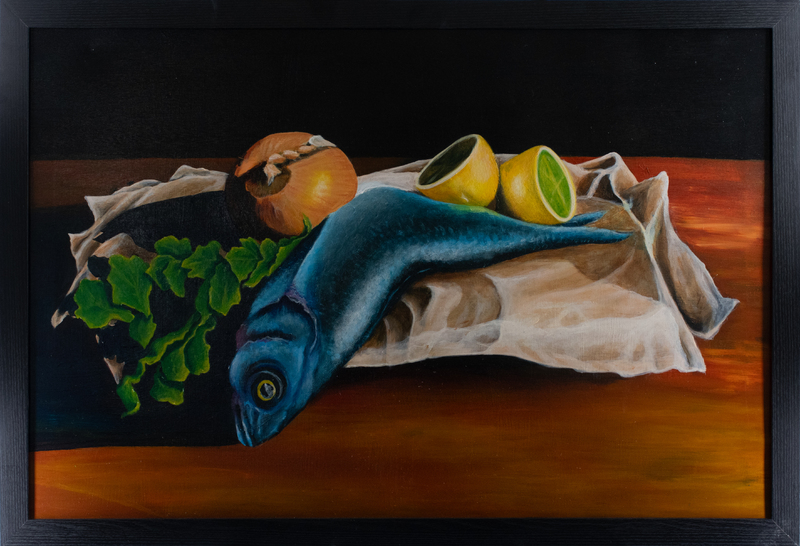
Hinojos' painting, "Pescador de Hombres," draws on Christian themes. The painting references the story of Jesus' miraculous feeding of the multiple with bread and fish, but also a symbolic representation of Christ as the "Bread of Life," a source of spiritual sustenance. Hinojos is a graduate of Texas Southern, accomplished airbrush artist, and founder of the Houston Art Center, an organization that aims to support artists in the Hobby area of Houston.
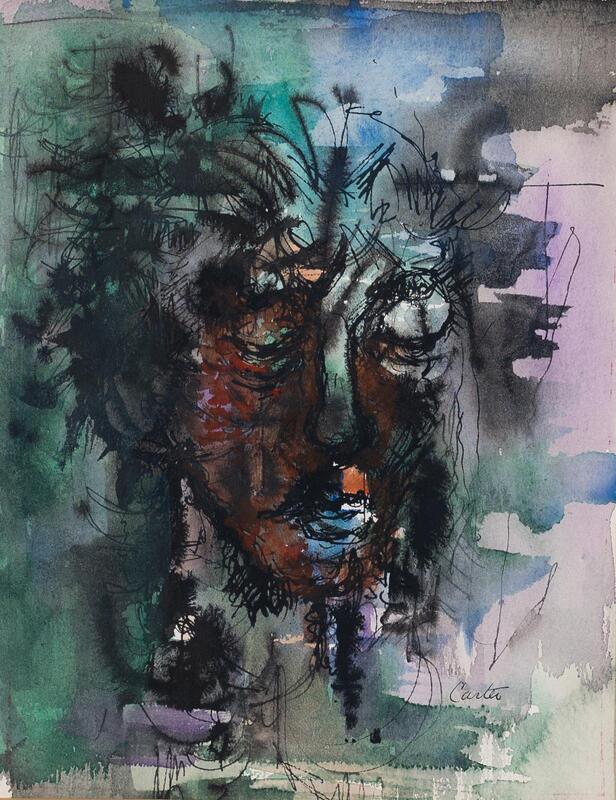
William S. Carter was an abstract, landscape, still-life, and figurative painter from St. Louis, Missouri. Pieta is an interpretation of Michaelangelo's Madonna della Pietà. The gestural ink markings create facial features and show eyes looking downward on top of a pastel-colored backdrop.
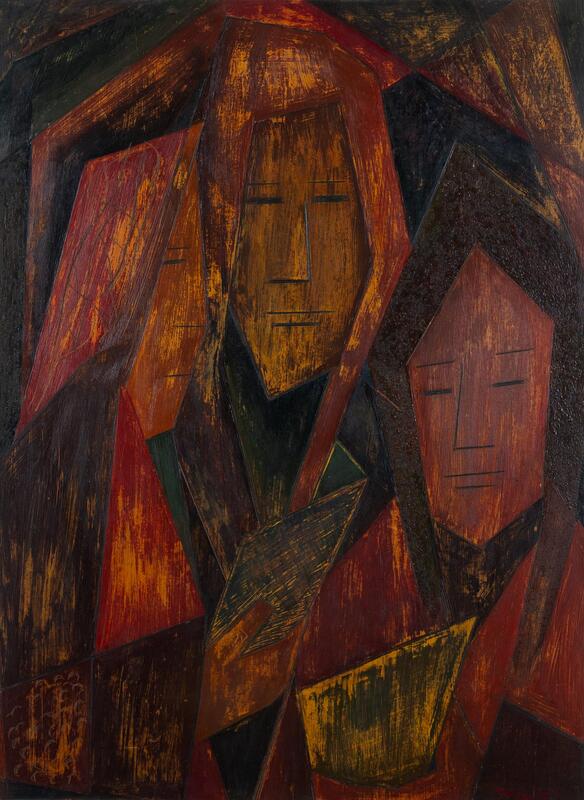
Merton D. Simpson was an abstract expressionist painter and African art collector from Brooklyn, N.Y. Portrait of The Wise Men is an oil painting of the three male Biblical magi. The men on the left and right hold texts, and the central man's head is visible between them. Simpson uses muted colors throughout the piece.
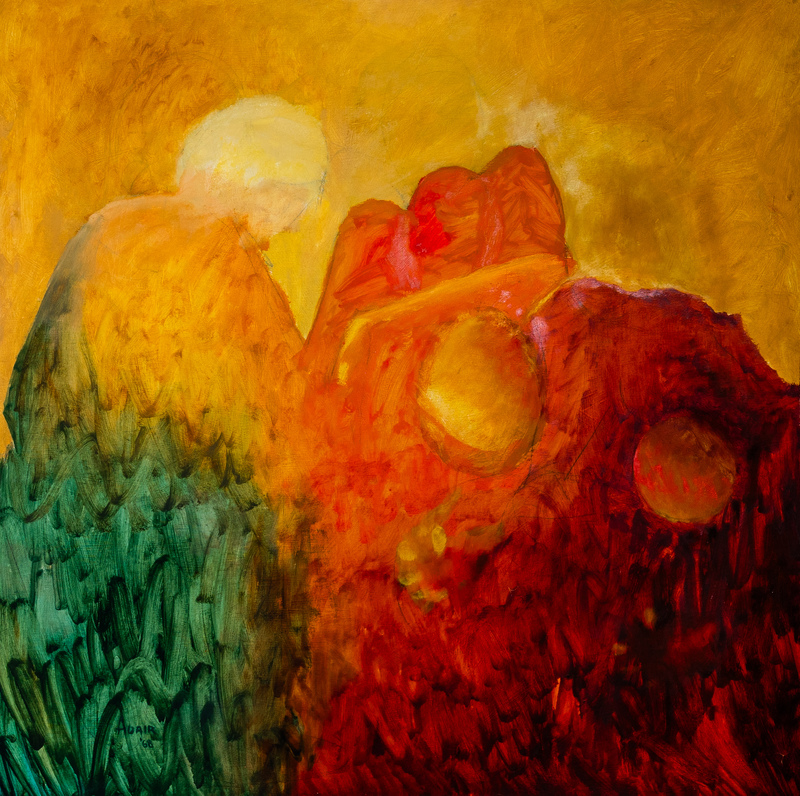
James Adair was an artist from Atlanta, GA. A prayer Meeting is an abstract depiction of a group of people practicing a religious ritual. Adair uses broad brush strokes of green, red, and yellow to create this scene of piety.
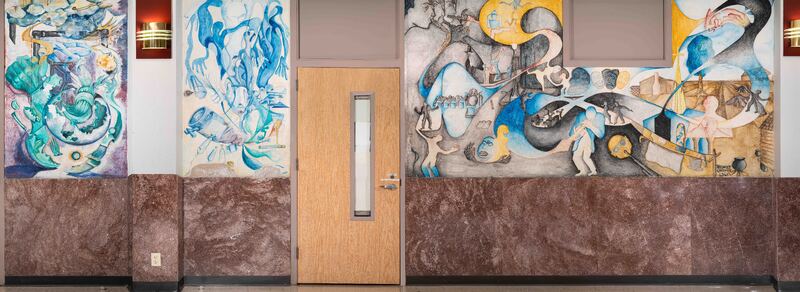
Goffney's intricate mural suggests themes of scientific discovery, fluid energy, and mid-century lifestyles. Scenes of nightlife and a rural church are featured on the right. Goffney signed his last name as Goeenet, perhaps his artist name.
Thomas’ mural depicts an abstracted circus scene. In the center, three clowns, perhaps self-portraits, dressed in collars and muted colors, look seriously towards the viewer. The figures’ contemplative expressions stand in sharp contrast to their dress and profession.