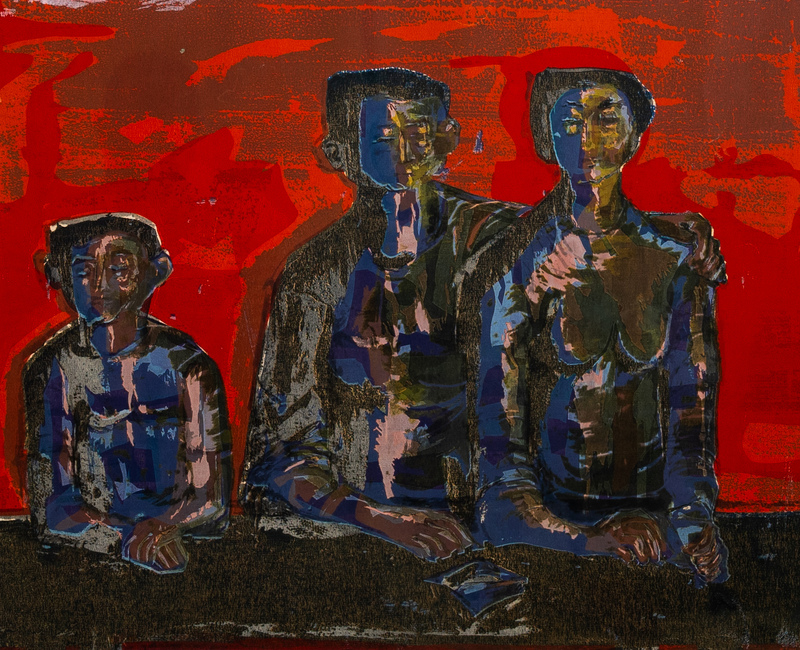
John Payne was an artist from New Orleans, LA. "Awaiting the Welfare Agents" is a mixed-media depiction of a traditional family with pensive expressions. They are sitting together preparing for a visit from a representative of the Department of Human Services.
Ed Perry served as a Democrat in the Mississippi Legislature from 1968-2000, later serving as House Clerk for 4 years. In this interview Mr. Perry discusses his educational background and how he landed in the Mississippi government and his experiences working with Robert Clark.
Fred Banks Jr. served in the Mississippi House of Representatives from 1976-1985 and Circuit Judge for the 7th Circuit District from 1985-1991. He details his experiences in the state legislature and his journey running for office. He also describes the early beginnings of the Mississippi Black Caucus and his mentorship under Robert Clark.
Johnny Palmer was appointed in 1980 as the first Black sergeant at arms at the Mississippi State Capitol. He had worked at the House as a maintenance and inventory supervisor since 1959. He details the challenges that Robert Clark faced and also talks about the dynamics that the presidents of the major Black colleges had with the House.
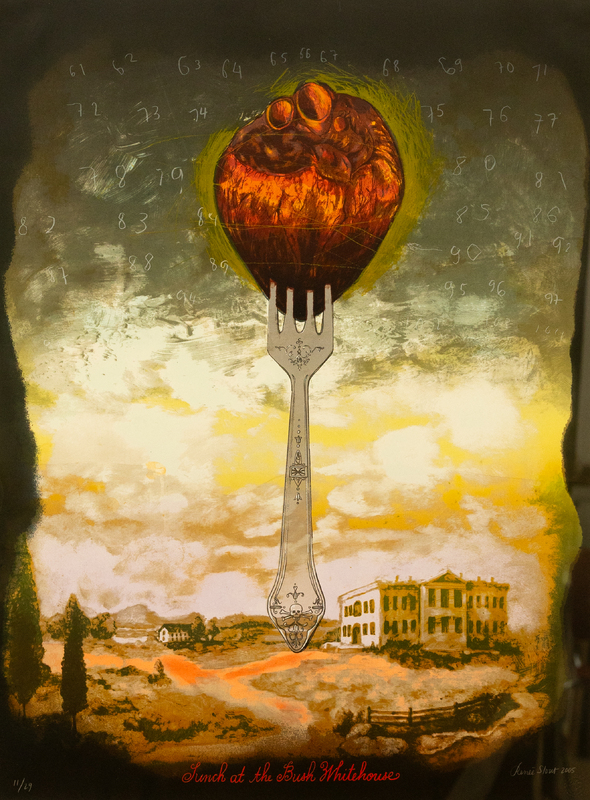
Renee Stout is an artist and sculptor from Junction City, KS. Lunch at the Bush White House is a conceptual gothic painting that explores the intersection of Stout's critique of the Bush administration and numerology from an atmospheric perspective. Above a plantation-like landscape, Stout depicts a heart impaled by an ornate fork.
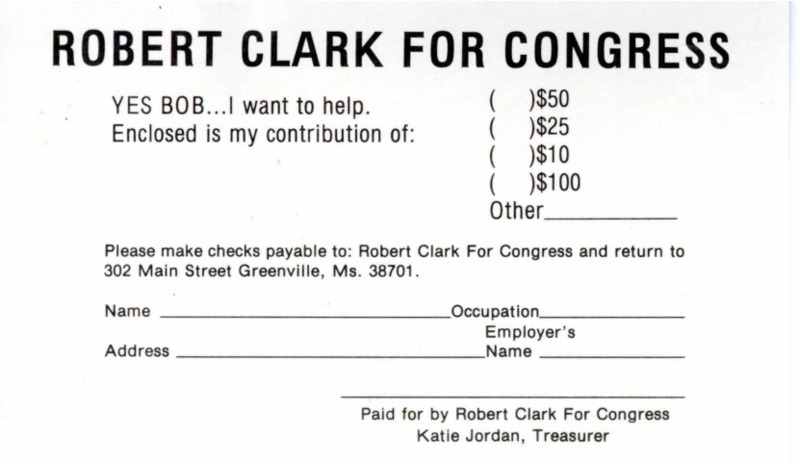
Collection of campaign materials from Robert Clark's 1984 campaign for the United States House of Representatives, 2nd Congressional District of Mississippi. This collection consists of letters, mailers, fliers, and more.
Mayor Phillip Curtis West returned to Mississippi from Chicago in 1964 to become involved in the Civil Rights Movement. Becoming involved with the NAACP at Alcorn State University led him to eventually end up in Mississippi politics, being elected to the Mississippi House of Representatives in 1997 and Mayor of Natchez, Mississippi in 2004.
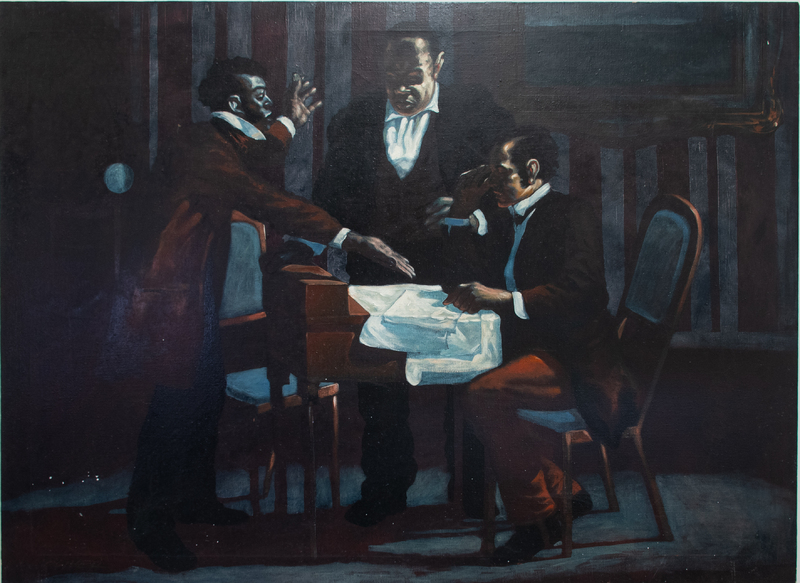
Oliver's painting depicts vanguard Black politicians from the Reconstruction period following emancipation. Radical Reconstruction saw the election of dozens of Black lawmakers in former slave states like Texas. After 1897, Texas didn't elect another Black legislator until 1966.
Sen. Alyce Griffin Clarke served in the Mississippi House of Representatives from 1984-2004. She talks about her work in education before running for office in 1984. She also discusses Robert Clark’s passion for education, the different committees she is involved in, the Institute of Higher Learning, and more.
Rep. Leonard Morris served in the Mississippi House of Representatives from 1993 until his death in 2007. He was head of the House Medicaid Committee. In this interview, Rep. Morris explains the nature of the Black Caucus and his time working with Henry Kirksey, Robert Clark, Ed Blackmon, and other notable Black Mississippi politicians.
Rep. Mary Stevens served in the Mississippi House of Representatives from 1981-2012 and was the mayor of West, Mississippi, for eight years. She has close ties to Robert Clark and speaks on her experiences in the Mississippi Legislature, serving on several committees such as Public Health and Appropriations.
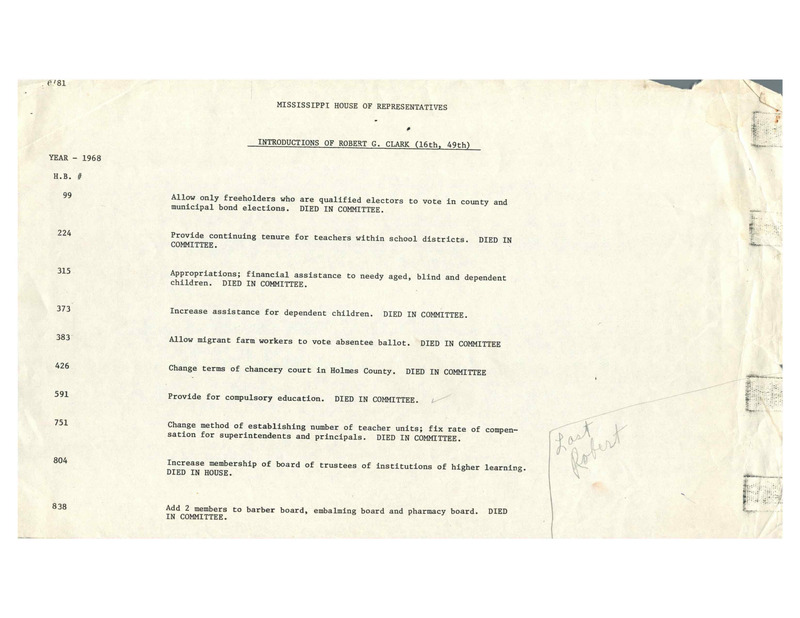
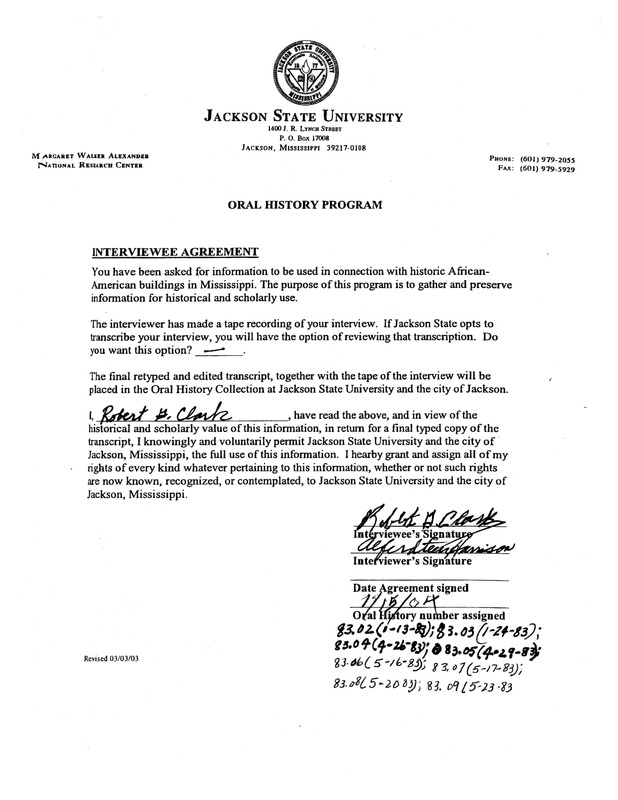
Rep. Robert G. Clark served in the Mississippi House of Representatives from 1968 to 2004. Rep. Clark talks about his legislative career and the racism he faced. He also talks about the impact the Civil Rights Movement had on him winning the election and his introduction of bills to create holidays for Martin Luther King, Jr., and Medgar Evers.
Rep. Robert G. Clark served in the Mississippi House of Representatives from 1968 to 2004. In this interview, Rep. Clark fills in some holes from the previous interviews, including: the difficulty in starting a family and maintaining a business while being involved in politics and some pushback his campaign and election received.
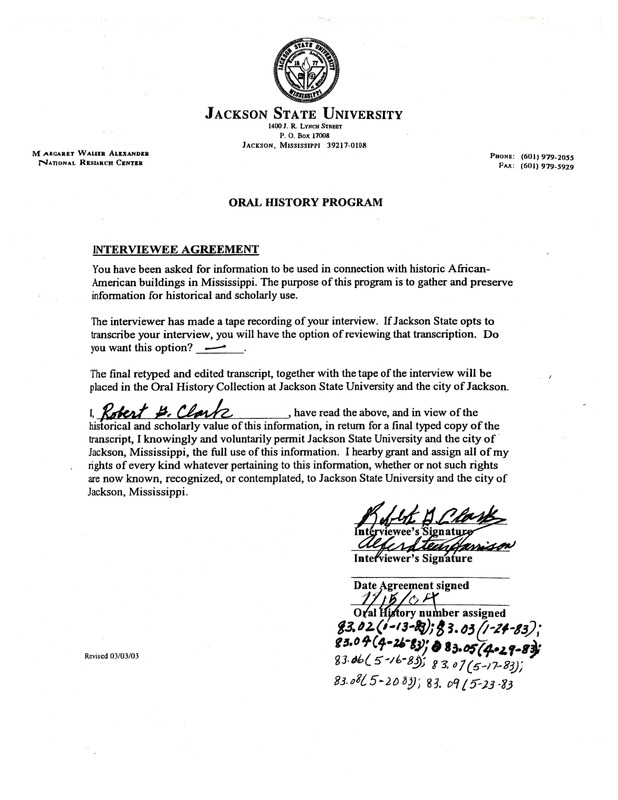
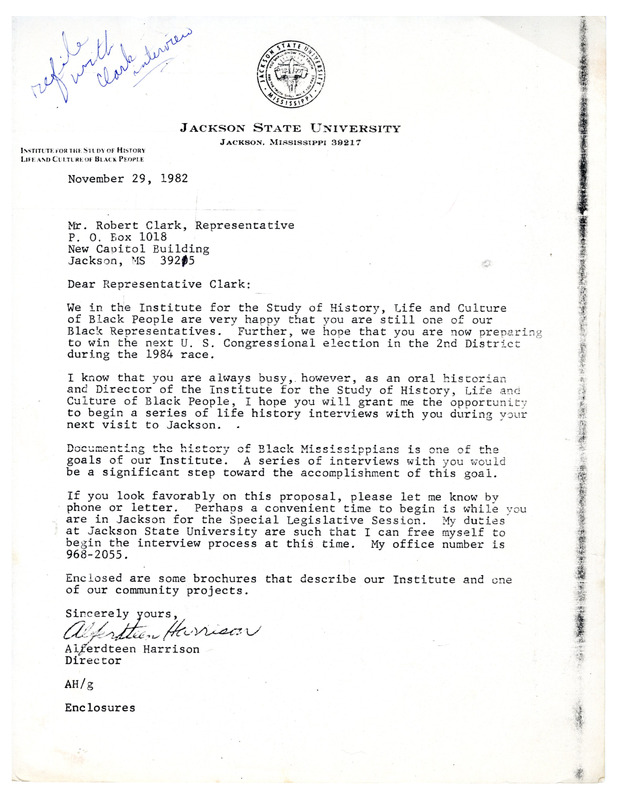
Collection of materials leading up to Robert Clark speaking on campus at Jackson State University for the 1983 Afro-American History Month Celebration. There are letters of invitation from Dr. Alferdteen Harrison as well as a biography of Robert Clark and the event program.
Sen. Alice Varnado Harden served in the Mississippi State Senate from 1988 until her death in 2012. She talks about her work with Robert Clark and the Mississippi Black Caucus. She also discusses the many issues she lobbied for as an elected official and her relationships with other members in the state legislature.
Senator David L. Jordan began serving on the Mississippi State Senate in 1993 and has been serving for 31 years. He recounts growing up on a plantation in Greenwood, Mississippi. The interview focuses on the work he did with Robert Clark in the Mississippi Legislature to support and obtain funds for Historically Black Colleges.
Sen. Willie Simmons served in the Mississippi Senate from 1993 to 2020. He details the opposition and challenges he faced while fighting for education reform and better treatment of the Black colleges in Mississippi. He looks at his career retrospectively and ponders over how he would like to be remembered.
Douglas Anderson served in the Mississippi House of Representatives from 1976-1980 and the state Senate from 1980-1992. He was one the first four African Americans elected to the Mississippi Legislature in the 20th century, after Robert Clark in 1967. He details his experiences while on various committees and working with Robert Clark.
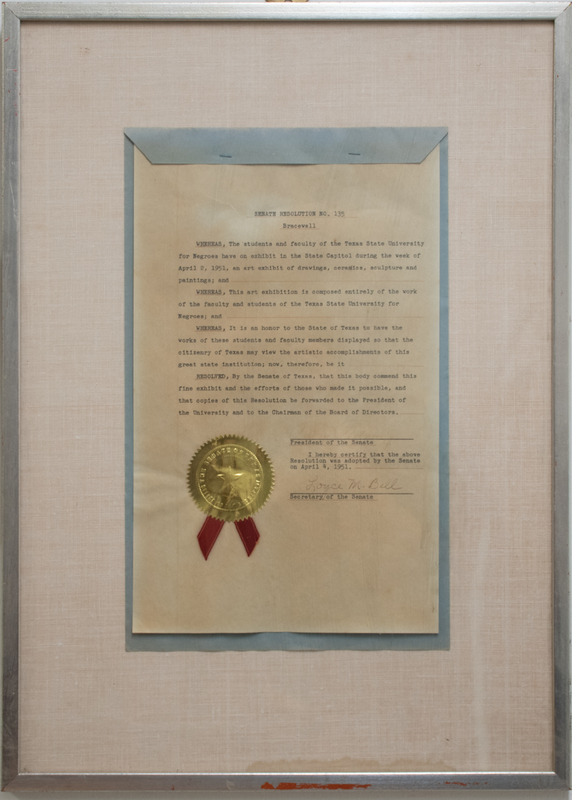
This Texas Senate resolution commends the art students and faculty of Texas State University for Negroes (now Texas Southern University) for their exhibition in the State Capitol in April 1951. It is notable that this exhibition took place years before desegregation.
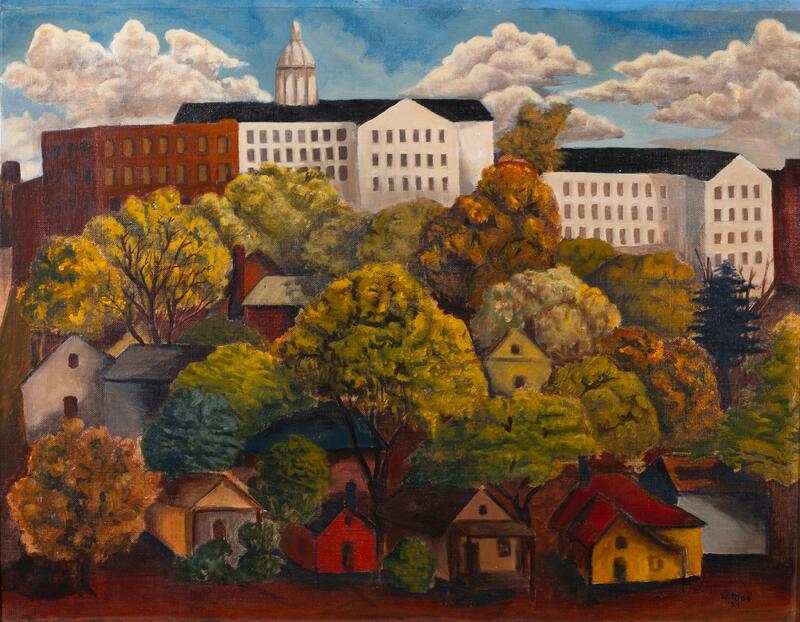
William E. Rice was an artist from Tallahassee, FL. The Capitol is a perspective painting of a residential area beside a Capitol building. In the foreground are several houses with multi-colored trees between them; in the background are larger buildings, including the Capitol, under a cloudy blue sky.
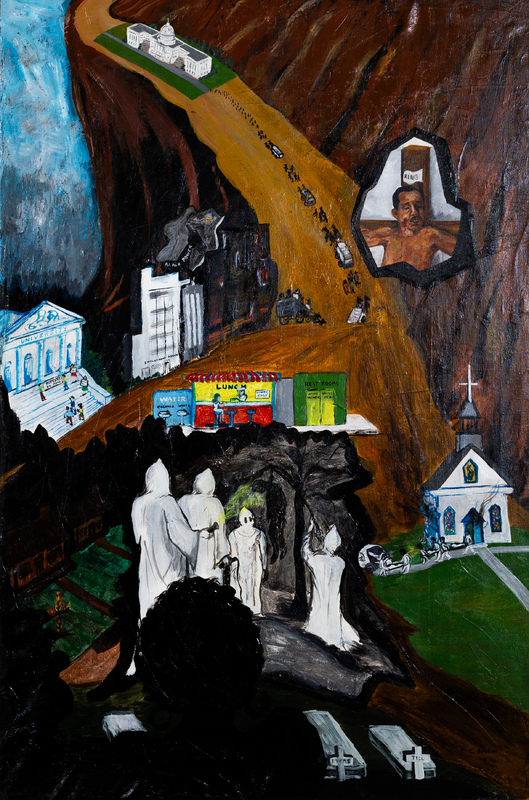
Eva Booker was an artist from Atlanta, GA. The Road we Trod depicts Black American experiences with white supremacy during the Civil Rights Movement. The piece critiques the KKK, lynching, lunch counter discrimination, education inequality, job orientation, religious hypocrisy and Black people's long march toward freedom in spite of.
Shelia Pree Bright is a cultural anthropologist and photographer from Waycross, GA. Young Americans Series: Tarrynn Deavens, age 18, African American depicts a young Black woman posing with the American flag binding her arms and mouth. This series is an examination of Generation Y's response to America.