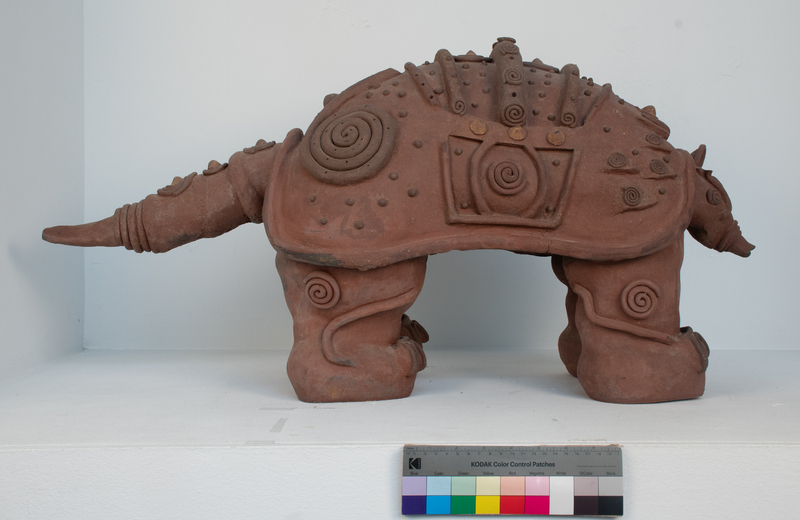
Johnny Jones’s sculpture, “Armadillo,” features decorative embellishments along the body of the animal, especially the shell. The spiral motif is often found on the sculptures of student artists taught by Carroll Harris Simms. Armadillos, which utilize their shells for protection, are commonly found in Texas.
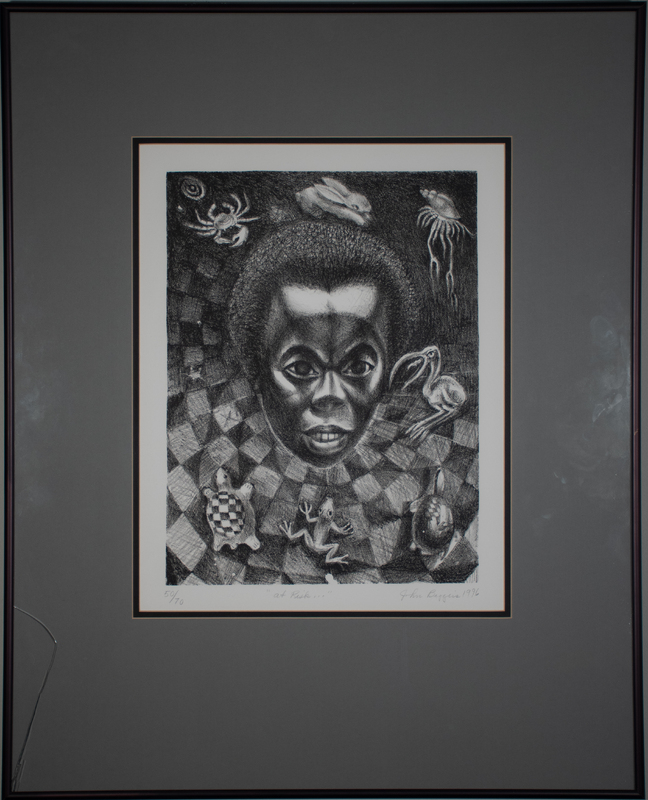
This Biggers print shows a person's head surrounded by animals and a checkerboard. Checkerboards and swirls are common motifs in Biggers' work, which he referred to as sacred geometry. The pictured animals are symbolic; for instance, tortoises represent longevity and rabbits represent bad omens.
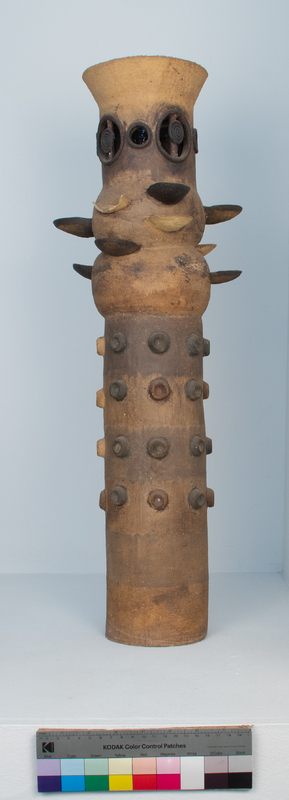
Elizabeth Montgomery Shelton’s terracotta is made up of a variety of colored clays with embellishments that have been painted using black and tan slips. The top half includes layers of plates extending out from the surface, while the bottom half is evenly decorated with pressed circular clay. The structure perhaps mimics an instrument or a bird feeder.
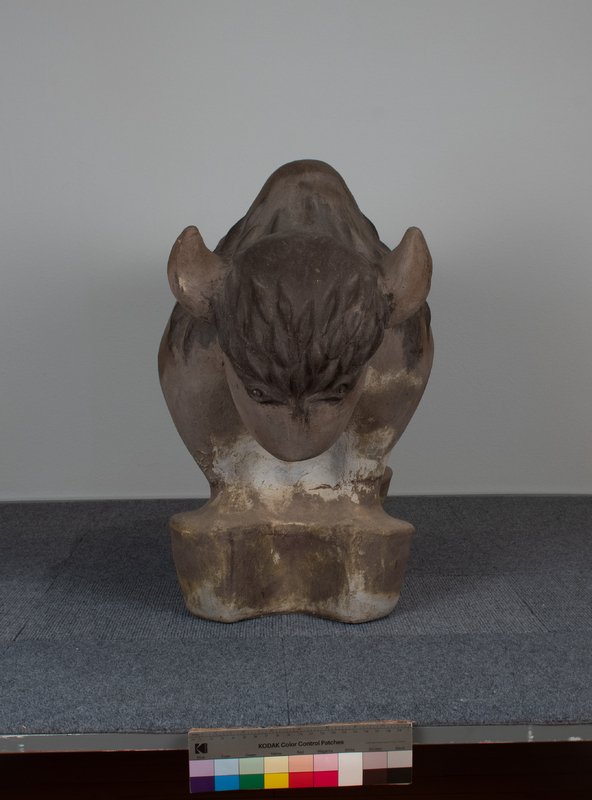
Erma Gordon’s “Bison” sculpture includes two-toned clay with a smooth finish on the body. The hair of the bison is carefully sculpted on the top of its body, lending a realistic, soft texture. The artist depicted herself creating this sculpture in her Hannah Hall mural. Wildlife are frequent subjects of TSU student terracottas.
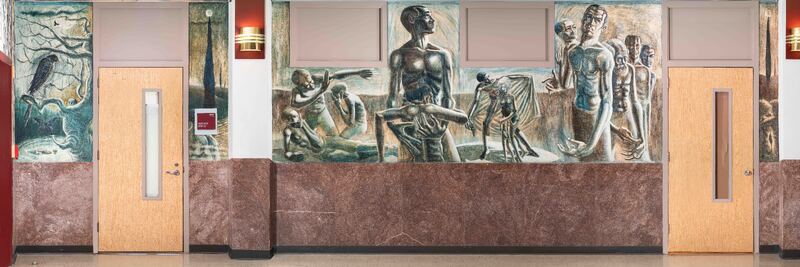
This is a universal scene of the despair and struggle facing a group determined to survive. The lone tree in the moonlight starkly symbolizes the darkness surrounding the scene (center left panel), while the tree rising from a swamp (leftmost panel) suggests hope with the bird, butterfly, and waterlily indicating transformative beauty.
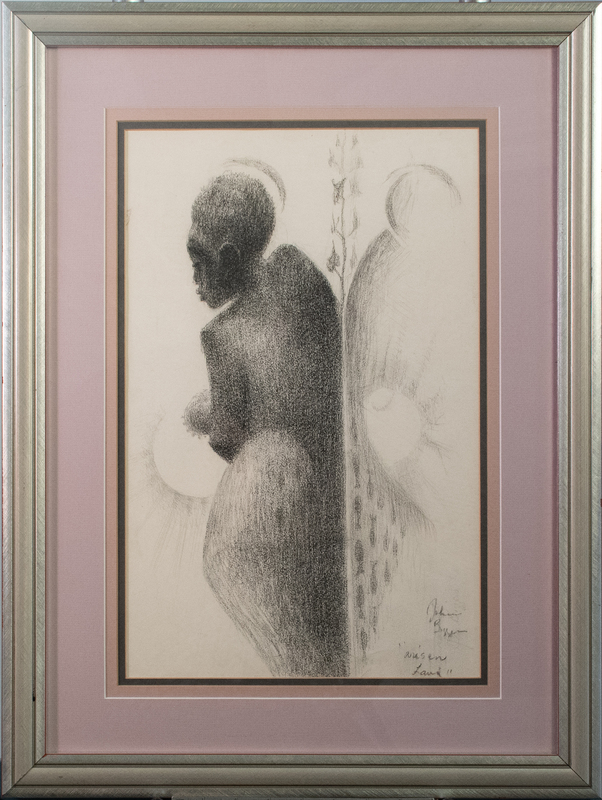
Biggers’ drawing shows a woman and her reflection. The woman, positioned on the left side of the composition, looks slightly back over her left shoulder, while the sun creeps out from around her midsection. The woman is cradling a baby in her arms. Her reflection is drawn loosely with minimal details, and the two are separated by a line of plant and fish shapes.
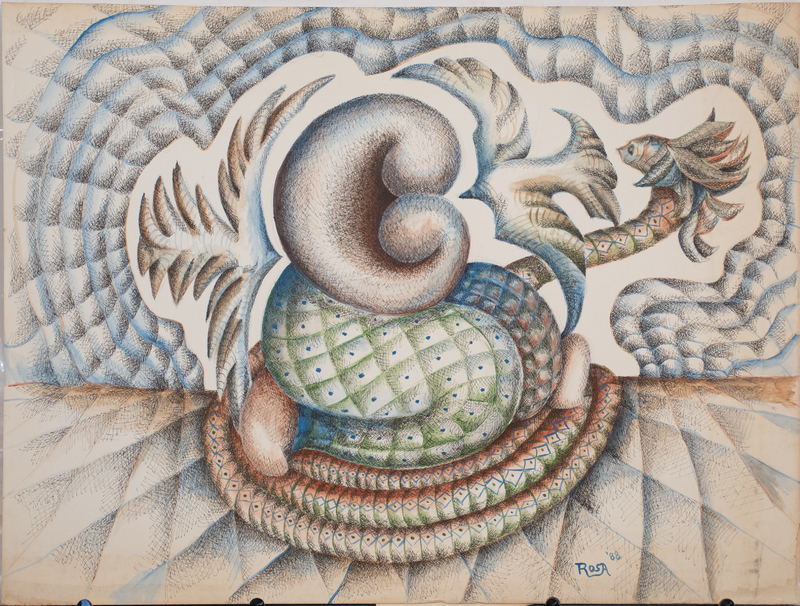
Mendoza’s drawing shows two doves and a serpent protecting an abstract, embryo-like figure. A geometric aura emanates from the bundle of creatures, perhaps alluding to the way parents protect their children. The drawing is created using crosshatching and heavy use of geometric shapes; both of these techniques are characteristic of the work of Dr. John T. Biggers and his students.
Houston Chandler was a sculptor, printmaker, painter, and teacher from Saint Louis, MO. "Duel in the Sun" is a print artwork of an avian battle on an abstracted landscape. One colorful rooster looks down upon the other it just defeated. The roosters are set on a green field against a blue sky with a swirling yellow sun.
In this interview, Texas Southern art alumnus Earl Jones, Jr. discusses his experience as a student who graduated in 1996. During his first period of study at TSU, Jones painted a mural reflecting on environmentalism and racism—these themes continue into his current works. Nowadays, Jones primarily creates intricate wood carvings.
This is a brochure for Jones’ senior art exhibition. The culmination of the Texas Southern art curriculum is a senior exhibition where students showcase artwork created over the course of their undergraduate studies. The brochure features a portrait of Jones, a brief biography, a catalog of the artwork featured in the exhibition, and several photos of his paintings, designs, weavings, and sculptures.
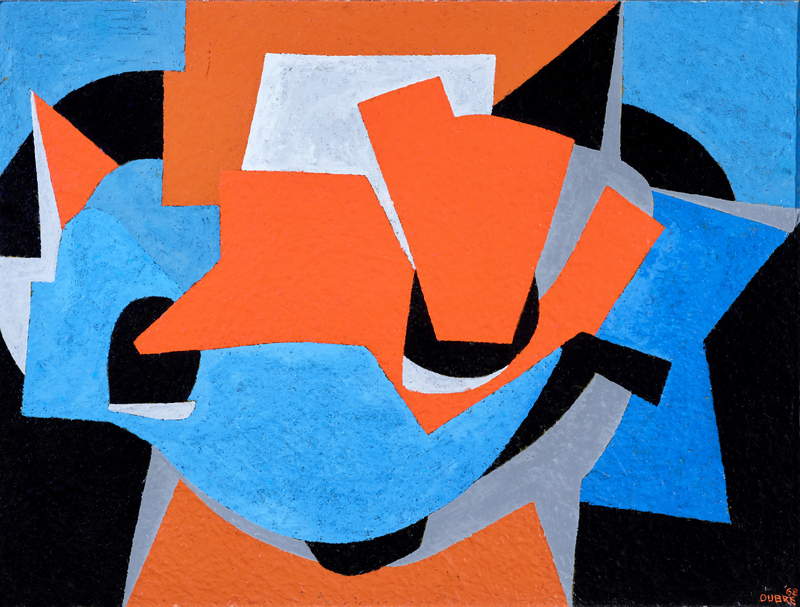
Hayward Oubre was a multimedia artist and educator from New Orleans, LA. "Equivocal Fox" is an abstract depiction of a fox using polygonal shapes. The red and blue forms overlap throughout the painting. The entire artwork is painted with a bumpy texture, which creates a slight relief sculpture effect.
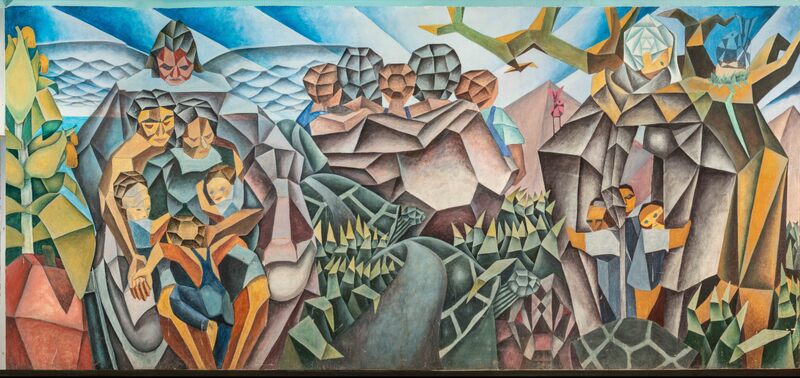
Sifuentes shows multiple generations of a family, painted in a geometric style. Sifuentes borrows visual symbols from his teacher, Dr. Biggers, including the tortoise (longevity) and the serpent (danger and rebirth). Guardian ancestors are represented by figures with angel wings.
Hubbard, a student of Carroll Harris Simms, created “Figure With Turtle and Bird” in 1966. This terracotta depicts a bird, atop an abstract tree, surrounding a tortoise. These animals are often paired in folktales, including an Igbo tale where a tortoise fools birds and is punished by having his shell broken. The fable says this is the cause of the irregular shape of tortoise shells.
Green’s sculpture is a maquette for his terracotta, which depicts the head and upper fins of a fish. The fish is decorated with ornamental swirls, holes, and ridges. Professor Carroll Harris Simms required his students to add these additional embellishments to their sculptures.
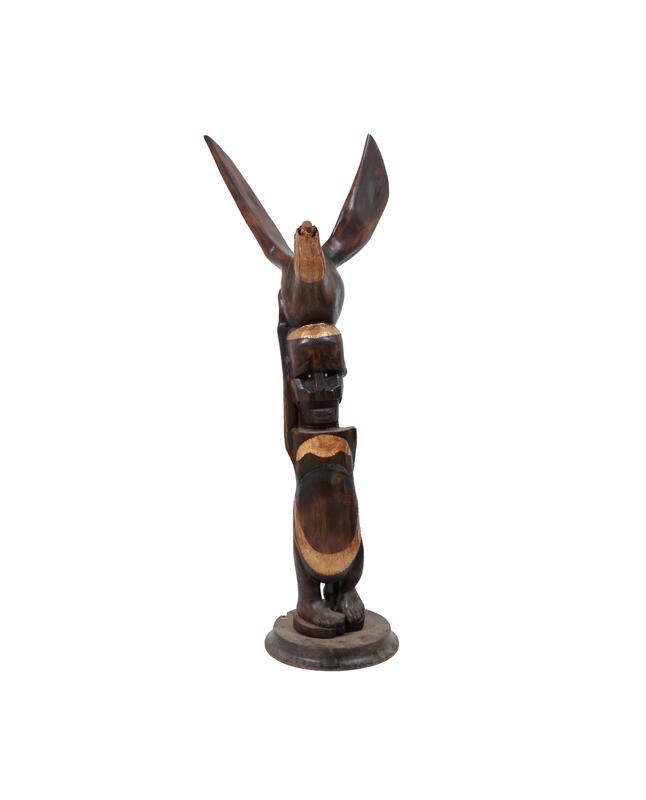
Edward L. Pryce was a landscape architect and artist from Lake Charles, LA. "Fisherman with Cormorant" is a medium-sized carving of a man fishing with a cormorant, a species of aquatic bird, on his head.
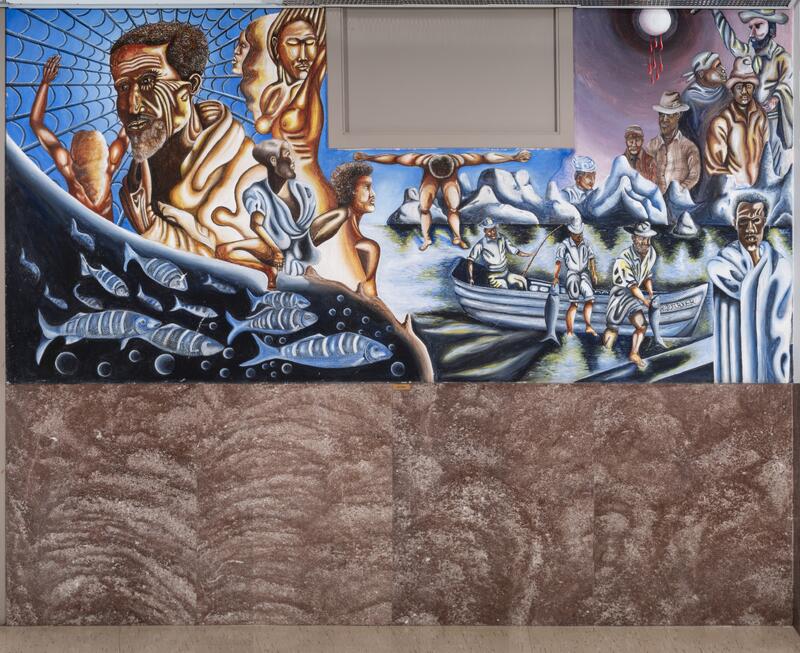
The mural shows fishing life along the water. In the middle and on the right, a man is doubled over from his burden, while a group of fishermen brings their catch to shore. On the left, an elderly man and other figures suggest the trials and challenges of the ancestors.
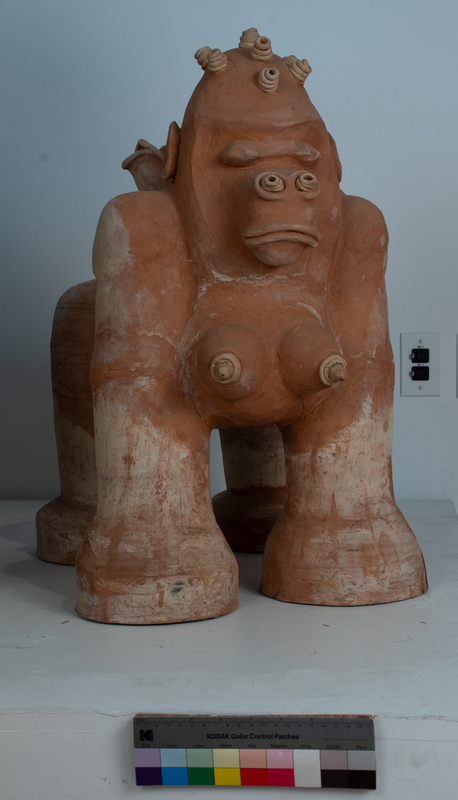
This terracotta sculpture features a mother gorilla with a child clinging to her back. The mother’s head, face, and body are adorned with spiral embellishments. A common theme featured in Texas Southern University’s permanent collection of terracotta sculptures is the relationship between mothers and their children.
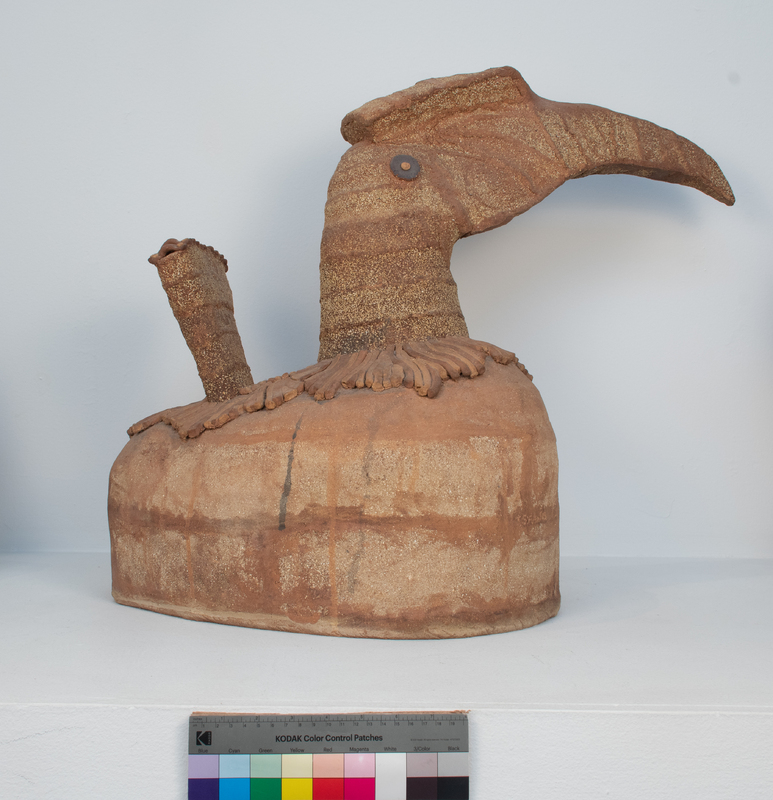
Jesse Sifuentes’ “Greater Hornbill” was created using the slab method, which was taught to students of Carroll Harris Simms. This method entails layering evenly rolled clay mixed with sand as artists build up their figures, working from the bottom layer to the top. Sifuentes frequently features hornbills, unique birds found in parts of Africa and Southeast Asia, in his art.
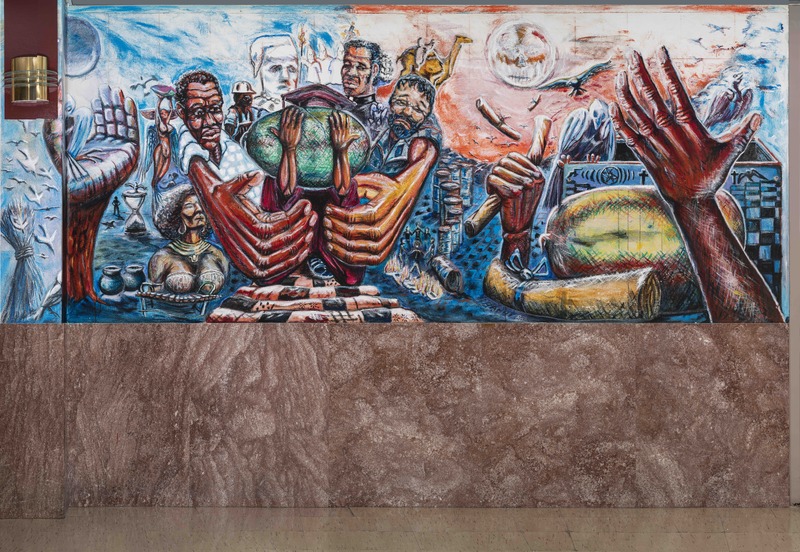
The artist boldly tackles the often stereotypical image of the watermelon while depicting the hypocrisy of organized religion in the Black community and the constant threat of the Klan. The large, reaching hands pull at a recent graduate, whose face is obscured by the watermelon they are holding.
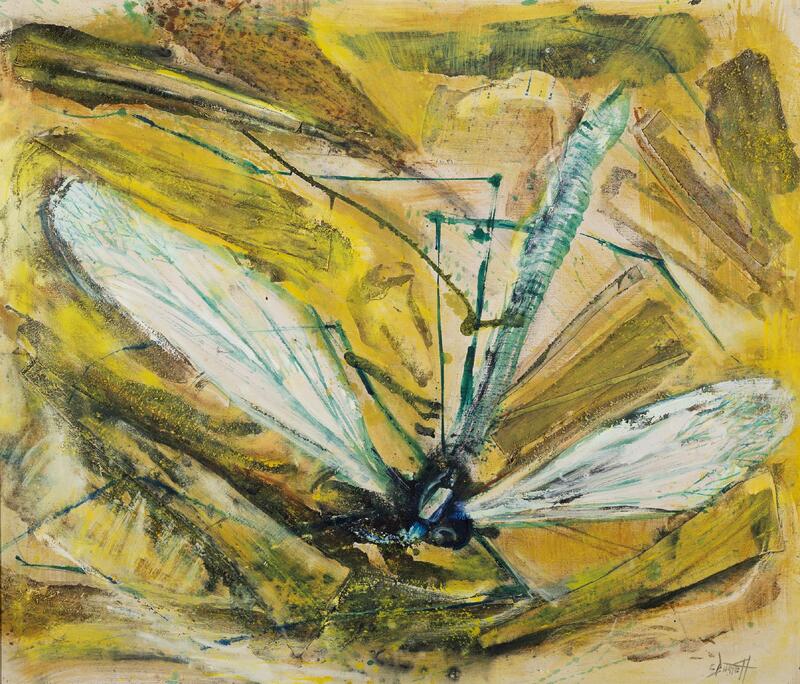
Calvin Burnett was a graphic artist, illustrator, painter, designer, and art teacher from Cambridge, MA. Insect is a painting of a dragonfly in a close-up perspective. The dragonfly is primarily bright green with long, thin legs, two white wings, and a dark blue head. A naturalistic setting of bright yellows, browns, and greens surrounds it.
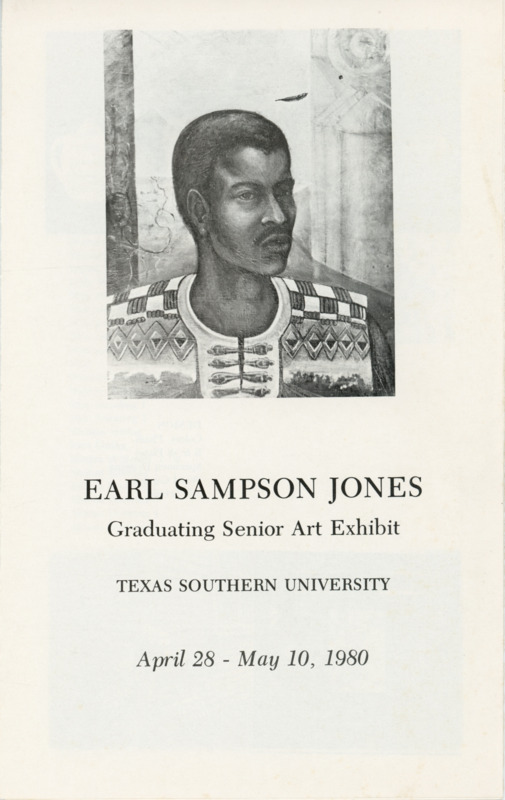
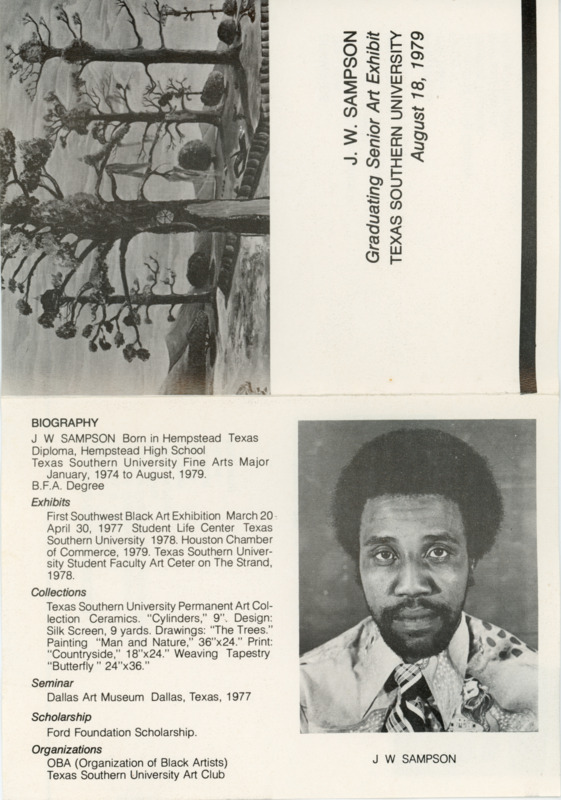
This is a brochure for Sampson’s senior art exhibition. The culmination of the Texas Southern art curriculum is a senior exhibition where students showcase artwork created over the course of their undergraduate studies. The brochure features a photo of Sampson, a brief biography, a catalog of the artwork featured in the exhibition, a photo of one of his tapestries, and photos of two of his paintings.
Jones' self-portrait has a piercing facial expression and displays protruding veins near the brow line and a direct stare from the eyes. The crown is adorned with a spider and the outline of a web along the scalp, along with a spiral near the left ear. The design may have been inspired by Spiderman, who debuted in comics 8 years earlier.
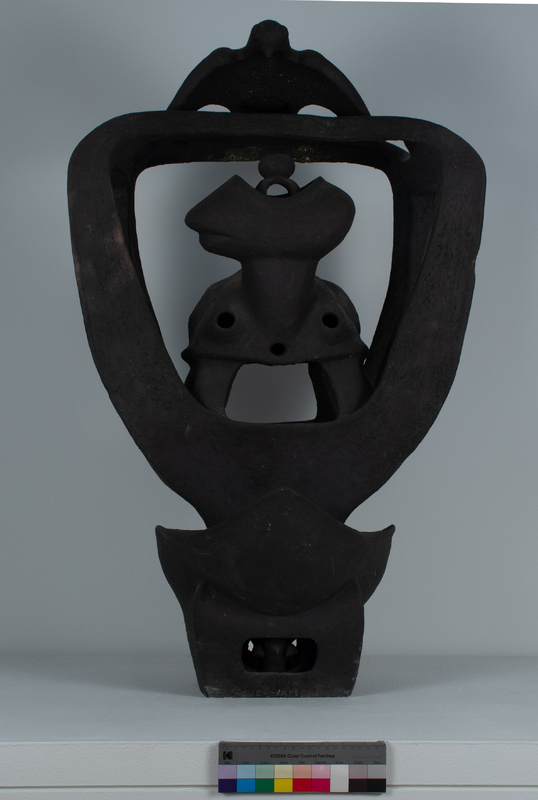
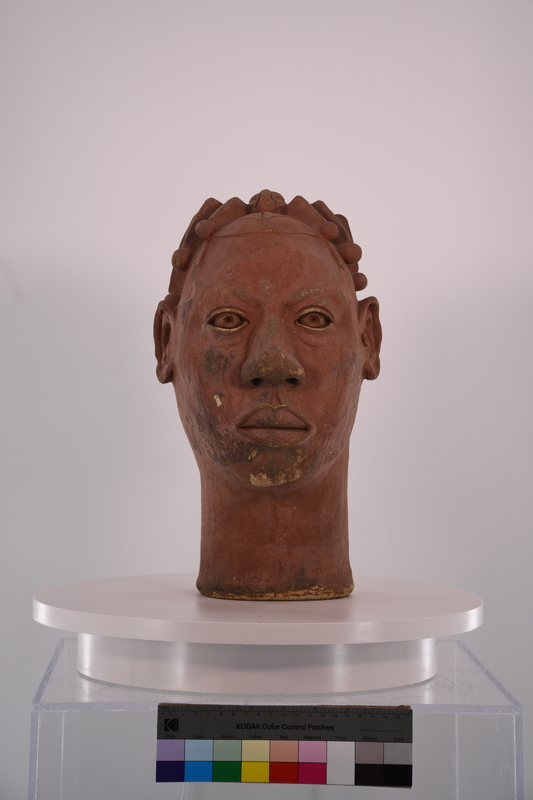
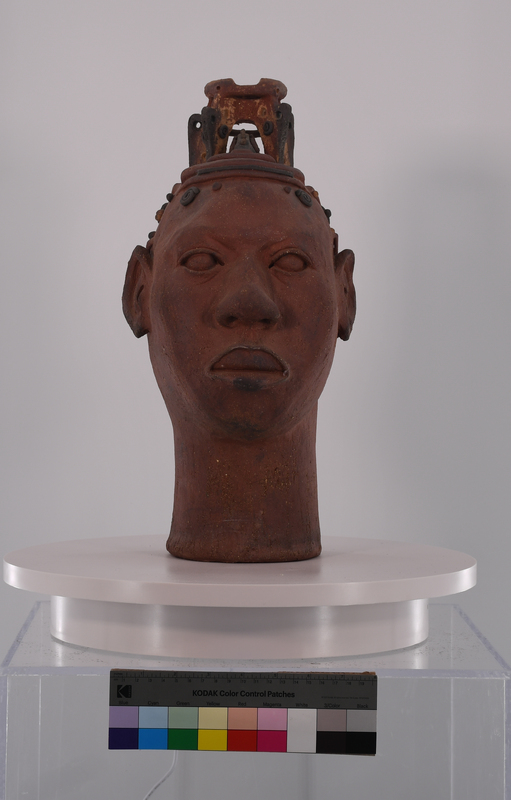
This bust is a self-portrait of the artist. Jones depicted his face with sharp features, high cheekbones, and protruding veins near the brow line. The crown is adorned with spiral motifs, dots, and rolled clay. Atop is a shrine structure, with a turtle within. Turtles and tortoises are often used to symbolize longevity. Students were encouraged to adorn their self-portraits with additional embellishments.
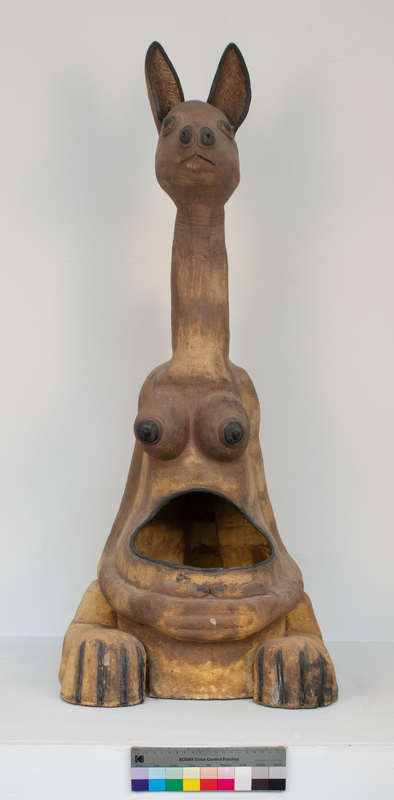
Moses Adams Jr.'s sculpture depicts a kangaroo mother with human-like hands and breasts. The clasped hands under the open pouch signify protection. Detailed, oversized hands are characteristic of the work of John Biggers and his students. Additionally, mothers of various forms and species are a common subject of the student terracottas from Texas Southern University.
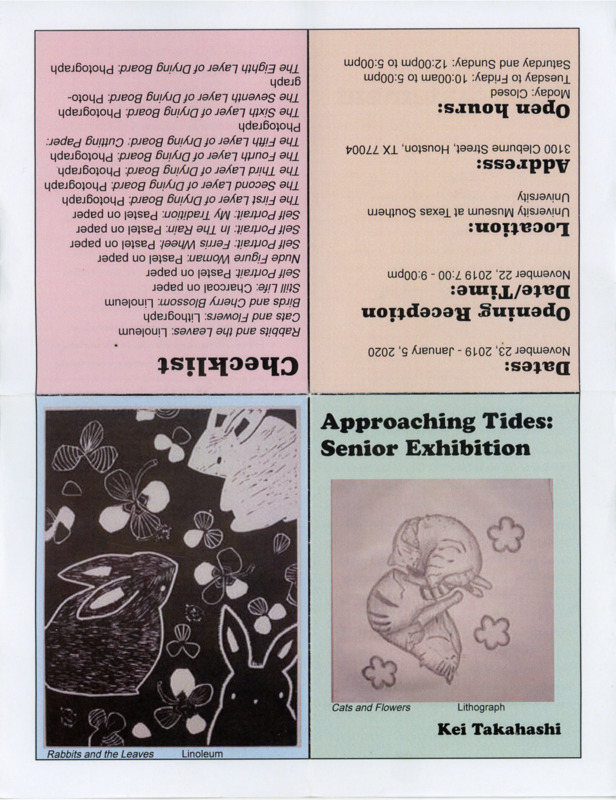
This is a brochure for Takahashi’s senior art exhibition. The culmination of the Texas Southern art curriculum is a senior exhibition where students showcase artwork created over the course of their undergraduate studies. The brochure features a brief biography, an artistic philosophy, a catalog of the artwork featured in the exhibition, exhibition viewing information, and three photos of her artwork.
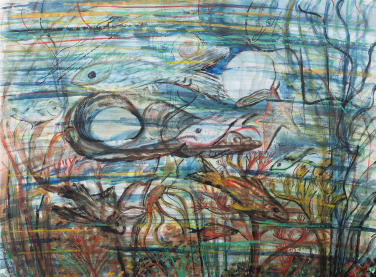
Jewell Woodard Simon was an internationally acclaimed artist, teacher, and poet from Houston, TX. Marine Land Fantasy is an underwater landscape drawing of fish and plants. Simon uses a variety of colors that illustrate aquatic biodiversity. Her use of lines evokes the depth of open water.
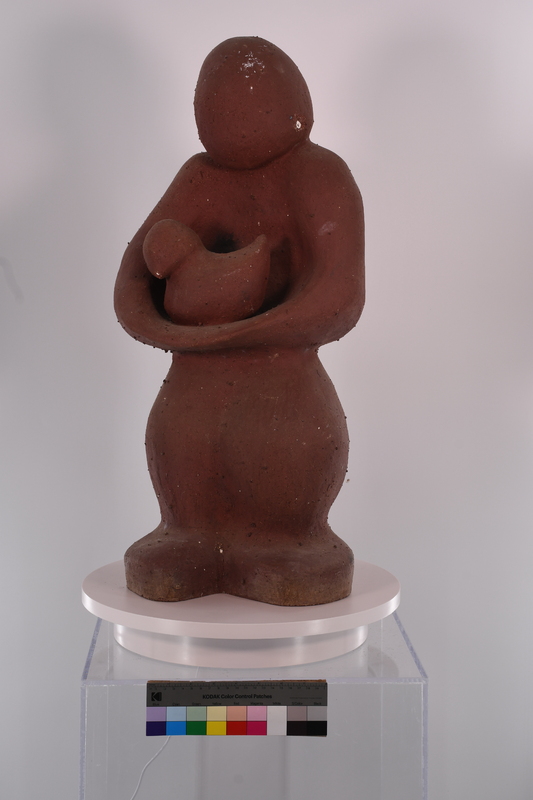
Windle’s terracotta portrays a figure embracing a bird in its arms. The exterior of the sculpture is smooth and lacking any of the decorative motifs typically featured on Texas Southern students’ terracottas. The embrace reflects the compassion of a mother and her child, while also displaying interspecies grace and kindness through the act of picking up this bird.
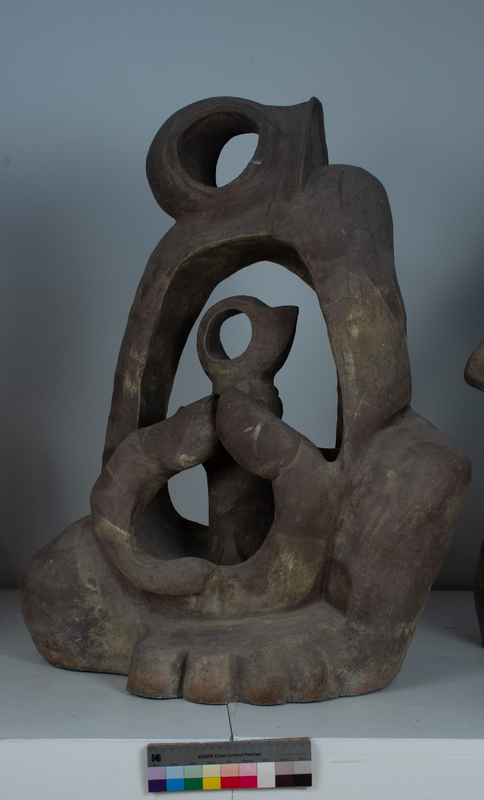
“Mother and Child,” by Warren Williams, reflects a theme of unity. The smaller figure is placed in the lap of the larger, held in place by two fingers connecting to form a circle. The sculpture’s form resembles a mother and child bird, perhaps perched in their nest. The mother-child relationship is an important motif in Texas Southern artwork.
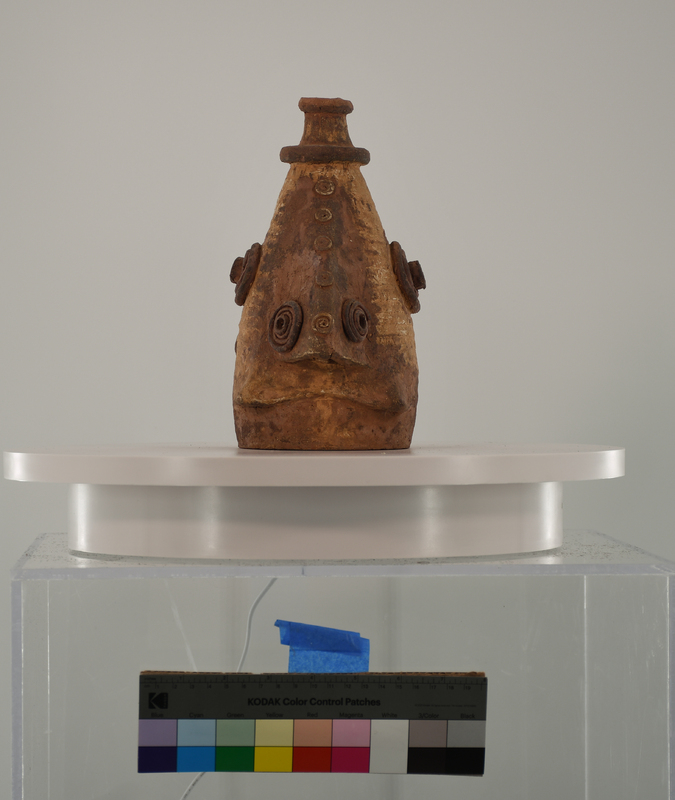
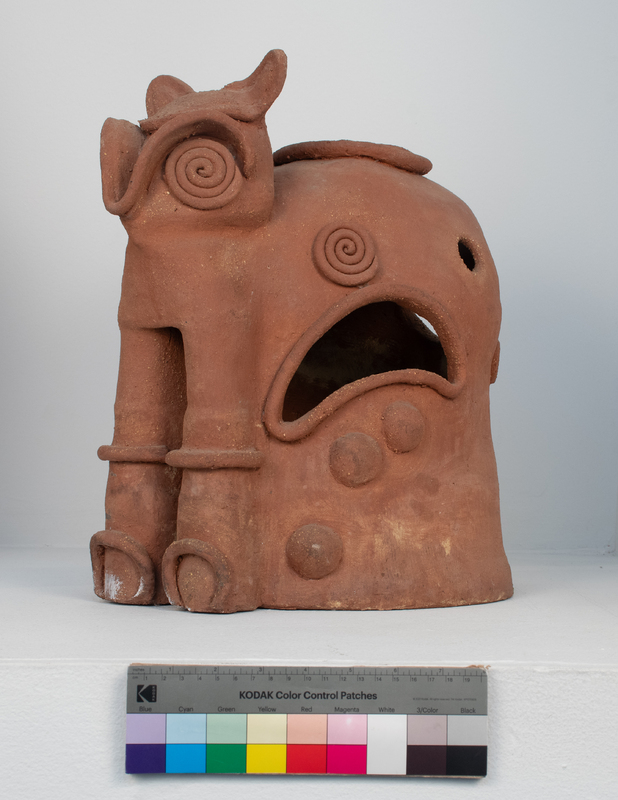
This terracotta features a snail-like creature with long legs, adorned with spiraled embellishments for the eyes and outer shell. The spiral motifs are placed in a symmetrical pattern on both sides of this sculpture. The clay is mixed with grog to create a better texture and prevent the terracotta from shrinking when fired.