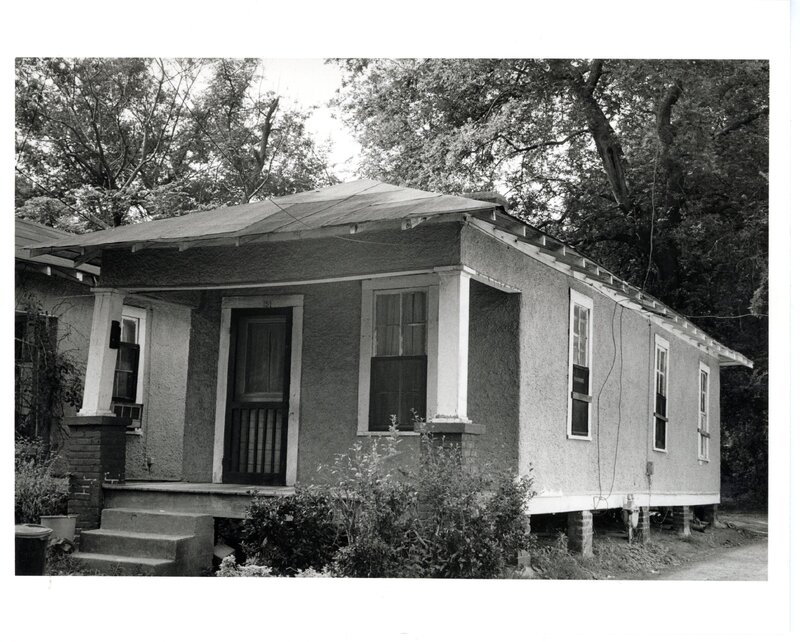
Dolly Smith moved to Jackson with her family in 1919 or 1920 when she was a little girl. She says the “Good Old Days” were the times when things weren't as expensive. She reminisces on her childhood and what life was like during the Great Depression and talks about Black owned businesses, race relations, and music in Jackson.
Dr. Aaron Shirley began his work with Head Start while working with the Freedom Schools during Freedom Summer in 1964; many of those schools became part of Child Development Group (CDGM). Dr. Shirley talks about his role as a medical services provider for Head Start programs all over Mississippi as part of a team of Black doctors.
Dr. Albert Briton was the medical director for Child Development Group of Mississippi (CDGM) and Head Start from the start of the program, brought in by director John Mudd because white physicians in the state were refusing to work in the program. Dr. Briton talks about his involvement with the Civil Rights Movement leading him to work with CDGM.
Dr. David White was the first Black optometrist in the state of Mississippi when he moved onto Farish Street in 1951. He talks about Farish Street before and after integration: Black businesses became less prosperous after integration as some Black customers went to white owned businesses. He also talks about his involvement with the NAACP.
Dr. David White was the first Black optometrist in the state of Mississippi when he moved onto Farish Street in 1951. He talks about how his first White customers came during the Civil Rights Movement as there was an active meeting place for activists above his business.
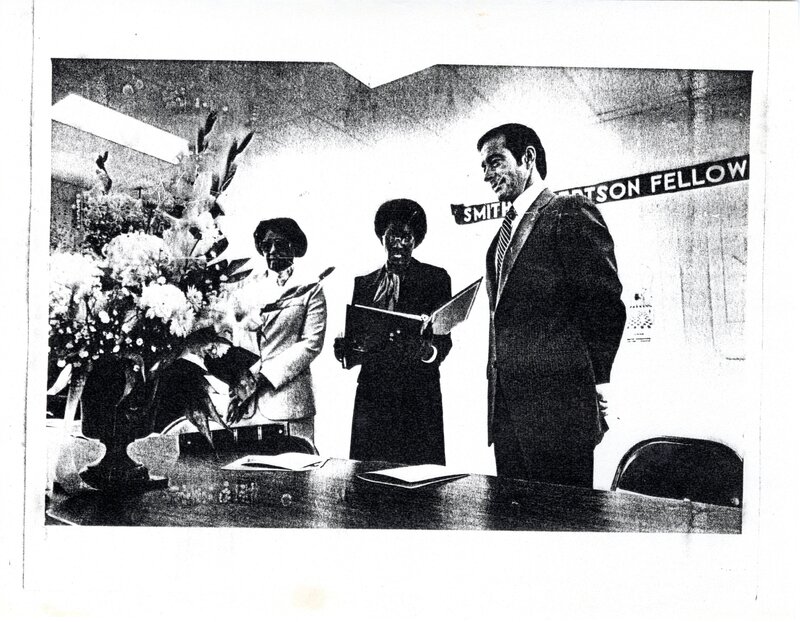
A copy of a photograph of Dr. Jessie Bryant Mosley, Dr. Alferdteen Harrison, and Mayor Dale Danks, Jr. at the Smith Robertson Neighborhood Folklife Festival, April 9-11, 1983. The festival was a grant sponsored event held on the grounds of the Smith Robertson Museum to celebrate the history and culture of the Farish Street Historic District.
Dr. Jim Hendrick's involvement with activism led him to work with Child Development Group of Mississippi (CDGM) to offer medical examinations for Head Start students. He talks about recruiting other doctors as well as some of the medical conditions he saw during these exams. Incomplete, Side B of the recording is missing.
Dr. Lee Williams was a homeowner in the Farish Street District from 1924-1954 and worked as Vice President of Administration at Jackson State University. He talks about his time as a student at Smith Robertson School and Lanier high School. He discusses the effects of segregation on the district and also the current efforts to revitalize the area.
Dr. Rejohnna Brown was working as a teacher in the Delta region of Mississippi when she left her job in the summer of 1965 to join a group that were the forerunners to the region’s first Head Start program, which became known as the Mid Delta Education Association. Dr. Brown decided to do this work because of the poverty she witnessed in the area.
Dr. Robert Smith was founder of the Medical Committee for Human Rights, a Civil Rights Movement organization that fought for better treatment of African Americans in the 1960s. Dr. Smith continued this work as the Head Start medical director in the early days of the program. He talks about his responsibilities and experiences in that position.
Dr. W.E. Miller was a physician and surgeon. He was born in 1903 and attended Smith Robertson School from 1908-1913. Dr. Miller talks about his time at Smith Robertson School and the community around the school, recounting the activities that were available for young people at the time. The transcript is edited with handwritten notes.
Earnest Crawford moved to Jackson, Mississippi, in 1940 to work for the Coca-Cola company and retired from there in 1965. Mr. Crawford talks about his experience sharecropping and his time spent as an airplane mechanic instructor during World War II. Only a biography, a summary, and an index are included.
Ed Perry served as a Democrat in the Mississippi Legislature from 1968-2000, later serving as House Clerk for 4 years. In this interview Mr. Perry discusses his educational background and how he landed in the Mississippi government and his experiences working with Robert Clark.
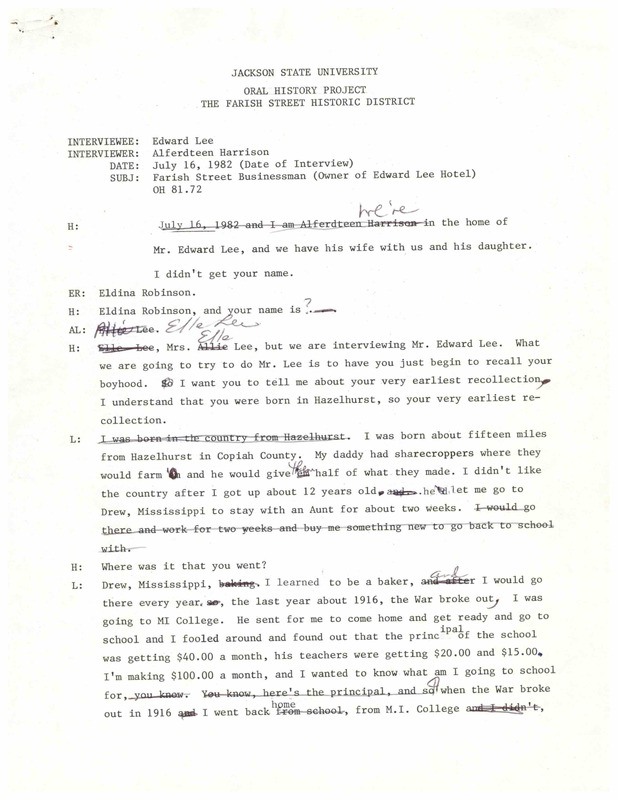
Edward Lee moved to the Farish Street District in 1925 and went on to own several restaurants in the area. He also booked and promoted dances and concerts for clubs and dance halls in the district. Mr. Lee talks about his education, life on a farm, family, and his youth. The transcript is heavily edited with handwritten notes.
Edward Lee moved to the Farish Street District in 1925 and went on to own businesses in the district including The Crystal Palace restaurant and lounge and the Edward Lee Hotel. Mr. Lee talks about his experiences with owning businesses in the district and gives advice to future Black business owners. Transcript is edited with handwritten notes.
Native Jacksonian, Elizabeth Thames discusses her experiences as the owner of Boot's Flower Shop on Farish Street, where she worked over 25 years as designer, manager and owner. She talks about the effect of the Civil Rights Movement on the general welfare of the people in the district as well as the effects on her business.
Elsie Slaughter was a years-long homeowner in the Farish Street District. She talks about her parents' background and occupations and her education. She discusses how White people were able to buy large amounts of property in the district by paying delinquent property taxes and how this was a different experience from most Black property owners.
Elzena Harris moved to the Jackson area in 1892 when she was 4 years old. She was the youngest of twelve children and she talks about her childhood, mentioning the games they would play. Ms. Harris also discusses her education from grade school through college at Jackson State. The transcript contains handwritten edits and is incomplete.
Elzena Harris moved to the Jackson area in 1892 when she was 4 years old. She became a member of the Lynch Street C.M.E. Church in 1909 when it was organized. The purpose of this interview was to discuss the function of the church in the community. The transcript contains handwritten edits and is incomplete.
Emma Mason began as a nurse with Head Start in 1965. She initially worked in Jackson, Mississippi, then in Edwards, Mississippi. She returned to Jackson and eventually worked in all 16 Head Start centers in the city. She talks about the health needs she saw with the students and discusses how workers were recruited for the program in Jackson.
Erma Sanders served on the Head Start board and worked with the first Head Start program that was established in Edwards, Mississippi, through Child Development Group of Mississippi (CDGM). She discusses the differences between the programs in Edwards and Jackson, Mississippi, and the ways that CDGM handled finding teachers for Head Start classes.
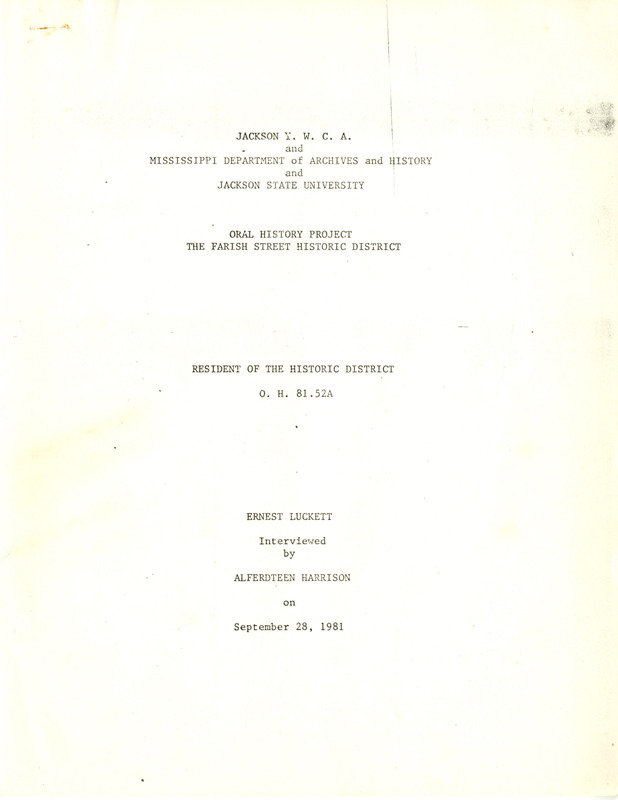
Ernest Luckett moved to the Farish Street District in 1922 at the age of 6 to attend Smith Robertson School. Mr. Luckett talks about his time as a student at the school and his admiration of a teacher. He discusses his relationship with P.G. Cooper, a lawyer on Farish Street who collected rent from tenants in the area for one of his clients.
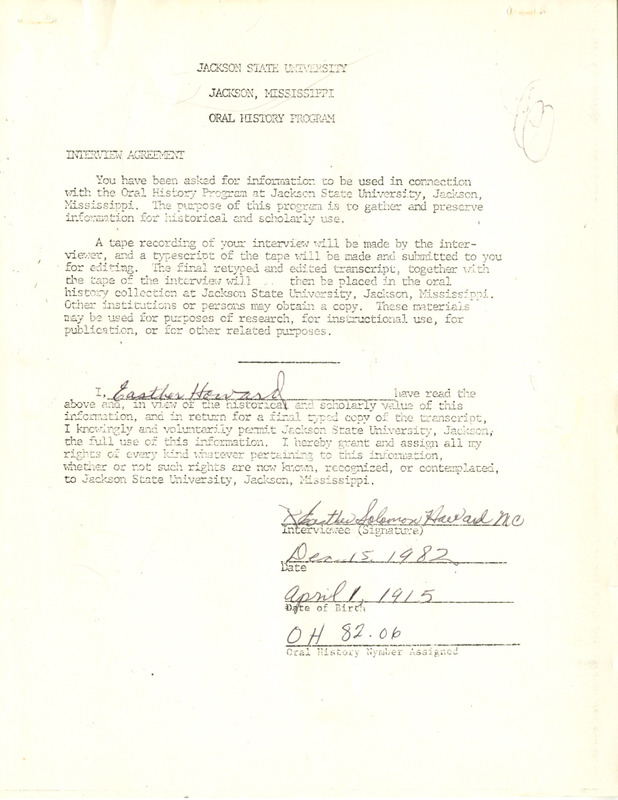
Esther Solomon Howard was born in the Farish Street District in 1915. Ms. Howard talks about her childhood in the Farish Street District, including attending Smith Robertson School, Central Church, and the Young Women’s Christian Association (Y.W.C.A.). She also talks extensively about her husband. The transcript is edited with handwritten notes.
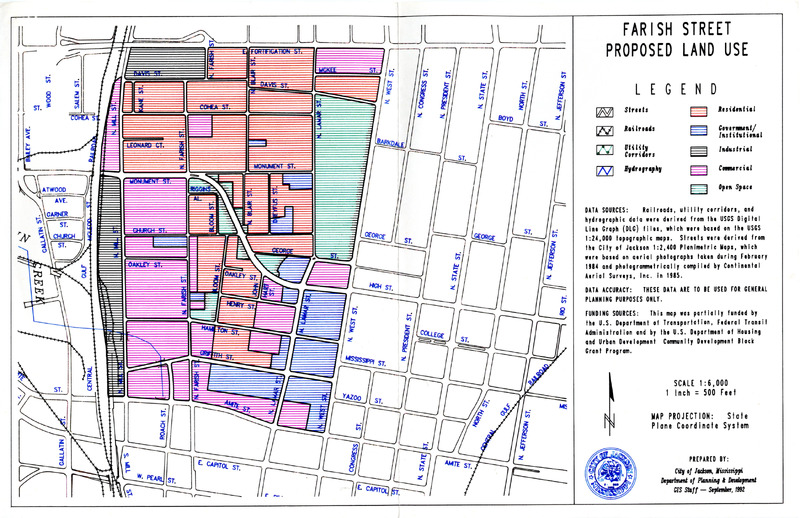
A map of the Farish Street Historic District with markers for different land uses: streets, railroads, utility corridors, hydrography, residential, government/institutional, industrial, commercial, and open space.
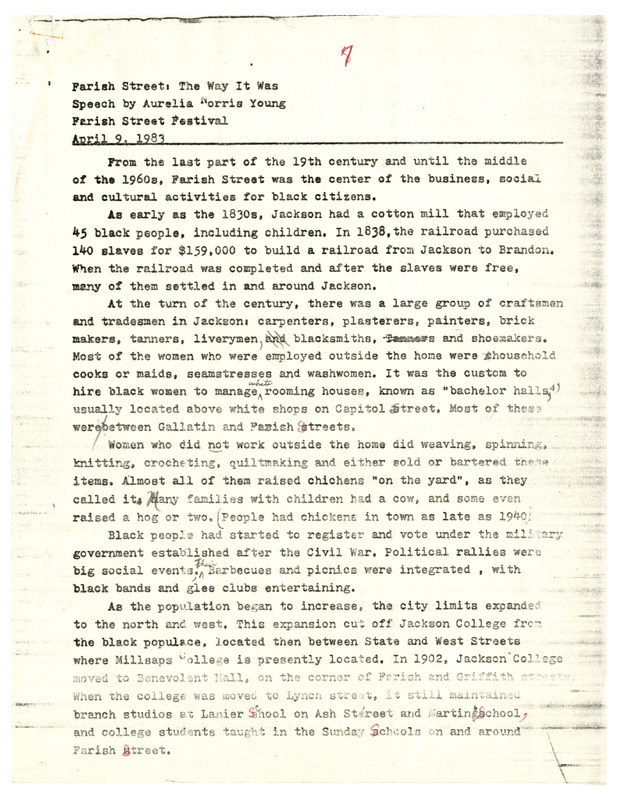
Aurelia Norris Young was a prominent Civil Rights activist and professor of music at Jackson State College and Tougaloo College. She gave this speech on the history of the Farish Street Historic District on April 9, 1983, at the Smith Robertson Neighborhood Folklife Festival, which honored the history and legacy of the district.
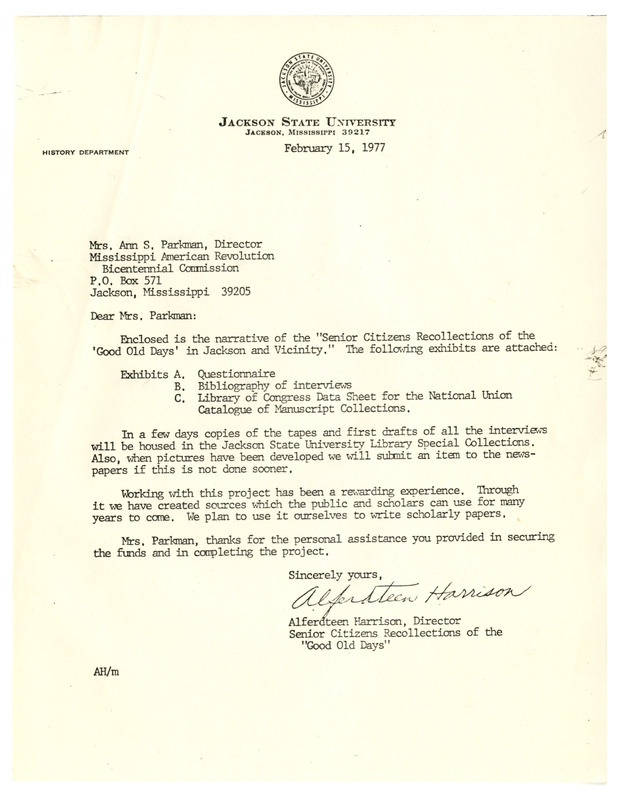
The final report on the Good Old Days Oral History project prepared by members of the Jackson State University History department and Center for Urban Affairs. The report was given to the sponsors of the project, the Mississippi American Revolution Bicentennial Commission and the Mississippi Department of Archives and History.
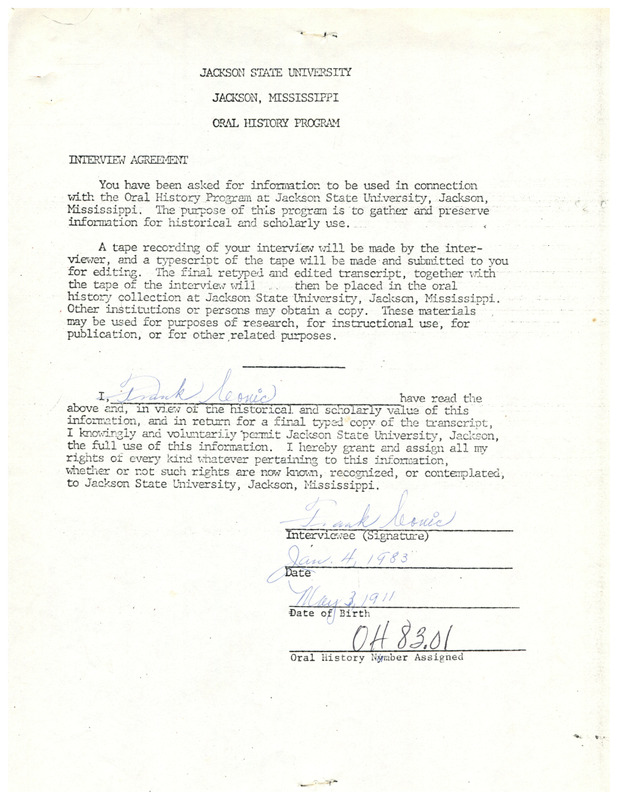
Frank Conic moved to the Farish Street District in 1919. He talks about his time growing up on Farish Street and working as a barber with his father while in high school. In 1950 he opened Conic Beauty and Barber Supply and he talks about that experience as a business owner in the district. The transcript is heavily edited with handwritten notes.
Fred Banks Jr. served in the Mississippi House of Representatives from 1976-1985 and Circuit Judge for the 7th Circuit District from 1985-1991. He details his experiences in the state legislature and his journey running for office. He also describes the early beginnings of the Mississippi Black Caucus and his mentorship under Robert Clark.