Beatrice Martin was born in Rankin County, Mississippi, in 1904 and moved to Jackson two years later. For her, the "Good Old Days" were when she was younger and went to church and played games with her father. She discusses getting married in 1928 and purchasing some land and a home in a part of Jackson that had not yet been fully developed.
Ceolia Herman was born in McGee, Mississippi, in 1904 and came to Jackson in 1919 to go to high school while living with her sister until getting married and moving to Chicago. She moved back and worked as a nurse and then in a cleaners. She recalls the "Good Old Days" as days when she was younger and didn't have to worry about anything.
Dr. David White was the first Black optometrist in the state of Mississippi when he moved onto Farish Street in 1951. He talks about Farish Street before and after integration: Black businesses became less prosperous after integration as some Black customers went to white owned businesses. He also talks about his involvement with the NAACP.
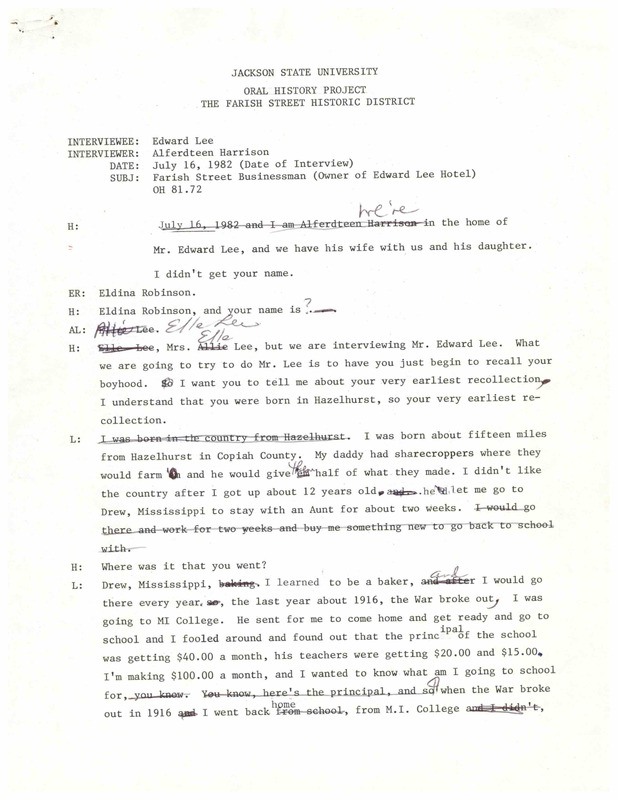
Edward Lee moved to the Farish Street District in 1925 and went on to own several restaurants in the area. He also booked and promoted dances and concerts for clubs and dance halls in the district. Mr. Lee talks about his education, life on a farm, family, and his youth. The transcript is heavily edited with handwritten notes.
Ernest Luckett moved to the Farish Street District in 1922 at the age of 6 to attend Smith Robertson School. Mr. Luckett talks about his time as a student at the school and his admiration of a teacher. He discusses his relationship with P.G. Cooper, a lawyer on Farish Street who collected rent from tenants in the area for one of his clients.
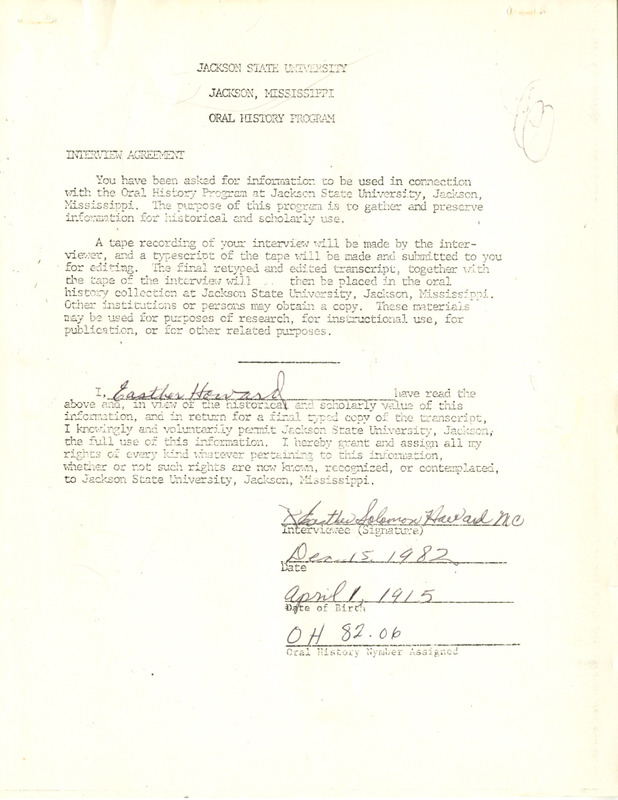
Esther Solomon Howard was born in the Farish Street District in 1915. Ms. Howard talks about her childhood in the Farish Street District, including attending Smith Robertson School, Central Church, and the Young Women’s Christian Association (Y.W.C.A.). She also talks extensively about her husband. The transcript is edited with handwritten notes.
Ethel George McCallister recalls many memories from her childhood, the plantation she lived and worked on, family, school, and her experiences in the church. She talks about her social life when she was young, and the relationships between the farmers, her marriage, and starting a family. She ends by talking about her family history.
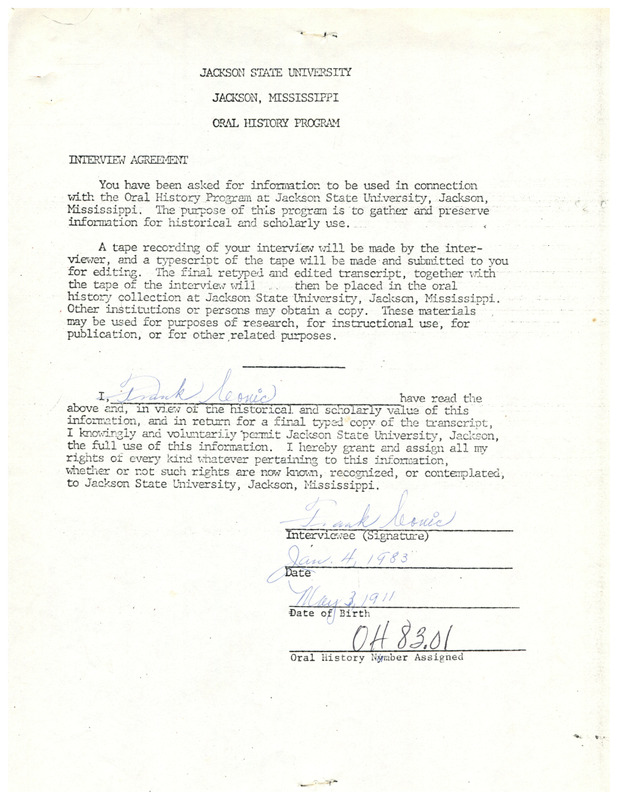
Frank Conic moved to the Farish Street District in 1919. He talks about his time growing up on Farish Street and working as a barber with his father while in high school. In 1950 he opened Conic Beauty and Barber Supply and he talks about that experience as a business owner in the district. The transcript is heavily edited with handwritten notes.
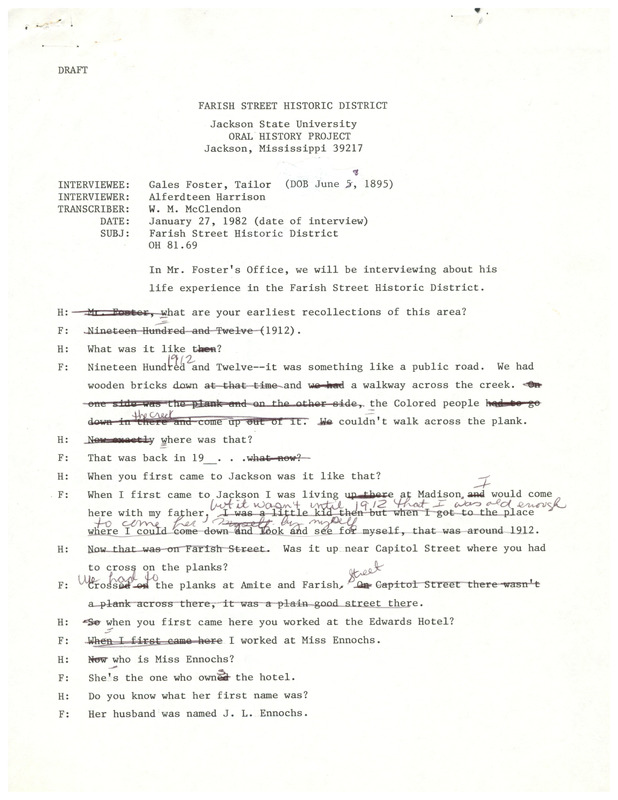
Gale Foster talks about his oldest memories of visiting the Farish Street District, dating back to 1912 when Farish Street was a dirt road. Mr. Foster went on to own a tailor shop on Farish Street and he discusses his history as a tailor and his life as a business owner. The transcript is heavily edited with handwritten notes.
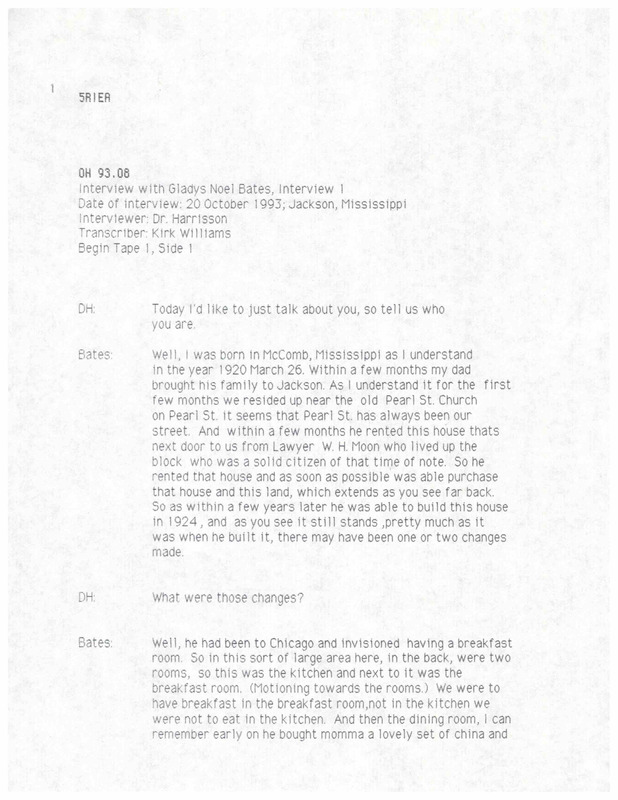
Gladys Noel Bates moved to Jackson with her family in 1920 and soon after settled in the Farish Street District. She talks extensively about her entire life, including her childhood and family, attending school during desegregation, and her involvement in the Civil Rights Movement.
Gustava Gooden was born in the Farish Street District and at the time of the interview had lived in the home she was in since she was a teenager. She talks about growing up in what she calls the "slum" of the Farish Street District. She discusses the red light district, schools, churches, and businesses in the area.
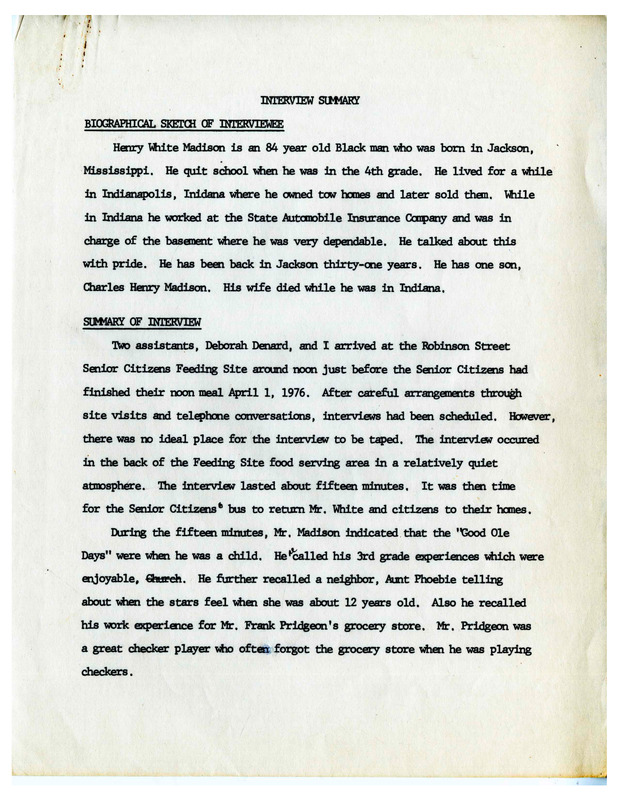
Henry White Madison was born in Jackson, Mississippi, in 1892. Mr. Madison talks about his first voting experience and recalls the "Good Old Days" when he was a youth with his own band (Madison Band), playing baseball, and working for Pridgeon's Grocery Store in Jackson, Mississippi. The transcript is heavily edited with handwritten notes.
Hollis Watkins was a Civil Rights organizer in Mississippi in the 1960s. This interview was recorded in a meeting of Dr. Alferdteen Harrison's Oral History class at Jackson State and featured questions from Dr. Harrison and several students. Mr. Watkins talks about his experiences with the Civil Rights Movement and the beginnings of Head Start.
Mr. Lee moved to Dreyfus Street in the Farish Street Historic District in 1924. He attended schools in the district and eventually served as Vice President of Administration at Jackson State for many years. He talks about his time living in the district and the social and cultural life there, including businesses, churches, and music.
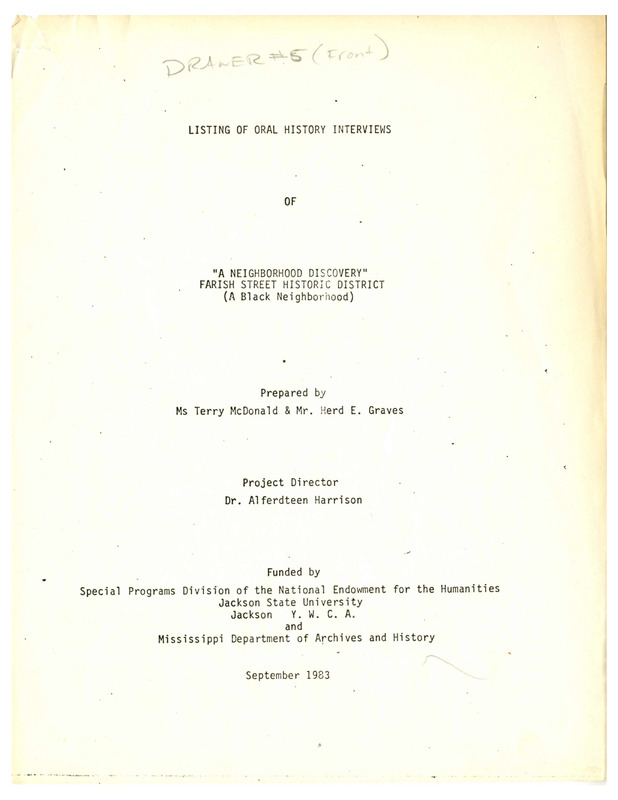
A list of all the interviews conducted as part of the Farish Street Oral History Project and a short essay outlining the history of the Farish Street Historic District.
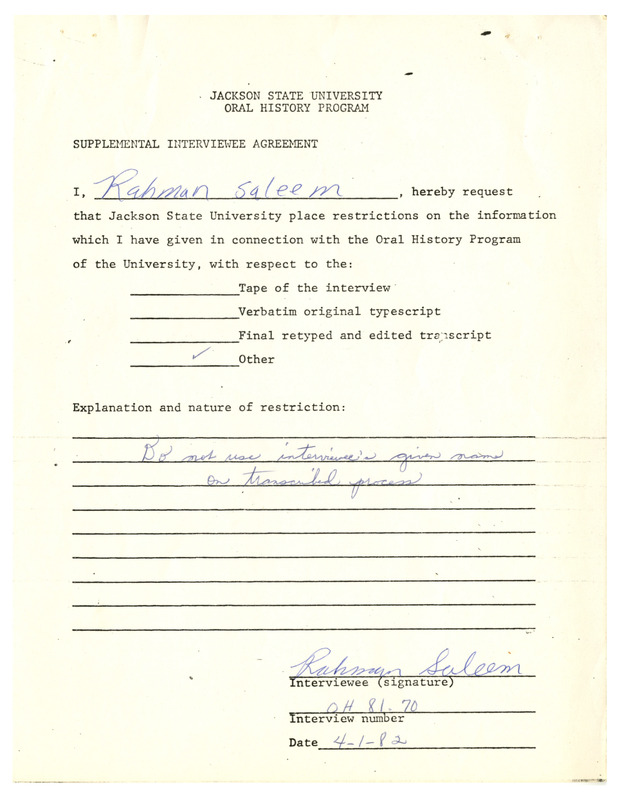
Rahman Saleem was a student at Smith Robertson School starting in 1956 when he was 5 years old. He talks about his experience at the school and tells other stories of his childhood in Jackson. The transcript is heavily edited with handwritten notes.
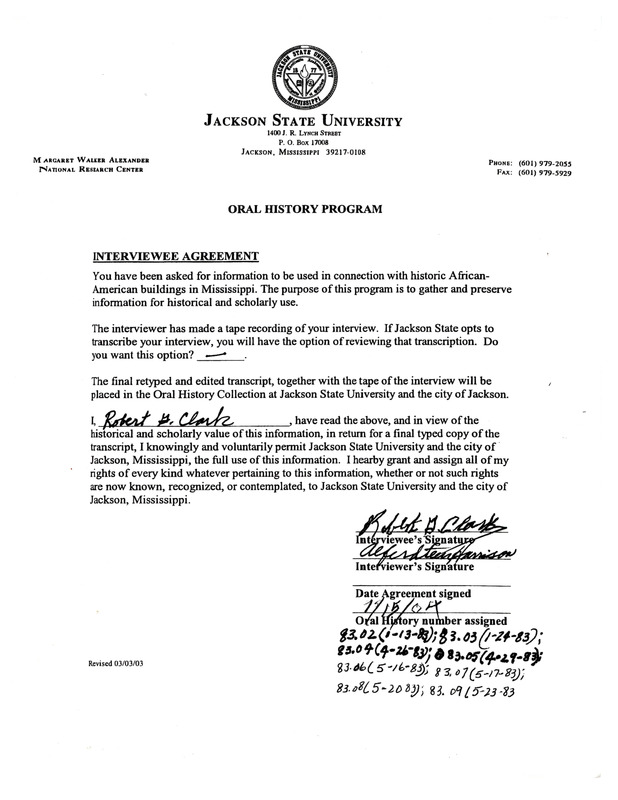
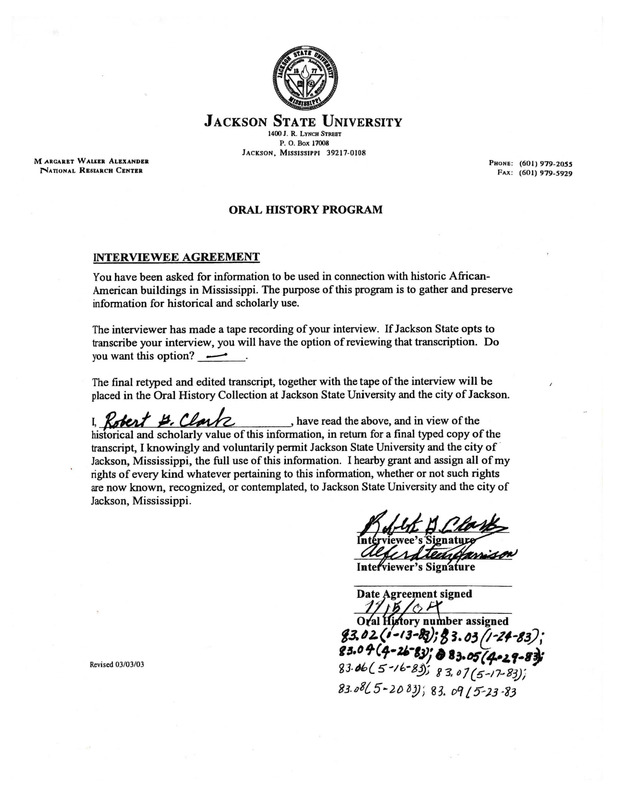
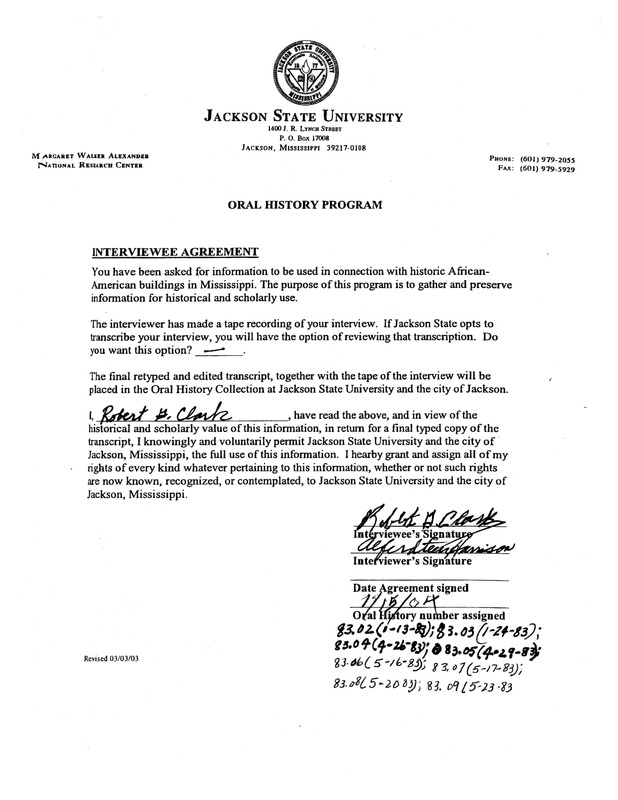
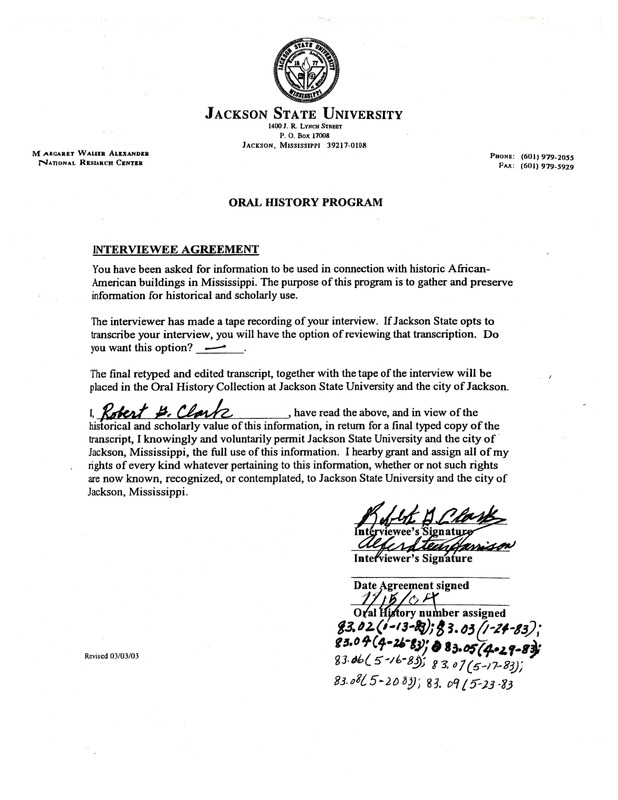
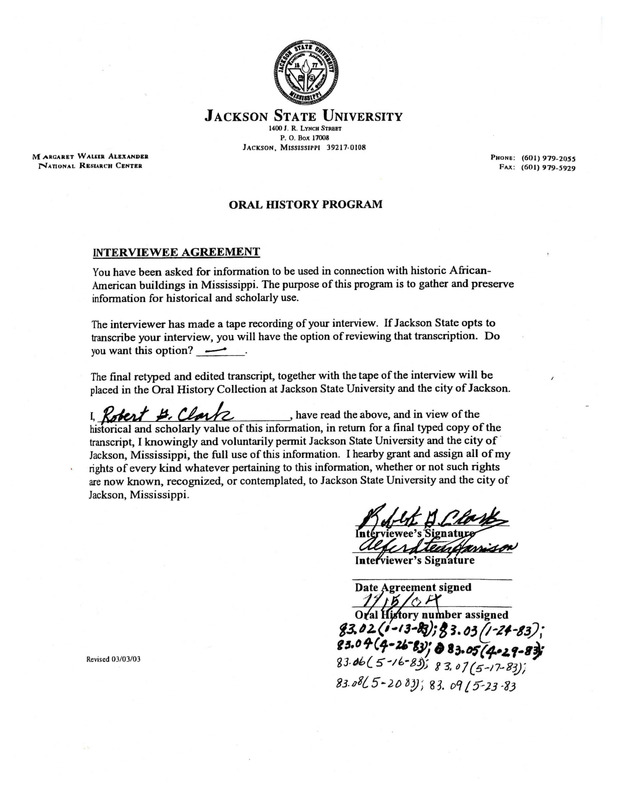
Rep. Robert G. Clark served in the Mississippi House of Representatives from 1968 to 2004. In this interview, Rep. Clark talks about his childhood, his time at Jackson State College, and his time as a teacher. He talks about threats his campaign received but also the support he got from the Mississippi Freedom Democratic Party.
Rep. Robert G. Clark served in the Mississippi House of Representatives from 1968 to 2004. In this interview, Rep. Clark talks about his childhood, his experiences in school up to 8th grade, and his membership at Pleasant Green Missionary Baptist Church. He also talks about interactions he had with white people when he was teenager.
Rep. Robert G. Clark served in the Mississippi House of Representatives from 1968 to 2004. In this interview, Rep. Clark talks about his vocational education in agriculture he began after graduating the 8th grade. He also talks about playing basketball in high school and college even though his eyesight had begun to fail him.
Rep. Robert G. Clark served in the Mississippi House of Representatives from 1968 to 2004. He was the first African-American member of the Mississippi Legislature since 1894. In this interview, Rep. Clark summarizes in detail his time at Jackson State College.
Rep. Robert G. Clark served in the Mississippi House of Representatives from 1968 to 2004. In this interview, Rep. Clarks talks about his eyesight issues keeping him out of the U.S. military, even though he did want to serve. He also discusses his teaching career out of college and his decision to enter politics in the mid-1960's.
Rep. Robert G. Clark served in the Mississippi House of Representatives from 1968 to 2004. Rep. Clark talks about his legislative career and the racism he faced. He also talks about the impact the Civil Rights Movement had on him winning the election and his introduction of bills to create holidays for Martin Luther King, Jr., and Medgar Evers.
Rep. Robert G. Clark served in the Mississippi House of Representatives from 1968 to 2004. In this interview, Rep. Clark fills in some holes from the previous interviews, including: the difficulty in starting a family and maintaining a business while being involved in politics and some pushback his campaign and election received.
Rep. Robert G. Clark served in the Mississippi House of Representatives from 1968 to 2004. In the final interview of the series, Rep. Clark talks about isolated incidents and experiences he had as a legislator, including being appointed to the commission to handle the aftermath of Hurricane Camille and his decision to run for re-election in 1971.
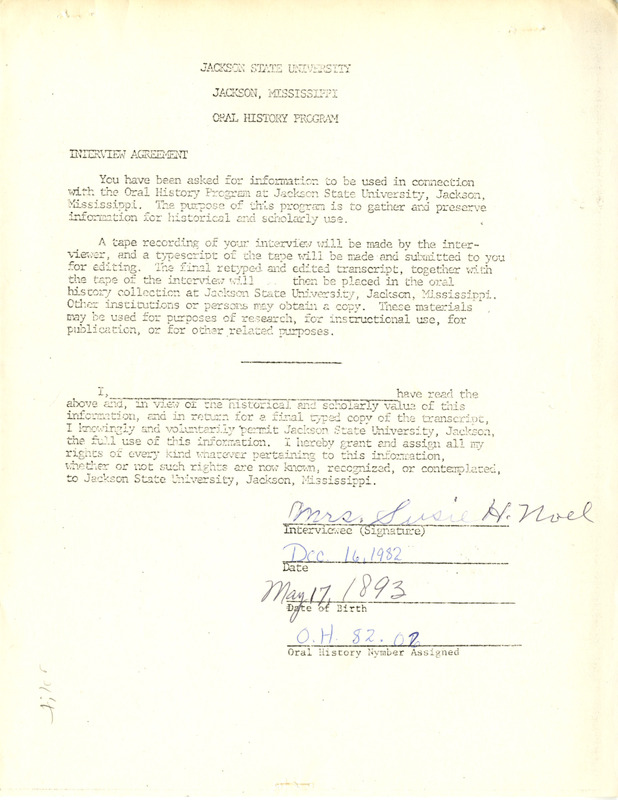
Susie Noel has lived in the Farish Street District since 1922. She talks about her experiences with the NAACP and the violence against Black people in the district during the Civil Rights Movement. She recounts her relationships with some of the Freedom Riders. She also talks about the different businesses and people in the district from the past.