Ellie Steward attended Lane College in Tennessee and returned to Benton County, Mississippi, in 1966 to become director of the county’s first Head Start program. She discusses the training she and others received in Oklahoma City, Oklahoma, as well as some of the prejudice she experienced when applying for the position of director.
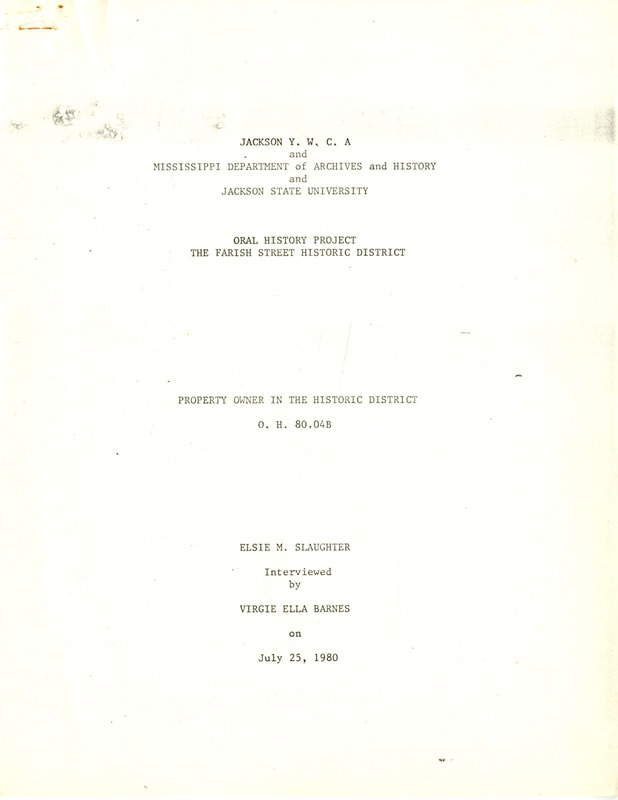
Elsie Slaughter was a years-long homeowner in the Farish Street District. She talks about her parents' background and occupations and her education. She discusses how White people were able to buy large amounts of property in the district by paying delinquent property taxes and how this was a different experience from most Black property owners.
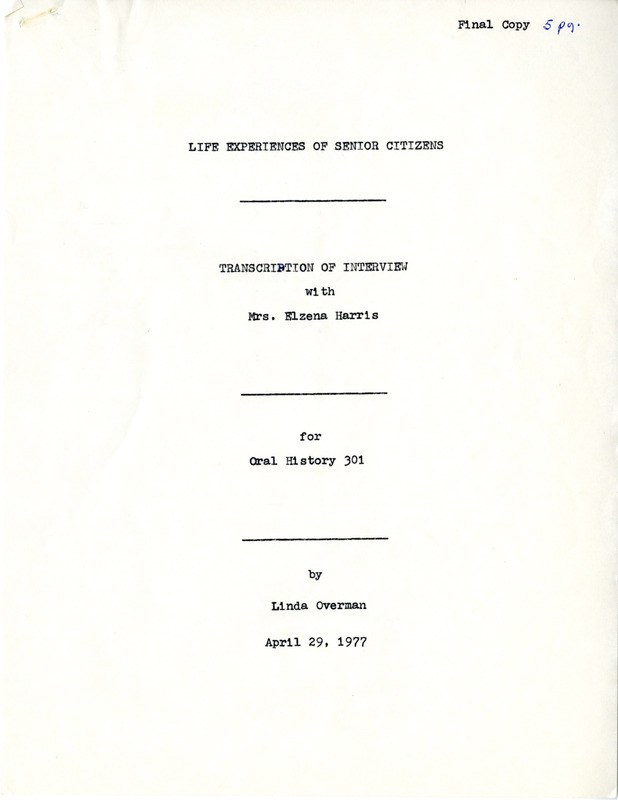
Elzena Harris moved to the Jackson area in 1892 when she was 4 years old. She was the youngest of twelve children and she talks about her childhood, mentioning the games they would play. Ms. Harris also discusses her education from grade school through college at Jackson State. The transcript contains handwritten edits and is incomplete.
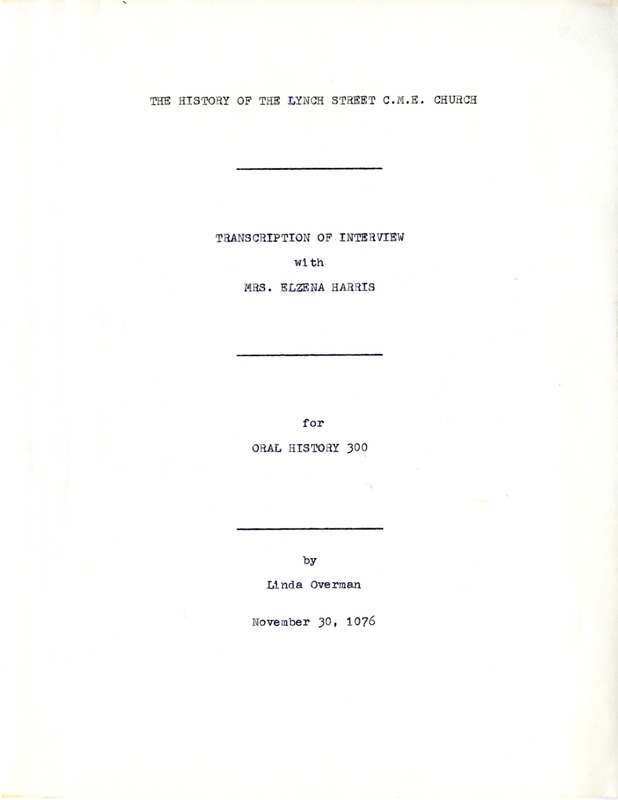
Elzena Harris moved to the Jackson area in 1892 when she was 4 years old. She became a member of the Lynch Street C.M.E. Church in 1909 when it was organized. The purpose of this interview was to discuss the function of the church in the community. The transcript contains handwritten edits and is incomplete.
Elzie Collins was one of the first Mississippi employees of the Head Start program and went on to have over 25 years of experience with the organization. In the interview, she breaks down the organizational structure of the early program.
Emma Jones talks about her experiences with early childhood education (through Head Start) when she was younger and the advantages that gave her entering into primary education. She also talks about the Head Start Program in general and how she sees it growing in the future.
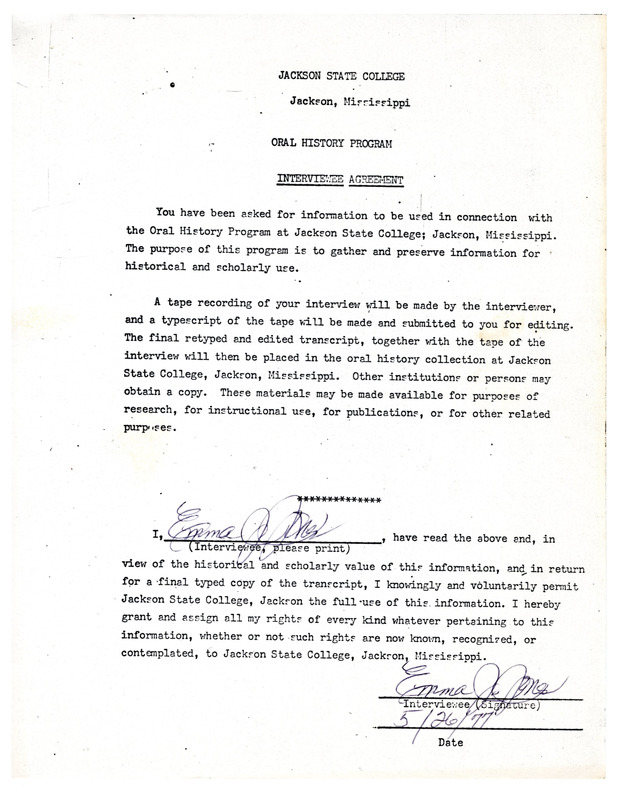
Emma Mason began as a nurse with Head Start in 1965. She initially worked in Jackson, Mississippi, then in Edwards, Mississippi. She returned to Jackson and eventually worked in all 16 Head Start centers in the city. She talks about the health needs she saw with the students and discusses how workers were recruited for the program in Jackson.
Ms. Wheeler worked at Head Start from 1967-1977, first as a disbursement clerk, then bookkeeper, and eventually assistant director. In the interview, she talks about some of the things the students learned as part of the program and the role parents of students played in the program.
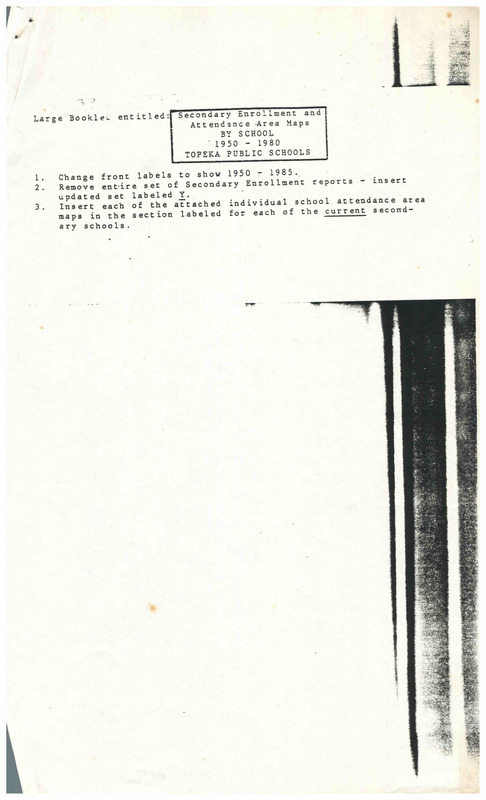
Case Data and Exhibits for Brown III, a relitigation of Brown v. Topeka Board of Education (1954) that corrected resegregation issues caused by open enrollment school choice in 1992. Charts and maps showing enrollment and attendance area breakdowns for every school in the Topeka Public School System from 1950-1985.
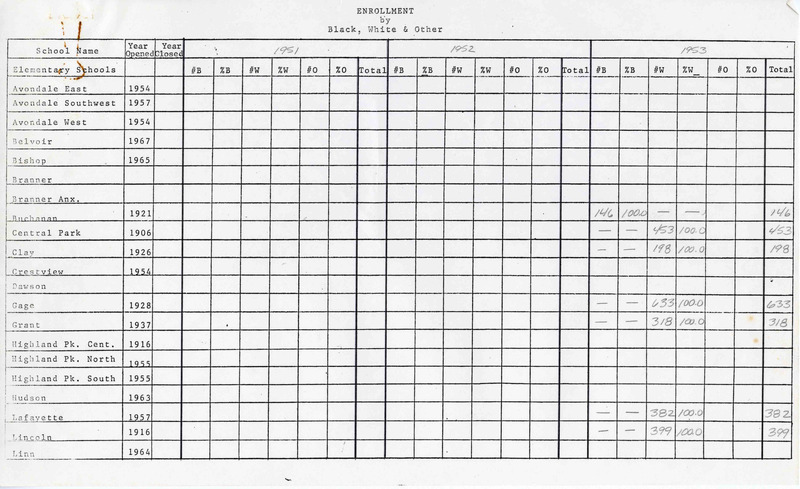
Case Data and Exhibits for Brown III, a relitigation of Brown v. Topeka Board of Education (1954) that corrected resegregation issues caused by open enrollment school choice in 1992. Spreadsheets of enrollment in elementary, junior, and high schools by Black, white, & other from 1951 to 1983 with handwritten analysis of the data, by William Lamson.
Jewell Woodard Simon was an internationally acclaimed artist, teacher, and poet from Houston, TX. "Ensenada Passage" illustrates a mountainous path to Ensenada, Mexico. A bridge leading to the city is in the foreground, roads lay in the middle ground, and the mountains build up towards the sky, creating an atmospheric perspective.
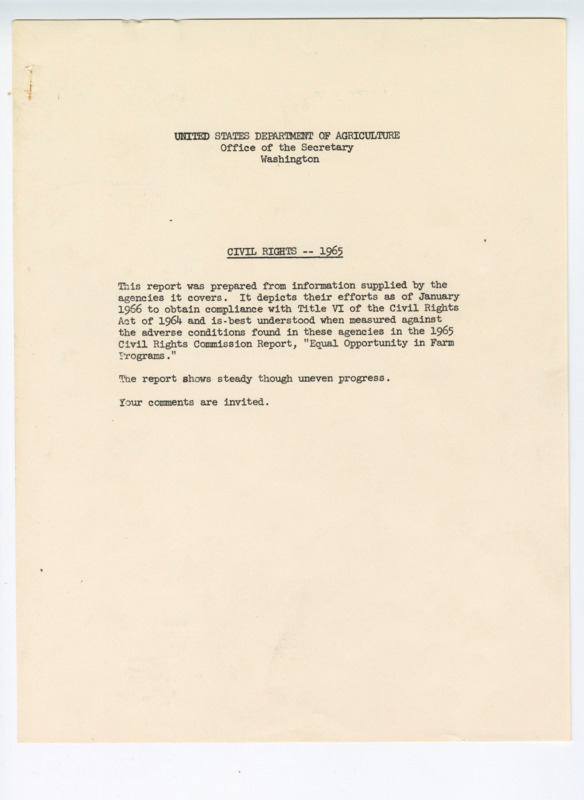
During President Gore's administration, the USDA pushed for increased Negro participation in agricultural decision-making, aiming to dismantle racial inequalities. Efforts included expanding access to resources, farming support, and programs like food stamps and school lunch initiatives for Negroes and other minorities across the South.
Hayward Oubre was a multimedia artist and educator from New Orleans, LA. "Equivocal Fox" is an abstract depiction of a fox using polygonal shapes. The red and blue forms overlap throughout the painting. The entire artwork is painted with a bumpy texture, which creates a slight relief sculpture effect.
Erma Sanders served on the Head Start board and worked with the first Head Start program that was established in Edwards, Mississippi, through Child Development Group of Mississippi (CDGM). She discusses the differences between the programs in Edwards and Jackson, Mississippi, and the ways that CDGM handled finding teachers for Head Start classes.
Erma Gordon's self-portrait shows the artist from three different angles. The three profiles are tied together by a light, almost translucent fabric that is worn by the frontmost figure and held by the others. This motif is used repeatedly by the artist, including in her mural. Two boys move fluidly and playfully through the background.
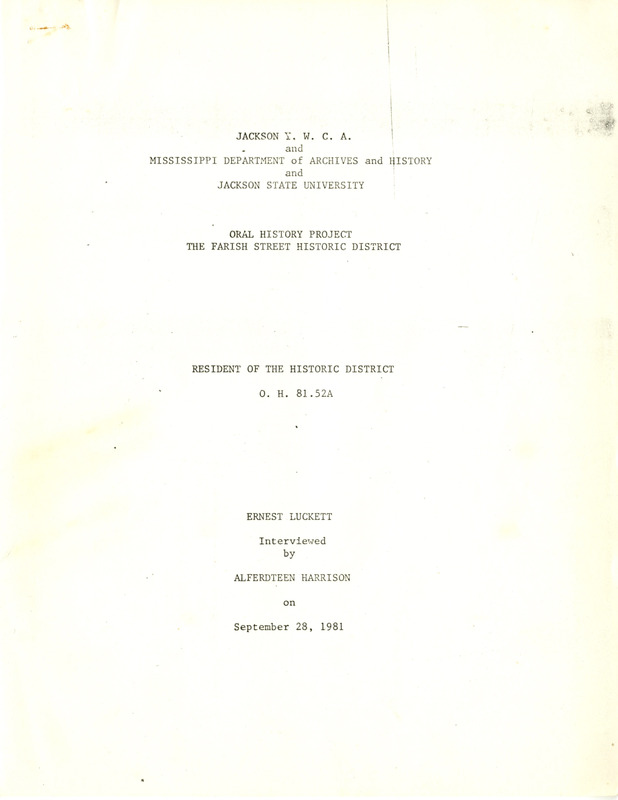
Ernest Luckett moved to the Farish Street District in 1922 at the age of 6 to attend Smith Robertson School. Mr. Luckett talks about his time as a student at the school and his admiration of a teacher. He discusses his relationship with P.G. Cooper, a lawyer on Farish Street who collected rent from tenants in the area for one of his clients.
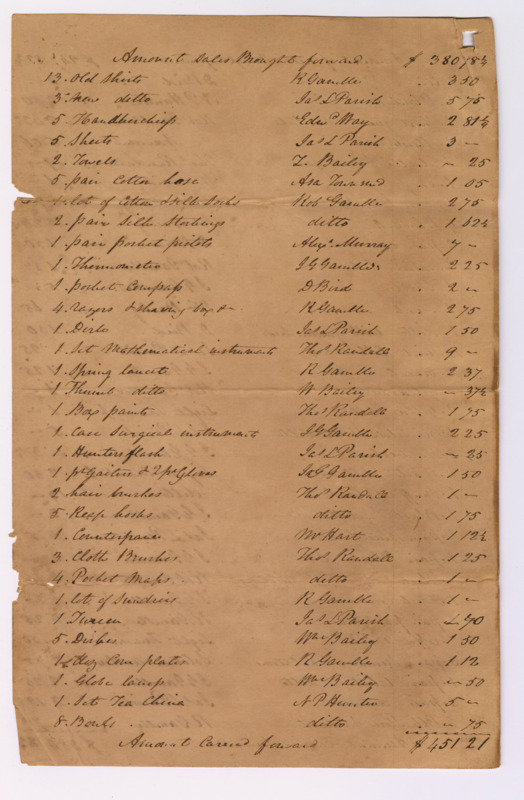
These rare 1832 slave documents from the Abraham Cabell estate provide detailed records of all of the slaves on the property and other purchases that were made. The list includes names, household items, property, and prices for everything.
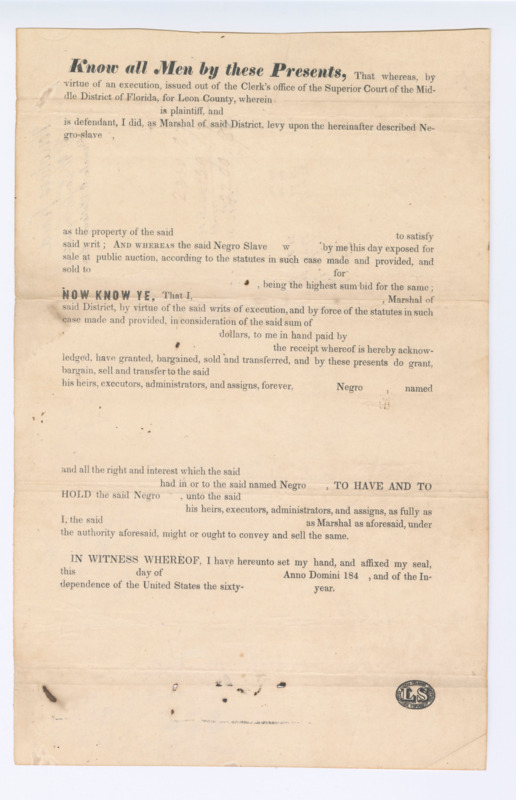
B. W. Taylor’s Estate Paper’s included a legal document that authorized the seizure and sale of an enslaved person to satisfy a debt or court judgment known as a Writ of Execution. This rare record illustrates the legal system’s role in treating enslaved individuals as property through the intersection of slavery and financial transactions.
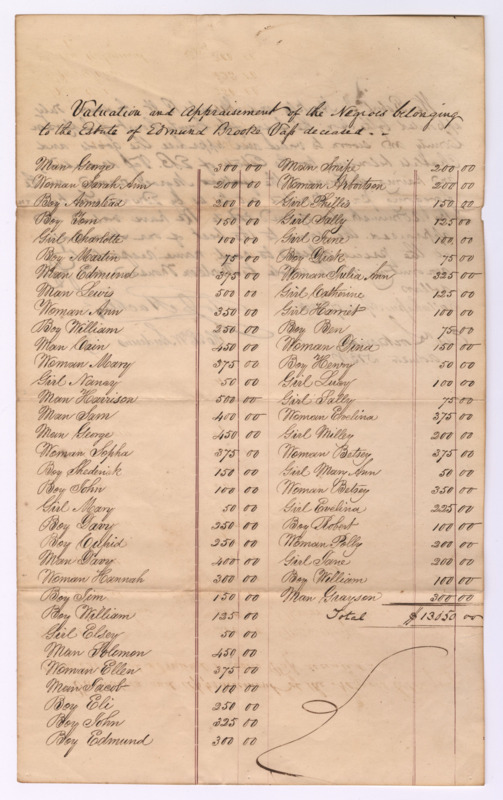
These rare 1843 slave documents from the deceased Edmund Brooke estate provide an itemized list of all of the slaves on the property. This list includes gender and age identifiers before each of their names, along with the price for each person.
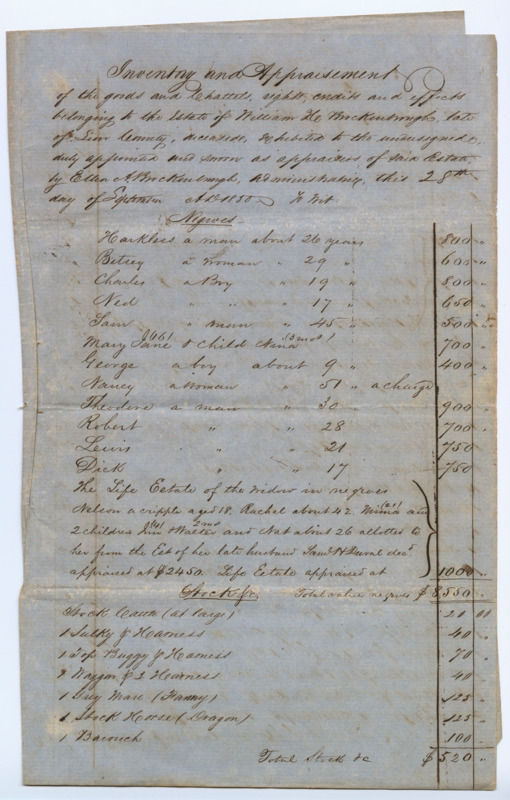
Rare 1850 slavery documents from the Ellen Brockenborough estate include a will and receipts of transfer between family members. These records provide critical insight into the legal and economic treatment of enslaved people as property, revealing the deep entrenchment of slavery in family estates.
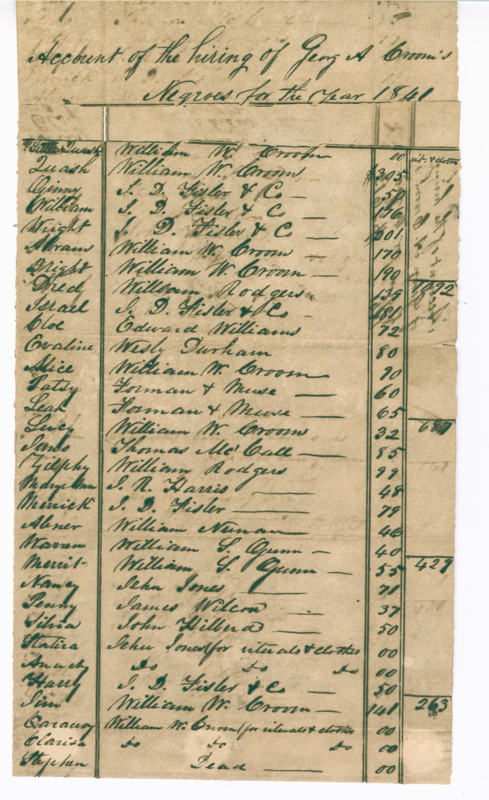
These rare 1841 slavery documents detail the hiring of Georg A. Croom's enslaved individuals, providing a unique glimpse into the leasing practices of the time. These records include contracts and financial arrangements, offering insight into the economic exploitation of enslaved labor and the broader system of slavery in the antebellum South.
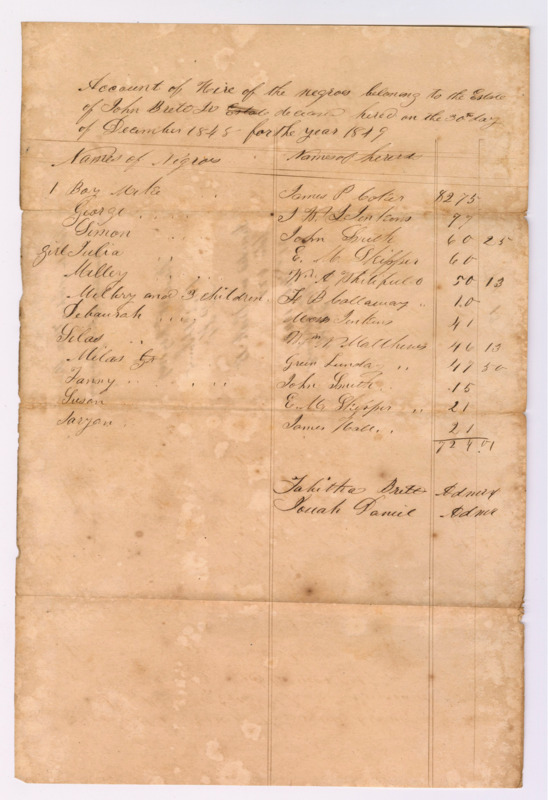
This document is an account of the enslaved African persons belonging to John Breto, Jr. It contains a list of their names and prices, calculated on December 30, 1848, for the year 1849.
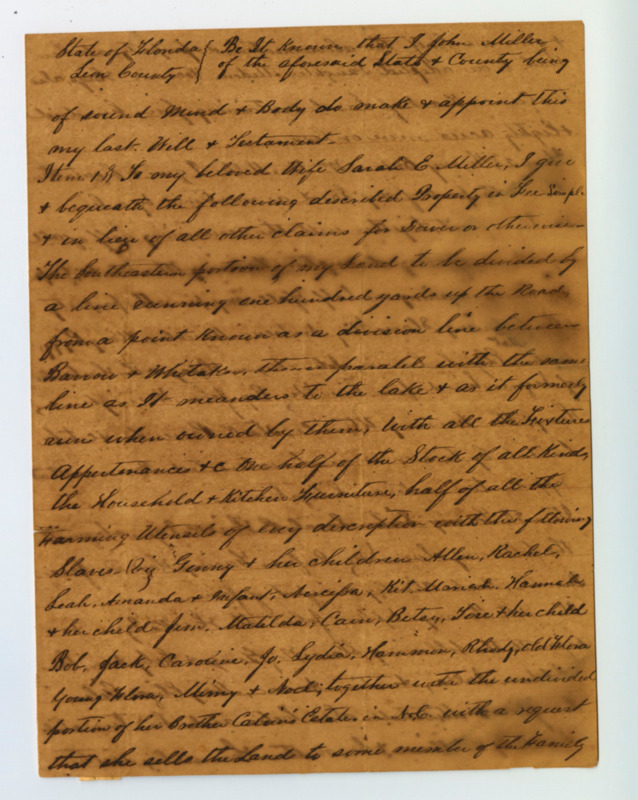
Estate papers of John Miller include his will and testament, detailing the distribution of property, including enslaved individuals. These documents provide significant insight into the legal processes surrounding inheritance and the treatment of enslaved people as assets, showcasing the economic reliance on slavery in the antebellum South.
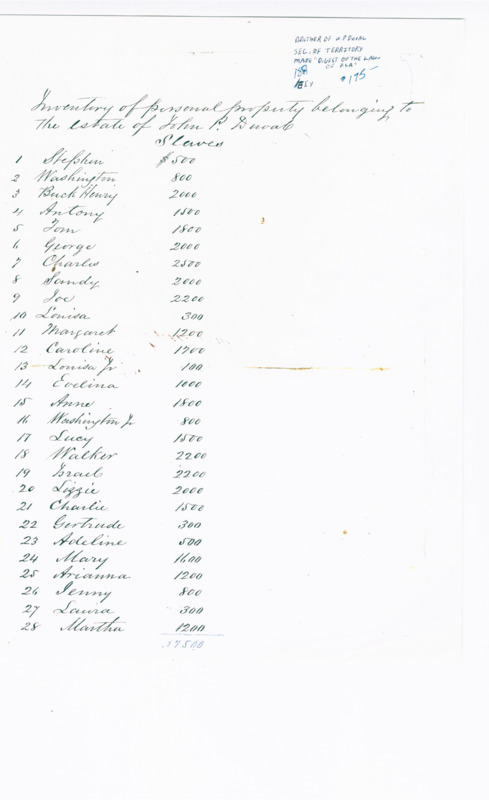
This document offers an inventory of the personal property belonging to the estate of John P. Duval. It contains a list of names of enslaved people and their prices.
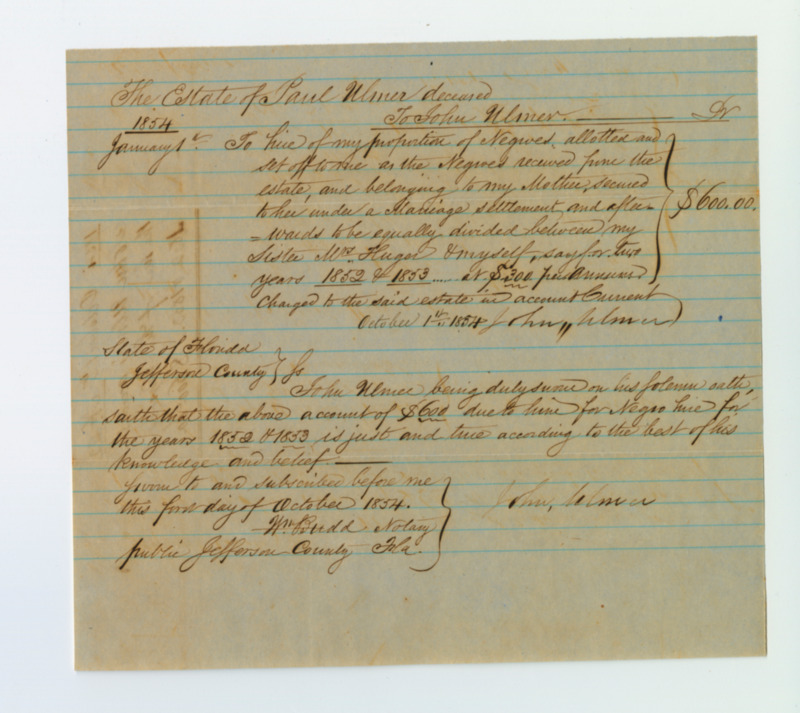
The 1854 petition by John Winer outlines the division of his deceased mother’s property, including employment of enslaved persons, with his sister. This document reveals the complexities of familial inheritance, the management of enslaved labor, and the economic implications of slavery within family dynamics.
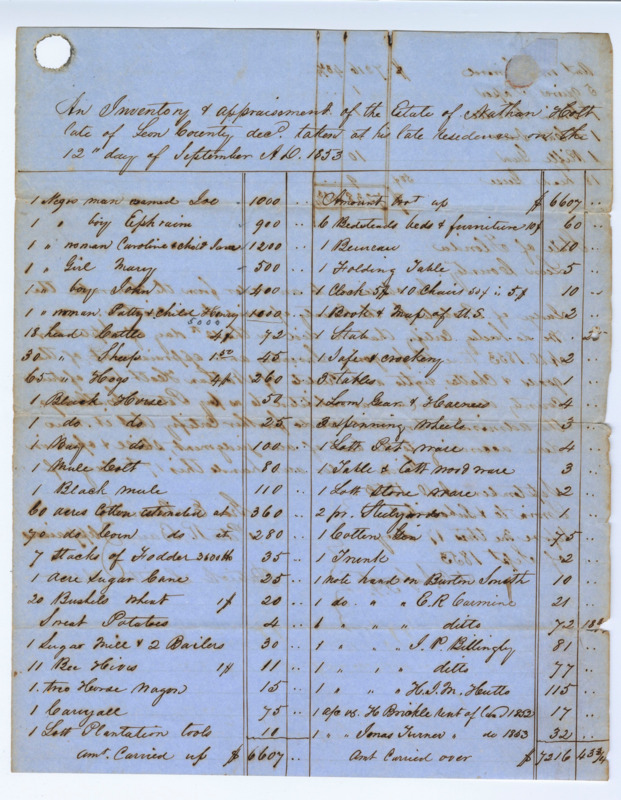
These rare 1853 slavery documents from the estate of Nathan Holt in Leon County detail the inventory, valuation, and transfer of enslaved individuals. These records offer crucial insights into the management and distribution of enslaved labor within an estate, reflecting the economic and social structures of slavery in mid-19th century Florida.
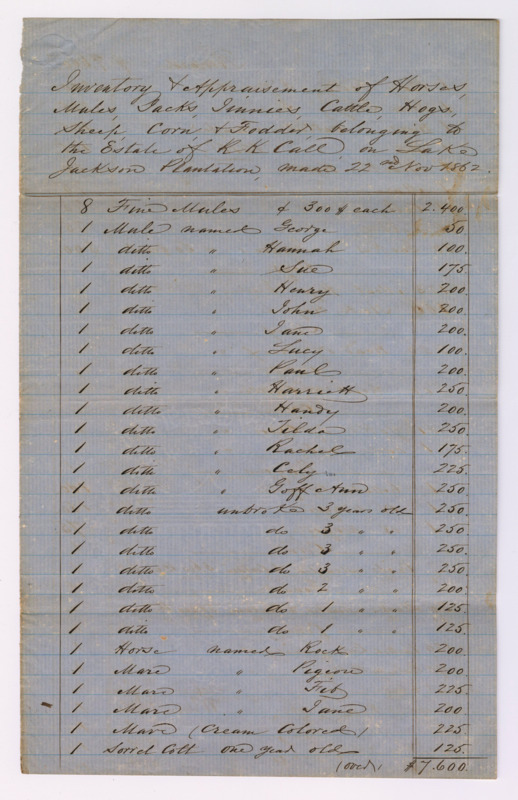
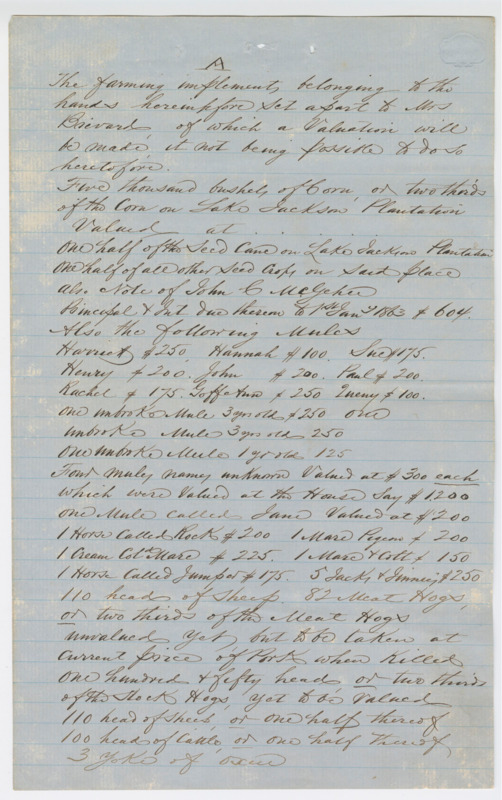
These rare 1862 slave documents from the Richard Call estate provide a detailed account of enslaved individuals at the Lake Jackson Plantation in Florida. These records include names, ages, and roles of enslaved people, offering critical insight into the operations of the estate and the broader system of slavery during the Civil War era.
The rare 1863 will and testament from Richard Call Keith provide documentation of his wishes to pass down his property. This document includes not only a written statement but also a list of all of the slaves he had ownership of. The list includes each of their names, ages, health conditions, and prices.