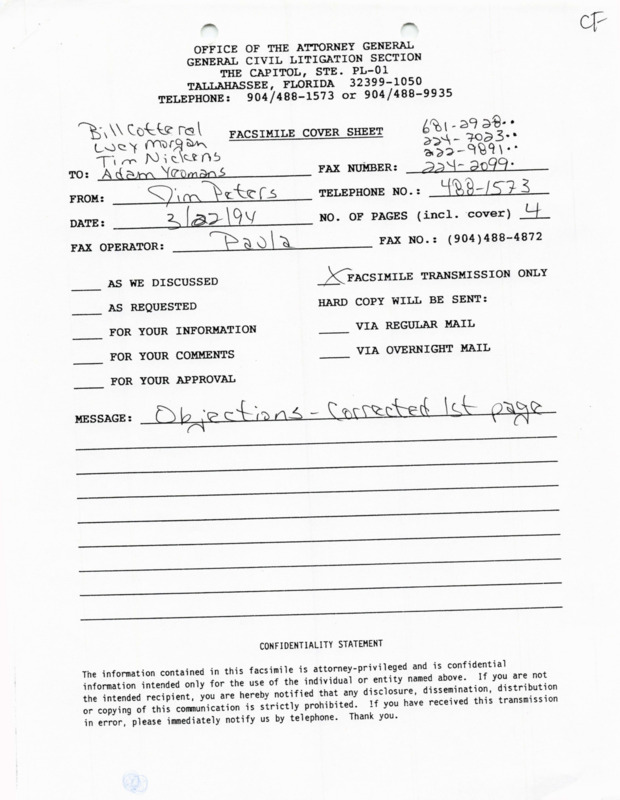
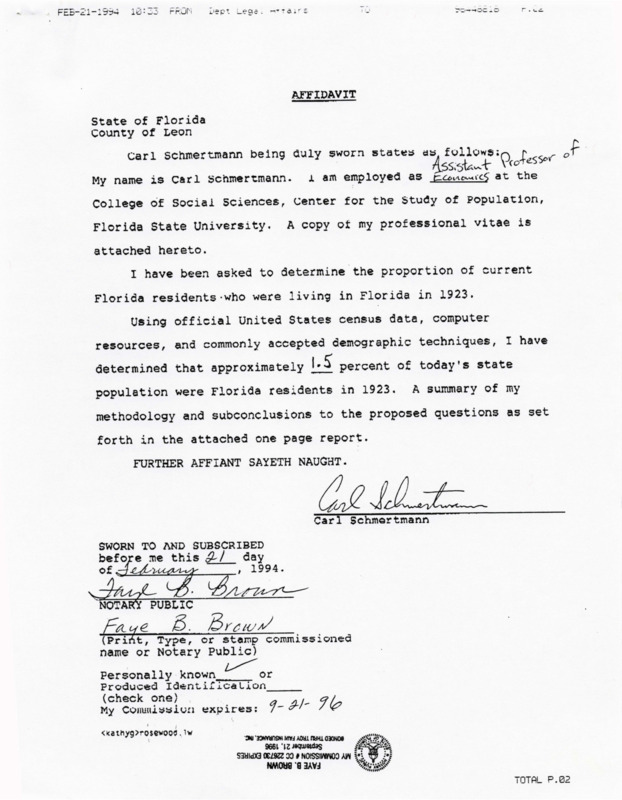
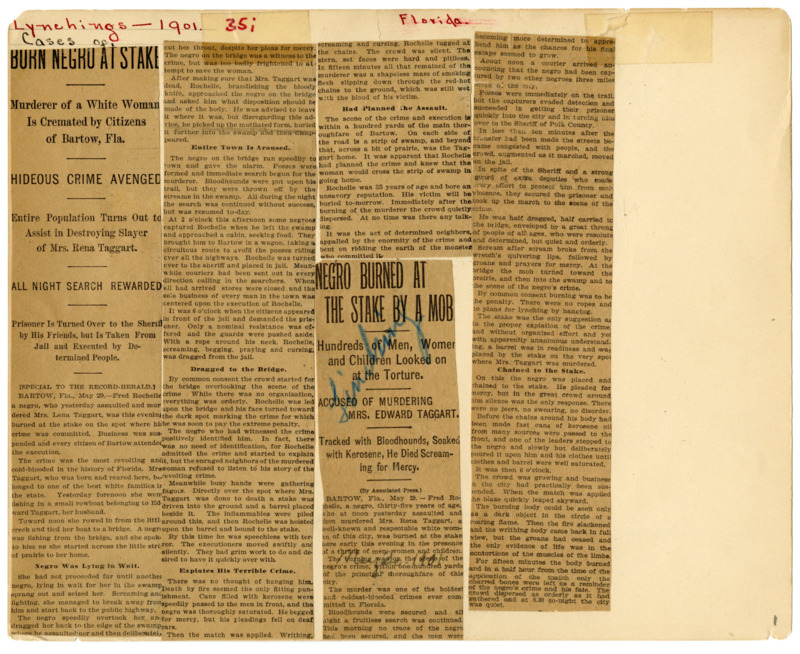
House of Representative bills introduced during the Rosewood investigation outlining committees, subcommittees, and procedures for claim bills under Section 6.63. Included are rosters of families eligible for compensation and an excerpt from the NAACP presenting uncontested facts for consideration throughout the investigation.
Rosewood Massacre-related Florida laws that established legal procedures for investigating the events and compensating affected families. These statutes set the groundwork for the state’s efforts to rectify the injustices of 1923 by ensuring a formal process for recognizing the descendants' claims and preserving the history of the tragedy.
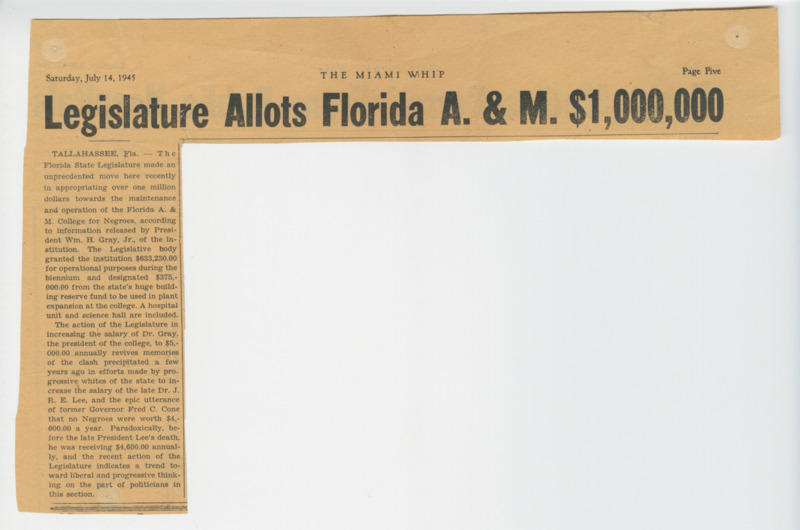
The Miami Whip covered the Florida State Legislature’s allocation of one million dollars for FAMC’s maintenance. Tensions arose when Governor Fred C. Cone criticized the late President J.R.E. Lee’s $4,600 salary, stating, “No Negro is worth that much,” revealing racial bias in the funding debate.
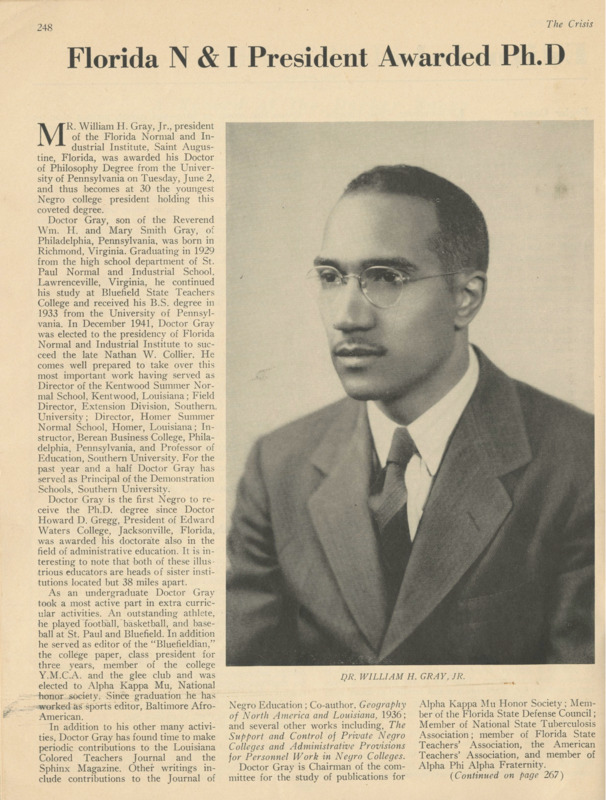
This article was featured in The Crisis, a magazine published by the National Association for the Advancement of Colored People (NAACP). In it, William H. Gray, Jr., president of the Florida Normal and Industrial Institute (modern-day Florida Memorial University), became the youngest Negro college president to receive a Ph.D.
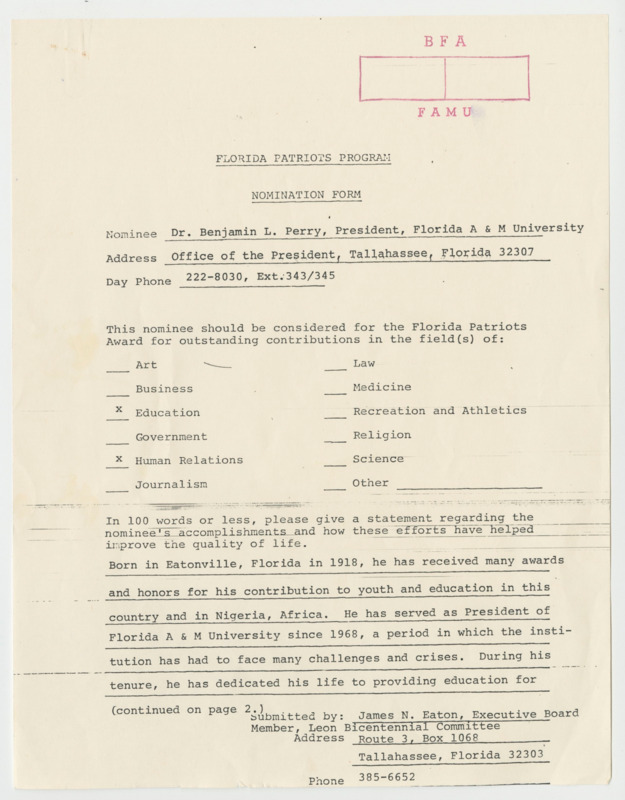
In January 1976, the Leon County Bicentennial Committee nominated and approved Dr. Benjamin L. Perry for “outstanding contributions in the fields of Human Relations and Education.” The document showcases the deep respect Dr. Perry fostered in his community through hard work performed locally, nationally, and internationally.
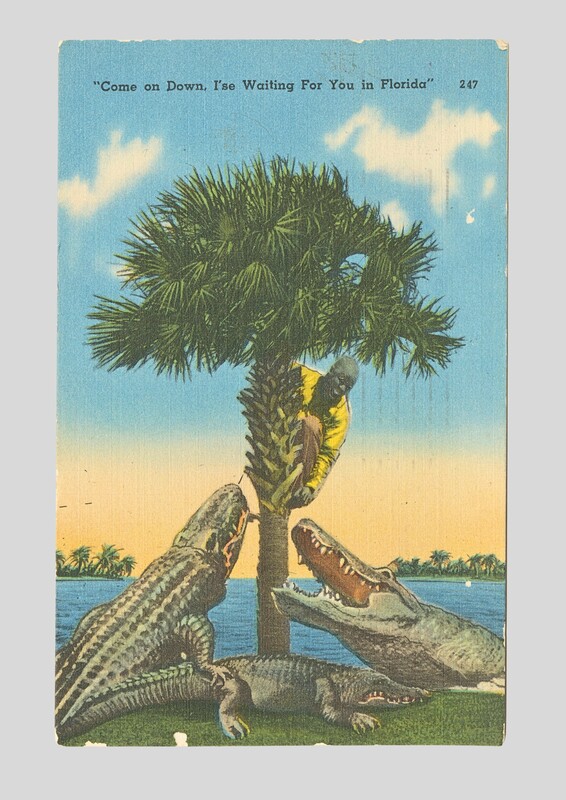
This 1954 Florida postcard shows a striking image of an alligator circling a palm tree, with a Black man seemingly holding on for dear life, his expression filled with fear. The alligators in this serve as a symbolic representation of the dangers and challenges faced by Black men in society, reflecting the racial tensions and struggles of the time.
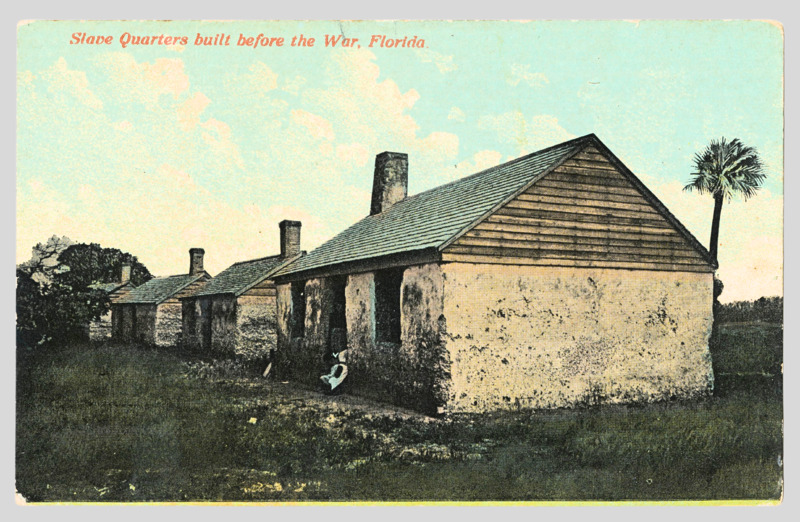
This vintage Florida souvenir postcard depicts slave quarters built before the Civil War. The image captures small, weathered structures used to house enslaved people on plantations. Such postcards often romanticized the antebellum South, overlooking the harsh realities of slavery while promoting Florida’s historic landscape to tourists.
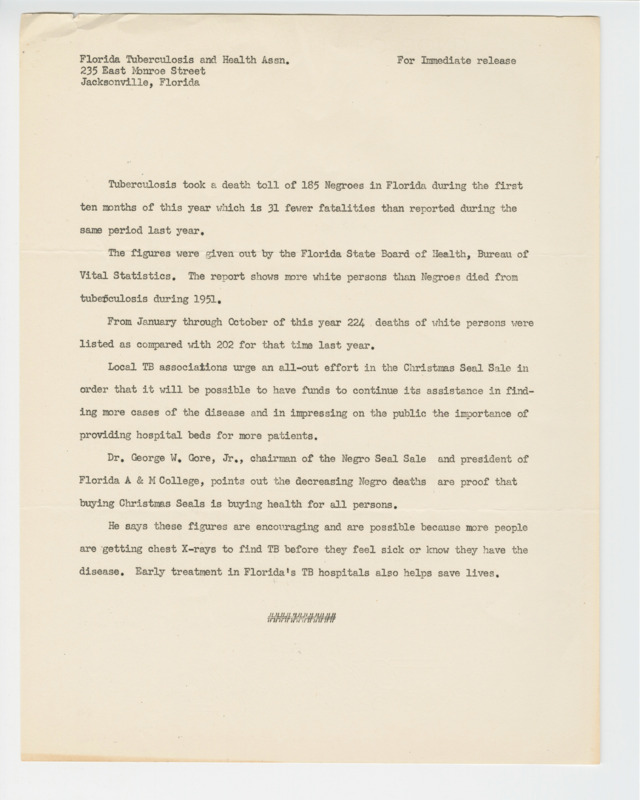
The Florida Tuberculosis and Health Association released this press release to raise awareness of how tuberculosis was affecting death rates in ethnic communities versus white communities. Dr. George W. Gore, Jr., as chairman of the Negro Seal Sale, also encouraged audiences to buy “Christmas Seals” to help ward off the illness through education.
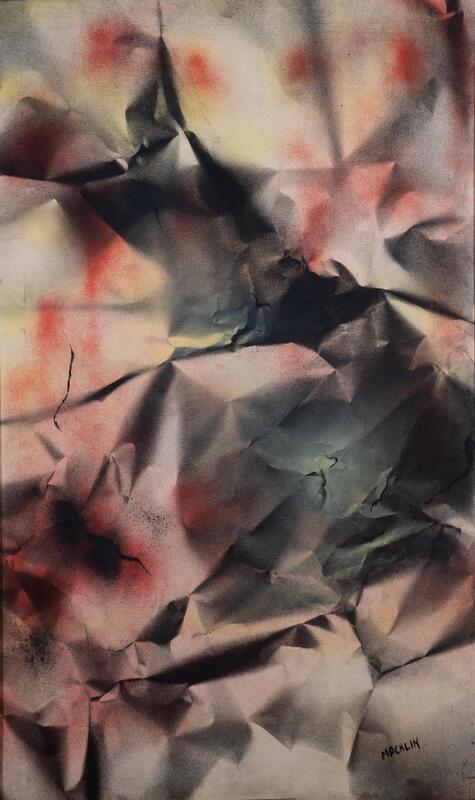
Anderson D. Macklin was an artist, professor, art historian, and author from Luther, OK. "Flowers and Paper Magnified" is an abstract view of its namesake. Macklin uses muted pastels and charcoal shadows to create a magnified perspective of the objects.
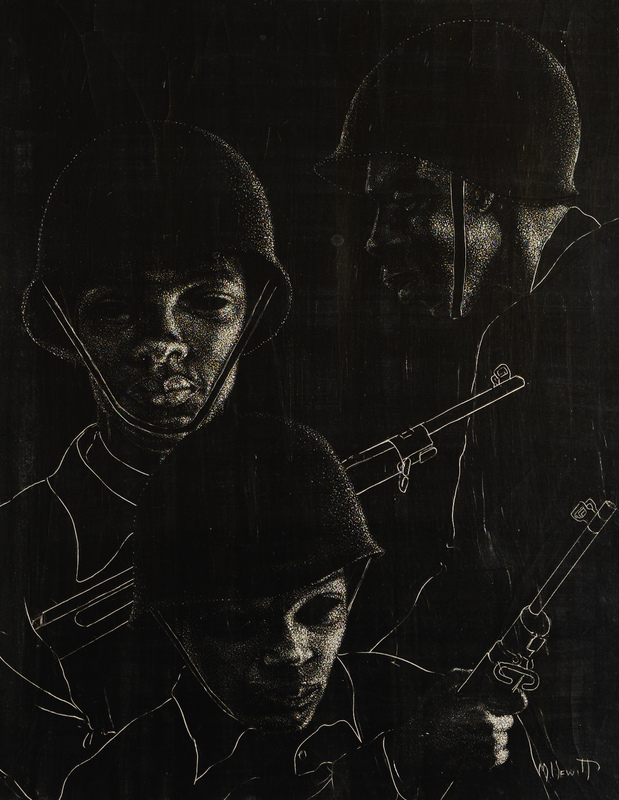
Mark Hewitt was an artist from Boston, MA. "Fort Devens" is a black-and-white drawing of three Black soldiers at a U.S. Army Reserves base in Massachusetts. In 1945, Fort Devens was a protest site for the treatment of the Black Women's Army Corps.
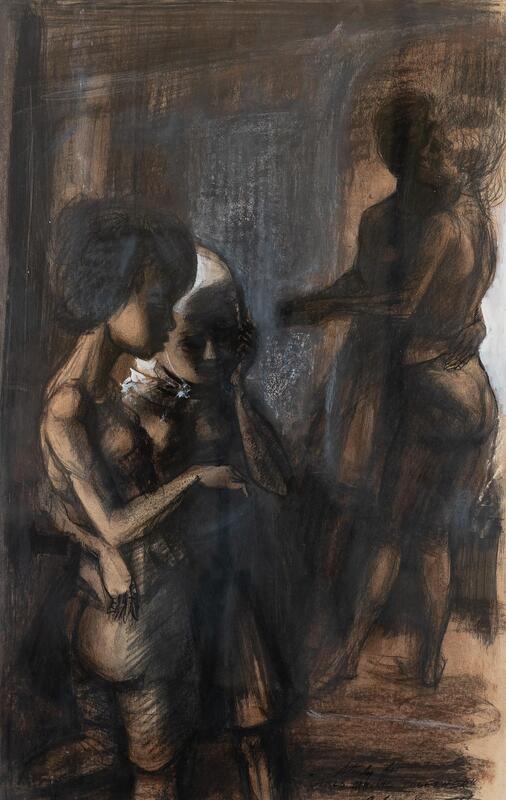
Calvin Burnett was a graphic artist, illustrator, painter, designer, and art teacher from Cambridge, MA. "Four Girls Dancing Together" depicts four young girls dancing in pairs in a shadowed room. While both pairs have sorrowful expressions and demeanors, the two girls in the foreground wear distinctly apprehensive expressions. Their seminude, shadowy bodies stand together in pairs as they sway, caressing each other.
Francis Alexander did extensive Civil Rights Movement work in Rolling Fork, Mississippi, in the 1960s. In this interview, Ms. Alexander talks in detail about that work as well as her work in the greater Rolling Fork community. Later, she went on to open a Head Start school in her home after she began teaching her own children how to read and write.
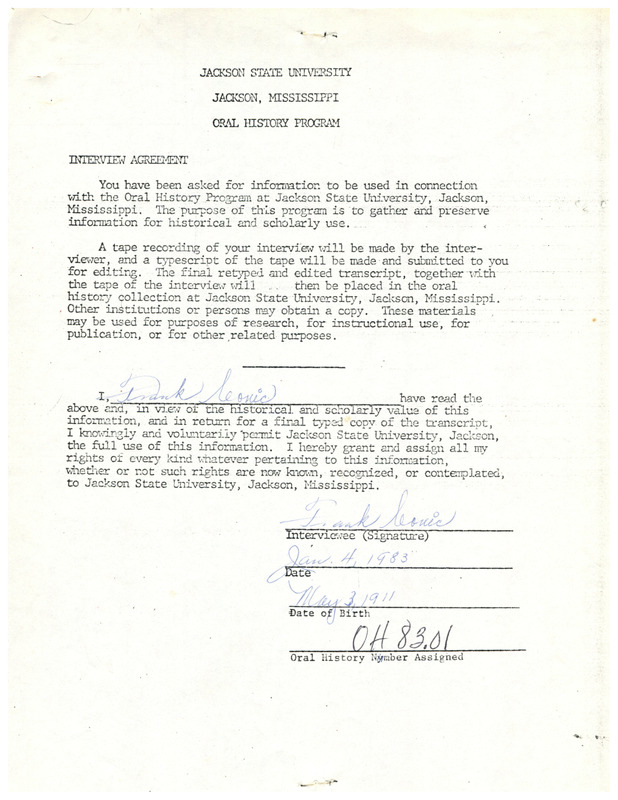
Frank Conic moved to the Farish Street District in 1919. He talks about his time growing up on Farish Street and working as a barber with his father while in high school. In 1950 he opened Conic Beauty and Barber Supply and he talks about that experience as a business owner in the district. The transcript is heavily edited with handwritten notes.
Fred Banks Jr. served in the Mississippi House of Representatives from 1976-1985 and Circuit Judge for the 7th Circuit District from 1985-1991. He details his experiences in the state legislature and his journey running for office. He also describes the early beginnings of the Mississippi Black Caucus and his mentorship under Robert Clark.
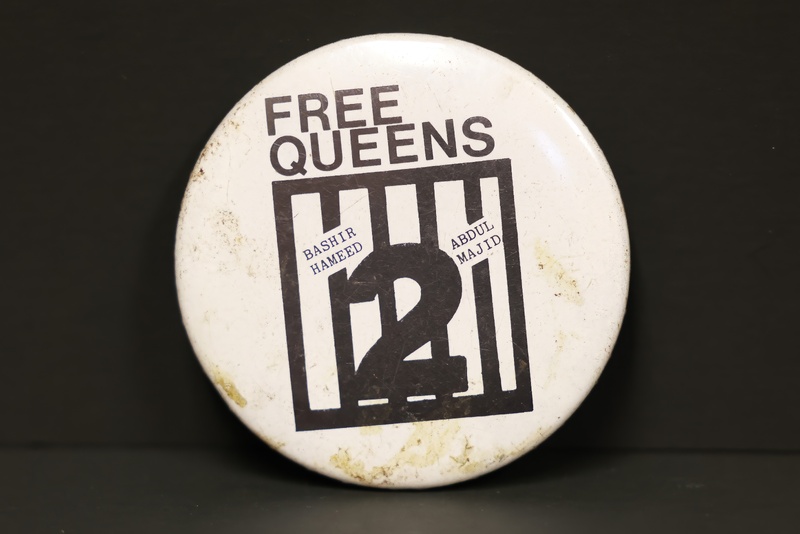
A white button in support of freeing the "Queens 2." Their names, Bashir Hameed and Abdul Majid, are listed on the button. The two members of the Black Liberation Army were sentenced to 33 years in prison for the 1981 murder of a New York cop. They were considered political prisoners because of discrepancies in their cases and convictions.
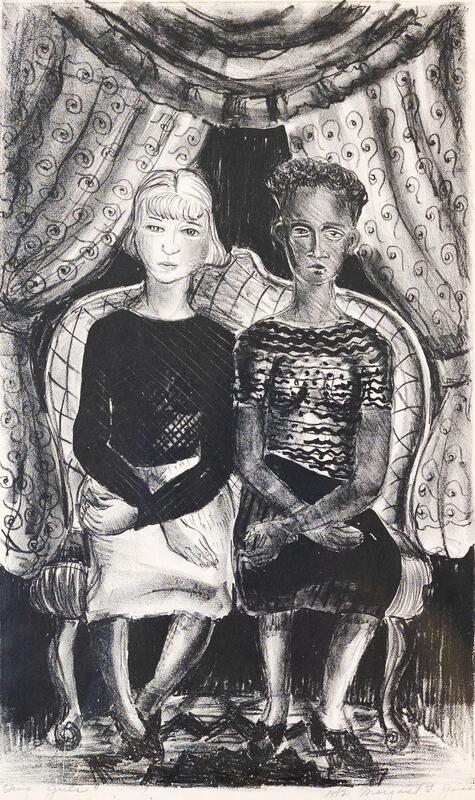
Margaret Taylor Goss Burroughs was an artist, historian, teacher, and writer from St. Rose, LA. "Friends" is a print depicting an interracial friendship. Two girls, one black and the other white, are sitting on a loveseat in front of a patterned curtain. This radical image of race relations was created during the height of the Jim Crow era.
A brief synopsis of Friends of Children of Mississippi, Inc., a non profit corporation organized 1964 to assist governmental and private agencies in administering grant funds for Head Start. The position paper discusses issues facing Head Start in Mississippi, such as the need for increased pay and improved working conditions.
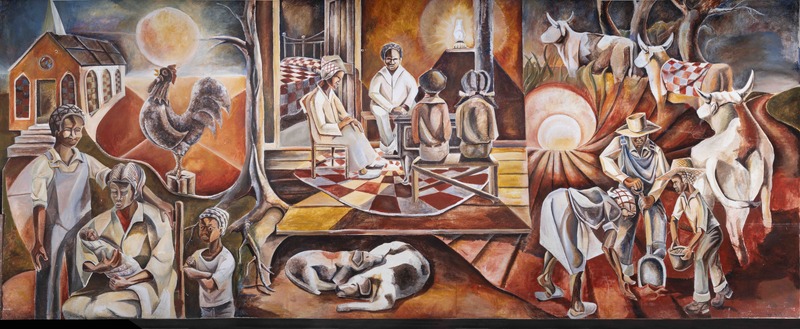
In a triptych style, Williams’ mural shows three central themes: a family gathered around a newborn (religion), seated near a hearth (home), and working together in the fields (labor). Black rural life is a major subject in the Hannah Hall murals.
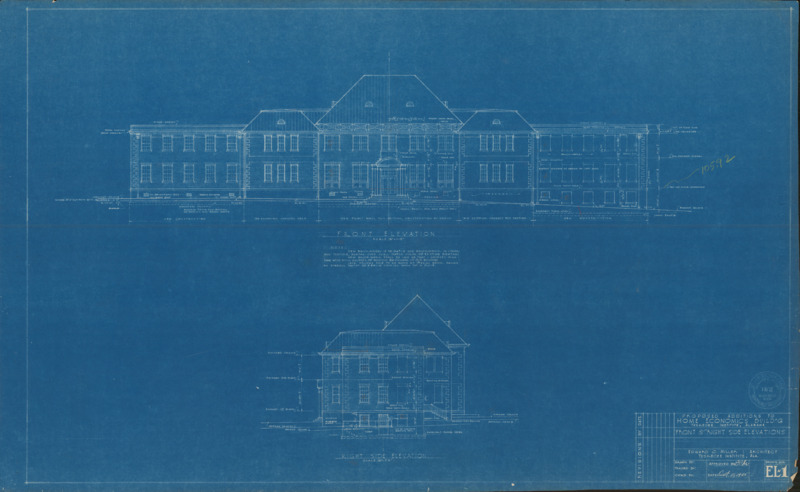
A construction blueprint drawing for the Home Economics Building under the electrical drawing section of the plans. This drawing shows the front and right-side elevations.
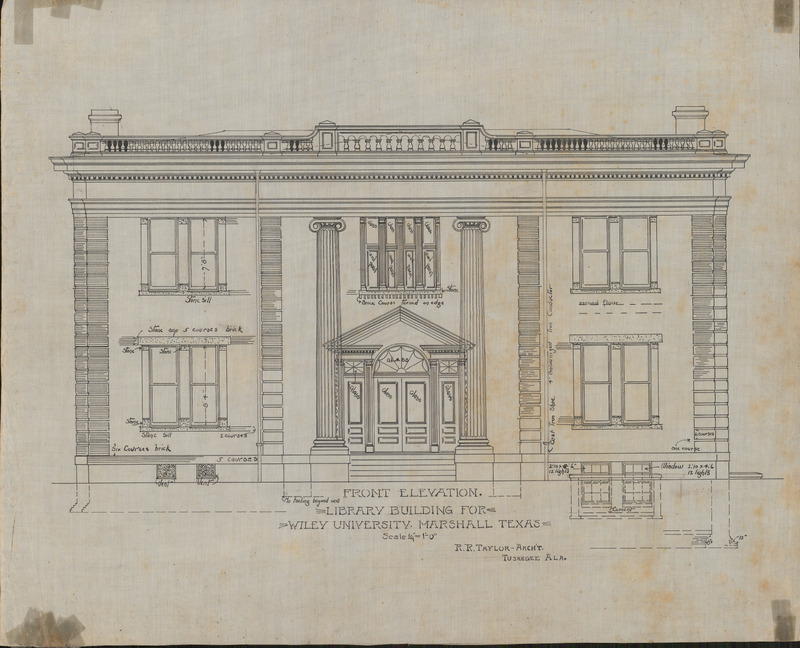
A construction front elevation drawing blueprint of the Library Building at Wiley University. This drawing the front face of the building depciting stone placement, brick placement, window and light placements, and pillars.
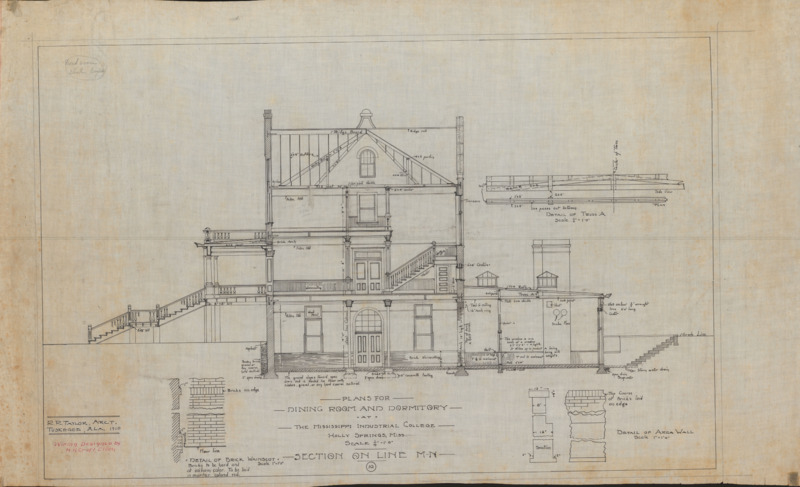
A white and balck architectural drawing created by Robert R. Taylor in 1910 for a dormitory/dining hall for Mississppi Industrial College. The drawing scale is 1/4' 1 foot 0 inches. This drawing shows in depth measurements regarding stair, wall, ground elevations as well as the brick type for the building.
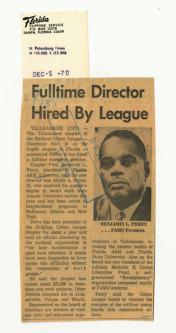
After student demonstrations afflicted Florida A&M University earlier in the year, the Tallahassee chapter of the National Urban League hired FAMU President Benjamin L. Perry as its full-time executive director. Members of the student organization that led the protest, the Malcolm X United Liberation Front, also joined the board of directors.
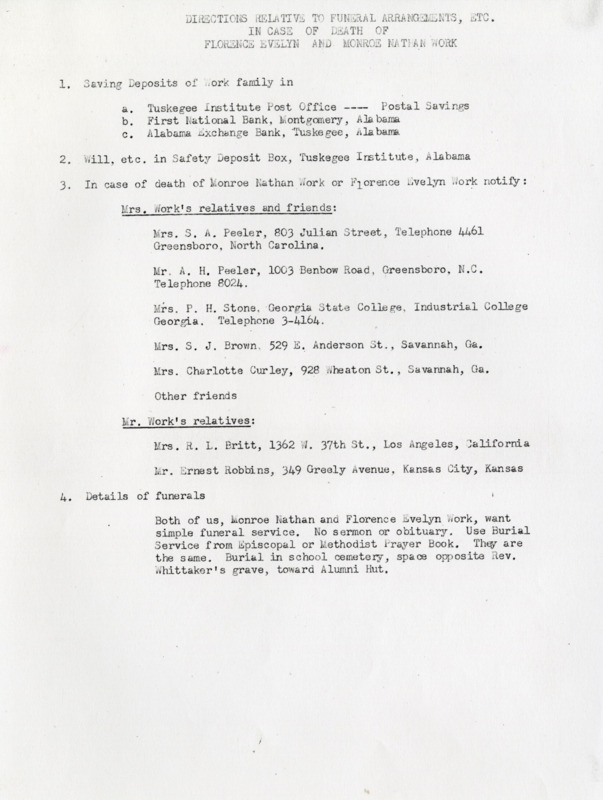
Two-pages of directions in case of the death of Florence Evelyn and Monroe Nathan Work. Contains information on the Work family's saving deposits, will, next-of-kin contacts, and details for funeral services.
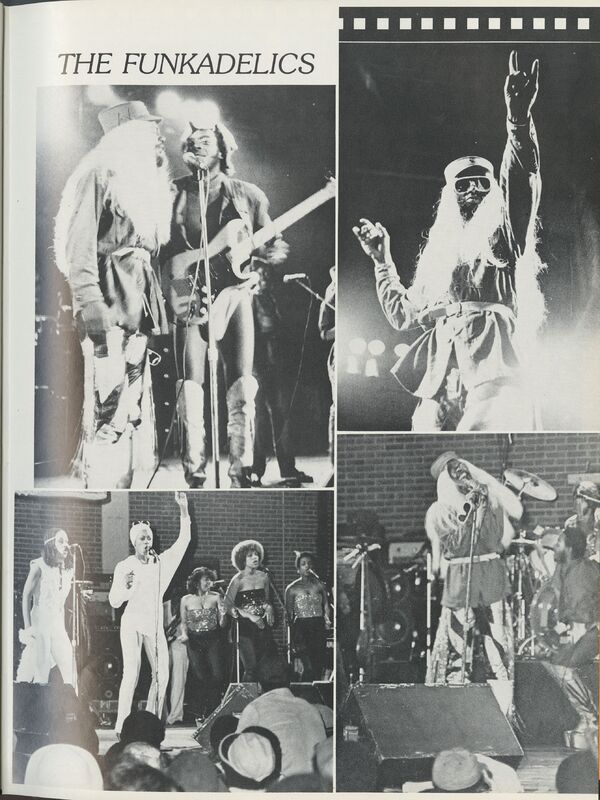
This spread, obtained from the 1979 Rattler Yearbook, shows the Funkadelics visiting Florida A&M University. George Clinton, the frontman of the Parliament-Funkadelic collective, is seen performing on stage. As of 2024, Clinton has been a Tallahassee resident for over thirty years.
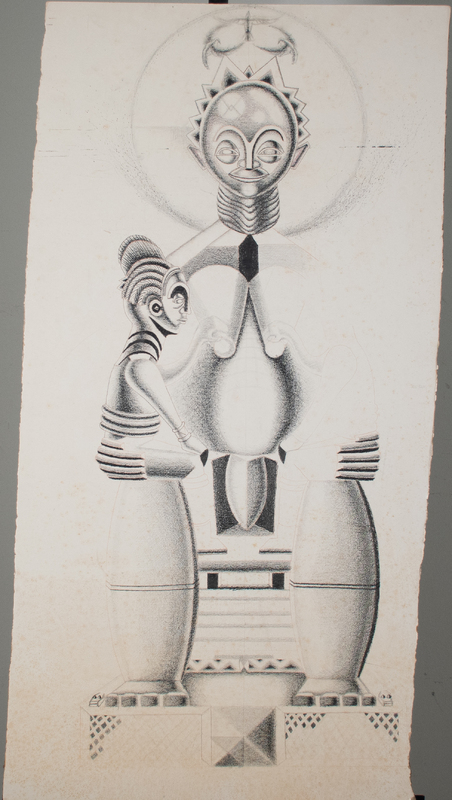
This drawing combines elements of traditional African sculpture and futuristic motifs. The figures’ faces resemble Ashanti akuaba (fertility dolls). The seated mother with a child is also a common motif in African sculpture, as seen in some works from the University Museum’s collection. The figures’ hair textures suggest a more futuristic design.