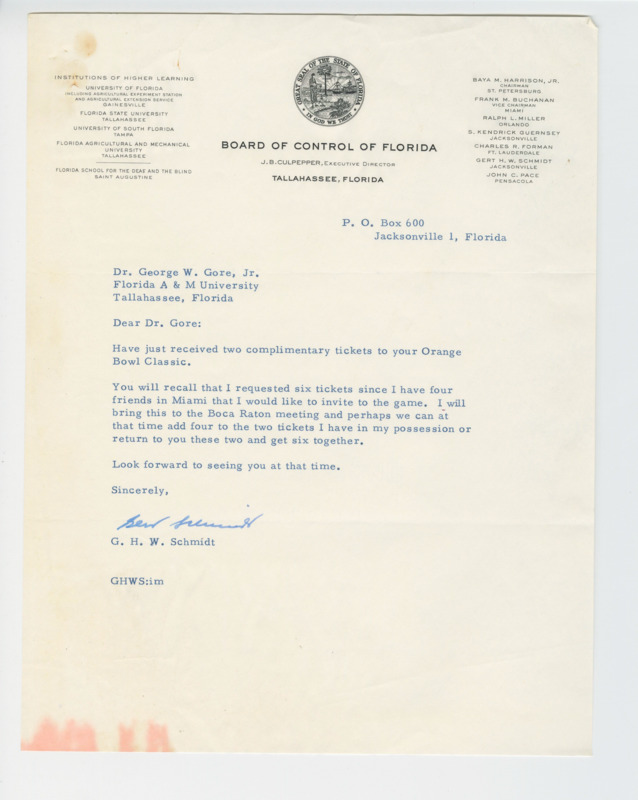
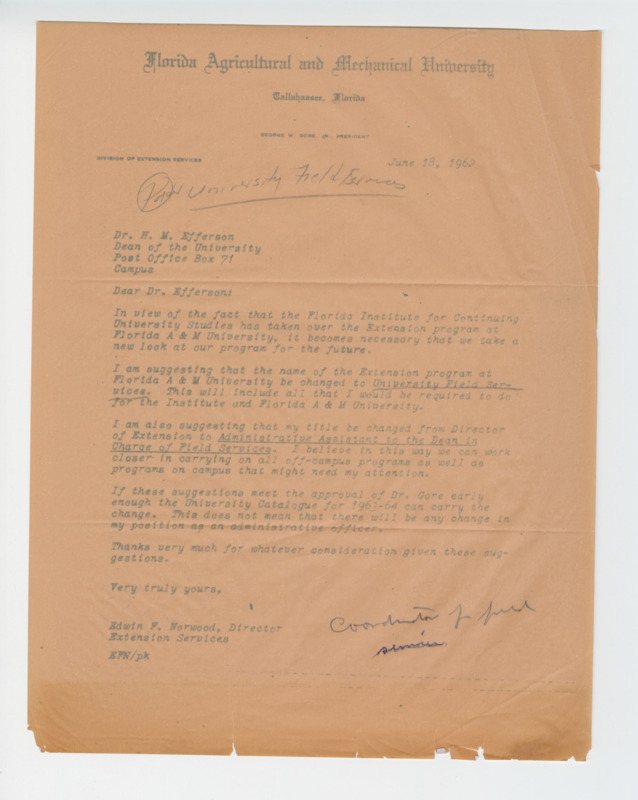
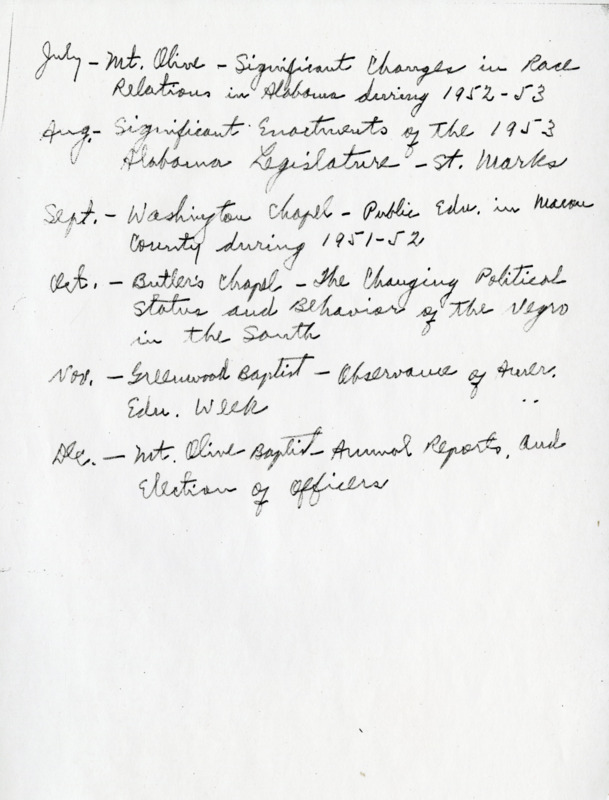
In 1954, letters captured exchanges between FAMU President Gore and leaders of UF and FSU about ticket distributions for university presidents. Additional correspondence outlines Gore’s 25-year plan with FAMU’s Law Dean, focusing on student enrichment and graduation growth in Home Economics and Agriculture.
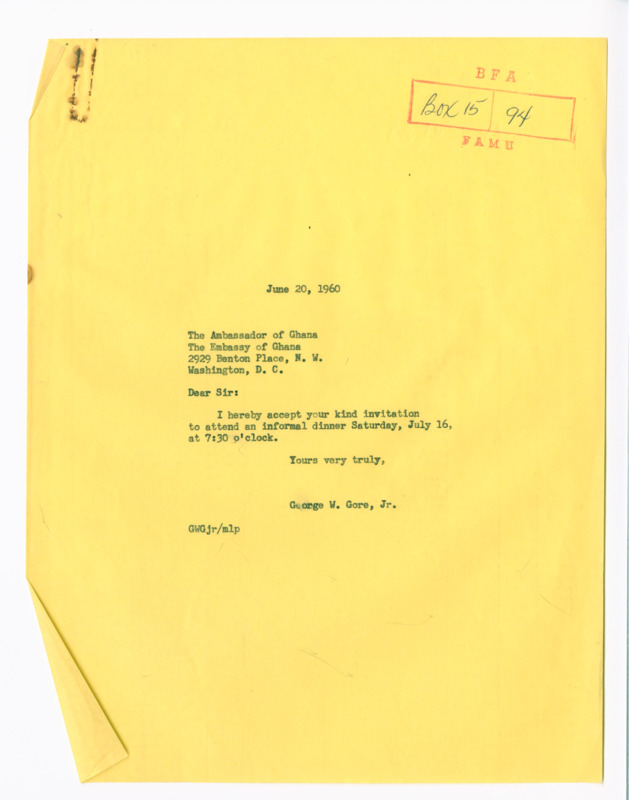
Letters between President George W. Gore and the Embassy of Ghana outline plans for a visit to FAMU in order to build educational ties and expand opportunities for Ghanaian students. Discussions include academic exchanges, scholarship options, and initiatives to further support Ghanaian students at FAMU.
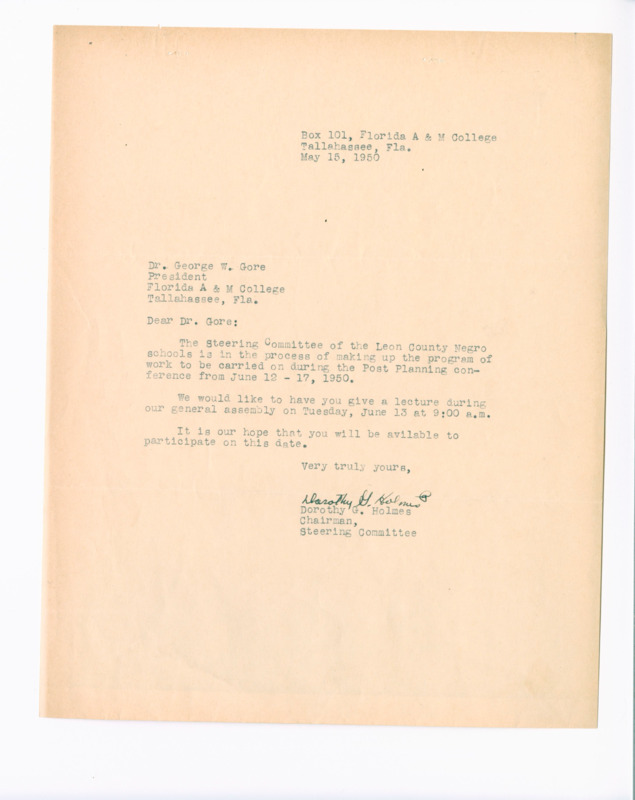
Letters between President George W. Gore and Supervisor Dorothy G. Holmes of Leon County discuss meetings and the urgency of enrolling students in summer classes at FAMC. The exchanges reflect Gore's commitment to ensuring access to education and promoting teacher involvement in summer school programs.
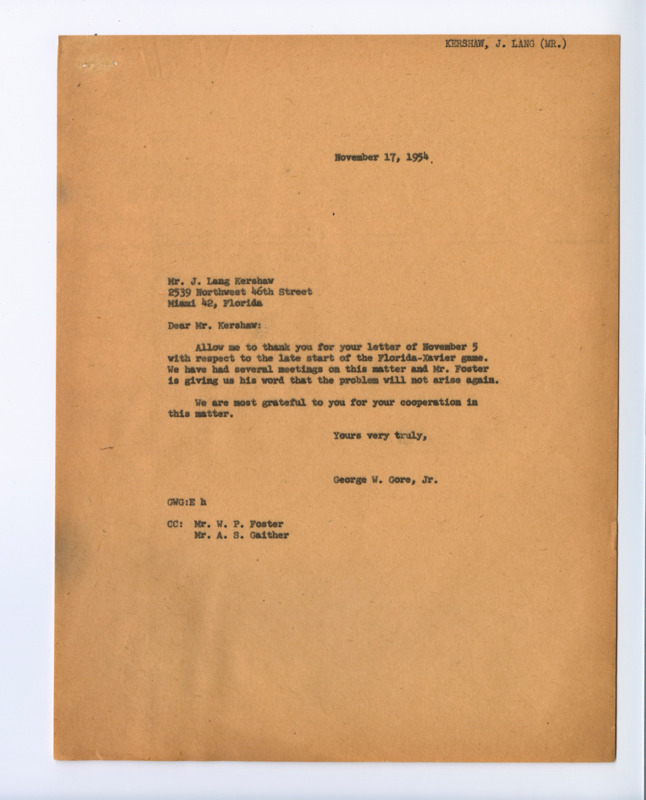
President Gore of Florida A&M College wrote to former student Joe Kershaw, a referee, to apologize for the delay in a recent football game caused by the university’s marching band. The exchange turned somewhat passive-aggressive, with both Kershaw and Gore exchanging letters before ultimately reaching a mutual understanding about the situation.
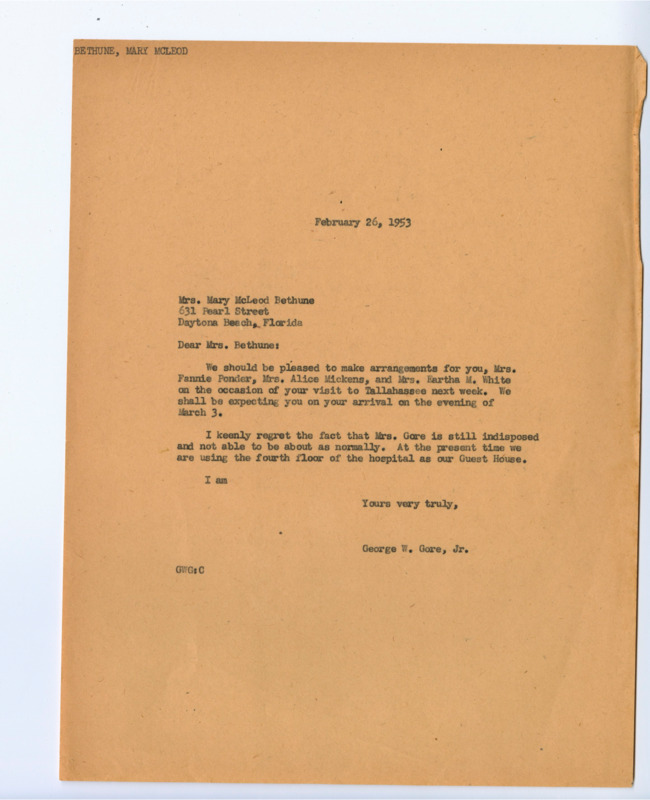
In telegrams exchanged during the months before her passing in 1955, Dr. Mary McLeod Bethune conveyed her plans to visit Tallahassee, despite the personal challenges President Gore was facing with his wife’s illness. Her dedication to the cause and support for the community remained steadfast.
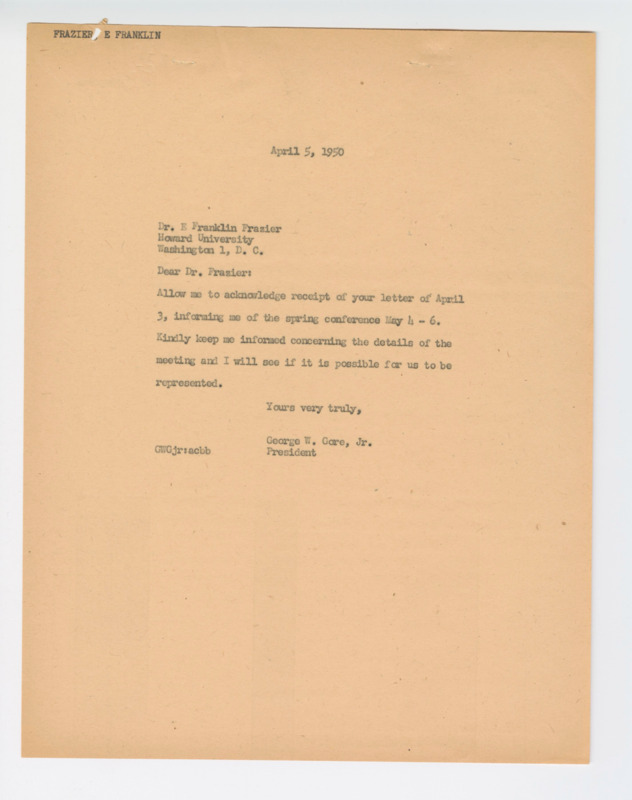
This collection of letters to and from President Gore reflects his vital collaboration with Dr. E. Franklin Frazier and leaders of Negro Land Grant Colleges. Together, they shared statistics, leadership insights, and event invitations to drive the Cooperative Social Studies Project and expand educational access.
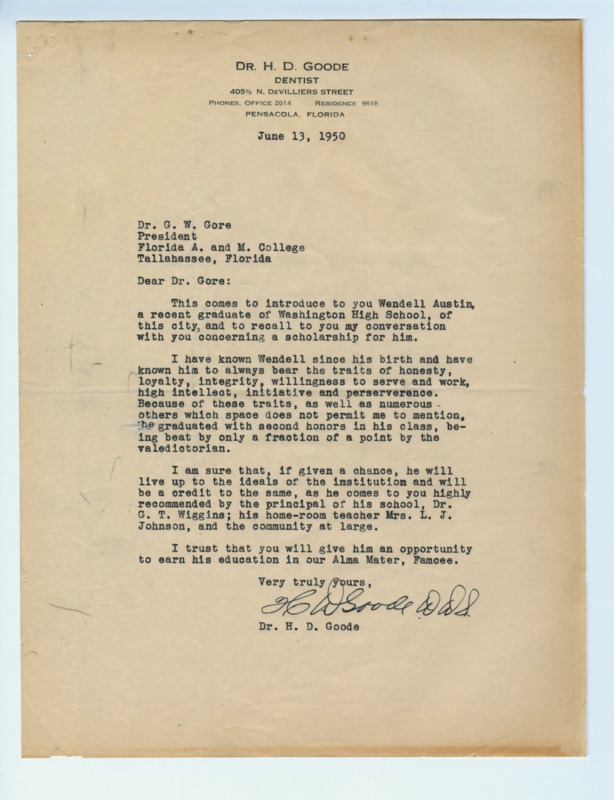
A series of letters chronicles Wendell Austin’s journey, beginning with his interest in attending Florida A&M College and securing a scholarship. The correspondence includes registration details and his campus accomplishments, culminating in his election as Student Government President in 1953.
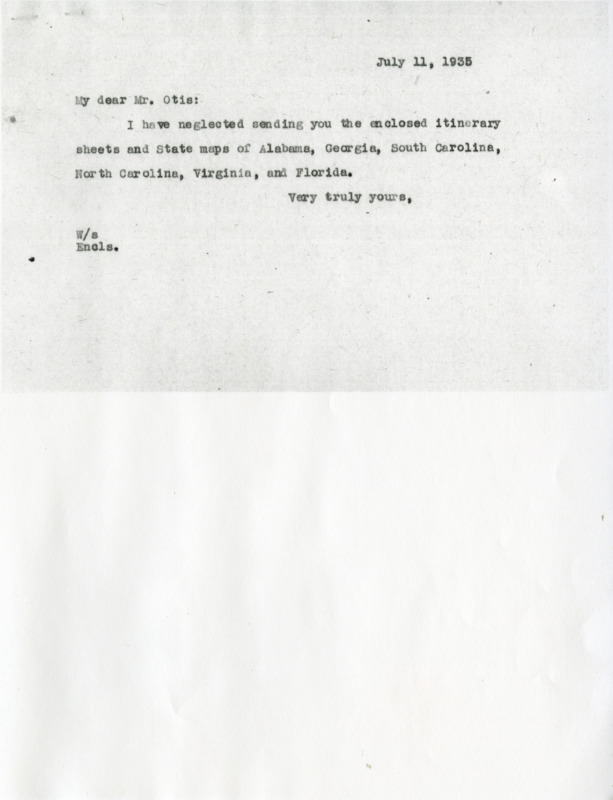
Four letters from Monroe N. Work to "Mr. Otis" regarding a "study of occupations in the Southern areas" in conjunction with the Agriculture Department. Three letters are dated July 1935, one letter is dated November 1935.
Letters regarding university renovations and a student-faculty relationship survey outlined FAMU's planned improvements, funding strategies, and renovation timelines. The communications emphasized the university's commitment to enhancing campus facilities and fostering a modern, functional environment for students and faculty.
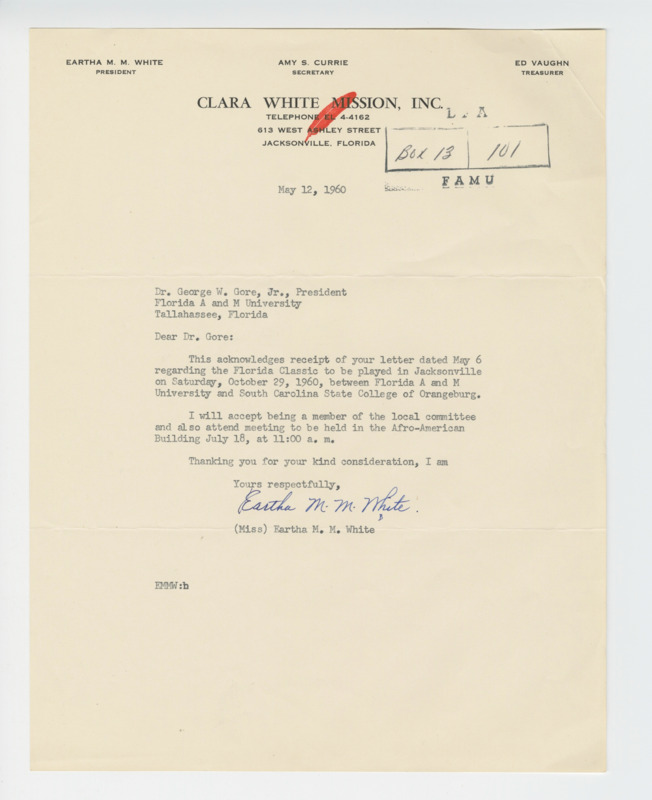
Ms. Eartha White sent a letter expressing her appreciation for joining the local committee and confirming receipt of President Gore's previous correspondence about the Florida Classic. In a separate letter, Mr. Edward Jones from the Department of Painting and Decorating highlighted the significance of African history in Florida.
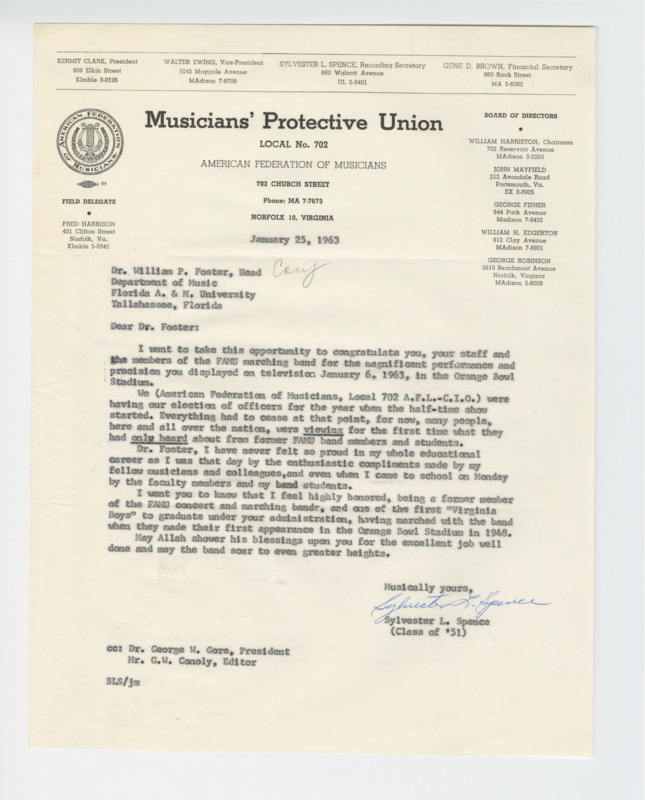
A collection of letters celebrating the accomplishments of FAMU’s Jazz Ensemble, Concert Choir, and Marching Band, all under the direction of Dr. William P. Foster from John Hopkins, founder of Hopkins University. These letters offer praise for the ensembles' performances.
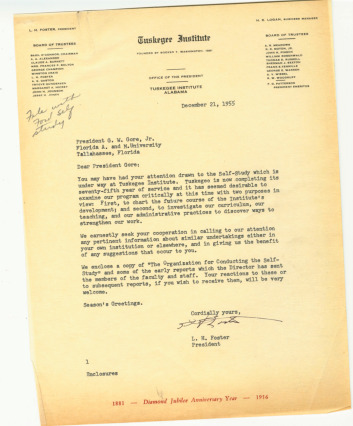
Letters exchanged with President L. H. Foster of Tuskegee University highlighted the organization of the self-study and initial reports from the director, emphasizing the steering committee’s essential role in preparing for the milestone anniversary.
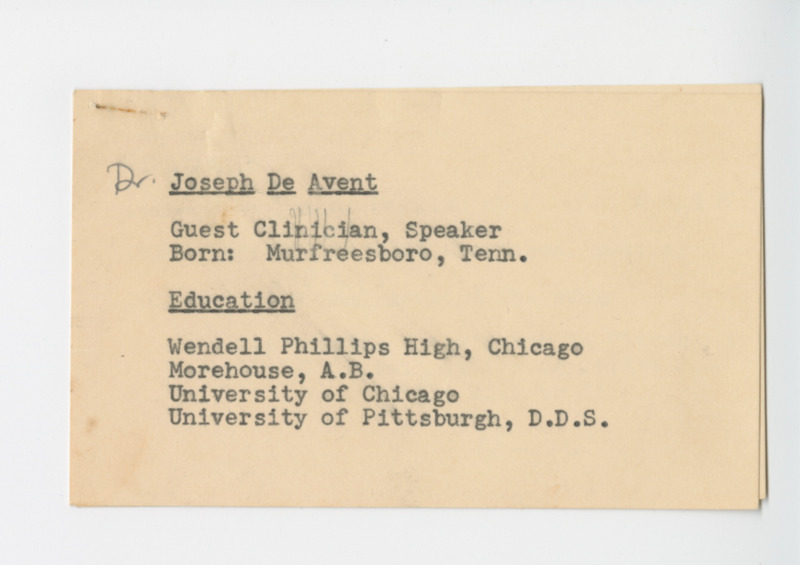
These heartfelt letters from Dr. Joseph De Avent, esteemed FAMC professor, reflect his gratitude and commitment to students and fellow educators. Filled with wisdom and encouragement, they show his enduring impact on the FAMC community and his dedication to fostering growth and excellence.
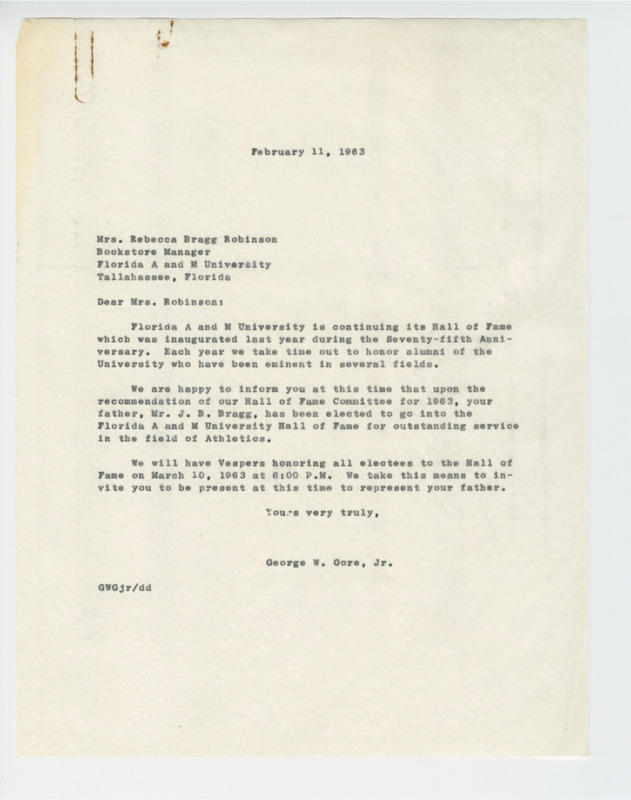
Recommendation letters from President Gore regarding FAMU's Second Annual Hall of Fame, a celebration of the university's 75th anniversary, highlight the election of Mr. David Bryant and Mr. Rufus J. Hawkins. Both accepted the invitation, while Mr. Robert Bacon regretted he could not attend due to scheduling conflicts.
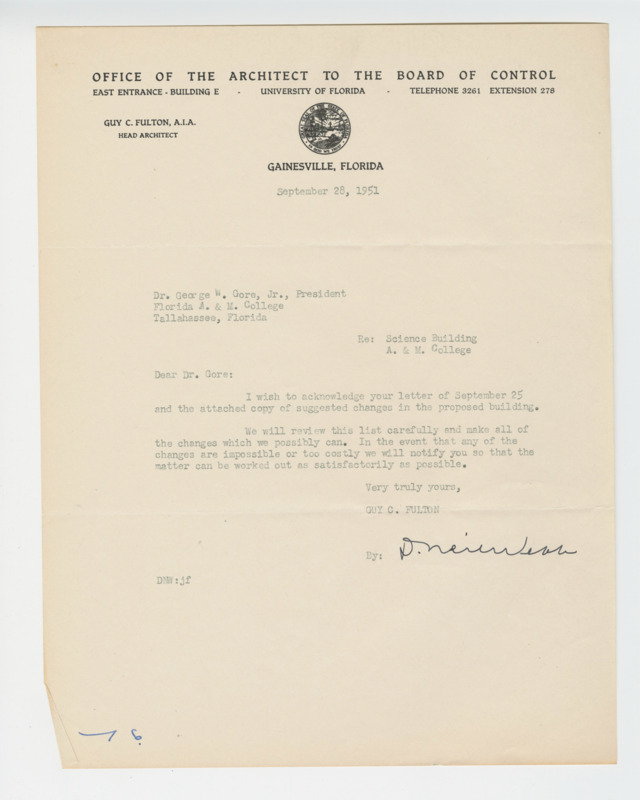
These letters concern President Gore's institutional expansion projects. The correspondences detail Mr. Guy Fulton's attempts to contact the Federal Security Agency regarding delays in the approval of critical materials needed for FAMC's Law building and the creation of the Geology and Demonstration buildings.
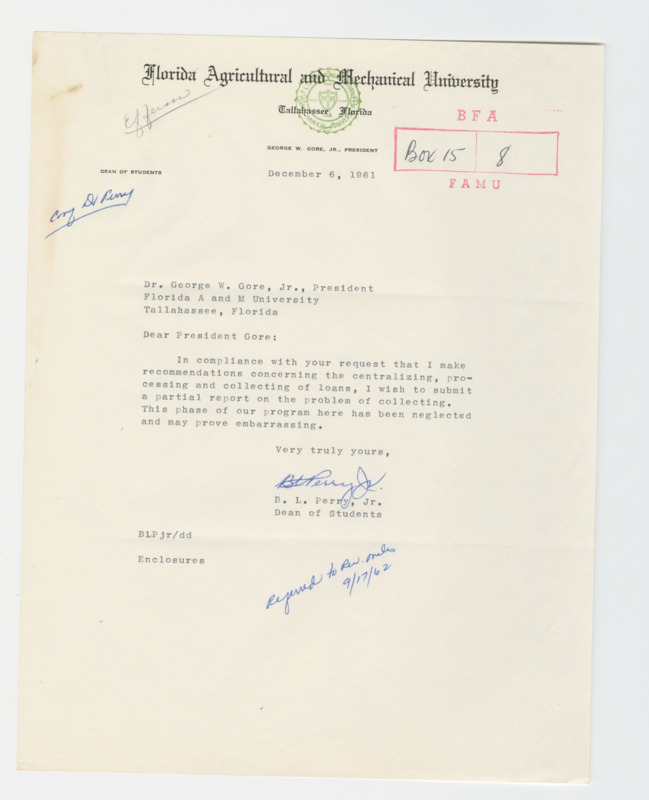
Letters between B.L. Perry, then Dean of Students, and President Gore outline Perry's two-year leave of absence from FAMU to pursue his passion for education at Michigan State University, where he served as a member of its Advisory Team at the University of Nigeria.
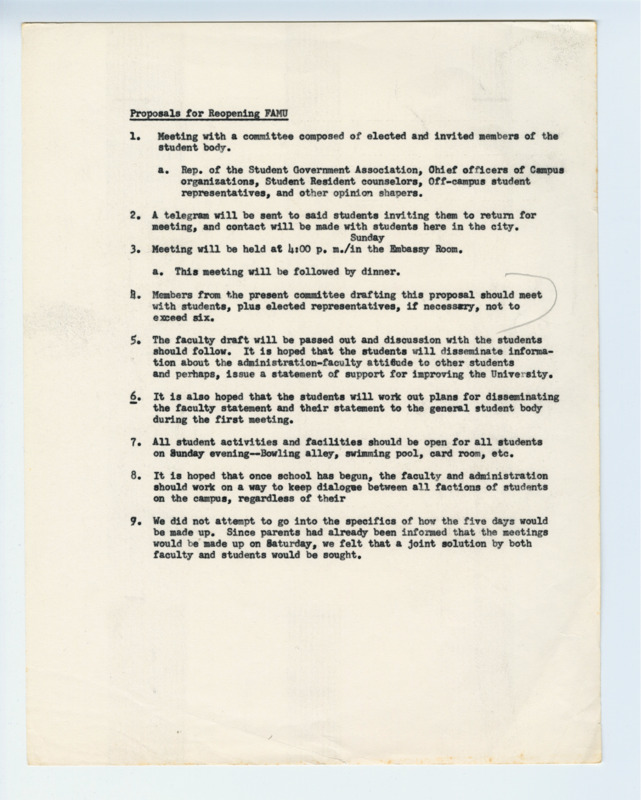
Two letters address FAMU's response to post-reform challenges. The first proposes reopening the university, calling for open dialogue among all student factions to foster unity and understanding. The second notifies students about reimbursements for unused meal tickets and laundry services and includes details on collection procedures.
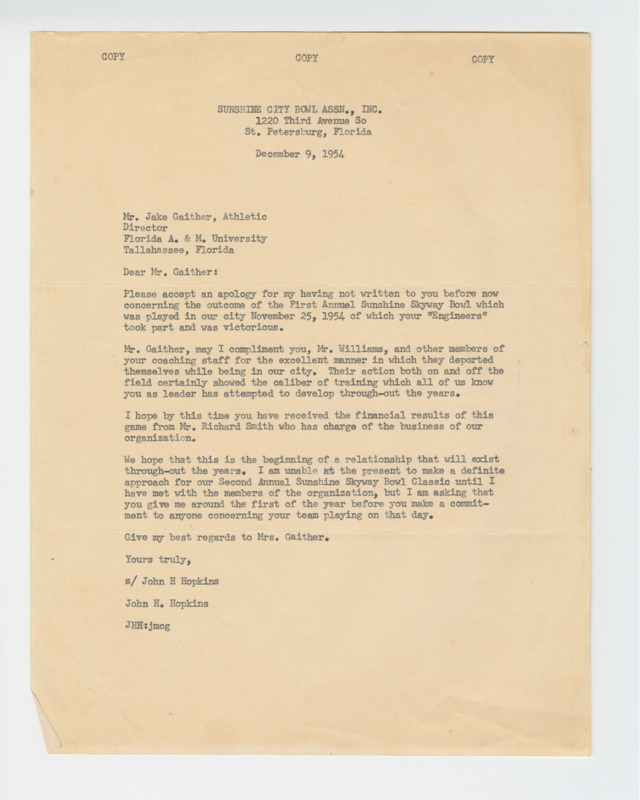
Letters recognizing Coach Alonzo "Jake" Gaither’s leadership in the athletics program at FAMU. These letters highlight achievements within the program and discuss the administration of summer school courses for student-athletes, emphasizing the importance of academic support when balancing education and athletics.
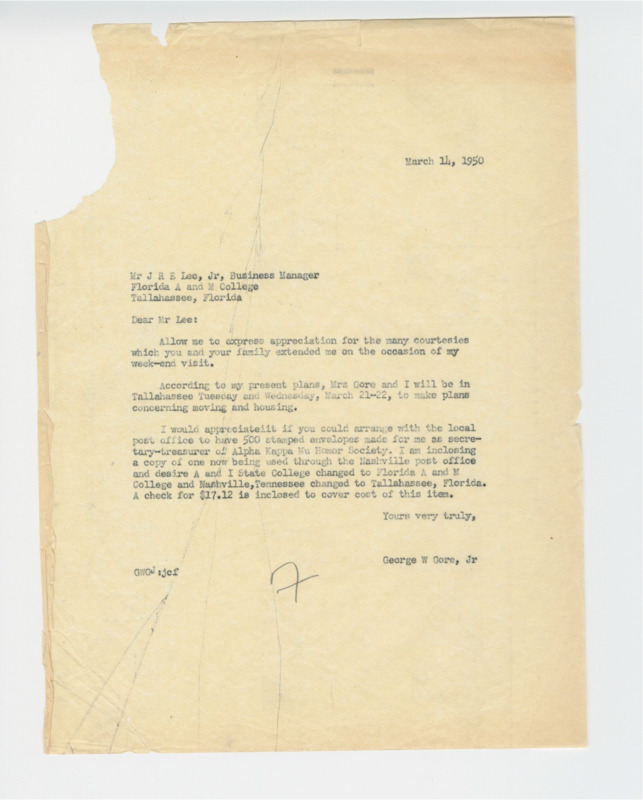
A collection of letters and documents between FAMU officials and former president Dr. J.R.E. Lee Jr. covers key operational matters, financial considerations, and administrative decisions regarding the university's budget, resources, and strategic planning.
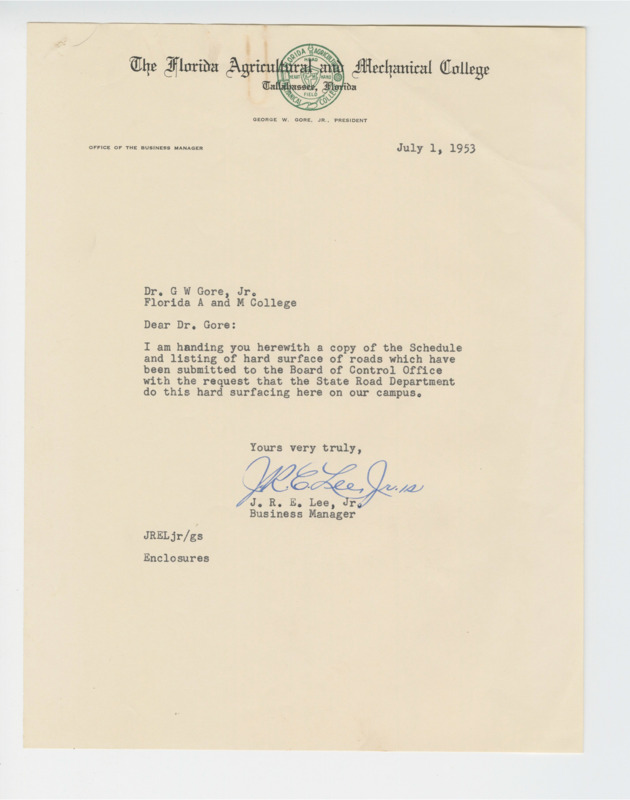
These letters provide insights into the challenges faced by FAMC in maintaining and upgrading its facilities, curriculum, and campus services. Despite evolving institutional needs, FAMC maintained a focus on improving the student experience and physical environment.
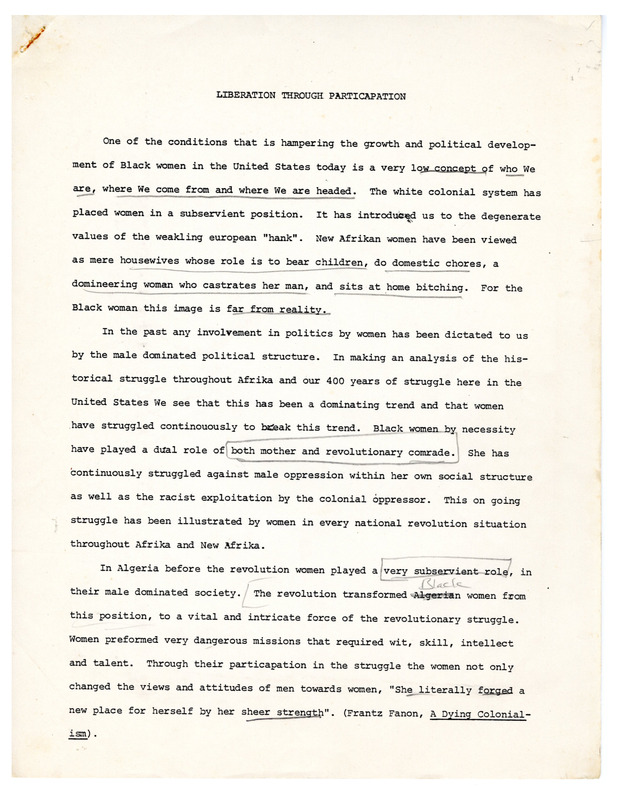
Bernice Jones (aka Safiya Bukhari) was a Black Panther Party member and vice president of the Republic of New Afrika. In this essay, she writes about the concept of New Afrikan Women and the New Afrikan Women's Organization (NAWO).
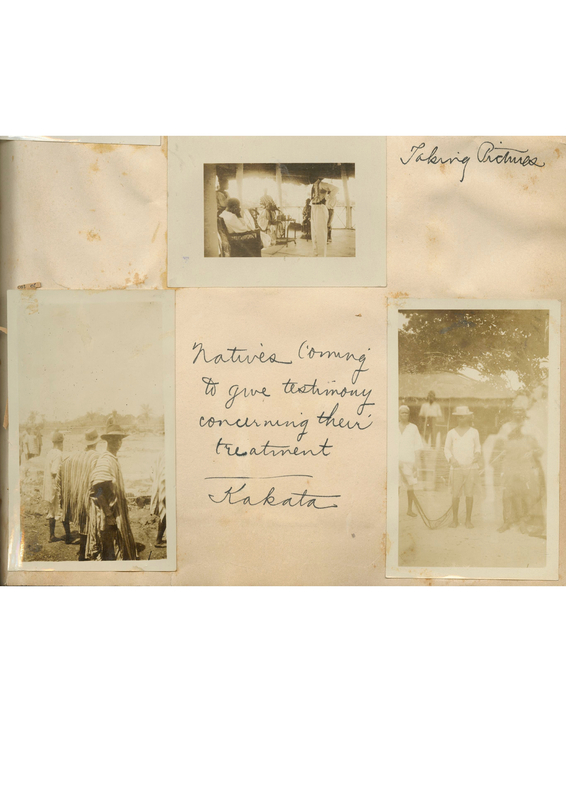
These three images, albeit faded and discolored due to being taken in the 1930s, were taken by John Frederick Matheus on a visit to Liberia for the International Commission of Inquiry. Matheus, a Florida A&M University faculty member, spent extensive time in Liberia and Haiti to contribute to research on the regions, highlighting Black voices.
Mrs. B.B. Walcott, who discusses Carver's contributions, including his 300 products from the peanut and 100 from the sweet potato. She also details his religious and spiritual life, noting his involvement in various churches and his founding of a Bible class at Tuskegee Institute.
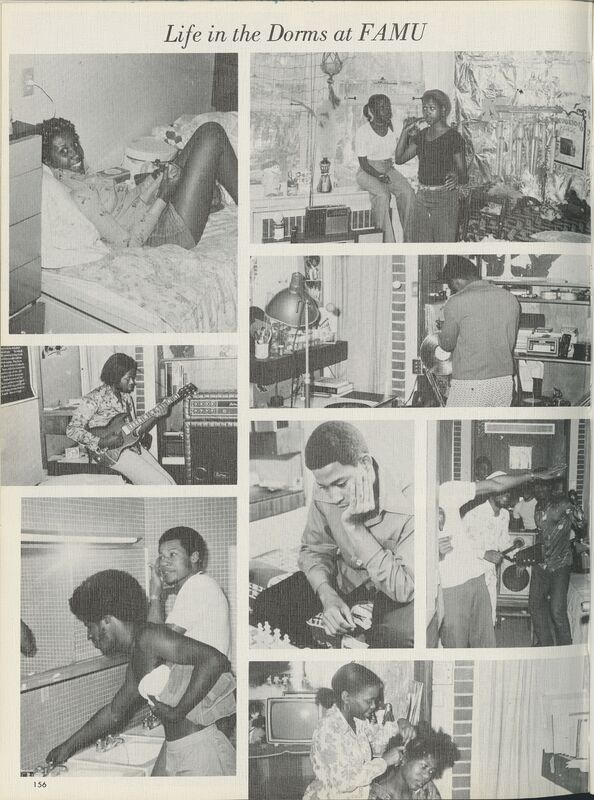
This black-and-white full-page spread featured in the 1975 Rattler Yearbook gives viewers a rare glimpse into the inner lives of Florida A&M University students. In dorm life, regular aspects of Black culture appear like braiding hair with roommates or playing chess. The next page also shows the inclusivity brought by the accessible cafeteria.
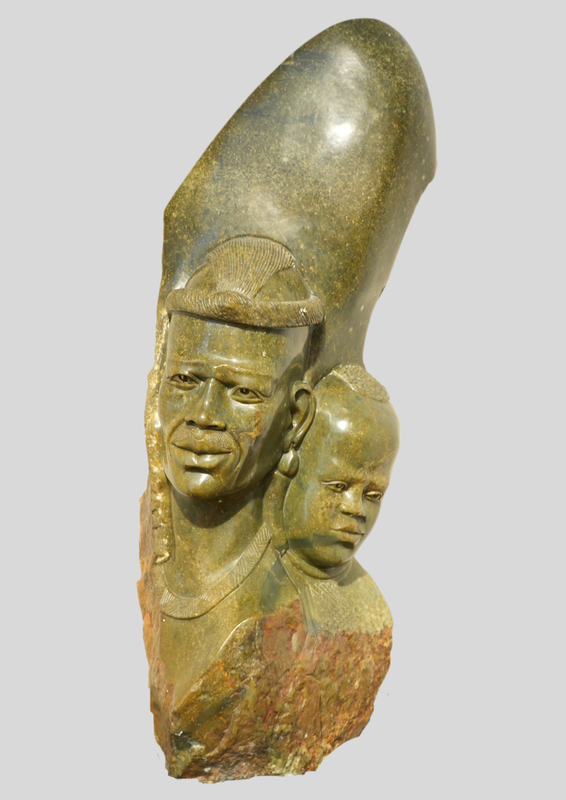
Second-generation sculptor, Joseph Mutasa, made this highly detailed, 220-pound Zimbabwean sculpture from an 800-pound block of opal stone. Showing two male figures, a father and a son, protruding from stone allows the viewer to witness the similarities between them – almost as if to say they are two sides of the same coin or, in this case, stone.
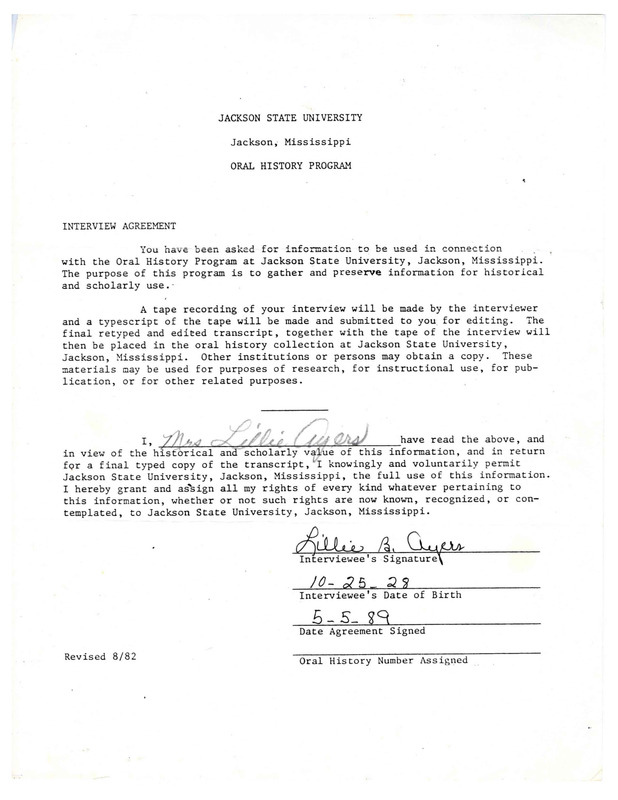
Lillie Ayers was an employee at the Child Development Group of Mississippi (CDGM) from 1965 until 1971. She talks about her husband's involvement with the fight for equal rights and equal pay at his job, and her work with CDGM and Head Start as well as the benefits the programs had for her family and the community.
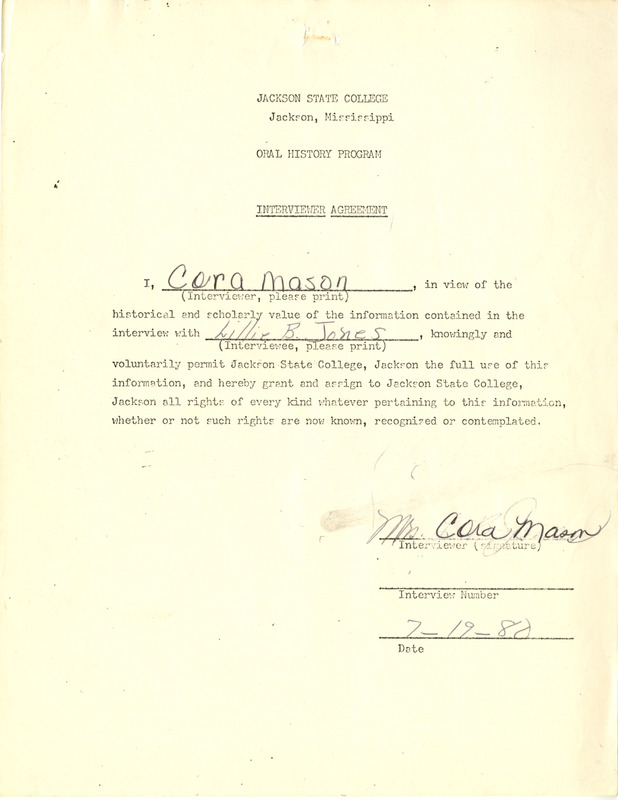
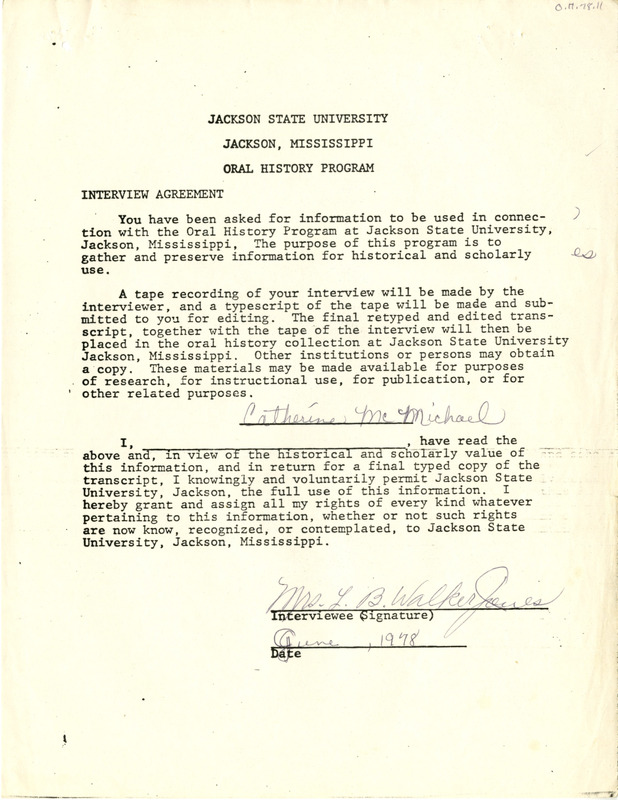
Lillie B. Jones worked at the Farish Street Young Women’s Christian Association (Y.W.C.A.) from the beginning and talks about her experiences there and what the YWCA meant to the community. She also talks about her childhood and young adult days and going through the Great Depression. The transcript is edited heavily with handwritten notes.
Lillie B. Jones came to Jackson in 1935, eventually working at the Young Women’s Christian Association (Y.W.C.A.) in the Farish Street District. She was instrumental in the building of the new $250,000 facility in 1964-1965. She discusses her time as director of the Y.W.C.A. and the influence the Y.W.C.A. had on local young people.
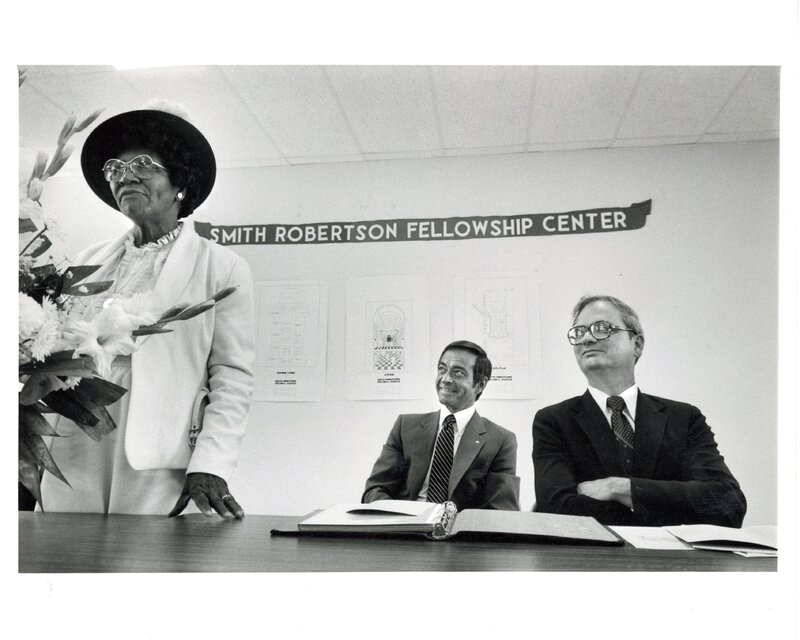
A photograph of Lillie Bell James, Mayor Dale Danks (1977-1989), Jr., and Elbert Hilliard at the Smith Robertson Neighborhood Folklife Festival, April 9-11, 1983. The festival was a one-time grant sponsored event held on the grounds of the Smith Robertson Museum to celebrate the rich history and culture of the Farish Street Historic District.