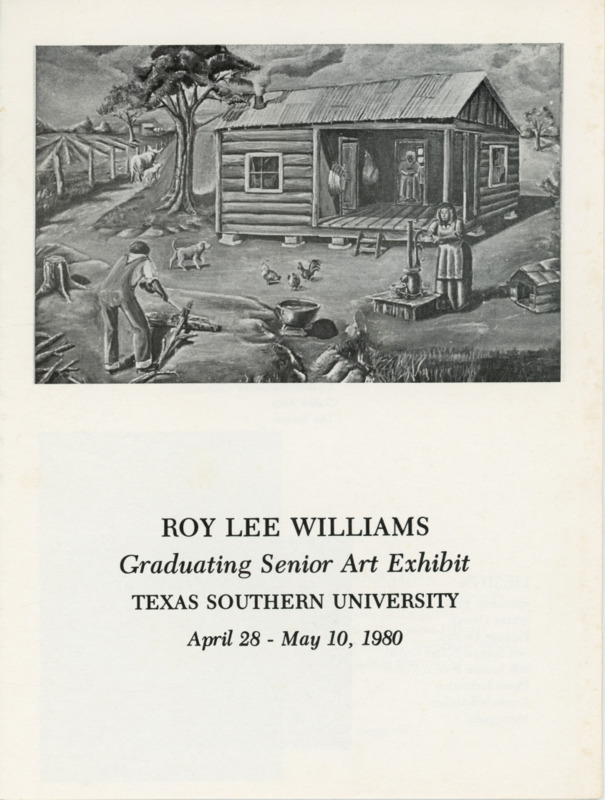
This is a brochure for Williams’ senior art exhibition. The culmination of the Texas Southern art curriculum is a senior exhibition where students showcase artwork created over the course of their undergraduate studies. The brochure features a portrait of Williams, a brief biography, a catalog of the artwork featured in the exhibition, and several photos of his paintings, designs, weavings, and sculptures.
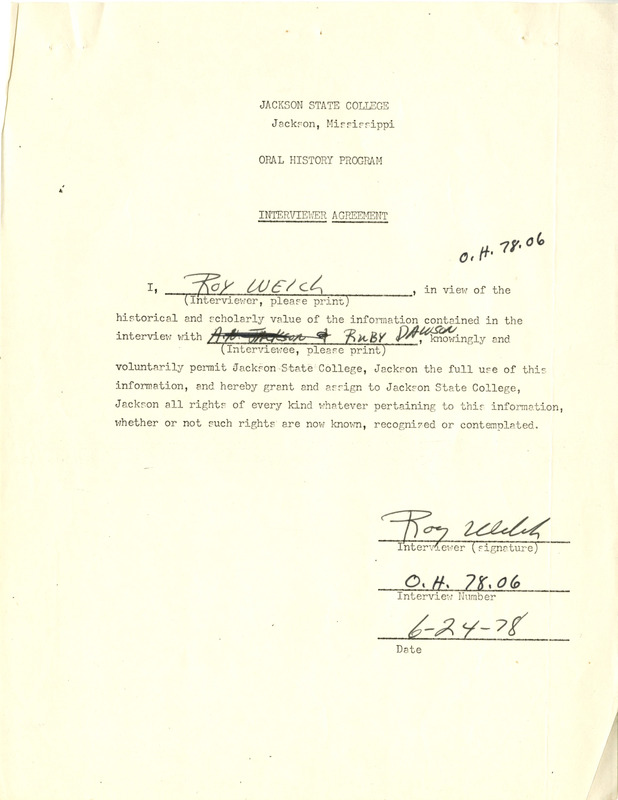
Ruby Dawson was born in Jackson in 1904 and attended Smith Robertson School until the 4th grade before attending Tougaloo College in Jackson. In 1928 she returned to Smith Robertson as a teacher. In the interview, she talks about her time as both a student and teacher. The transcript is edited with handwritten notes.
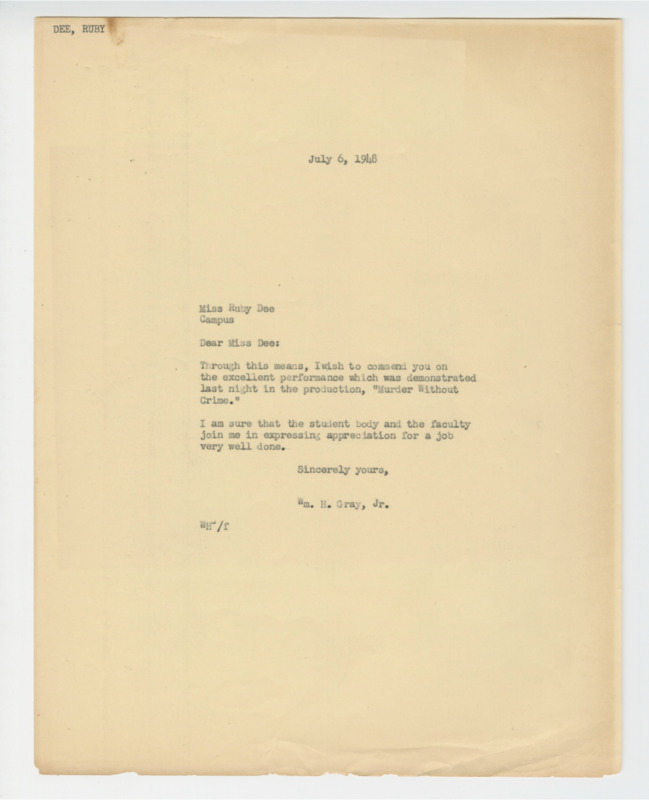
Actress Ruby Dee’s correspondence with President W. H. Gray revealed frustration over delayed payment after her FAMC appearance. Five letters over three months highlighted the issue, with Mr. Wiggins' absence causing delays. Miss Dee expressed disappointment but still hoped to serve FAMC in the future.
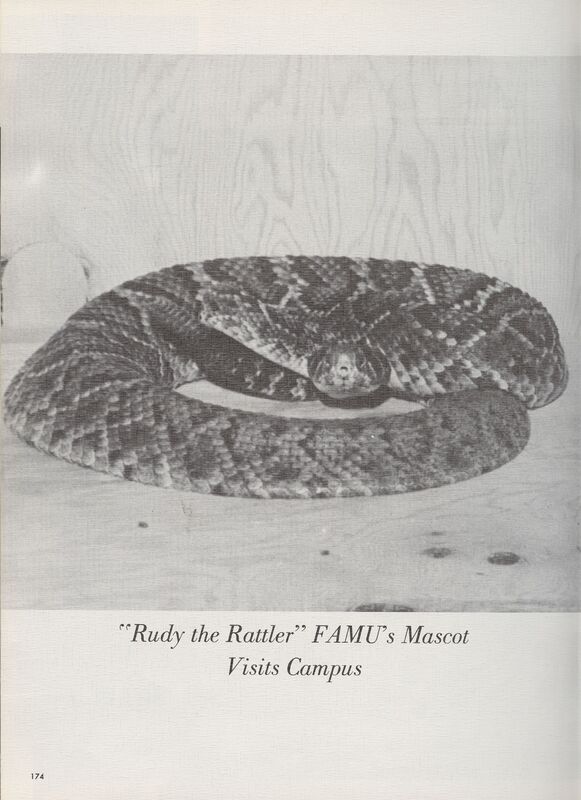
In this photograph obtained from the Rattler 1975, the official Florida A&M University yearbook, the star is “Rudy the Rattler.” Rudy the Rattler was FAMU’s official mascot, a taxidermy rattlesnake sculpture, possibly modeled after a real-life one.
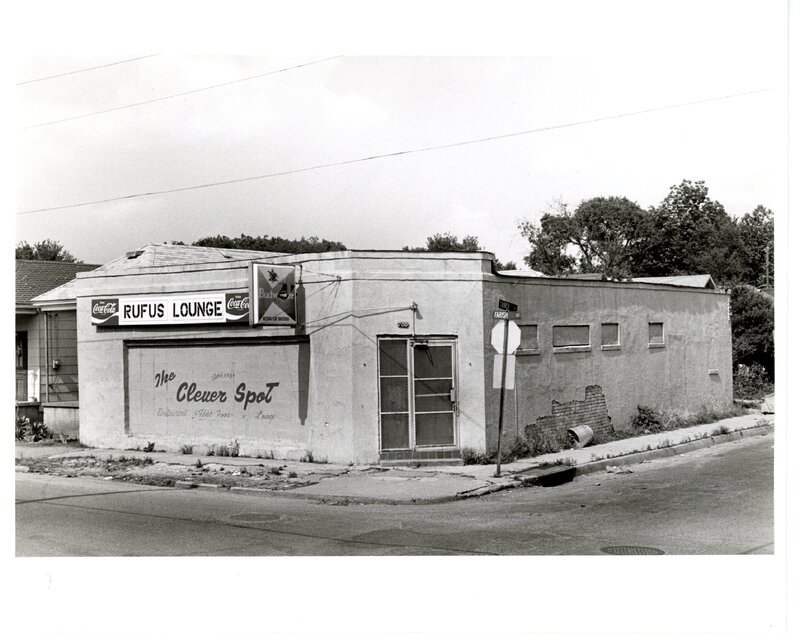
A photograph of Rufus Lounge on N. Farish Street in the Farish Street Historic District. At the time of the photograph, the business was closed and the building was in disrepair.
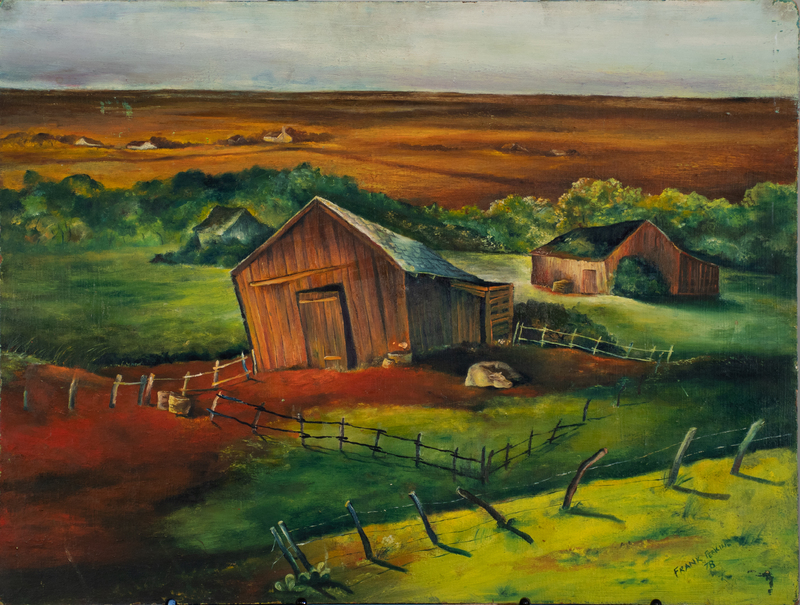
Perkins’ landscape painting displays a rural scene featuring barns, farmhouses, and a sleeping cow. The landscape is divided with lush greenery and dry, brown land. The fence shows its age in its bent and leaning posts. Dr. John Biggers encouraged Texas Southern student artists to create art based on what they saw – perhaps this instruction inspired Perkins, who may have grown up in a rural environment similar to this one.
Ruth Fitts became a teacher with Head Start in Tupelo, Mississippi, in 1966 after being alerted by her husband to a job opening in an advertisement. She talks about her experiences being a White teacher in the Head Start Program and discusses a number of colleagues she worked with.
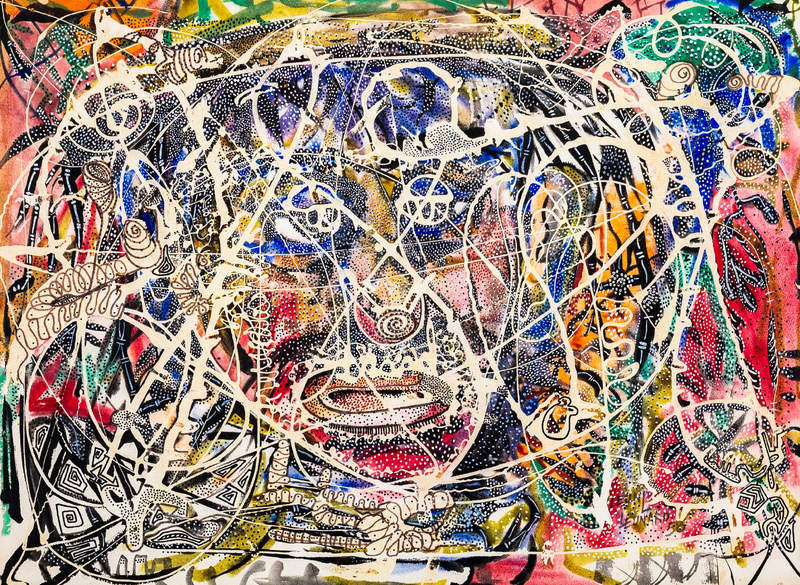
Leon Lank Leonard, Sr. was a painter, sculptor, and educator from Waco, TX. Sad Jester combines gestural line art, expressive brushwork, and abstract forms. These techniques are layered to create a face that is centered in the composition. There are mixes and hues of blue, red, green, yellow, orange, and black.
Sam Whisterton was a teacher in Madison County, Mississippi in 1965. He talks about how students coming to his classes were prepared by Head Start. He also talks about the connection between the Freedom Schools of Freedom Summer and the Head Start program and some of the support and push back Head Start experienced when it started.
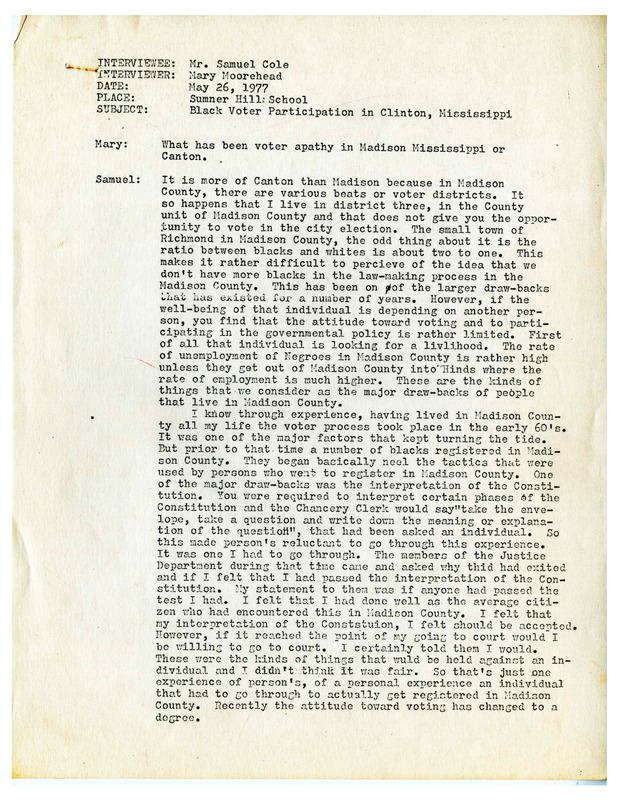
Mr. Cole worked all over the nation as a voting rights activist. In this interview, he talks about voting, especially through the lens of his memories of voter registration drives during the Civil Rights Movement and up to the present day. He gives a nuanced interpretation of voting rights and voting activities in several parts of Mississippi.
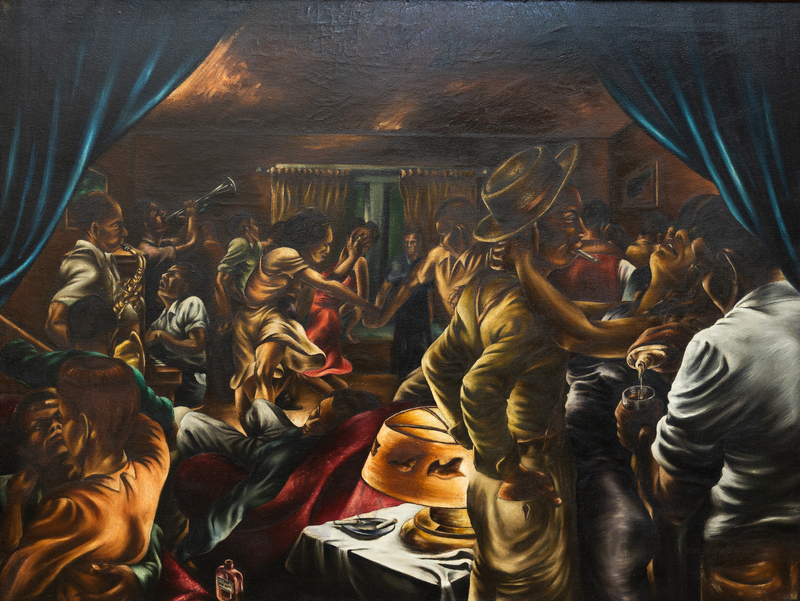
William Hayden was a painter and educator from Lexington, NC. Saturday Night Function is a juke joint scene depicting Black people dancing, playing instruments, and socializing. Hayden illuminates the interiorities of African-American nightlife in the mid-1900s.
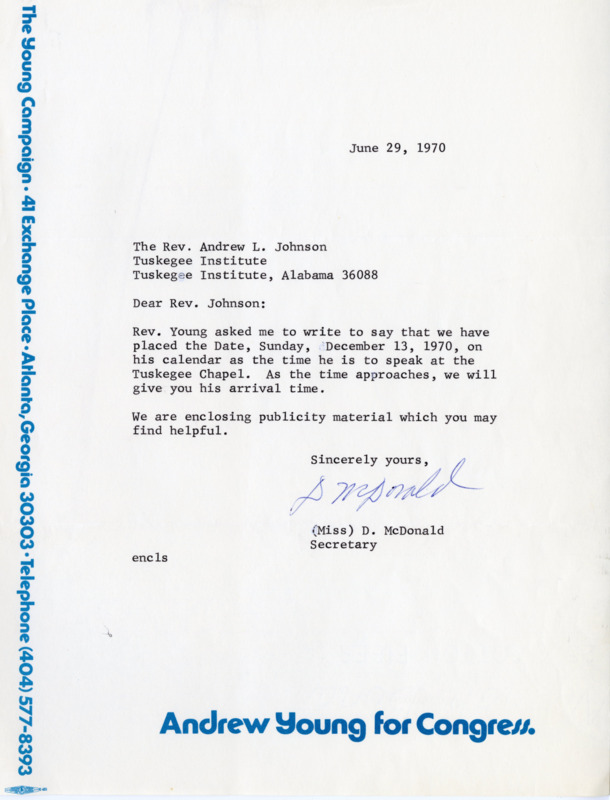
A Letter from Miss Dora McDonald to Chaplain Johnson that Congressman Andrew Young has saved the date of 12/13/1970 to speak at Tuskegee on his calendar.
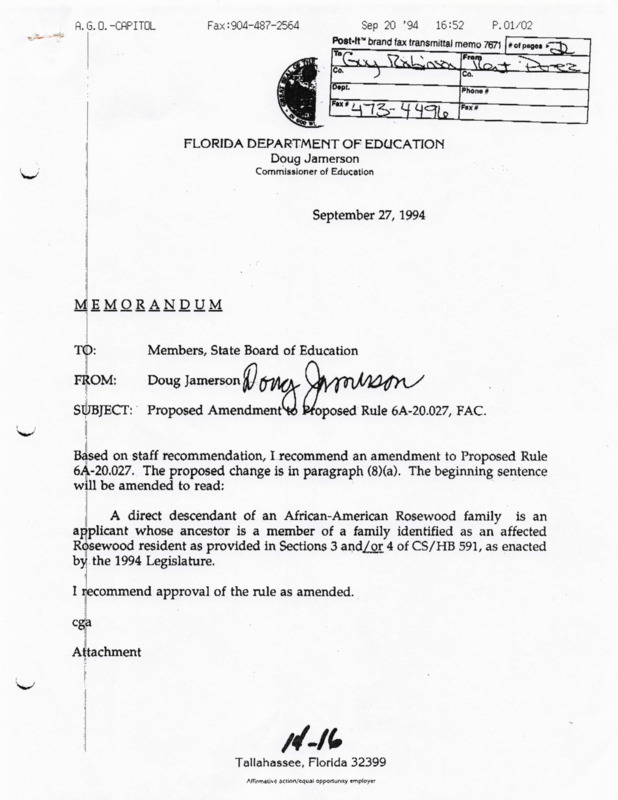
Letters from the Office of Student Financial Assistance regarding a scholarship for Rosewood descendants. Issued by the Florida Department of Education, they request documentation such as proof of lineage through great-grandparents and beyond, ensuring the preservation of these families’ legacies.
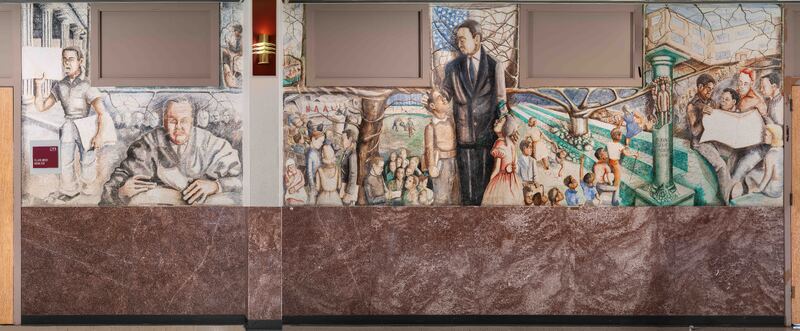
Royal’s mural illustrates the desegregation of public schools following Brown v. Board of Education (1954). In the center of the scene is attorney and future Supreme Court justice Thurgood Marshall, with Black students entering integrated schools. At the far left is Chief Justice Earl Warren.
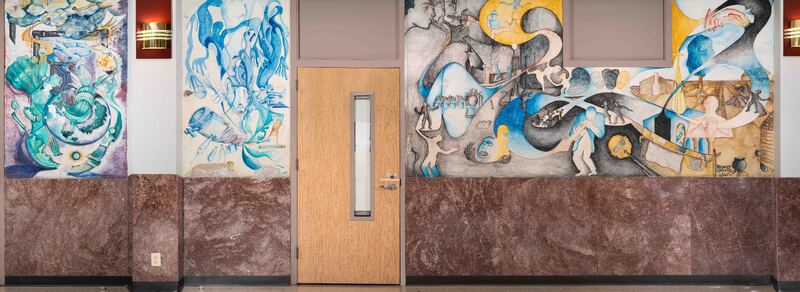
Goffney's intricate mural suggests themes of scientific discovery, fluid energy, and mid-century lifestyles. Scenes of nightlife and a rural church are featured on the right. Goffney signed his last name as Goeenet, perhaps his artist name.
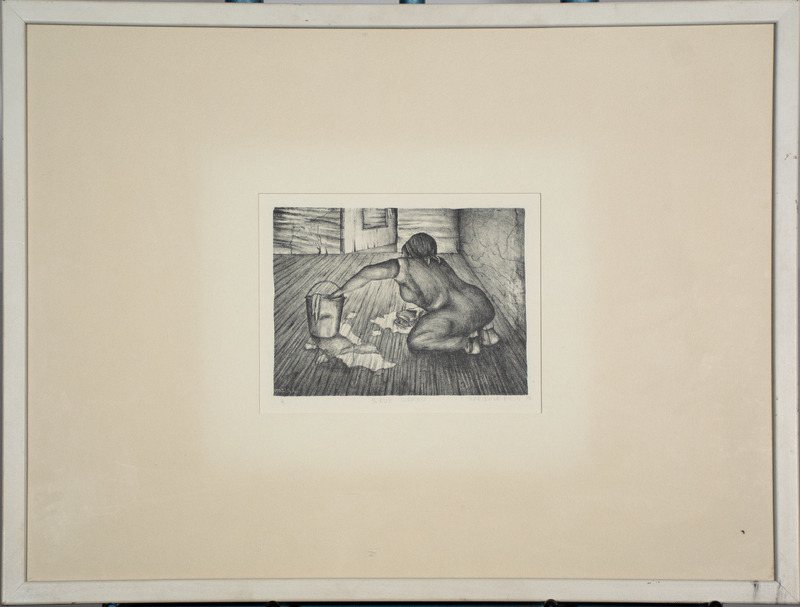
Rison-Isom’s print depicts a woman kneeling to clean wooden floors with a scrubber and bucket. The room appears worn and cracked, indicating age and heavy use. This work highlights the importance of Black women’s labor, which has too often been neglected. In the 19th and 20th centuries, huge numbers of Black women worked as domestic laborers.
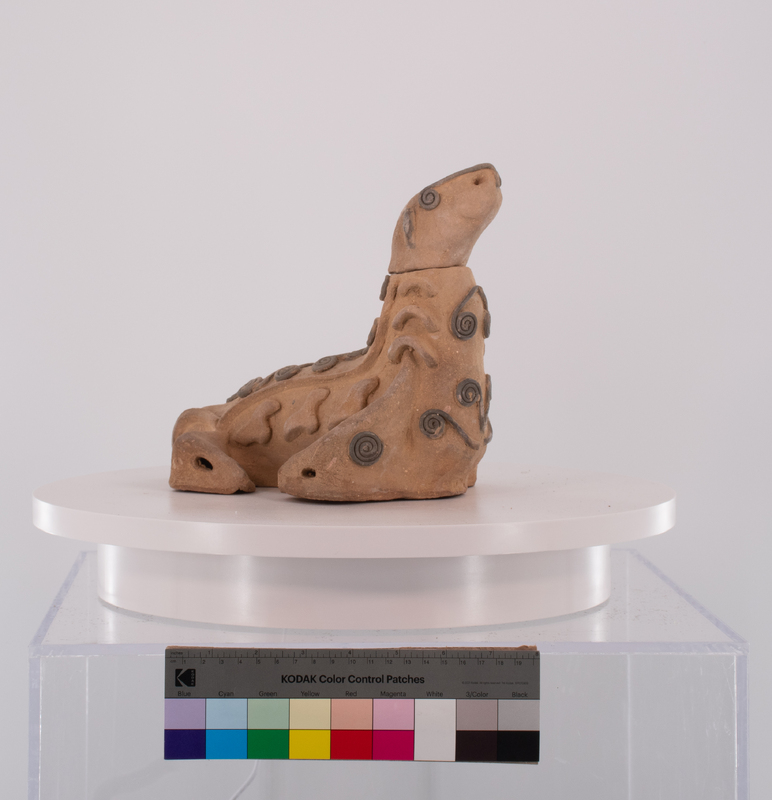
This maquette is a largely realistic depiction of a sea lion. The sea lion is adorned with swirls, the most common visual motif used by Simms' students in their sculptures. The final, full-size version of the sculpture contains even more embellishments that the maquette lacks.
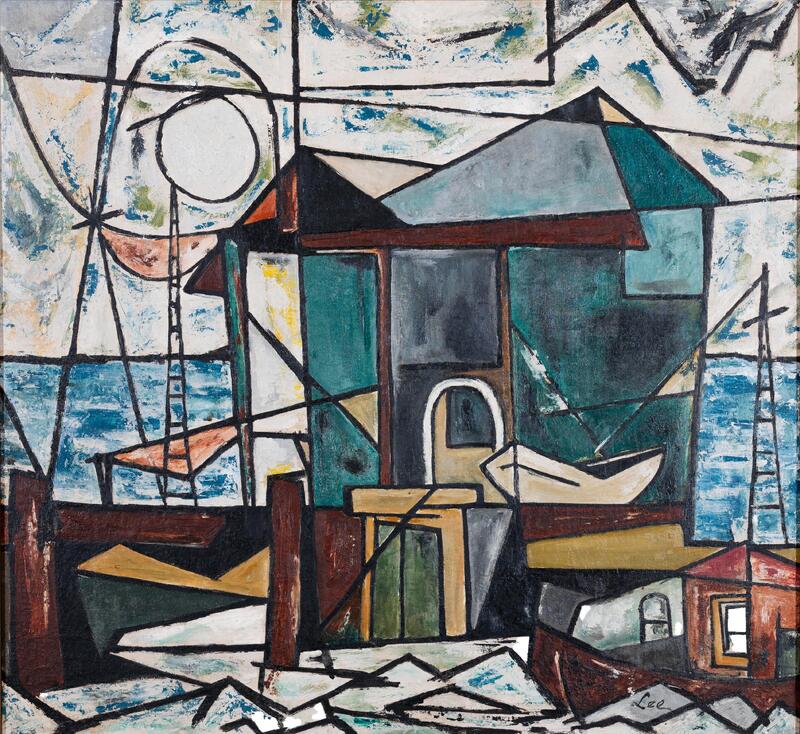
Harvey W. Lee Jr. was born in St. Louis, MO, and he moved to Daytona Beach, FL. to teach art history professor at Bethune-Cookman College in 1952. Seascape depicts a house by the sea. The cubist painting uses intersecting stark black lines with shades of brown, green, blue, and red to create a full composition.
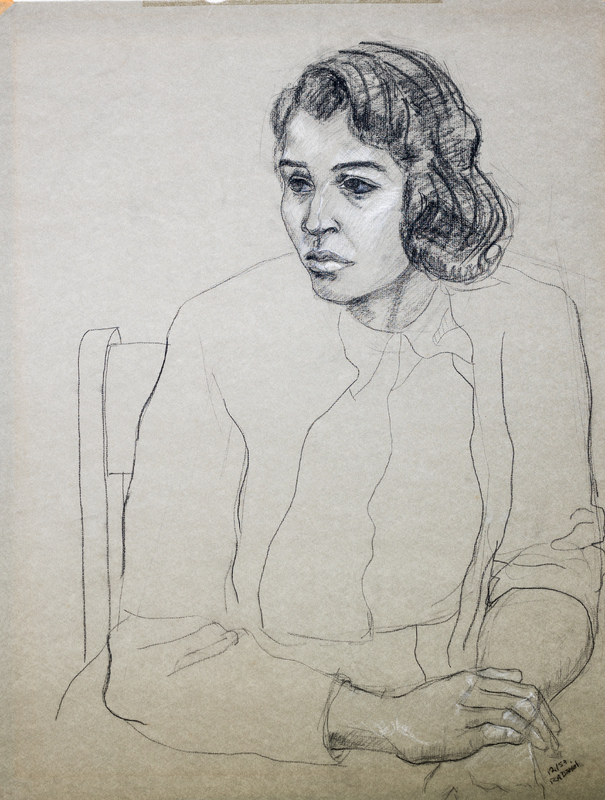
Robert A. Daniel was an artist from Tallahassee, FL. Seated Figure is a portrait of a Black woman sitting in a green chair in front of an ironing board. She seems to be resting from doing domestic labor.
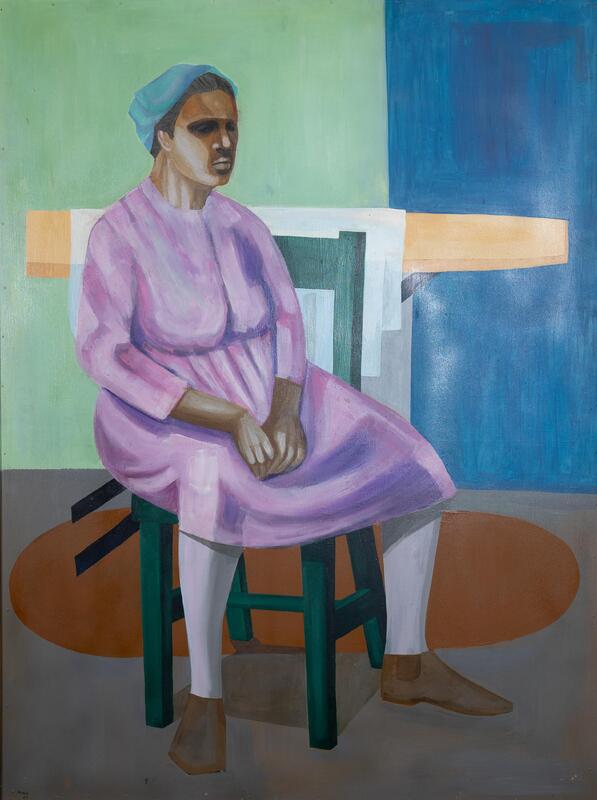
Jack Adams was an artist from Atlanta, GA. Seated Figure depicts a wearied woman resting after domestic duties. She sits in a green chair in front of an ironing board, dressed in a purple dress, blue headdress, stockings, and brown boots.
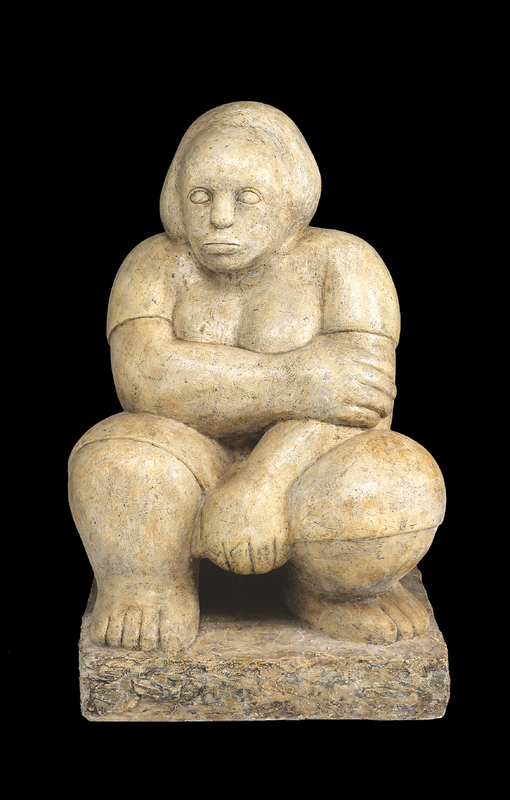
Hayward Oubre was a multimedia artist and educator from New Orleans, LA. Seated Woman is a sculpture of a bodacious woman with a solemn expression. Her right arm is crossed over her chest, and her left arm hangs between her legs.
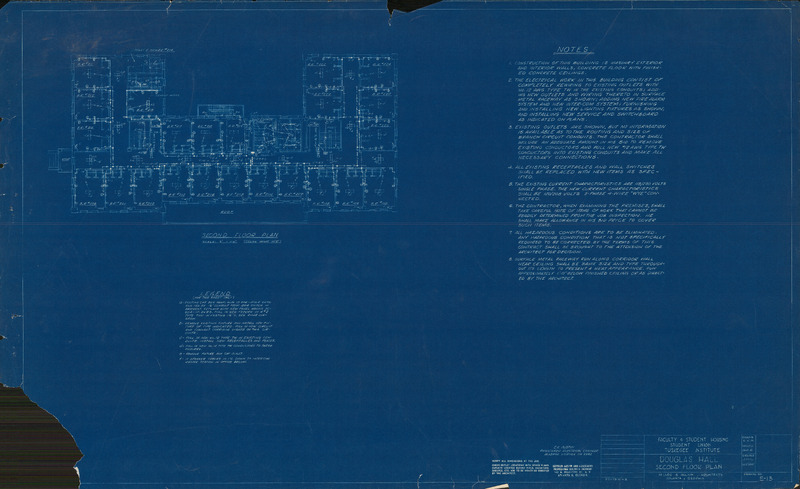
13th Electrical drawing blueprint for Douglass Hall Second Floor Plan blueprint. Drawing has construction notes, drawing legend, and electrical outlet layout.
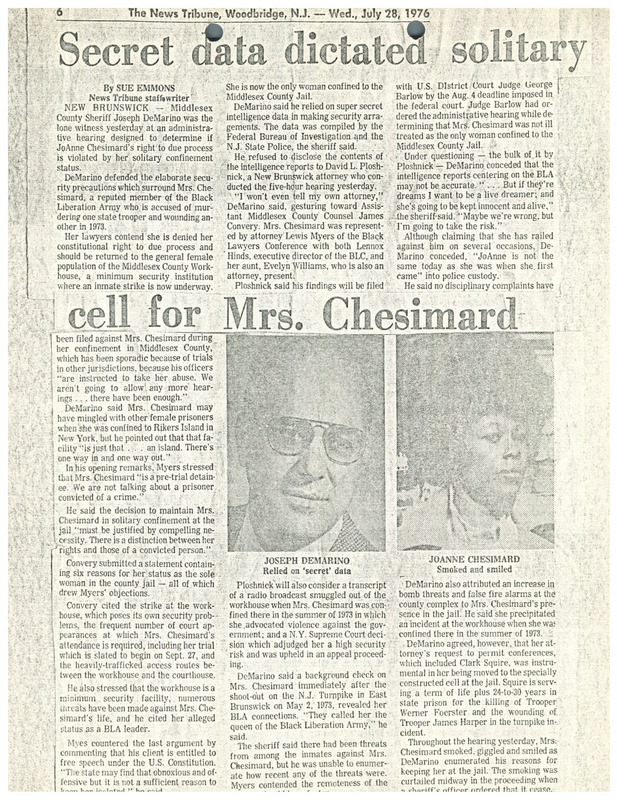
A newspaper article from The News Tribune about Assata Shakur (JoAnne Chesimard) being in New Jersey to stand trial for the May 1973 killing of a state trooper. The author writes about the process that went into Assata Shakur (JoAnne Chesimard) being confined to solitary confinement and the court hearing that took place to examine the evidence.
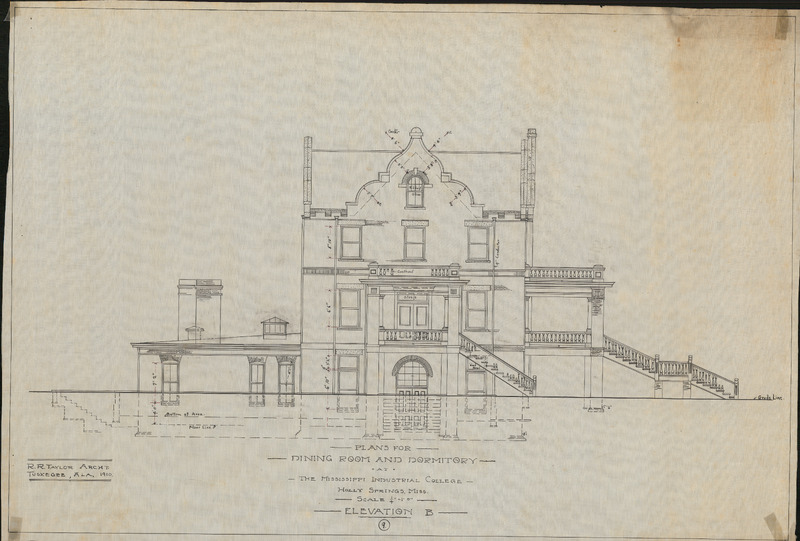
A black and white architectural drawing crafted by hand by Robert R. Taylor in 1910 for a dormitory/dining hall for the Mississppi Industrial College located in Holly, Springs Mississippi. The Drawing Scale is 1/4 1'0'' Elevation B Drawing page Number 9. This is the front face of the proposed building.
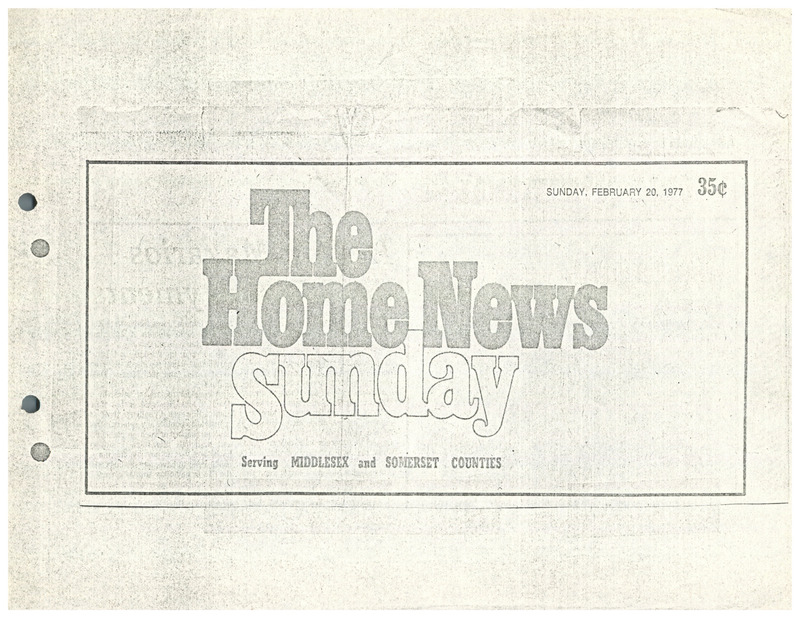
A newspaper article from The Home News about the heavy security that accompanied Clark Squire on his move from Trenton State Prison to Middlesex County for a six hour meeting with Assata Shakur (JoAnne Chesimard) and her defense team. Squire was earlier convicted of the same 1973 killing of a state trooper that Shakur was on trial for.
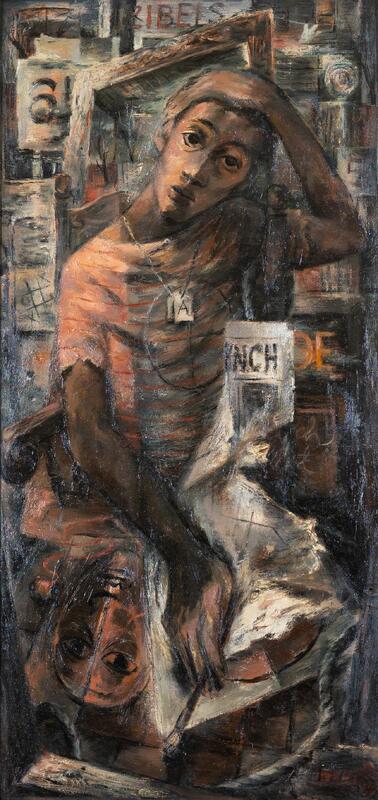
Cecil D Nelson Jr. was a painter born in Champaign, IL. Self Portrait - Confronted Age, 16 depicts a Black male teenager haunted by racial violence. He sits in a chair holding a paintbrush with his hand on his head, wearing a shirt with a target symbol. There is also a rope, mask, and torn newspaper with the headline “lynch.”
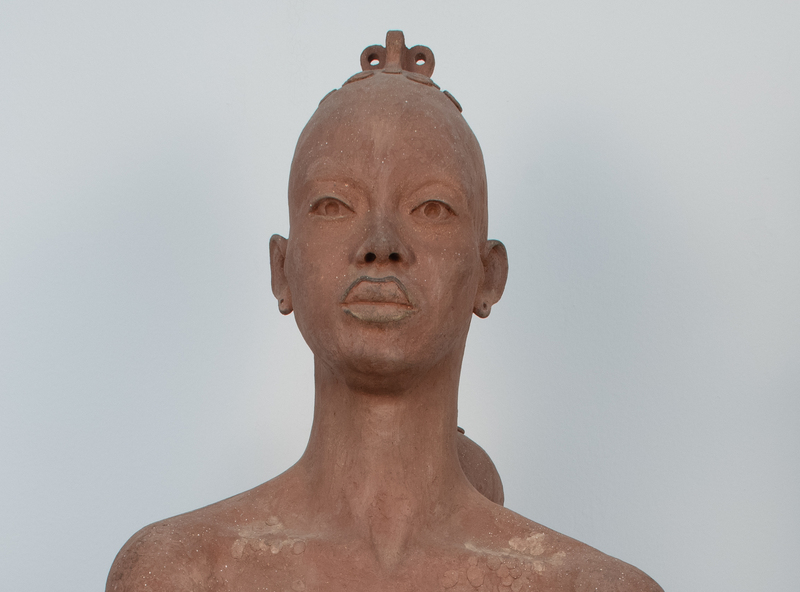
Elizabeth Montgomery Shelton’s “Self-portrait” is a bust of the artist herself, carrying her child on her back. Embellishments, including spirals, adorn her head in a faithful execution of Professor Carroll Harris Simms’ instruction. The artist had previously created a different self-portrait sculpture and was encouraged to create this piece by Biggers and Simms after the birth of her child.
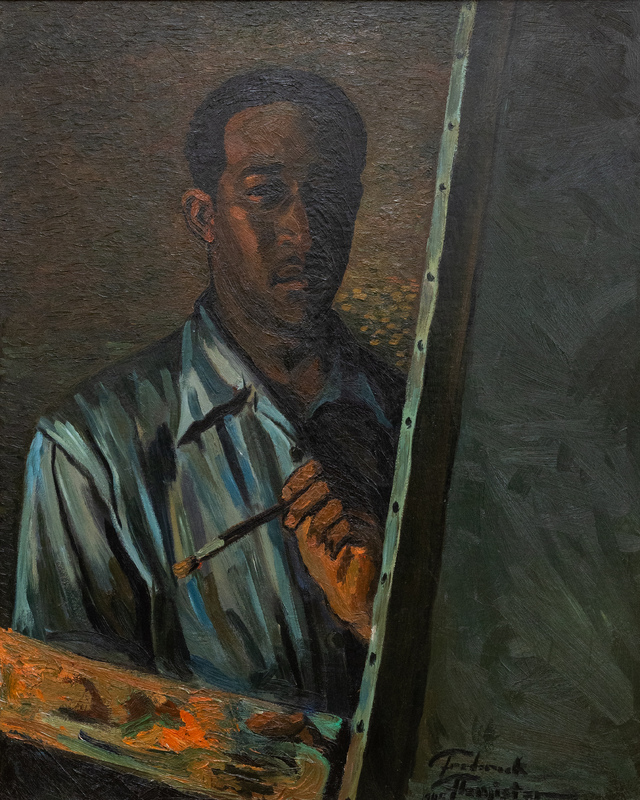
Frederick C. Flemister, native to Jackson, GA, was a student of Hale A. Woodruff at Atlanta University in the 1940s. Self-Portrait is an impressionistic piece depicting Flemister preparing to paint. He is standing in front of a canvas while holding a paintbrush in his left hand and a palette in his right.
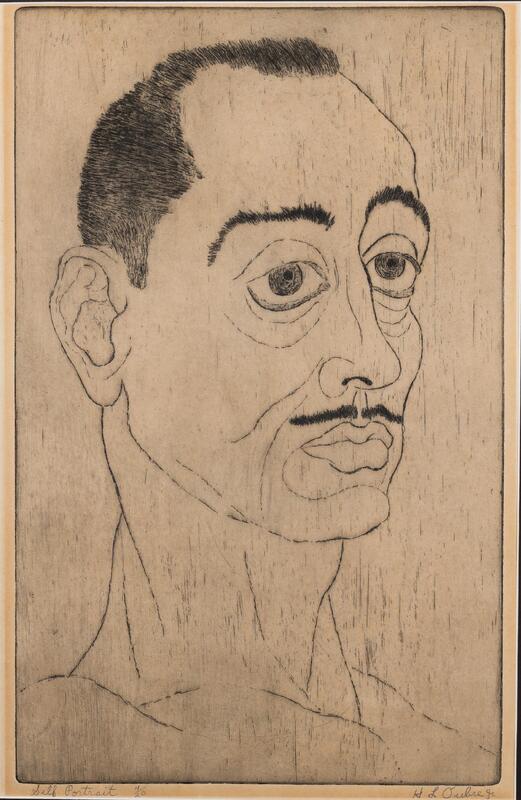
Hayward Oubre was a multimedia artist and educator from New Orleans, LA. Self Portrait is an etching of the artist from the shoulders up. His neck, shoulders, ears, and mouth are etched lightly, while his hair, eyebrows, eyes, and mustache are dark and etched deeply.
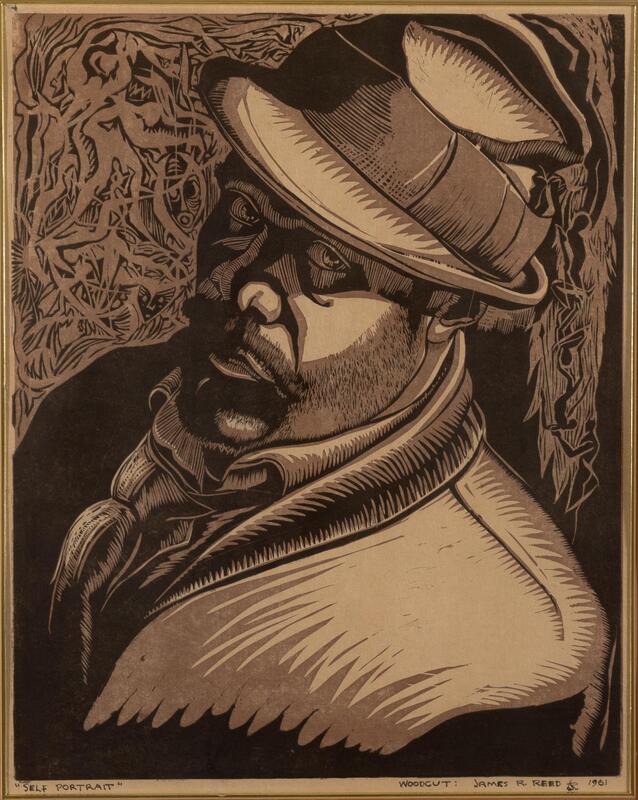
James Reuben Reed was a painter born in Kansas City, MI. Self Portrait is a print depiction of the artist staring toward the viewer. In the background are abstract shapes and dark shadows.